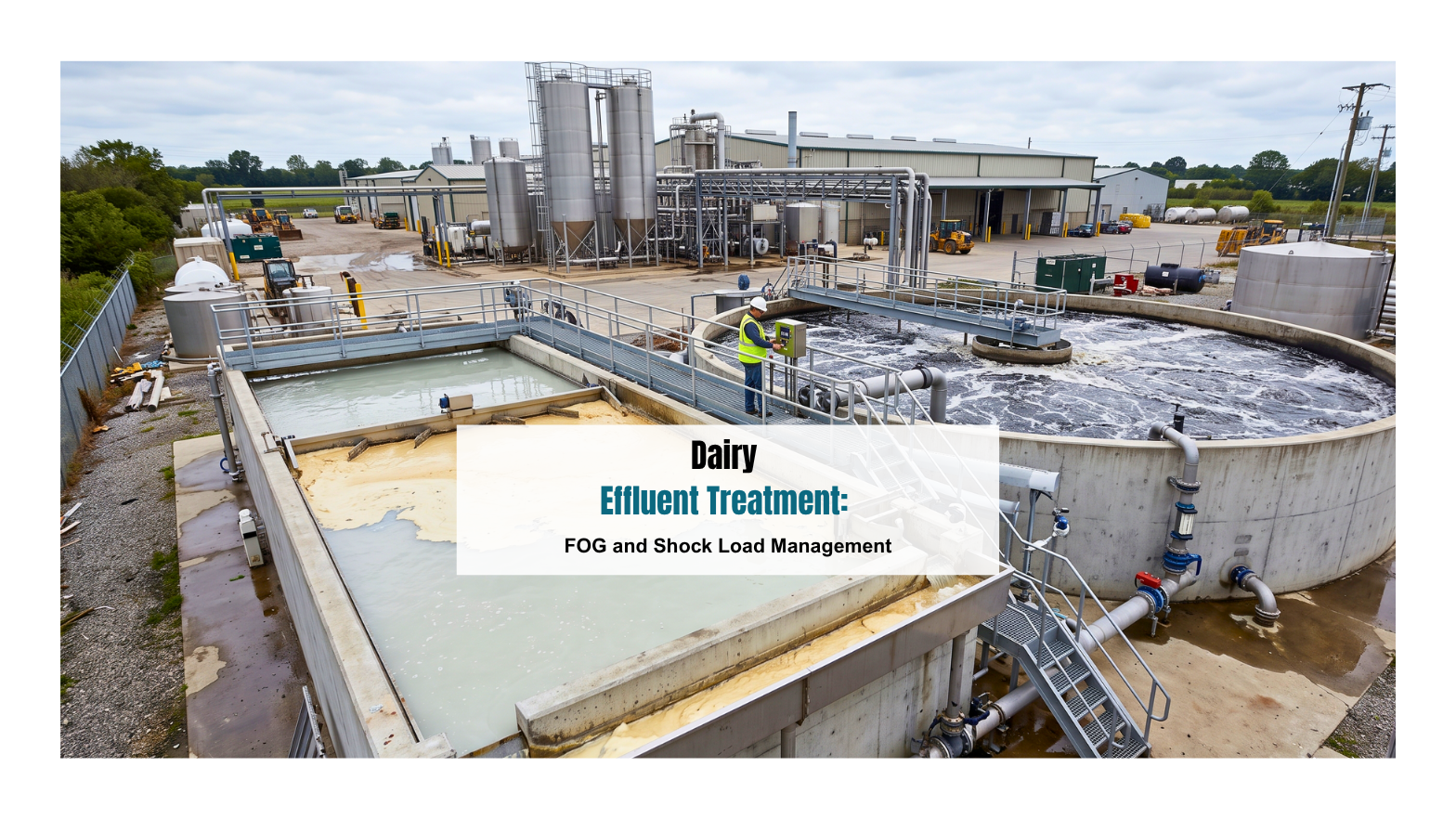

Dairy Effluent Treatment: FOG and Shock Load Management
It is Monday morning, and you have barely parked the car. You walk over to the aeration tank and there it is: a thick, greasy scum layer sitting on the surface, grey and stubborn. A sour smell is drifting toward the plant gate. Before you reach your desk, the phone rings. The environment officer wants to know what happened over the weekend. If that scene feels uncomfortably familiar, you are not alone.
Almost every ETP manager in a dairy has lived some version of this morning. The cause is rarely one big failure. It is usually a quiet build-up of fats, a cleaning cycle that dumped a sudden load, and a biomass that simply could not keep up.
Dairy effluent treatment is hard because the wastewater changes character through the day, and fats do not behave like ordinary organic matter. This article walks you through what really happens inside your dairy ETP, why FOG and shock loads cause so much trouble, and how lipolytic biocultures, enzymatic pre-treatment and biological equalization can bring your system back under control. We will also cover what your team can do this week, before a single product is dosed.
Why Milk Processing Wastewater Is One of the Toughest Streams to Treat
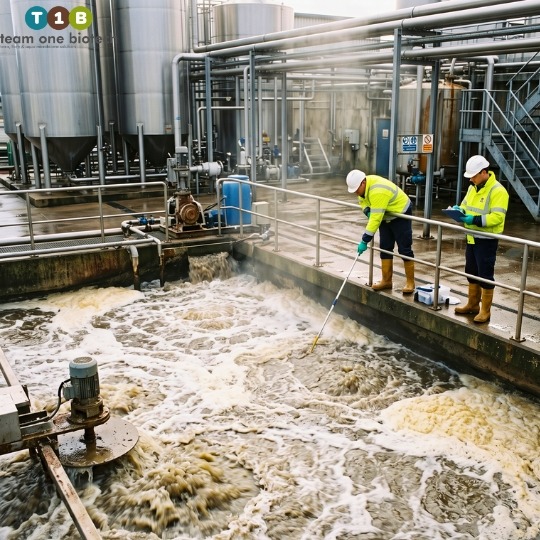
Milk is food. That is the root of the problem. Every drop that reaches the drain carries lactose, proteins and fat, all easy meals for bacteria. The result is milk processing wastewater with an organic strength far above most domestic and many industrial streams. Raw BOD and COD commonly sit in the thousands of mg/L.
Strength is only half the story. Variation is the real enemy. A cheese plant, a butter line and an ice cream unit each produce different effluent, and even inside one plant the stream changes by shift, by product and by season. Peak milk season brings more volume and more whey. Hot weather brings warmer effluent that sours faster.
Then come the cleaning chemicals. Caustic washes and acid rinses from CIP systems push the pH well outside the comfortable range for microbes, which prefer roughly 6.5 to 8.5. Add sanitisers and detergents, and you have a stream that feeds your bacteria and stresses them at the same time.
Note: These are general values. Actual figures vary from one ETP to another depending on product mix, plant design, cleaning practices and operating conditions.
Dairy wastewater is not just strong. It is strong, changeable and chemically unpredictable, and your treatment plan has to respect all three.
Understanding FOG in Dairy Effluent: What Really Happens Inside Your ETP
How fats turn into LCFAs and why they inhibit biomass
Milk fat is made of triglycerides: three fatty acid chains attached to a glycerol backbone. Bacteria cannot swallow that whole molecule. They first need enzymes called lipases to cut the chains loose. Once that happens, you get glycerol, which is easy to digest, and long-chain fatty acids, or LCFAs, which are not.
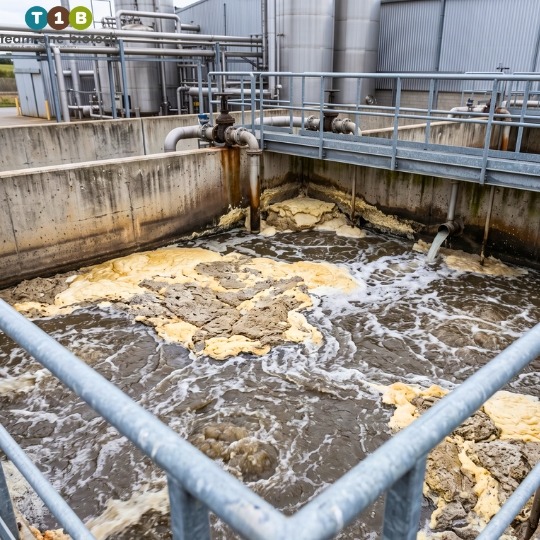
Here is where plants get caught. When fats arrive faster than the biomass can process them, LCFAs accumulate. At high concentrations they coat bacterial cell walls and interfere with how cells take in food and oxygen. Picture a thin oily film over every microbe in your tank. Activity slows, treatment efficiency drops, and the fat that should have been consumed floats to the top instead.
Cold effluent makes it worse. Fats solidify, stick together and travel through the system as lumps rather than fine droplets that bacteria can reach.
Scum, clogged diffusers, foul odor and filamentous growth: the chain reaction
Once fats collect, a chain reaction begins. It usually runs in this order:
- Fats float and form a scum layer in the equalization tank and aeration basin.
- Grease coats diffuser membranes and pipework, cutting oxygen transfer.
- Dissolved oxygen falls in pockets of the tank, and anaerobic zones appear.
- Those zones release sour, rotten odors from volatile fatty acids and sulfur compounds.
- Filamentous bacteria, which thrive on low oxygen and fatty food, take over and cause sludge bulking.
- Sludge settles poorly in the clarifier, solids carry over, and TSS, BOD and oil and grease in the final discharge climb.
Every step feeds the next. That is why chasing odor alone, with masking agents or extra chemicals, rarely works. You have to break the chain where it starts, at the point where fat enters.
Scum, odor and bulking are usually one problem seen from three angles. Control the FOG, and the other two often ease.
Shock Loads and pH Swings: The Silent Killers of Your Aeration Basin
Common shock load sources inside a dairy plant
A shock load is any sudden jump in organic strength, flow or pH that your biomass has not had time to adapt to. In dairy plants, the usual suspects are:
- CIP cycles, especially when pre-rinse and final rinse streams go straight to the drain
- Product changeovers that flush concentrated residues out of pipelines and tanks
- Whey or buttermilk spills, and rejected batches sent to drain instead of being collected
- Batch dumping of expired, returned or off-spec product
- Shift-end washdowns, when several sections discharge together
- Fat-heavy cleaning from butter, cheese vat and ice cream lines
Most of these are not failures. They are normal operations. The problem is timing. Everything arrives together, and your ETP sees it as one big gulp.
What a shock does to the microbial population
Your aeration basin is a living community. The bacteria in it need steady food, steady oxygen and a steady pH. A sudden organic surge makes them consume oxygen faster than your blowers can supply it. Dissolved oxygen collapses, sensitive species die back, and the survivors tend to be the filamentous ones that cope better with low oxygen.
A pH swing does similar damage in a different way. A strong caustic slug can rupture cells outright, while an acid slug favours fungi and filaments over healthy flocs. Recovery is slow because the community has to rebuild, and rebuilding takes days to weeks while your discharge keeps going to the regulator.
The signs are familiar: rising foam, brown or grey scum, cloudy supernatant, poor settling and a sharp smell. If your microscope also shows fewer protozoa and more filaments, shock has already done its work.
Note: These are general values. Actual figures vary from one ETP to another depending on product mix, plant design, cleaning practices and operating conditions.
Aeration basin stability depends on predictability. Shock management is really about making your load and pH arrive in a way your biomass can handle.
Struggling with recurring scum or sudden BOD spikes? Talk to the Team One Biotech technical team about a site-specific assessment of your dairy ETP.
The Biological Approach to Dairy ETP Management
A biological approach does not mean doing nothing and hoping. It means giving your biomass the tools to handle fats and fluctuations, and the conditions to do its job. Three tools carry most of the weight.
Lipolytic biocultures for FOG breakdown
Lipolytic biocultures are selected bacterial strains that produce lipases and can break down fats, oils and grease. Dosed at the right point, they establish themselves in the system, attack the scum layer and stop fat from building up again. Because they work on the triglycerides and also help consume the LCFAs that follow, they deal with the inhibition problem at both ends.
Results depend on choosing cultures that tolerate the real conditions of your plant: fluctuating pH, variable temperature and traces of cleaning chemicals. A culture that performs well in a lab can struggle in a working dairy ETP. That is why site-specific selection matters, and why dosing should be steady rather than occasional. Many plants see visible improvement in scum and odor within a few weeks of consistent dosing, though this varies.
This is the heart of bioremediation for ETP: use living microbes to do what chemicals only partly achieve, without adding to your sludge.
Enzymatic pre-treatment to open up fats before they reach the aeration tank
Enzymes are the fast starters. Lipase-based formulations dosed in the grease trap, collection sump or equalization tank begin splitting fats before they ever reach the aeration basin. Fats that are already opened up are easier for bacteria to take in and less likely to form floating mats.
Think of it this way. Enzymes cut the big pieces, and biocultures eat the smaller ones. Together they shorten the path from stubborn fat to digestible material. Contact time matters, so dose where there is enough retention for the enzymes to act and where temperature and pH are reasonably favourable.
Enzymatic pre-treatment also helps keep sewer lines, pumps and screens cleaner. That means fewer blockages and less foul odor around the collection area.
Biological equalization to buffer load and pH
An equalization tank is where you flatten the peaks. In many plants it is treated as a simple holding tank, but it can do far more. When it is mixed, gently aerated and seeded with the right cultures, it becomes a first biological stage that starts consuming easily degradable load and buffers the pH before the stream reaches the main reactor.
The benefits add up:
- Flow and load reach the aeration basin at a steadier rate, so the biomass is never surprised.
- Caustic and acid streams from CIP partly neutralise each other, narrowing pH swings.
- Fats are partially degraded, which reduces scum at the next stage.
Keep the tank mixed enough to avoid settling and septic conditions, but not so hard that you create foam. A pH range of roughly 6.5 to 8.5 at the equalization outlet is a practical target.
Note: These are general values. Actual figures vary from one ETP to another depending on product mix, plant design, cleaning practices and operating conditions.
Biocultures do the long-term work, enzymes give a head start, and equalization protects both from the worst of your load swings.
Operational Best Practices Your Team Can Start This Week
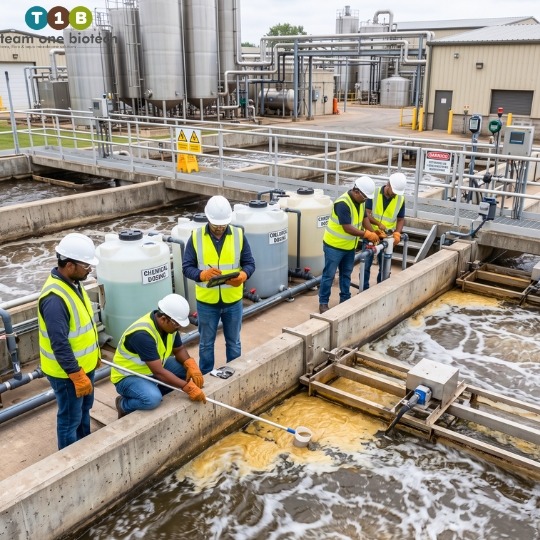
None of these need a capital project. Your team can begin today.
- Grease trap upkeep: Inspect and clean traps on a fixed schedule rather than after they overflow. Remove fat solids by hand and never wash them down the drain.
- Flow equalization: Spread discharges across the day where possible. Use the equalization tank as a true buffer and avoid bypassing it during cleaning or spills.
- CIP scheduling coordination: Sit down with production and sanitation teams. Stagger CIP cycles so caustic, acid and rinse streams do not hit the ETP together, and collect first rinses for separate handling.
- DO and MLSS monitoring: Check dissolved oxygen at several points in the basin, not just one. Track MLSS and settling behaviour so you spot drift before it becomes a failure.
- Regular microscopic checks: A simple microscope shows filaments, protozoa and floc structure long before lab results do. Make it a routine, not an emergency tool.
- Dosing discipline: Biocultures and enzymes work through consistency. Dose at the same points and times, and keep a log. Skipping doses in busy weeks is a common reason for relapse.
Also keep whey, buttermilk and rejected product out of the drain wherever possible. These are worth more as by-products or feed than as effluent, and they are among the biggest single causes of sudden BOD spikes.
A calm ETP is built on small, boring habits done every day.
Compliance Benefits: Staying Ahead of CPCB and SPCB Norms
CPCB and SPCB discharge norms for BOD, COD, oil and grease and TSS leave little room for erratic performance. A plant that meets limits on a good day and misses them on a bad one is still exposed to notices, penalties and, in serious cases, closure directions. Regulators care about consistency, and consistency is where biology does well.
Chemical-heavy approaches can bring quick clarity, but they carry costs. Coagulants and flocculants create chemical sludge that must be handled, stored and disposed of, and that disposal is itself a liability. Chemical use also rises with every spike. In a biological system, much of the organic load is converted into biomass and gas rather than concentrated into chemical sludge.
A biological approach is designed to help support compliance in several ways:
- It can make BOD and COD reduction steadier by keeping the biomass active and healthy.
- It helps with oil and grease removal by degrading fats directly instead of just skimming them.
- It supports better settling, which helps TSS control.
- It can reduce chemical sludge and the disposal burden attached to it.
- It helps protect municipal sewers and surface receiving bodies from fat-laden, oxygen-hungry discharge.
Better odor control also protects you from neighbour complaints, which are often what trigger an inspection in the first place. No product can guarantee compliance, and operation, monitoring and housekeeping still matter. But a stable biological system gives you something chemical dosing rarely does: a margin of safety.
Quick Takeaway: Regulators reward steady performance. Biology helps you deliver it without piling up chemical sludge.
Want to know where your plant stands? Request a free consultation to review your current ETP performance against CPCB and SPCB norms.
Frequently Asked Questions
How do you control FOG in dairy wastewater biologically?
Start with good grease trap practice, then add lipolytic biocultures and lipase enzymes at the trap, sump or equalization tank. The enzymes open up the fat and the cultures consume what is left. Steady dosing and good mixing are what make it work.
Why does my dairy ETP smell worse after cleaning cycles?
CIP discharges bring a surge of organic load, fats and sudden pH change. Oxygen demand spikes, anaerobic pockets form, and volatile acids and sulfur compounds are released. Staggering cleaning and buffering in equalization usually reduces this.
How can a dairy ETP handle sudden shock loads?
Buffer first, then biology. A well-mixed equalization tank, coordinated CIP schedules and a robust, regularly dosed culture help the system absorb surges. Watching dissolved oxygen closely also gives you time to react.
Can bioremediation reduce chemical sludge in milk processing wastewater?
Yes, it can. When biology handles more of the organic and fat load, the need for coagulants and flocculants often drops, and so does the sludge they generate. The extent depends on your plant design and current practice.
How long before I see results?
Many plants notice changes in scum and odor within a few weeks of consistent dosing, followed by steadier BOD, COD and oil and grease trends. Timelines depend on loading, temperature and how well the basics are managed.
Bringing Your Dairy ETP Back Under Control
Dairy effluent treatment will never be effortless. Milk processing wastewater is rich, variable and loaded with fats, and your cleaning routines will always create peaks. But a Monday morning with scum, smell and a phone call is not inevitable. When you control FOG at its source, buffer shocks through biological equalization and keep a healthy, well-fed culture working in the aeration basin, your dairy ETP becomes calmer, cheaper to run and far easier to defend in front of a regulator.
Team One Biotech works with milk, cheese, butter and ice cream plants to build site-specific biological programs around lipolytic biocultures and enzymatic solutions. You do not have to guess your way through it..
Your aeration tank can recover. Team One Biotech will help you get there, one stable day at a time.
Disclaimer: The information in this article is for general guidance only. Wastewater characteristics, treatment performance and dosing requirements differ in every ETP. A site-specific assessment is recommended before any process change.
Looking to improve your ETP/STP efficiency with the right bioculture?
Talk to our experts at Team One Biotech for customised microbial solutions.
Contact: +91 8855050575
Email: sales@teamonebiotech.com
Visit: www.teamonebiotech.com
Discover More on YouTube – Watch our latest insights & innovations!-
Connect with Us on LinkedIn – Stay updated with expert content & trends!