
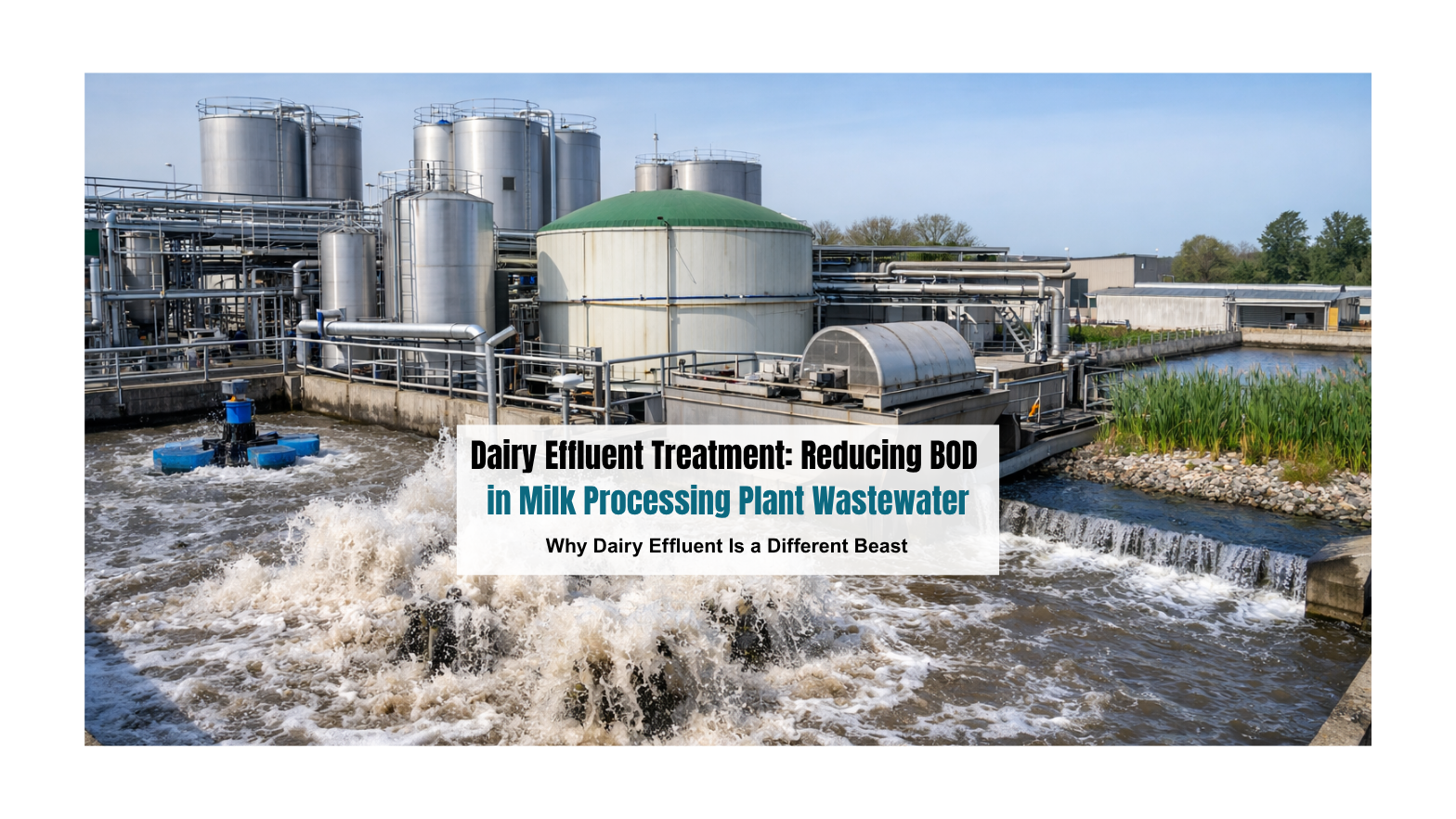
Dairy Effluent Treatment: Reducing BOD in Milk Processing Plant Wastewater
You know the feeling. A notice from the Pollution Control Board lands on your desk, and suddenly your entire week pivots. The ETP that has been “managing” your dairy plant’s effluent is now under a microscope, and the BOD levels in your discharge report are not going to make the conversation easy.
For dairy plant managers across India, this is not a hypothetical. It is Tuesday morning.
The Indian dairy industry is among the country’s most economically vital sectors, processing millions of litres of milk daily across states like Punjab, Rajasthan, Uttar Pradesh, and Maharashtra. But behind every chilled packet and processed dairy product is a wastewater story that does not get told enough. Milk processing generates some of the most organically loaded effluent in the food industry, high in BOD, COD, fats, oils, and suspended solids. Left inadequately treated, it does not just attract regulatory action. It ferments. It smells. It kills aquatic life in nearby water bodies and quietly poisons the groundwater your neighbouring community depends on.
This piece is for the EHS manager who is tired of patching a broken system with chemicals and hoping the next inspection goes smoothly. There is a better way, and it starts with understanding what you are actually dealing with.
Why Dairy Effluent Is a Different Beast
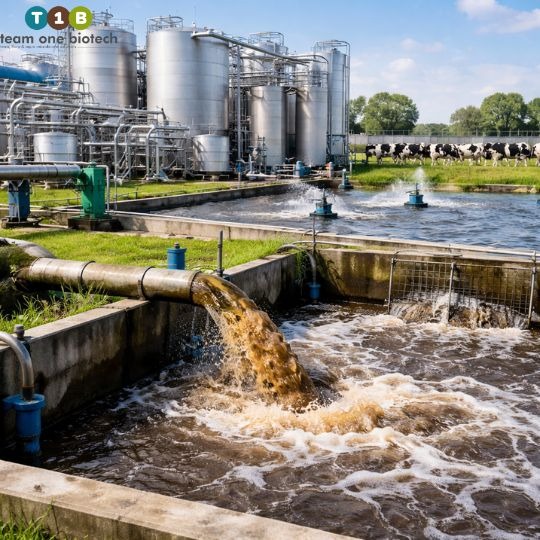
Most industrial wastewater is complicated. Dairy wastewater is complicated and stubborn.
When your plant cleans processing equipment, rinses pasteurisation lines, flushes out cheese vats, or disposes of off-spec batches, what goes down the drain is a concentrated cocktail of organic matter. Milk proteins, lactose, casein, butter fat, cleaning chemical residues, and in some cases animal waste from nearby collection points, all of it lands in your ETP. BOD levels in untreated dairy effluent routinely range across a broad spectrum, from a few hundred to several thousand mg/L depending on the product mix and plant hygiene practices. COD follows a similar trajectory, often running two to three times the BOD value.
This is what makes dairy effluent treatment technically demanding:
- FOG (Fats, Oils, and Grease): These float to the surface, coat pipes, clog biological treatment media, and create a suffocating layer over aeration basins that kills the microbial activity you need.
- High Nitrogen Load: Casein degradation releases ammonia-nitrogen into the effluent stream, complicating secondary treatment and raising Kjeldahl nitrogen values.
- Fluctuating Organic Load: Seasonal milk procurement peaks, post-monsoon flush milk, festival season production surges, mean your ETP experiences dramatic influent swings, which destabilise conventional treatment systems.
- Low pH Events: Acidic whey from paneer or curd production can crash your aeration basin’s pH and wipe out your microbial population almost overnight.
When untreated or poorly treated dairy effluent reaches surface water bodies, the consequences are severe. Dissolved oxygen depletes rapidly as microorganisms consume the organic load. Fish kills, algal blooms, and foul odours in surrounding areas follow. For a plant operating near agricultural land or a town water source, the liability, legal and reputational, is immense.
Bioremediation: The Green Future for Dairy Wastewater
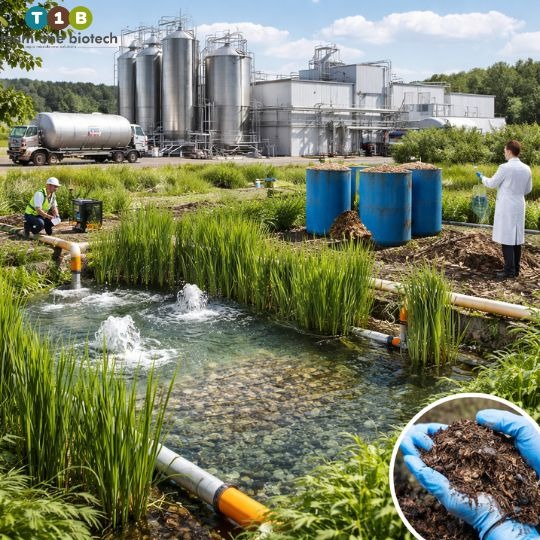
The conventional approach to dairy effluent treatment has largely relied on coagulation-flocculation, chemical dosing, and extended aeration. These methods work, partially. They are also expensive to run continuously, sensitive to load fluctuations, and generate large volumes of chemical sludge that create their own disposal headache.
Bioremediation offers a fundamentally different model.
At Team One Biotech, we have spent years developing and refining microbial consortia specifically engineered for high-FOG, high-BOD industrial wastewater. The principle is straightforward: instead of fighting the organic load chemically, you deploy the right microbial strains to consume it biologically, faster, more completely, and at a fraction of the residual impact.
Here is what happens when you introduce our specialised bacterial cultures into your ETP:
- Lipase-producing bacteria break down FOG fractions that would otherwise coat your aeration tank surfaces and reduce oxygen transfer efficiency.
- Protease-active strains digest milk proteins and casein, reducing nitrogen loading and preventing the build-up of putrefying solids.
- Facultative and aerobic heterotrophs drive BOD reduction through accelerated organic oxidation.
- Biosurfactant producers enhance the bioavailability of emulsified fats, allowing microbial attack on compounds that conventional systems simply cannot degrade.
The result is a measurable, consistent reduction in BOD and COD, without the chemical costs, without the sludge volume spike, and with a microbial community that adapts to your plant’s specific effluent fingerprint over time.
This is not a theoretical promise. It is applied microbiology in action.
Reducing BOD Step by Step: A Practical Framework
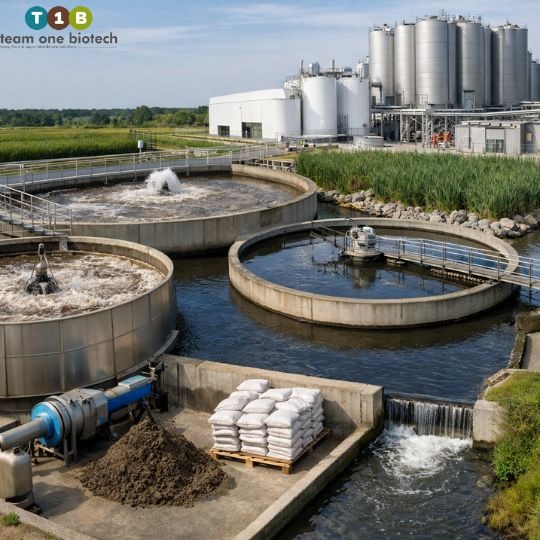
Step 1, Primary Treatment (Physical Separation First)
Before any biological intervention can work effectively, your ETP needs a clean primary stage:
- Screening and Grit Removal: Remove coarse solids and packaging remnants.
- Grease Traps and DAF (Dissolved Air Flotation): Critical for dairy. A well-maintained DAF unit removes a significant fraction of FOG before it reaches biological treatment. This alone reduces the organic load entering secondary treatment substantially.
- Equalisation Tank: Given the fluctuating nature of Indian dairy plant operations, an adequately sized equalisation basin is non-negotiable. It buffers pH swings and load spikes before they damage your microbial culture in the aeration basin.
Step 2, Secondary (Biological) Treatment
This is where bioremediation does its most important work:
- Activated Sludge Process (ASP) or Sequential Batch Reactor (SBR): Both are viable platforms for microbial treatment. The key variable is MLSS (Mixed Liquor Suspended Solids), maintaining this within the right operational range ensures your biological community has enough active biomass to handle the load.
- Sludge Age Management: One of the most overlooked parameters in dairy ETPs. Too short a sludge retention time, and nitrifying organisms wash out. Too long, and you accumulate inert solids that reduce treatment efficiency. Team One Biotech’s bioaugmentation products help stabilise this balance, particularly after a load shock or chemical dosing event that has crashed your native microbial population.
- Nutrient Dosing: High-carbohydrate, high-protein dairy effluent sometimes lacks sufficient phosphorus for optimal microbial growth. Balancing the BOD:N:P ratio supports a more robust biological community.
Step 3, Tertiary Treatment and ZLD Compliance
Zero Liquid Discharge (ZLD) is increasingly mandated by CPCB and various SPCBs for food processing units in ecologically sensitive zones and those drawing on groundwater. For dairy plants, ZLD means:
- Treated effluent passing through filtration, ultrafiltration, and Reverse Osmosis (RO) stages before water recovery.
- The biological quality of effluent entering the tertiary stage directly impacts RO membrane life and fouling rates, which is why effective secondary BOD reduction is not optional, it is foundational.
- Recovered water can be cycled back into CIP (Clean-in-Place) operations, cooling towers, or utility use, reducing freshwater consumption.
Our bioaugmentation programme reduces the organic burden reaching RO systems, extending membrane replacement intervals and lowering your tertiary treatment operational costs.
Compliance, Climate, and Cost For Dairy Effluent Treatment
CPCB guidelines set discharge standards for food processing industry effluent that include specific BOD, COD, suspended solids, and oil-grease thresholds. State Pollution Control Boards often apply additional, more stringent norms. Non-compliance attracts penalties, closure notices, and in repeat cases, criminal liability under the Environment Protection Act.
But Indian dairy plants face a challenge that CPCB norms do not account for: seasonality. Post-monsoon flush milk production in states like UP, Punjab, and Gujarat significantly increases both milk procurement and processing volumes, and therefore effluent generation, over a relatively short window. Conventional chemical treatment systems, sized for average loads, are overwhelmed. Microbial systems, by contrast, scale biologically. A higher substrate load simply means more microbial growth and accelerated BOD removal, provided the system is seeded with the right culture and given adequate oxygen and nutrients.
Hot-climate fermentation is another reality. Organic matter in Indian dairy ETPs degrades faster in summer months, generating odours that affect community relations and invite complaints to the local SPCB. Deploying odour-control microbial blends alongside your treatment programme addresses this at the source rather than masking it with deodorants.
Team One Biotech: Your Compliance Partner, Not Just a Product Supplier
Team One Biotech’s product portfolio for industrial wastewater treatment India covers the full spectrum of dairy ETP needs:
- Bioaugmentation cultures for BOD/COD reduction in ASP and SBR systems.
- FOG-degrading microbial blends for grease trap and DAF system enhancement.
- Odour management bioproducts for equalisation tanks and sludge handling areas.
- Sludge volume reduction formulations that lower your dewatering and disposal costs.
Beyond dairy, our solutions are trusted across pharma effluent treatment, paper and pulp, sugar mill wastewater, and food processing sectors, which means if your facility handles multiple product lines or if you manage a diversified portfolio of plants, we have a solution tailored for each.
We do not hand you a product catalogue and leave. Our team conducts site-specific assessments, reviews your current ETP performance data, and recommends a dosing protocol calibrated to your actual effluent characteristics. We stay engaged through the stabilisation period, adjusting the programme as your plant’s operational conditions evolve.
Stop Reacting. Start Treating Properly.
The next PCB inspection is coming. The question is whether you will be explaining a compliance failure or presenting a treatment system that actually works.
BOD reduction in dairy is not a one-time fix, it is an ongoing operational commitment. Bioremediation, done right, makes that commitment sustainable, cost-effective, and genuinely compliant with CPCB wastewater compliance standards.
Ready to get your dairy ETP under control?
Request a Free Site Audit, Let our bio-experts assess your current ETP performance and identify gaps. Consult Our Industrial Wastewater Specialists, Speak with a senior team member about bioremediation for milk plants and get a customised treatment roadmap.
Team One Biotech. Bioremediation that works. Compliance you can stand behind.
Looking to improve your ETP/STP efficiency with the right bioculture?
Talk to our experts at Team One Biotech for customised microbial solutions.
Contact: +91 8855050575
Email: sales@teamonebiotech.com
Visit: www.teamonebiotech.com
Discover More on YouTube – Watch our latest insights & innovations!-
Connect with Us on LinkedIn – Stay updated with expert content & trends!