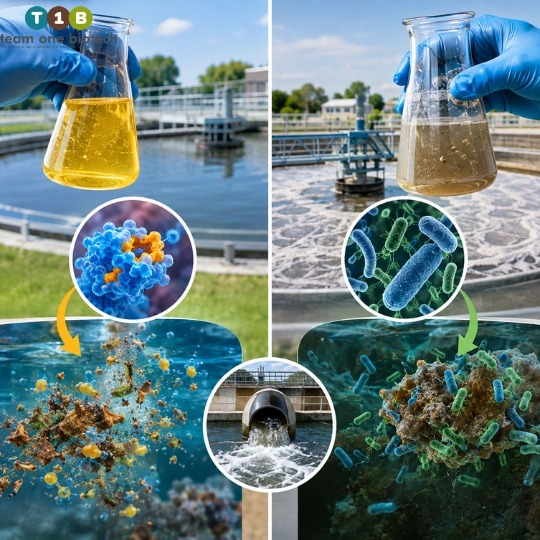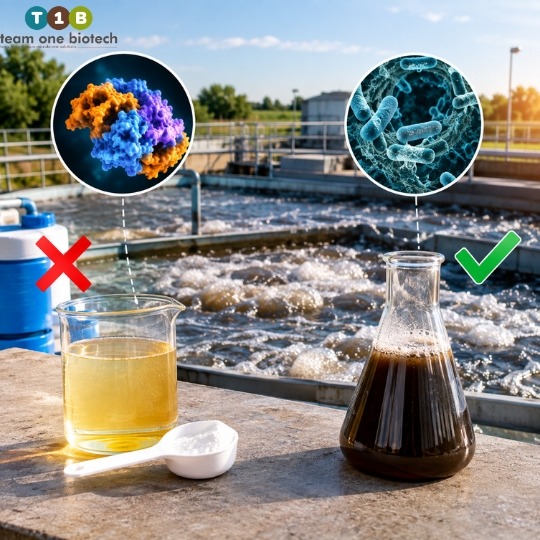
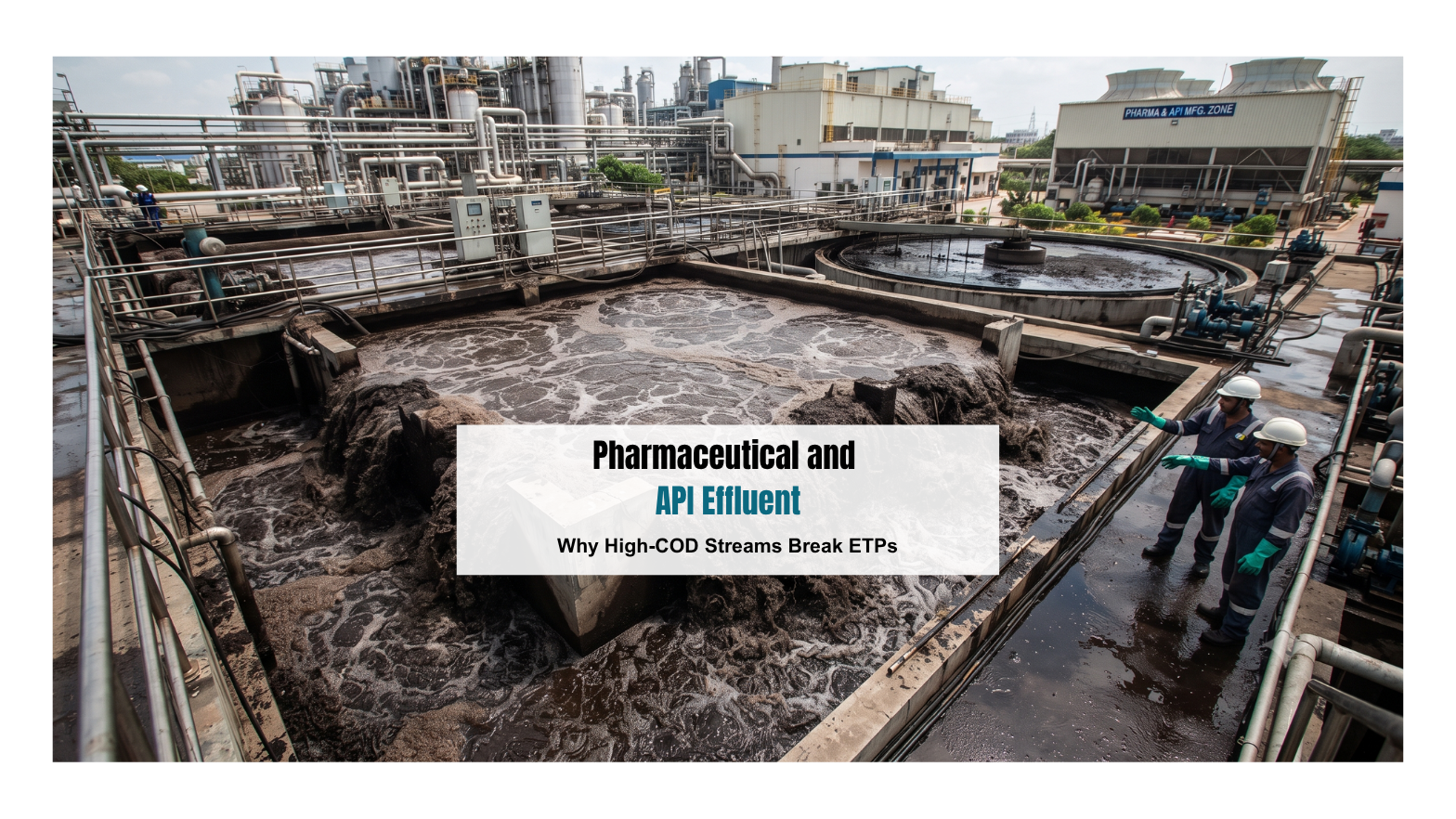
Pharmaceutical and API Effluent: Why High-COD Streams Break ETPs
It’s a little after six in the morning. You reach the aeration tank and something is off before you even touch the railing. The foam is the wrong colour. The smell has changed. The MLSS you logged last evening has collapsed overnight, and the clarifier looks like weak tea.
Production wants to know if the reactors can keep running. Management wants a cause. The regulator’s inspection window is closing in.
Anyone who has run pharma effluent treatment for a few years knows that sinking feeling.
Here’s the uncomfortable truth. Your pharma ETP probably wasn’t badly designed. It was designed for wastewater, and what your plant sends it is a moving chemical hazard. This article explains why high-COD streams from API and pharmaceutical plants defeat standard biological systems, what the early warning signs look like, which post-crash mistakes make things worse, and what practical API wastewater treatment recovery and prevention looks like.
Why Pharma and API Effluent Is Not “Just High-COD Wastewater”
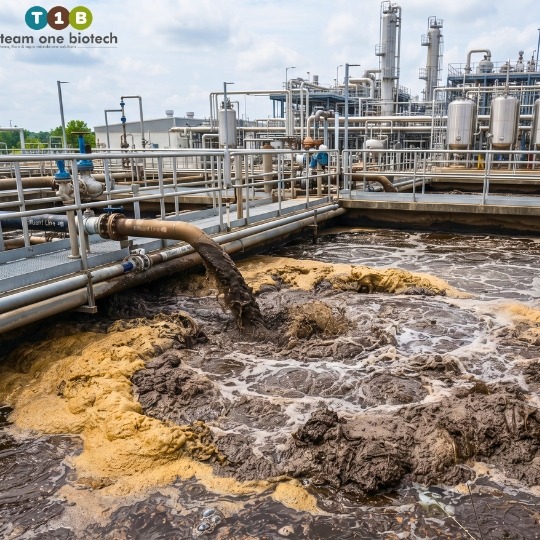
Walk into any multi-product API unit and ask what the effluent looks like. You’ll get a different answer on Monday than on Thursday. That’s the first clue. Pharmaceutical effluent characteristics shift with the campaign, the solvent system, the reaction step and even the cleaning schedule.
COD alone tells you very little. A stream running from several thousand to well over a lakh mg/L can be easily biodegradable in one plant and stubbornly toxic in another. These are general ranges and vary from one ETP to another.
What matters is the nature of that COD. Is it carbon your microbes can eat, or carbon that sits there untouched while quietly poisoning the ones trying? Conventional high COD wastewater treatment designs assume the first. API streams frequently deliver the second.
Think of activated sludge as a skilled workforce with a defined job. Hand it a stream loaded with solvents, salts, antibiotics and aromatic rings, arriving in unpredictable batches, and you’ve rewritten the job description overnight. The workforce doesn’t adapt. It leaves, or it dies.
The Six Ways High-COD Streams Break a Pharma ETP
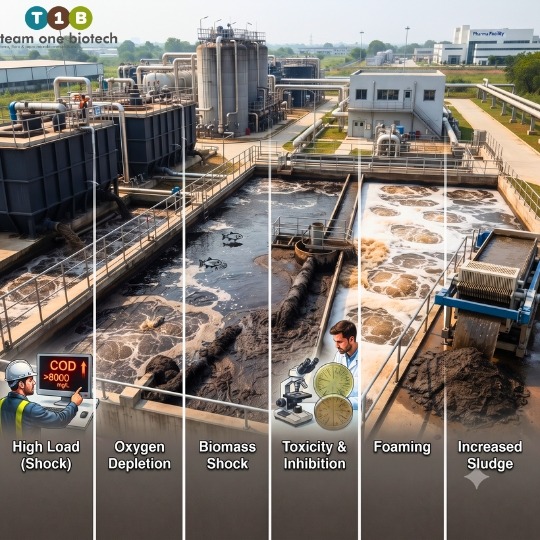
Most crashes aren’t caused by a single villain. Usually two or three of the following are working together. Here’s how each one does its damage.
Hard COD Versus Biodegradable COD
Your lab reports total COD. Your biology only cares about the biodegradable part. The gap between the two is hard COD, and in API effluent that gap can be wide.
Ignore it and the ETP gets sized and operated on a number that doesn’t reflect what microbes can actually remove. COD passes through the aeration tank barely touched, the F/M ratio looks fine on paper, and treated effluent still fails against CPCB discharge norms. Plenty of plants pass or fail on this gap alone.
Recalcitrant Aromatics and Persistent Organics
Complex aromatics, halogenated rings and persistent by-products resist ordinary heterotrophs, because the enzymes needed to attack them aren’t present in generic sludge. These recalcitrant compounds pass straight through, build up in recycle loops, and show up later as colour, toxicity or stubborn residual organic carbon. Some adsorb onto flocs and quietly hurt settling. Refractory organics are rarely a sudden failure. They’re a slow leak that becomes a flood.
Residual Drug Molecules and Antimicrobial Effect
If your plant makes antibiotics, or uses them as intermediates, your sludge sees them. Residual active molecules suppress exactly the bacterial groups you rely on for COD removal and nitrification. That’s bio-inhibition in its purest form. The F/M ratio looks normal, oxygen uptake falls, and nobody can say why. Over time, resistant populations can get selected, changing sludge behaviour in ways routine tests won’t catch.
Solvent Toxicity
Spent solvents, mother liquors and process washes reach the drain, sometimes by design and sometimes by accident. Solvent toxicity in effluent works in two ways. Some solvents damage cell membranes at modest concentration. Others are biodegradable, but arrive in such a slug that they strip oxygen faster than your blowers can supply it. Either way you get a biological shock load, and the damage often shows up hours later, usually when nobody’s watching.
High TDS and Osmotic Stress
Salts from neutralisation, work-ups and RO reject loop-backs build quickly, especially in plants moving towards ZLD pharma operations. High TDS effluent pulls water out of microbial cells. They shrink, lose activity and eventually lyse. You’ll see turbid effluent, falling oxygen demand and sludge that refuses to settle. Salinity swings hurt more than steady high salinity, because the biology never gets a chance to adapt.
Batch Discharge, pH Swings and Nutrient Imbalance
Multi-product plants don’t produce steady flow. They produce events. A reactor wash here, a mother liquor dump there, an acidic campaign followed by an alkaline one. Add heavy inorganic loads and carbon-rich streams with little nitrogen or phosphorus, and the biology never settles into a rhythm. Sludge bulking, filamentous growth and foaming usually follow.
Why a Biological Crash Becomes a Compliance Problem
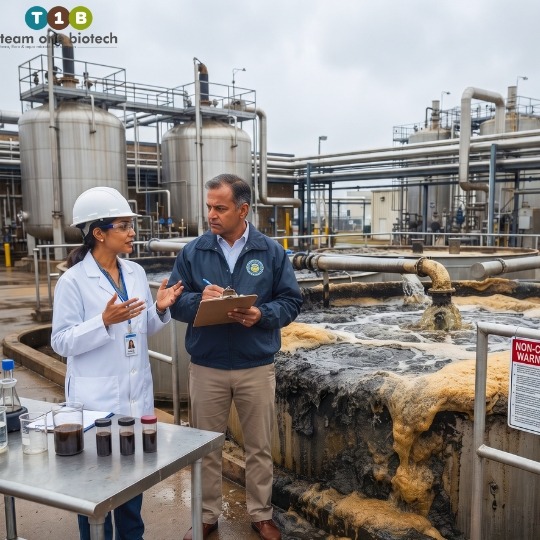
A crashed biological stage isn’t just an operations headache. It’s a compliance event. Hard COD, refractory organic carbon, specific active drugs and toxicity in treated effluent can drift out of range fast. Exact limits depend on your state board, consent conditions and discharge route, so we won’t quote any here. Check yours.
What doesn’t vary is the chain of consequences. A failed sample leads to a notice. A repeat leads to a show-cause order. Persistent failure can mean production curtailment and, in the worst case, a shutdown direction. For plants working under ZLD mandates, uninterrupted compliance isn’t optional, because a weak biological stage pushes load onto the MEE and RO, and neither forgives it. SPCB compliance is the business risk sitting behind every tank in your pharma ETP.
Early Warning Signs Your Biology Is Struggling
Crashes rarely arrive without warning. They creep in. Watch for these:
- Oxygen uptake falling while the COD load stays the same
- Foam that changes colour, texture or volume, or won’t knock down
- Rising SVI, bulking sludge, or a clarifier blanket that keeps climbing
- MLSS dropping with no wasting, or MLSS and MLVSS drifting apart
- Effluent turning cloudy, coloured or smelling of solvent
- Microscopy showing fewer protozoa and rotifers and more dispersed bacteria or filaments
- Nitrification slipping, since nitrifiers are usually the first casualty
- pH and DO needing constant manual correction
Spot two or three of these together and treat it as an ETP upset in the making, not a blip. Catching it early costs far less than recovering from it.
Common Mistakes Plants Make After a Crash
The first response often makes things worse. These are the usual culprits:
- Over-dosing chemicals. More antifoam, coagulant or nutrients feels like control. It often adds TDS, raises toxicity and hides the real signal.
- Restarting by only adding more sludge. Fresh sludge dropped into the same toxic stream dies the same way. You’ve just fed it to the problem.
- Ignoring equalization. If the shock reaches the aeration tank unbuffered, the restart fails again.
- Skipping pre-treatment. Sending strong mother liquors or solvent-heavy washes straight to biology is usually how the crash started.
- Using generic cultures. A general-purpose culture isn’t built for refractory aromatics, solvents or salinity, and it shows quickly.
What Actually Works in Pharma Effluent Treatment: Recovery and Prevention
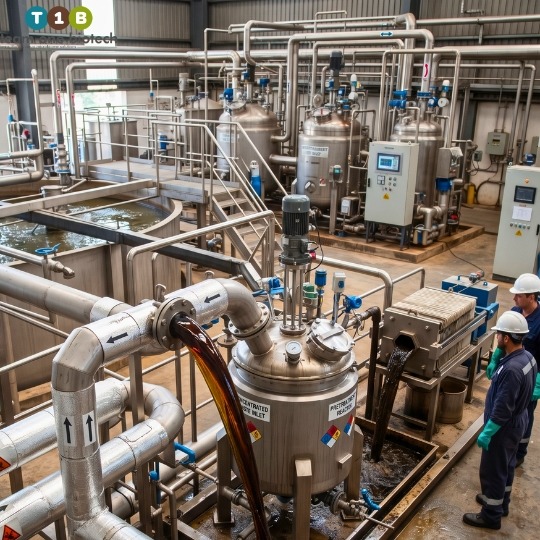
Recovery isn’t a single action. It’s a sequence, and bioaugmentation is one part of it, not a magic fix. A typical order of work looks like this:
- Isolate or divert the stream that caused the crash.
- Stabilise pH, DO and nutrients in the aeration tank.
- Characterise the stream: biodegradable versus hard COD, TDS, solvent profile and toxicity.
- Rebuild biomass gradually with an acclimatised culture, not raw sludge alone.
- Reintroduce load in steps while tracking F/M ratio, SVI and oxygen uptake.
- Lock in the controls that stop a repeat.
Pre-treatment and Stream Segregation
The cheapest fix is the one upstream. Keep high-strength, solvent-heavy, high-TDS and antibiotic-bearing streams away from the biology. Strip or recover solvents. Send concentrated mother liquors to MEE or incineration instead of the aeration tank. Use chemical or advanced oxidation only where it genuinely reduces toxicity, and check it doesn’t create new by-products. Good API wastewater treatment starts at the process block, not at the ETP inlet.
Equalization and Shock-Load Buffering
A well-sized, well-mixed equalization tank is the shock absorber of your ETP. It evens out flow, pH and COD so the biology sees gradual change instead of events. Many crash histories trace back to an equalization tank that was bypassed, undersized or left unmixed. Do pH correction and nutrient balancing after equalization, not before it. Whether you run MBBR or conventional activated sludge, buffering protects both.
Specialized Strain Bioaugmentation for Tough Organics
This is where bioaugmentation for pharma ETP earns its place. Specialized microbial strains, selected and acclimatised for particular compound families, bring enzymatic capability your generic sludge lacks. They can help with refractory organics, tolerate more solvent and salinity, and often improve recovery after upsets. They work best alongside corrected operating conditions, and results depend on your effluent. A bench trial on your own stream is the honest way to find out.
Acclimatization and Monitoring Routines
Biology adapts, if you let it. Ramp load gradually after any restart. Track MLSS, MLVSS, SVI, DO, oxygen uptake and F/M ratio on a fixed routine, and look at the sludge under the microscope regularly. Log every campaign change against ETP performance so patterns show up. Recovery can take from a few weeks to a couple of months depending on severity. These are general ranges and vary from one ETP to another.
Not sure where your ETP stands? Request a free effluent assessment or technical consultation. Our team will look at your stream data and sludge condition and tell you plainly where the risk is.
How Team One Biotech Helps
Team One Biotech manufactures bioremediation and bioaugmentation products for industrial and pharmaceutical effluent. For API wastewater treatment and pharma ETPs, the approach is practical:
- Review of your effluent data, product mix and ETP configuration
- Selection of microbial consortia suited to your stream, including cultures for refractory and solvent-heavy loads
- Support for bench-scale evaluation before any full-scale dosing
- Guidance on dosing, acclimatization and monitoring alongside your operating team
We don’t promise guaranteed COD reduction or guaranteed compliance, and nobody honest can. Every effluent is different. What we can do is help you build a biological system better matched to what your plant discharges, as part of a wider plan that includes pre-treatment and operational control.
Share your effluent data or a description of your sludge condition, and our technical team can suggest a suitable strain and bioaugmentation plan for your ETP. Talk to our technical team.
FAQs
Why does my pharma ETP fail even when the design looks fine on paper?
Design calculations usually assume steady, biodegradable load. Real pharma effluent arrives in batches, carries hard COD, solvents, salts and residual drugs, and changes with every campaign. The biology then faces bio-inhibition and shock loads the design never accounted for. Paper capacity doesn’t equal biological capacity, so the fix is usually better buffering, segregation and a culture suited to the actual stream.
Can bioaugmentation help with API wastewater treatment?
It can, when it’s used properly. Specialized strains may improve removal of certain refractory organics, speed up recovery after an upset and add tolerance to solvents or salinity. It works best alongside segregation, equalization and good operating control. Results depend on your effluent, so a bench-scale trial on your own stream should come before any full-scale decision.
How does high TDS affect biological treatment in a pharma ETP?
High salinity creates osmotic stress. Water leaves microbial cells, activity drops and cells can lyse, which shows up as poor settling, turbid effluent and falling oxygen uptake. Sudden salinity swings do more harm than steady high levels because microbes can’t adapt in time. Controlling salt sources, blending through equalization and using salt-tolerant cultures all help.
What is hard COD and why does it matter for compliance?
Hard COD is the portion of COD that biology can’t readily remove. It passes through the biological stage and appears in treated effluent, so you can run a healthy-looking ETP and still miss your limits. Because discharge conditions vary by state board, consent and discharge route, knowing your hard COD fraction early helps you plan treatment and avoid surprises.
How should a plant respond when the biological system crashes?
Divert or isolate the offending stream first. Then stabilise pH, DO and nutrients, and characterise what hit the system. Avoid dumping chemicals or fresh sludge into unchanged conditions. Rebuild biomass with an acclimatised culture, reintroduce load in steps and monitor closely. Recovery can take from a few weeks to a couple of months, and these are general ranges that vary from one ETP to another.
Protect Your Biology Before the Next Crash
Pharma effluent treatment rarely fails because of one bad decision. It fails when what the plant discharges and what the biology was built to handle drift apart. High COD is only the headline. Hard COD, solvents, residual drugs, salts and batch swings do the real damage.
Fix it upstream with segregation and buffering. Support it with specialized strains and steady monitoring. Keep your regulator’s expectations in view, because the cost of a crash is rarely just the repair bill.
Don’t wait for the next crash or the next notice. Talk to our technical team today. Request a site-specific assessment and get your ETP evaluated before the next campaign starts.
The ranges and observations above are general and vary from one ETP to another.
Disclaimer: The values, ranges and observations in this article are general in nature. Actual effluent characteristics, treatability, and results differ in every ETP based on the product portfolio, process, design, and operating conditions. A site-specific study is recommended before any treatment decision.
Looking to improve your ETP/STP efficiency with the right bioculture?
Talk to our experts at Team One Biotech for customised microbial solutions.
Contact: +91 8855050575
Email: sales@teamonebiotech.com
Visit: www.teamonebiotech.com
Discover More on YouTube – Watch our latest insights & innovations!-
Connect with Us on LinkedIn – Stay updated with expert content & trends!