Received a CPCB or SPCB Compliance Notice for Your STP? Here’s What to Do in the Next 30 Days  

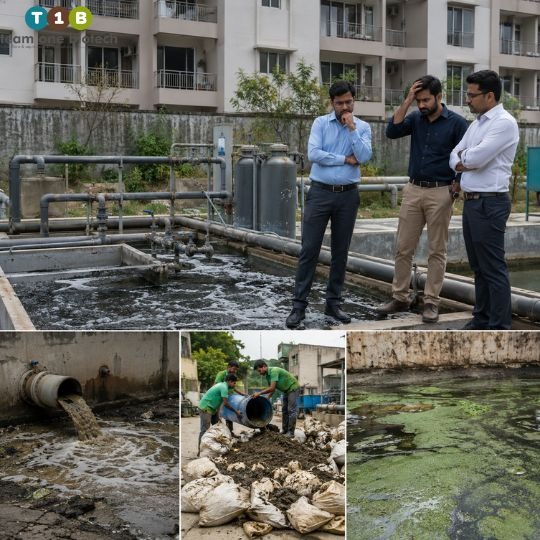
The morning starts like any other. Then someone hands you an official envelope with a government seal, or your inbox flags an automated alert from your state pollution control board’s portal. Your stomach drops. The words “Show Cause Notice,” “Non-Compliance,” or worse, “Direction for Closure” stare back at you from the page.

If you manage a housing society, run an industrial facility, or oversee operations at a commercial hotel, this is one of the most disorienting documents you can receive. The legal language is dense. The timelines feel brutal. And the consequences, power disconnection, water supply cutoff, steep environmental compensation charges under the Water Act of 1974 and the Environment Protection Act of 1986, feel terrifyingly real.

Here is the truth: receiving a CPCB notice for your STP, or a similar directive from your SPCB, does not mean the situation is already lost. What it means is that the next 30 days are the most critical operational window your facility will face. Every hour you spend in paralysis is an hour you are not spending on recovery.

This guide is written for you, the person holding that notice right now, to move from panic to a clear, legally defensible, operationally sound response plan.

Step 1: Decoding the Allegations, Days 1 to 3

Step 1: Decoding the Allegations, Days 1 to 3

Before you respond to anything, you need to understand precisely what you have been accused of. Not all notices carry the same weight, and conflating them leads to either catastrophic under-reaction or costly over-response.

The Three Categories of Notices You May Have Received:

  • Minor Non-Compliance Warning: This is typically an advisory or a preliminary notice flagging a specific parameter, elevated BOD or COD in your treated effluent, for instance, or a lapsed Consent to Operate (CTO). It is a warning shot, not a verdict. Most boards issue these before escalating.
  • Show Cause Notice (SCN): This is a formal legal document requiring you to explain, within a specified window (typically a 7 to 15 day reply period), why regulatory action should not be taken against your establishment. This is serious, but it is also an opportunity, it means the board has not yet closed the matter.
  • Closure or Stop-Work Direction: This is the highest-severity notice, issued under Section 33A of the Water Act, 1974, or under the powers vested in state boards by the Environment Protection Act, 1986. If you have received this, you need legal counsel immediately alongside your technical remediation plan.

What to Look for When You First Read the Notice:

Read the notice slowly, twice. Identify the following without editorial judgment:

  • The specific section of law cited (Water Act, EP Act, or your state’s own environmental rules)
  • The alleged violation, is it high BOD/COD in discharge, bypass of the treatment system, no functional STP, or expired CTO?
  • The exact response deadline and the designated authority to whom the reply must be submitted
  • Whether an inspection report or lab analysis is attached as an annexure

Do not, at this stage, make calls to the board or make any verbal admissions. Everything from this point forward must be documented.

Step 2: Fact-Finding and Data Collection, Days 4 to 10
Step 2: Fact-Finding and Data Collection, Days 4 to 10

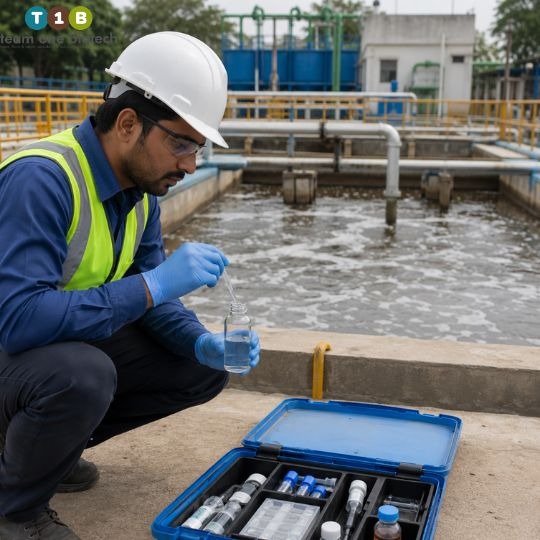
This phase is where your compliance case is either built or broken. You are gathering evidence “without prejudice”, meaning you are assembling a factual picture of your STP’s operational history before crafting your official position.

The Documents You Must Pull Together Immediately:

  • Your current Consent to Operate (CTO) certificate and its expiry date. If it has lapsed, this is a primary allegation you must address directly.
  • STP Logbooks covering at least the last 6 to 12 months, daily operational records, chemical dosing entries, sludge removal logs.
  • Third-Party Lab Test Reports for your treated effluent. If you do not have recent ones, commission an accredited lab immediately. You will need these as baseline evidence.
  • AMC (Annual Maintenance Contract) agreements with your STP vendor, proving ongoing maintenance commitment.
  • Any prior correspondence with your state pollution control board.

Navigating Your State Board’s Online Portal:

Each state board has its own digital infrastructure, and knowing where to file, track, and respond is non-negotiable.

  • KSPCB (Karnataka): The Karnataka State Pollution Control Board’s online portal allows CTO applications and compliance submissions. Responses to notices are typically routed through the regional officer’s desk.
  • TSPCB (Telangana): Telangana’s board has a dedicated compliance management module where notice responses and supporting documents can be uploaded against your unit’s registration number.
  • MPPCB (Madhya Pradesh): MPPCB processes consent renewals and show cause replies through its online consent management system. Physical submissions to the regional office are often required in parallel.
  • GPCB (Gujarat): Gujarat Pollution Control Board has one of the more digitized portals in India. CTO renewals, reply submissions, and inspection scheduling can often be completed end-to-end online.
  • UPPCB (Uttar Pradesh): UPPCB processes notices through its regional environmental offices. Many housing societies and industrial units in the NCR region interact with both CPCB and UPPCB simultaneously, requiring dual-track correspondence.

If your state board has an auto-generated portal reference number on your notice, and most now do, use it as your primary tracking ID in every subsequent communication.

Step 3: The Operational Fix, Days 11 to 20
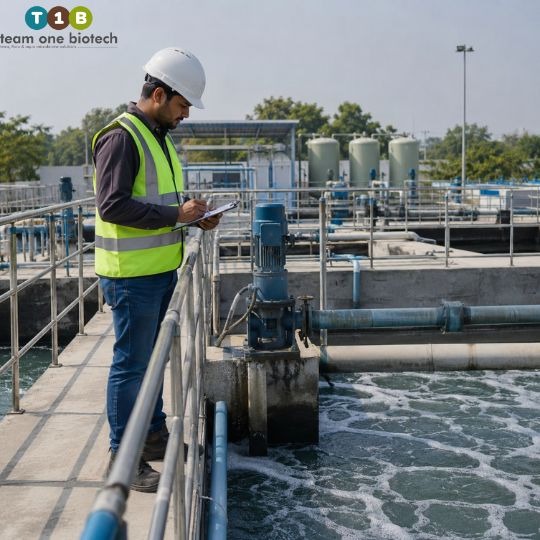
This is the phase that most compliance guides skip entirely, and it is the most consequential. Legal replies and paperwork matter enormously, but if your STP is still discharging non-compliant effluent when the re-inspection happens, no amount of well-crafted documentation will save you.

You need to fix the biology of your plant before the inspector returns.

Why Biological Parameters Fail, and Why Mechanical Fixes Are Too Slow

Most SPCB STP non-compliance notices are triggered by elevated BOD (Biochemical Oxygen Demand), COD (Chemical Oxygen Demand), TSS (Total Suspended Solids), or FOG (Fats, Oils, and Grease) in treated effluent. These are biological process failures. The microbial community inside your STP’s aeration or sludge treatment zone has been disrupted, by chemical shock, overloading, inadequate aeration, or simple neglect.

Mechanical overhauls, replacing blowers, installing new filter media, rebuilding diffuser arrays, take weeks to months, cost significantly, and do not address the root biological cause. By the time a new mechanical system is commissioned, your compliance window has likely closed.

The Bioremediation Rapid-Response Approach

Modern industrial bioremediation deploys precisely selected, high-density live microbial cultures, bacteria and bioenzymes specifically active against BOD, COD, and sludge-forming organic compounds. When introduced into a failing STP at the correct dosage and stage, these cultures recolonize the biological treatment zone rapidly, outcompeting the non-functional microbial population and restoring the degradation efficiency of the system.

The operational outcomes, when the plant is functioning at a hydraulic load it was designed for, are meaningful. BOD and COD levels in the treated effluent can begin declining noticeably within approximately 7 to 14 days of microbial intervention. Accumulated organic sludge volume can reduce by around 50% to 70% over a treatment cycle.

Note: These are general values and operational outcomes will vary based on the specific design, hydraulic load, and unique operational parameters of individual Sewage and Effluent Treatment Plants (STPs/ETPs).

Critically, during this remediation window, your team should be collecting daily effluent samples and running in-house or third-party COD/BOD tests. This documentation becomes part of your compliance file, proof that active corrective action was underway from a specific date.

If you are unsure of your current effluent parameters, contact Team One Biotech for a rapid site-based water quality assessment before committing to any treatment protocol.

Step 4: Crafting a Bulletproof Reply, Days 21 to 25

Your pollution control board show cause notice reply is a legal document. It is also, in practical terms, a piece of institutional communication, and tone matters as much as substance.

The Framework of an Effective SCN Reply:

A strong reply to a CPCB or SPCB non-compliance notice follows this structure:

  1. Acknowledgment without admission: Formally acknowledge receipt of the notice, cite the reference number, and state your intent to cooperate fully with the board’s mandate.
  2. Factual rebuttal or contextual explanation: For each specific allegation, provide documented counterevidence or a factual explanation. If a parameter was high on the inspection date due to a verifiable operational event (a chemical discharge from a contractor, a 48-hour aeration failure that has since been repaired), say so, with supporting records.
  3. Corrective action already undertaken: Present the remediation actions you initiated, the bioremediation treatment program, the lab results showing improving parameters, the AMC renewal, the CTO renewal application if it was lapsed.
  4. Timeline of full compliance restoration: Commit to a specific, achievable window for full parameter compliance. Be conservative. Under-promise and over-deliver.
  5. Request for re-inspection: Formally request a board inspection at your stated compliance date. This demonstrates confidence and good faith.

What the reply must never be: defensive, dismissive of the board’s concerns, or vague about timelines. Boards across India, from KSPCB to GPCB, have seen thousands of generic, non-committal replies. A reply that demonstrates genuine operational intervention stands out.

State-by-State Portal Navigation Matrix

State BoardOnline Portal for Reply SubmissionTypical Reply WindowCTO Renewal Online?Key Contact Mechanism
KSPCB (Karnataka)KSPCB Online PortalTypically 15 to 30 days from notice dateYesRegional Environmental Officer
TSPCB (Telangana)TSPCB Compliance Management SystemTypically 15 to 21 daysYesUnit-linked portal tracking ID
MPPCB (Madhya Pradesh)MPPCB Consent Management PortalTypically 15 to 30 daysPartial, physical follow-up often requiredRegional Office + Online
GPCB (Gujarat)GPCB Online Services PortalTypically 15 to 30 daysYes, largely digitizedOnline submission + hard copy
UPPCB (Uttar Pradesh)UPPCB Regional Office PortalTypically 15 to 21 daysPartialRegional Officer + Portal

Always verify current deadlines directly from the notice. Portal interfaces and processing timelines are subject to update by the respective boards.

From Reactive Panic to Proactive STP Health

The 30-day window after receiving a CPCB notice for your STP is high-pressure by design. Regulatory architecture is built to compel action, and that pressure, channeled correctly, can become the inflection point at which your facility genuinely upgrades its compliance posture rather than simply surviving this one inspection cycle.

The facilities that handle these situations best are not the ones with the most expensive STPs. They are the ones that respond fast, document everything, fix the biology of their plant using the most efficient tools available, and communicate with the board in a tone of calm, professional accountability.

Environmental compensation charges in India can extend into significant amounts for repeated violations. A pattern of non-compliance also directly affects Consent to Operate renewal timelines, sometimes triggering additional scrutiny that extends for years. The cost of doing nothing, or doing too little, too late, is always higher than the cost of the right intervention at the right time.

Act Now, Before Your Re-Inspection Window Closes

If you are reading this with an active CPCB notice, SPCB show cause notice, or closure direction in hand, the time for general research is over. You need specific answers for your specific plant.

Team One Biotech specializes in rapid STP compliance recovery for housing societies, industrial facilities, and commercial establishments across India. Our microbial rapid-response kits are engineered for fast biological stabilization of failing STPs, bringing BOD, COD, and TSS back within board-specified limits ahead of your re-inspection.

We offer immediate STP compliance audits, effluent parameter testing, and a structured 30-day remediation program designed to give your compliance reply the operational evidence it needs to be credible.

Note: Remediation outcomes will vary based on the specific design, hydraulic load, and unique operational parameters of individual Sewage and Effluent Treatment Plants (STPs/ETPs).

Ready to take the first step toward full STP compliance?

Visit our Contact Page to speak directly with a Team One Biotech compliance specialist — or to request an immediate site assessment, effluent testing, or a microbial rapid-response kit dispatch to your facility.

Contact Team One Biotech Now

We respond to compliance emergencies within one business day.

Looking to improve your ETP/STP efficiency with the right bioculture?
Talk to our experts at Team One Biotech for customised microbial solutions.

Contact+91 8855050575

Email:  sales@teamonebiotech.com

Visit: www.teamonebiotech.com

Discover More on YouTube – Watch our latest insights & innovations!-

Connect with Us on LinkedIn – Stay updated with expert content & trends!
OC Pending Because Your STP Isn’t Compliant? What Builders and Developers Need to Do

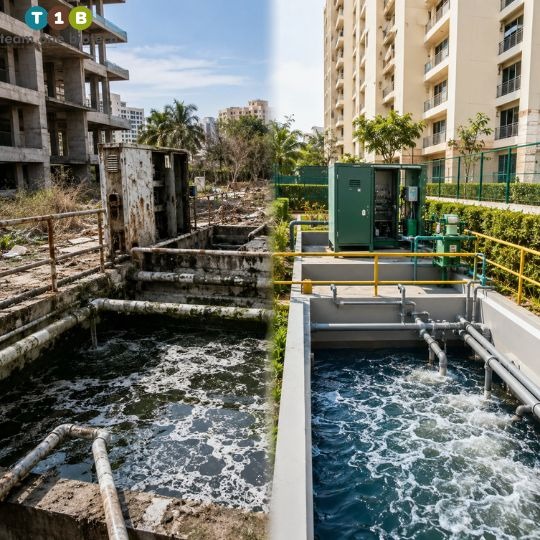
You have crossed every milestone. The structural work is done. The finishing is complete. Buyers have toured their units, confirmed their registry paperwork, and are now calling every other day asking when they can move in. RERA deadlines are not a theoretical risk anymore, they are a countdown. And yet, your project sits frozen at the final gate.

The Occupancy Certificate has not come through. Not because of a structural defect. Not because of a missing drawing. But because your Sewage Treatment Plant failed its inspection.

This is one of the most financially brutal situations a developer can face. A completed, market-ready project, representing hundreds of crores in investment, held hostage by a wastewater system that was never given the biological conditions it needed to perform. Capital is locked. Buyers are furious. Your reputation is quietly taking damage with every passing week.

The good news is that this is a solvable problem, and it is solvable far faster than most developers realize. But only if you act with the right understanding of what actually went wrong and what the right remedy looks like.

The Cost of Delay: Legal Exposure Under RERA and Local Body Compliance

The financial pressure of a stalled OC is obvious. What developers sometimes underestimate is the legal exposure running parallel to it.

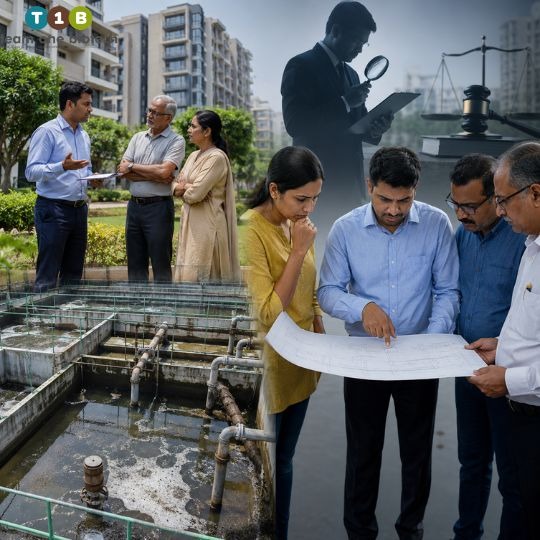
Under RERA Section 14, a promoter is legally obligated to deliver a unit along with all common amenities and infrastructure in full working condition, as per the specifications registered with the authority. A non-functional or non-compliant STP is not a minor snag, it is a breach of that obligation. Buyers have legal standing to file complaints, demand compensation for delayed possession, and escalate to the RERA appellate authority.

Local municipal and development bodies add another layer of accountability. In Bengaluru, both BBMP and BDA require verified STP compliance before releasing the OC for residential and commercial projects beyond a specified floor area threshold. In Mumbai, MCGM has progressively tightened its wastewater discharge verification protocols for large residential complexes. In Pune, PMRDA enforces STP standards as a hard gate in the occupancy sign-off process. In Hyderabad, GHMC has aligned its OC procedures with the National Green Tribunal’s broader push to enforce treated effluent standards across urban developments.

What this means practically is that an STP compliance failure is not a conversation you can defer. Every week of delay is a week of compounding RERA liability, buyer attrition risk, and financing cost on capital that should already have been recovered through possession handovers.

This is the question most developers never get a straight answer to, and it is worth understanding properly, because the answer changes your remediation strategy entirely.

A Sewage Treatment Plant does not operate on chemistry alone. It operates on biology. The core treatment process, particularly in activated sludge and sequential batch reactor systems, depends on a living, thriving microbial ecosystem. These microorganisms break down organic matter, reduce biochemical oxygen demand (BOD), chemical oxygen demand (COD), and total suspended solids (TSS) to the levels required under the Consent to Operate (CTO) issued by the State Pollution Control Board (SPCB).

When a new STP goes through its first official inspection, it almost always fails, not because the civil structure is wrong, but because the biology is absent or severely underdeveloped. A brand-new STP has not had the time or organic loading to cultivate a stable, high-density biomass. The microorganisms responsible for treatment simply are not present in sufficient numbers to process wastewater effectively.

Compounding this is what happens when a residential community begins occupancy. Dozens of families moving in simultaneously creates a sudden, dramatic spike in organic load, what engineers call a shock load. Traditional chemical and mechanical STP systems are particularly vulnerable to these spikes. The incoming wastewater overwhelms the existing microbial population before it has had a chance to establish itself, and treatment performance collapses exactly when the system is being tested most rigorously.

Add to this the reality that many Indian residential STPs are designed for average daily loads but commissioned and inspected during periods of maximum variance, and you have a structurally predictable failure pattern that the industry has not adequately addressed.

Note: These are general values and operational outcomes will vary based on the specific engineering design, current microbial health, and unique load parameters of individual Sewage Treatment Plants (STPs) or Effluent Treatment Plants (ETPs).

The Developer’s Emergency Action Guide

When an STP fails a compliance inspection, most developers lose critical time pursuing the wrong remedies, calling civil contractors, debating infrastructure upgrades, or waiting for the existing microbial population to mature on its own. None of these approaches deliver the speed the situation demands.

The correct emergency framework has three phases:

Phase One: Rapid Diagnostic Assessment. Before any intervention, a qualified wastewater specialist must conduct an on-site audit of the STP. This covers inlet and outlet water quality sampling, sludge health evaluation, aeration system performance, and a review of the current operational protocol. The goal is to distinguish between a biological failure, a mechanical failure, and an operational failure, because each has a different remedy.

Phase Two: Biological Seeding and Augmentation. If the root cause is low biomass, which it most commonly is in new and recently commissioned STPs, the fastest intervention is the direct introduction of high-concentration, application-specific microbial cultures. These bioenzyme and bioremediation cultures are developed to rapidly colonize the STP, accelerate the breakdown of organic waste, and bring BOD, COD, and TSS reduction to within the compliance range across a substantially compressed timeframe. Reductions in key parameters can move across a wide range in a matter of days rather than weeks, when the right cultures are introduced under proper operational supervision.

Phase Three: Operational Stabilization. Introducing biology is only part of the answer. The STP’s aeration schedule, sludge return rates, and retention times must be recalibrated to support the new microbial population. This operational tuning is what sustains performance through the next official inspection, and beyond.

Done correctly, this sequence can bring a failed STP to compliance within a window of days to a few weeks, depending on current system health and incoming load conditions.

Note: These are general values and operational outcomes will vary based on the specific engineering design, current microbial health, and unique load parameters of individual Sewage Treatment Plants (STPs) or Effluent Treatment Plants (ETPs).

Civil Overhaul vs. Bioremediation: Understanding the Real Tradeoff

Civil Overhaul vs. Bioremediation: Understanding the Real Tradeoff

When an STP fails inspection, the instinct of many MEP consultants is to recommend civil modifications, expanding tank volumes, adding filtration stages, replacing aeration systems. In some cases, structural changes are genuinely necessary. But in the majority of new-project OC failures, they are not.

Civil modifications come with a compounding set of problems in this context. They require SPCB approval before work begins. They introduce construction activity into a system that needs to be running. They take months to complete and commission. And they cost multiples of what a biological remediation program would cost, while delivering results on a timeline that makes RERA compliance functionally impossible to maintain.

Biological augmentation, by contrast, is non-invasive. It works within the existing civil structure. It can be initiated within days of a diagnostic assessment. It does not require regulatory clearance to begin. And its costs run at a fraction of what structural modifications demand. For a developer facing an OC bottleneck, the math is not particularly complicated, but only if the right expertise is brought in early.

STP Vendor Selection Criteria for Fast-Track Approvals

STP Vendor Selection Criteria for Fast-Track Approvals

One of the most preventable causes of OC delays is the wrong STP maintenance vendor being retained post-construction. Developers often hand over STP operations to a facility management company that lacks the specialized knowledge to manage biological treatment systems under variable loading conditions.

When evaluating vendors in a compliance emergency, or before you reach that point, the criteria must include demonstrated experience with biological treatment systems, not just mechanical or chemical ones. The vendor must be able to provide specific microbial cultures suited to your STP’s design, not generic off-the-shelf products. They should have documented experience supporting regulatory inspections and preparing technical compliance reports for SPCB and NGT-aligned assessments. And critically, they must offer rapid mobilization, a vendor who needs two weeks of lead time is not the right partner when your OC is already stalled.

Experience with multi-storey residential STPs and commercial real estate wastewater systems at scale, under the specific loading dynamics of Indian urban developments, is non-negotiable in this selection.

Protecting Your Brand Equity and Freeing Locked Capital

There is a longer-term consideration beyond the immediate OC crisis that developers in this position should not lose sight of.

Every month a project sits in compliance limbo is a month that word-of-mouth about your brand deteriorates. Buyers talk. Industry contacts notice. Future project financing conversations happen in the context of your track record, and a high-profile RERA complaint or delayed possession on a flagship project follows a developer’s reputation far longer than the crisis itself lasts.

Resolving an STP compliance failure quickly and decisively is not just about unblocking this project. It is about demonstrating to your buyers, your lenders, and your own organization that you have the operational depth to handle complex problems under pressure. That is brand equity. And it is worth protecting with the same urgency you would bring to any other high-stakes project decision.

Act Now: Book Your Emergency STP Compliance Audit

If your Occupancy Certificate is being withheld due to STP non-compliance, the window to act is now, not after the next failed inspection.

Team One Biotech specializes in rapid biological remediation for Sewage Treatment Plants and Effluent Treatment Plants across Indian residential and commercial real estate projects. Our bioenzyme and microbial culture solutions are specifically engineered for the high-variance, shock-load conditions that characterize new project commissioning in Indian urban developments.

We offer an Emergency STP Compliance Audit designed to assess your current system, identify the precise failure points, and deploy a targeted biological remediation protocol, all on a timeline designed to align with your next regulatory inspection window.

Contact Team One Biotech today to schedule your audit. Your buyers are waiting. Your capital is locked. The solution is closer than you think.

Book Your Emergency STP Compliance Audit

Looking to improve your ETP/STP efficiency with the right bioculture?
Talk to our experts at Team One Biotech for customised microbial solutions.

Contact+91 8855050575

Email:  sales@teamonebiotech.com

Visit: www.teamonebiotech.com

Discover More on YouTube – Watch our latest insights & innovations!-

Connect with Us on LinkedIn – Stay updated with expert content & trends!
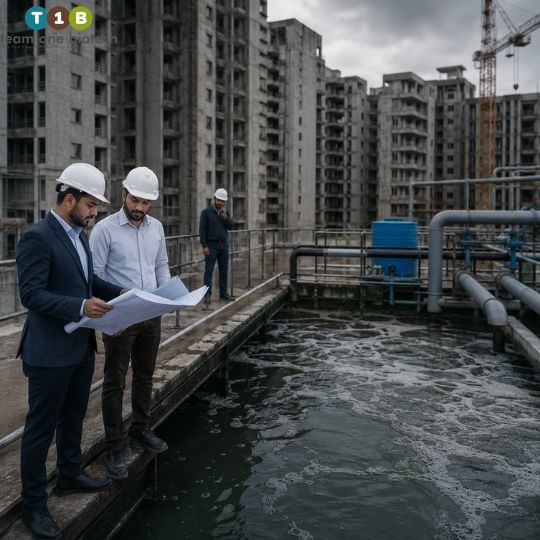
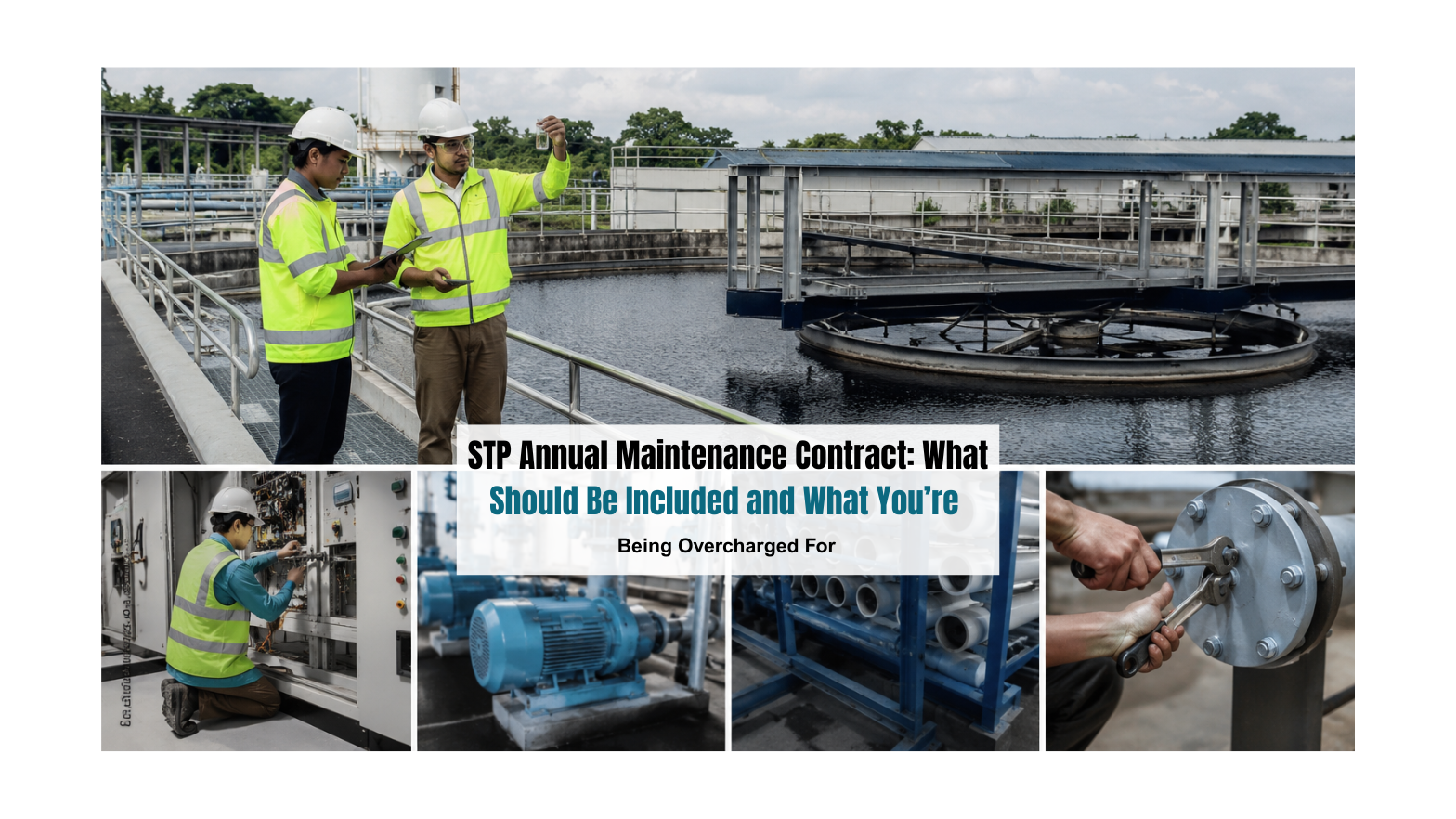
STP Annual Maintenance Contract: What Should Be Included and What You’re Being Overcharged For

There’s a particular kind of dread that hits an RWA treasurer or a factory procurement manager when an email lands from the State Pollution Control Board. It usually starts with words like show cause or violation, and within seconds, a routine Tuesday turns into weeks of paperwork, panic-driven vendor calls, and a budget conversation nobody wanted to have. Often, the root cause traces back to something as unglamorous as a sewage treatment plant that wasn’t maintained properly, despite an AMC supposedly being in place.

The second version of this dread is quieter but just as costly: discovering that this quarter’s emergency pump repair bill is the fourth one this year, each one billed separately, even though there’s an active annual maintenance contract sitting in a filing cabinet that was supposed to prevent exactly this. Somewhere between the contract’s fine print and the vendor’s invoice, money is leaking out, and most committees and procurement teams don’t realize it until the numbers are added up at year-end.

The STP AMC is, without exaggeration, one of the most misunderstood and most poorly negotiated line items in a housing society’s or factory’s annual budget. It’s treated as a checkbox, a mandatory expense to keep effluent flowing and inspectors satisfied, rather than what it actually is: a legally significant, technically complex service contract that directly determines whether a facility stays compliant or becomes the subject of a regulatory notice.

This guide walks through what a genuine, comprehensive STP AMC should include, where vendors typically pad costs or strip out coverage, and how a smarter biological approach to treatment can quietly reduce both compliance risk and the size of next year’s renewal quote.

The Legal Reality: Why Your Consent to Operate Depends on Daily STP Performance

Every facility discharging treated sewage, whether a residential township or an industrial unit, operates under a Consent to Operate (CTO) issued by the relevant State Pollution Control Board, working within the broader framework set by the Central Pollution Control Board. This isn’t a one-time approval. It’s a conditional, renewable license that assumes continuous compliance with CPCB discharge norms covering parameters like Biochemical Oxygen Demand (BOD), Chemical Oxygen Demand (COD), Total Suspended Solids (TSS), and pH.

The critical detail many committees miss is that CTO compliance isn’t measured by intentions or paperwork. It’s measured by what comes out of the outlet pipe on any given day, including the day an inspector decides to test it. An STP that runs adequately for eleven months and underperforms in the twelfth is still a compliance failure if that twelfth month happens to be when samples are drawn.

This is precisely why SPCB regulations increasingly expect facilities to demonstrate not just plant ownership but active, documented operation and maintenance. A functioning AMC isn’t a courtesy to your vendor relationship; it’s effectively part of your regulatory defense file. When a society or factory faces scrutiny, the maintenance logs, water testing records, and breakdown response documentation from the AMC vendor often become the primary evidence of due diligence.

Note: These figures, costs, and timelines are general guidelines and market ranges. Actual pricing and operational requirements will vary significantly based on plant capacity, design technology, current mechanical health, and the specific inlet-outlet parameters of individual Sewage and Effluent Treatment Plants (STPs/ETPs).

The Blueprint: What an Authentic STP AMC Must Include

A genuine sewage treatment plant AMC isn’t a vague promise of maintenance support. It’s a structured service commitment with specific, auditable components. If your current contract, or the quotes you’re comparing, don’t clearly spell out the following, that’s a planning gap worth raising before signing.

Preventative Mechanical and Electrical Audits

This is the backbone of any STP operation maintenance contract in India. It should include scheduled inspection cycles for blowers, aerators, pumps, motors, control panels, and electrical wiring, typically occurring multiple times per month depending on plant capacity and load. The contract should specify:

  • Routine visual and functional inspection of all rotating equipment
  • Lubrication and wear-component checks on a defined cycle
  • Electrical panel inspection, including checking for loose connections, overheating, and relay function
  • Plumbing and pipeline checks for leaks, blockages, or scaling
  • A documented maintenance log shared with the client after every visit, not just available on request

Water Quality Analytics and Compliance Reporting

An AMC without testing is essentially an AMC without proof. Your contract should mandate regular laboratory testing of treated effluent for BOD, COD, TSS, and pH, generally conducted somewhere between 2 to 4 times per month, though frequency can reasonably vary based on plant size and local SPCB requirements. These results should be shared as formal reports, not verbal assurances, and ideally retained in a format that can be produced instantly if a Consent to Operate compliance check arises.

Sludge Management Protocols

Sludge handling is frequently glossed over in vendor proposals, yet it’s central to both odor control and treatment efficiency. The contract should clearly define how often sludge wasting occurs, how it’s dewatered or stored, and how disposal is handled in line with local environmental guidelines. Ambiguity here often becomes a hidden cost center later.

Emergency Callout SLAs

Breakdowns happen, and how a vendor responds defines whether a minor fault becomes a major compliance event. A solid AMC should specify a guaranteed response window, commonly falling within 24 to 36 hours for non-critical issues, with shorter windows for critical failures affecting discharge quality. These SLAs should be written into the contract with measurable penalties for non-compliance, not just mentioned in a sales pitch.

Note: These figures, costs, and timelines are general guidelines and market ranges. Actual pricing and operational requirements will vary significantly based on plant capacity, design technology, current mechanical health, and the specific inlet-outlet parameters of individual Sewage and Effluent Treatment Plants (STPs/ETPs).

Want a structured way to check your current contract against this blueprint before your renewal date arrives? A simple side-by-side checklist can reveal gaps in minutes rather than after the next inspection.

Where the Money Bleeds: Common Overcharges and Contract Red Flags

This is where most procurement reviews and RWA budget discussions get uncomfortable, because the overcharges are rarely obvious. They’re built into structure, not single line items.

Biological dosing billed as an extra. Routine addition of bacterial cultures or enzymes to maintain biological treatment efficiency should typically be a built-in part of a comprehensive AMC, not an add-on invoiced separately each time the tank seems sluggish.

Visiting fees disguised as inspection charges. Some vendors quote a low base AMC cost, then attach a site visit fee for what should be a scheduled, contractually included monthly check. This single tactic is one of the most common ways sewage treatment plant AMC charges quietly balloon over a year.

Unbundled emergency repairs. Pump or blower repairs that should fall under preventative maintenance get rebranded as emergency callouts and billed at a premium, even when the failure was a predictable result of deferred servicing.

Vague consumable clauses. Contracts that don’t clearly state which consumables (chemicals, filters, minor spare parts) are included versus billed separately tend to generate disputes precisely when budgets are tightest.

No defined exit or escalation clause. If a vendor underperforms, is there a documented process to flag it, demand correction, or exit the contract without penalty? Many AMCs are silent here, leaving clients stuck.

When comparing STP AMC cost India quotes, the cheapest quarterly figure is often the one with the most exclusions. A genuinely comprehensive contract may carry a higher headline number but eliminates the unpredictable add-ons that erode any savings within two or three billing cycles.

Note: These figures, costs, and timelines are general guidelines and market ranges. Actual pricing and operational requirements will vary significantly based on plant capacity, design technology, current mechanical health, and the specific inlet-outlet parameters of individual Sewage and Effluent Treatment Plants (STPs/ETPs).

Comprehensive vs. Labor-Only Contracts: A Side-by-Side Comparison

AspectComprehensive AMCLabor-Only Contract
Scope of coverageMechanical, electrical, plumbing, biological dosing, and consumables typically bundledCovers technician visits and labor only; parts, chemicals, consumables billed separately
Cost predictabilityHigher, more stable monthly or annual outlay; fewer surprise invoicesLower headline cost, but frequent unpredictable add-on billing
Risk allocationVendor absorbs more operational risk; performance-linked SLAs commonClient absorbs most risk; vendor liability limited to labor presence
Compliance documentationUsually includes structured water testing reports and maintenance logsDocumentation often inconsistent or client-managed
Best suited forSocieties and facilities prioritizing regulatory certainty and budget stabilityFacilities with strong in-house technical oversight and spare parts inventory
Typical cost rangeGenerally varying from INR X to INR Y per month depending on plant capacity and inclusionsOften lower base rate, but cumulative annual cost can exceed comprehensive plans once add-ons are tallied

Note: These figures, costs, and timelines are general guidelines and market ranges. Actual pricing and operational requirements will vary significantly based on plant capacity, design technology, current mechanical health, and the specific inlet-outlet parameters of individual Sewage and Effluent Treatment Plants (STPs/ETPs).

How Smart Biology Lowers Mechanical Costs

How Smart Biology Lowers Mechanical Costs

Here’s the part of the conversation that procurement teams and RWA committees rarely get from a purely mechanical vendor: the biological health of an STP directly determines how hard its mechanical components have to work.

A plant struggling with weak or imbalanced microbial activity tends to develop excess sludge, increased odor, and inconsistent BOD and COD reduction. That imbalance forces blowers and aerators to run longer and harder, accelerates wear on pumps, and increases the frequency of unexpected mechanical interventions that, as covered earlier, often get billed as emergencies.

This is where advanced bioremediation solutions and engineered microbial cultures, like those developed by Team One Biotech, change the equation. By introducing targeted bacterial strains and enzymatic formulations suited to a plant’s specific influent characteristics, biological treatment optimization becomes achievable in a way generic, one-size-fits-all dosing rarely allows. The practical results tend to include reduced sludge volumes, more stable effluent quality even under fluctuating load, and notably less strain on rotating equipment.

Over time, this biological stability gives facilities genuine leverage in AMC negotiations. A plant that consistently meets CPCB discharge norms with minimal mechanical drama is a far less risky, less labor-intensive account for any maintenance vendor to service, and that should be reflected in lower renewal quotes.

Note: These figures, costs, and timelines are general guidelines and market ranges. Actual pricing and operational requirements will vary significantly based on plant capacity, design technology, current mechanical health, and the specific inlet-outlet parameters of individual Sewage and Effluent Treatment Plants (STPs/ETPs).

From Passive Buyer to Informed Procurement Supervisor

The single biggest shift a treasurer or procurement manager can make isn’t switching vendors every renewal cycle. It’s reading the existing contract the way a compliance officer would: scope by scope, exclusion by exclusion, SLA by SLA. Most overcharges and most compliance risks live in the gaps between what was promised verbally and what was actually written down.

Before your next AMC renewal, request a structured breakdown from your current or prospective vendor that separates mechanical coverage, biological treatment support, water testing frequency, and emergency response commitments into distinct, itemized sections. If a vendor hesitates to put this in writing, that hesitation is itself useful information.

If your facility’s STP has been generating recurring mechanical complaints, inconsistent test results, or rising emergency invoices, the underlying issue may not be your equipment at all. It may be the biological foundation the equipment is being forced to compensate for. Team One Biotech works with housing societies and industrial facilities to assess and strengthen the microbial health of sewage and effluent treatment systems before committing to another expensive mechanical AMC cycle. A plant that’s biologically optimized is simply cheaper, safer, and easier to maintain, regardless of which vendor eventually signs the contract.

Every renewal cycle is a fresh opportunity to ask harder questions of your AMC vendor, and the answers often reveal more about your plant’s biological health than its mechanical condition. Rather than locking into another year of reactive repairs and unpredictable invoices, it’s worth starting with an honest assessment of what’s actually happening inside your tanks. Get in touch with Team One Biotech to evaluate your STP’s biological performance, identify the inefficiencies quietly inflating your maintenance costs, and build a treatment strategy that keeps your Consent to Operate secure without overpaying for it. 

Looking to improve your ETP/STP efficiency with the right bioculture?
Talk to our experts at Team One Biotech for customised microbial solutions.

Contact+91 8855050575

Email:  sales@teamonebiotech.com

Visit: www.teamonebiotech.com

Discover More on YouTube – Watch our latest insights & innovations!-

Connect with Us on LinkedIn – Stay updated with expert content & trends!
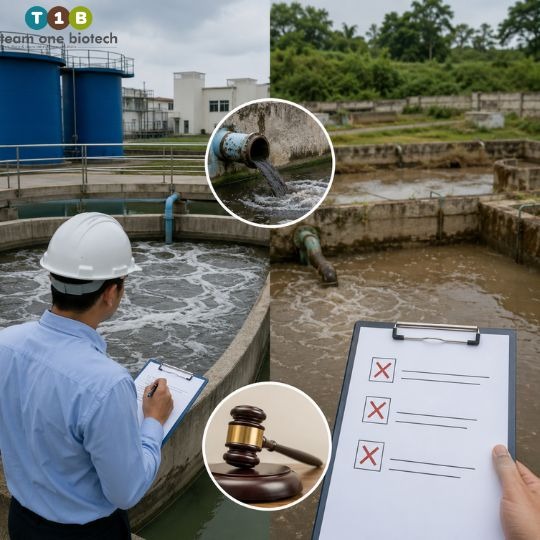
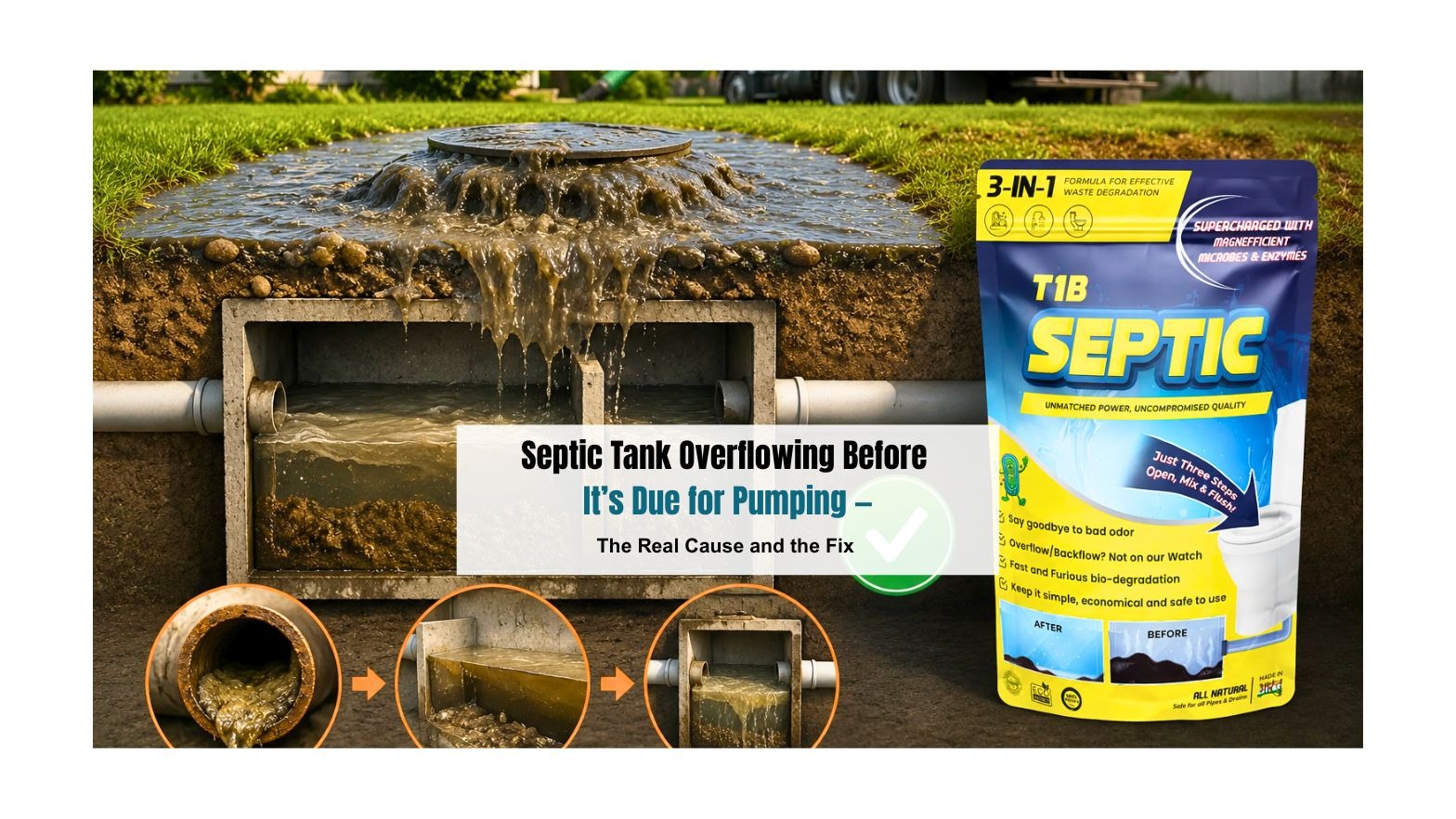
Septic Tank Overflowing Before It's Due for Pumping? The Real Cause and the Fix
Septic Tank Overflowing Before It’s Due for Pumping? The Real Cause and the Fix

There’s a particular kind of dread that sets in when you catch that first whiff near the lawn, sharp, sulfurous, unmistakable. Maybe you’ve got relatives arriving in two days for a wedding function. Maybe it’s a Tuesday morning at your apartment complex and three different residents are already calling the facility manager. Either way, the thought that follows is always the same: we just had this pumped.

You did everything right. You scheduled the service, paid the vendor, watched the truck pull away thinking the problem was handled for months. And now there’s standing water near the soak pit, a gurgling drain in the bathroom, or worse, backup coming up through the floor trap. The frustration here is completely valid. You paid for a solution and got a few weeks of relief at best.

Here’s the part nobody explains clearly enough: pumping was never the actual solution. It was maintenance on the wrong half of the problem. If your septic tank overflowing before its due date has become a recurring nightmare, the real story is happening at a microscopic level, and no amount of mechanical suction is going to fix it.

The Myth of Pumping Alone

The Myth of Pumping Alone

Pumping a septic tank does exactly one thing, it physically removes accumulated solids and sludge sitting at the bottom of the chamber. That’s it. It’s a vacuum job, not a treatment.

What pumping does not do:

  • Restore the bacterial colonies that actually digest organic waste
  • Repair compaction or clogging in the drain field / soak pit
  • Address the chemical residues that may have killed off your tank’s microbial population in the first place
  • Prevent the same premature buildup from happening again in a matter of weeks

A septic tank is not a holding box. It’s a living biological reactor. Inside that dark, oxygen-starved chamber, colonies of anaerobic bacteria are constantly working to liquefy solid waste, breaking it down into simpler compounds, gases, and effluent that can safely move into the drain field. When you pump the tank, you’re emptying the workshop, but if the workforce inside has already been wiped out, the tank starts refilling with undigested solids almost immediately. That’s why a septic tank full before pumping was even technically due is so common, and so misunderstood.

The Real Culprit: Biological Die-Off

The Real Culprit: Biological Die-Off

This is the piece that gets left out of almost every plumber’s explanation, and it’s the actual root cause behind most premature overflow cases.

Septic systems rely on a delicate consortia of bacteria to survive and multiply. These microorganisms need a stable, undisturbed anaerobic environment to do their job. The problem is that modern households and commercial spaces are, often unknowingly, waging a slow chemical war against that ecosystem every single day.

Common bacteria-killers found in almost every Indian home or facility:

  • Heavy-duty antibacterial floor cleaners and toilet disinfectants
  • Bleach-based products used for laundry or surface cleaning
  • Strong detergents and degreasers poured down kitchen sinks
  • Drain-opening chemicals used to clear minor clogs
  • Excessive use of phenyl and harsh acid-based cleaners in bathrooms

Each of these is designed to kill bacteria, that’s literally their job on your bathroom floor. But every drop that goes down a drain eventually reaches the septic tank, where it does the exact same thing to the bacteria you actually need. Over time, repeated exposure can knock the colony down to a fraction of a healthy population, and without enough live bacteria to keep pace with daily waste input, solids start accumulating far faster than the system was ever designed to handle.

Note: These are general values and operational timelines will vary based on individual system usage, soil absorption rates, and the unique design parameters of the localized treatment layout or Effluent Treatment Plant (ETP) elements.

This is precisely why pumping alone solves nothing long-term. You’re removing the symptom while the underlying biological collapse continues untreated.

If this sounds like your situation right now, call for emergency pump-out service if you have active backup, but understand that without restoring the bacterial ecosystem afterward, you’ll likely face the same overflow again. This is the exact gap that Team One Biotech Septic Tank Cleaner Bacteria Powder is engineered to close. It’s formulated to repopulate the tank with the specific bacterial strains needed to resume natural waste digestion immediately after a crisis, not weeks later.

The Indian Factor: Why Local Conditions Make This Worse

The Indian Factor: Why Local Conditions Make This Worse

Septic systems across India face a unique combination of environmental and usage pressures that accelerate early failure far more than in drier, lower-density climates.

Monsoon Saturation

During heavy monsoon months, soil around the drain field or soak pit becomes oversaturated. Saturated soil loses its ability to absorb and filter effluent, which means liquid that should be draining away instead backs up into the tank, or worse, into the yard. A tank that was functioning adequately in dry season can suddenly seem to overflow with no warning once groundwater levels rise.

High Ambient Temperatures

Bacterial activity is temperature-sensitive. While moderate warmth generally speeds up microbial digestion, extreme heat swings combined with already-weakened bacterial populations create unpredictable performance. A struggling colony that might survive in cooler conditions can collapse faster under sustained high temperatures, especially in tanks that were already chemically compromised.

High-Density Usage Patterns

Indian residential complexes, hostels, and commercial facility blocks frequently run far higher occupancy-to-tank-capacity ratios than the systems were originally designed for. More users means more daily waste volume, more frequent chemical cleaning cycles, and less recovery time for bacterial colonies between cleaning events.

Note: These are general values and operational timelines will vary based on individual system usage, soil absorption rates, and the unique design parameters of the localized treatment layout or Effluent Treatment Plant (ETP) elements.

Put these three factors together, soil saturation, temperature stress, and overloading, and you have the exact recipe for a septic tank overflow reasons India property owners report most often: a system that was “fine” a month ago suddenly backing up with no obvious trigger.

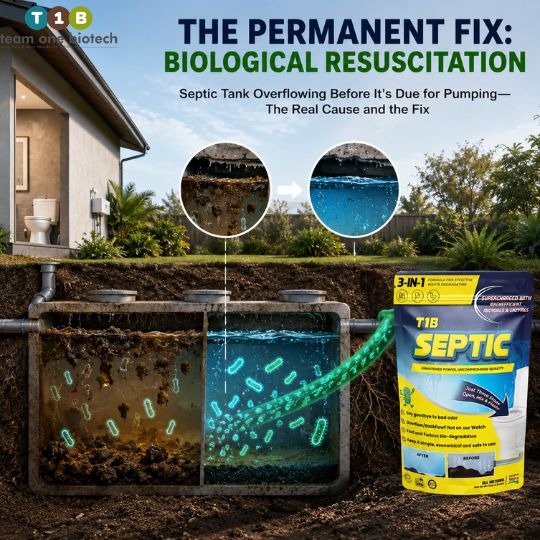
The Permanent Fix: Biological Resuscitation

The Permanent Fix: Biological Resuscitation

If biological die-off is the disease, the cure is reintroducing a concentrated, targeted population of the right bacterial strains, fast, and in sufficient quantity to outpace incoming waste.

This is exactly what T1B Septic Tank Cleaner Bacteria Powder is built to do. It’s a natural microbial formulation designed specifically for septic tanks, bio-toilets, and biodigesters, where it works to:

  • Actively break down accumulated organic solids and existing sludge
  • Repopulate the anaerobic ecosystem with consortia of microorganisms suited to degrading household and human waste
  • Control the foul odor caused by anaerobic decomposition imbalance
  • Reduce the rate of future sludge accumulation, extending the real interval between pump-outs
  • Support a more functional drain field by improving the quality of effluent reaching the soil

Rather than treating the tank as a container to be emptied, this approach treats it as what it actually is, a biological treatment system that needs its workforce restored, not just its space cleared out.

Comparative Breakdown: Mechanical Pumping vs. Biological Treatment

FactorMechanical Pumping AloneBiological Treatment (Bacteria Powder)
What it addressesPhysical solids removal onlyRoot cause: bacterial population and digestion capacity
Effect on odorTemporary reliefSustained reduction as digestion normalizes
Typical recurrence intervalOften within a few weeks to a couple of months if bacteria remain depletedGenerally extends meaningfully, often into several months, with regular use
Drain field impactNo direct improvementSupports healthier effluent quality reaching the soil
Cost pattern over a yearRecurring emergency call-out costs, often higher cumulativelyLower ongoing cost with routine, planned dosing
Long-term system healthCycle of repeated crisis managementRestores self-sustaining biological balance

Note: These are general values and operational timelines will vary based on individual system usage, soil absorption rates, and the unique design parameters of the localized treatment layout or Effluent Treatment Plant (ETP) elements.

Action Plan: What to Do Right Now

If you’re dealing with an active overflow or a septic tank not draining solution is what you’re searching for at this exact moment, here’s the immediate sequence:

  1. Stop all chemical use immediately, no more bleach, phenyl, or antibacterial cleaners going down any drain in the property.
  2. Reduce water load where possible, stagger laundry, dishwashing, and bathing across the household or facility until the system stabilizes.
  3. Call for pump-out if there is active visible backup, this clears immediate physical risk and gives you a clean starting point.
  4. Reintroduce bacterial treatment immediately after pumping, this is the step almost everyone skips, and it’s the reason the problem returns.
  5. For commercial properties, establish a routine dosing schedule as part of standard commercial septic maintenance rather than waiting for the next crisis.

Restore the Balance, Don’t Just Empty the Tank

A septic tank overflowing before it’s due for pumping isn’t bad luck. It’s a system telling you, urgently, that its biological core has been compromised. Pumping buys you days. Restoring the bacterial ecosystem is what actually stops the cycle.

If you’re standing over a backed-up drain right now, the fastest path back to a stable, odor-free, properly functioning system is reintroducing the exact microbial workforce your tank has lost. Get Team One Biotech Septic Tank Cleaner Bacteria Powder into your system today, and give your tank the one thing pumping alone can never provide, a living, working digestive ecosystem built to keep up with real life.

Looking to improve your ETP/STP efficiency with the right bioculture?
Talk to our experts at Team One Biotech for customised microbial solutions.

Contact+91 8855050575

Email:  sales@teamonebiotech.com

Visit: www.teamonebiotech.com

Discover More on YouTube – Watch our latest insights & innovations!-

Connect with Us on LinkedIn – Stay updated with expert content & trends!
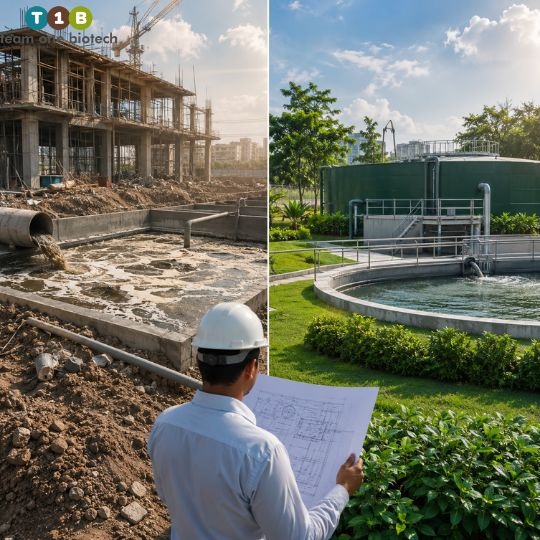
Builder Handed Over a Non-Functional STP to Your Housing Society — What to Do Next

It’s 11 AM on a Tuesday. The OPD waiting area is full, the mall’s food court is at peak footfall, or the school cafeteria is mid-lunch service, and somewhere below the tiles, a grease-choked line decides this is the moment to back up. Within minutes, you’re not managing a maintenance ticket anymore. You’re managing a compliance exposure, an odor complaint, possibly an HVAC alarm triggered by chemical fumes from last week’s “quick fix,” and a line of stakeholders asking why this keeps happening.

This is the quiet, recurring reality for facility managers, operations directors, and infrastructure heads across hospitals, schools, corporate campuses, and malls. Drain failures rarely announce themselves on a convenient schedule. And the way you respond to them, chemically or biologically, shapes far more than just whether the water flows again. It shapes your pipe lifespan, your ETP load, your CPCB compliance standing, and your long-term operating costs.

The debate of bio drain cleaner vs chemical isn’t a minor procurement detail. It’s a strategic decision that touches structural integrity, safety, and sustainability reporting all at once.

The Chemical Illusion: Fast Relief, Slow Damage

The Chemical Illusion: Fast Relief, Slow Damage

Chemical drain cleaners, typically caustic or acidic formulations, are seductive because they work fast. Pour, wait, flush, done. For a facility manager fighting the clock, that speed feels like control.

But the relief is largely cosmetic. These formulations dissolve the visible clog through aggressive chemical reactions that generate significant heat, and that same reactivity doesn’t discriminate between organic buildup and the pipe material itself. Over repeated use, this erodes gaskets, weakens pipe joints, and corrodes metal piping, particularly in older institutional buildings where plumbing infrastructure may already be decades old.

There’s also the human factor. Strong fumes from acidic or alkaline cleaners can trigger air quality sensors, irritate respiratory systems, and in healthcare or school settings, create genuine safety incidents rather than solving maintenance ones. Many facility teams report that fume-related complaints or false HVAC alarms cluster shortly after chemical dosing, an operational headache layered on top of the original problem.

And critically, chemical cleaners do nothing for the underlying biofilm and organic accumulation lining your pipe walls. They clear the immediate blockage and leave the structural cause untouched, which is why the same drain tends to fail again within a short window.

The Bioenzyme Paradigm: Maintenance That Works With Your Infrastructure, Not Against It

Bioenzyme-based cleaners take a fundamentally different approach. Instead of chemically blasting through a blockage, they introduce specific microbial strains and enzymes that actively digest fats, oils, grease (FOG), and organic matter at the molecular level. This is enzymatic pipe cleaner technology functioning as it’s designed to, biological, not destructive.

Rather than a one-time reaction, bioremediation works progressively. Microbial colonies establish themselves along pipe walls and continue breaking down organic residue over time, reducing the buildup that causes recurring blockages in the first place. Many facilities see meaningful improvement in flow consistency within roughly 3 to 5 weeks of consistent application, with full normalization of problem lines often extending further depending on the severity of prior buildup.

Note: These are general values and operational outcomes will vary based on the specific design, microbial load, and unique parameters of individual Effluent Treatment Plants (ETPs).

Because there’s no corrosive reaction, there’s no fume risk, no HVAC trigger events, and no progressive damage to gaskets or joints. It’s a maintenance philosophy built around prevention rather than emergency response, which matters enormously once you look at how drain failures play out differently across facility types.

Vertical-Specific Impact: Why One-Size-Fits-All Drain Care Doesn’t Work

Vertical-Specific Impact: Why One-Size-Fits-All Drain Care Doesn't Work

Hospitals and Healthcare Facilities

In clinical environments, drain maintenance intersects directly with infection control. Chemical fumes near patient areas, labs, or ICUs are a documented safety liability, and even brief exposure events can trigger compliance reviews. Beyond fumes, healthcare facilities also depend on a stable hygienic microbial balance in plumbing systems, chemical cleaners can disrupt this, occasionally creating conditions where harmful pathogens face less competition. Bioenzyme solutions, by contrast, populate drains with beneficial microbial activity that competitively suppresses pathogenic growth while supporting the facility’s broader institutional wastewater treatment protocols.

Schools and Educational Institutions

Student safety considerations make chemical-free environments a near non-negotiable priority for many school administrators today. Beyond the immediate fume risk in tightly packed corridors and washrooms, schools also face asset longevity pressures, campuses are often built to last generations, and corrosive chemical cycles shorten the usable life of plumbing infrastructure that’s expensive and disruptive to replace. Bioenzyme maintenance protects both the immediate safety profile and the long-term asset value of the building.

Malls and Corporate Hubs

High-footfall commercial environments generate unpredictable, often massive volumetric loads, food courts, multiple kitchen tenants, and dense washroom usage all feeding into a shared plumbing and Effluent Treatment Plant network. During India’s monsoon months, this strain compounds further: storm water infiltration, fluctuating municipal water quality, and surface runoff can all interact with grease-laden lines to accelerate backups. Bioenzyme treatment helps keep ETPs functioning within optimal biological parameters even as the surrounding load swings seasonally, rather than introducing chemical residues that can throw off the treatment plant’s microbial balance.

Head-to-Head: Bio Drain Cleaner vs Chemical Cleaner

FactorChemical Drain CleanersBioenzyme Drain Cleaners
Structural SafetyCorrodes pipes, gaskets, and joints over repeated useNon-corrosive; supports long-term pipe integrity
Speed of ActionImmediate, reactive clearingProgressive improvement, typically within 3 to 5 weeks of consistent use
Long-Term CostLower upfront cost, higher repair and replacement frequencyHigher initial investment, generally lower lifecycle costs over 1 to 2 years
Environmental ImpactCan disrupt ETP microbial balance and violate discharge normsSupports eco-friendly bioremediation and ETP stability
Maintenance FrequencyFrequent reapplication often needed within weeksReduced frequency as microbial colonies establish, generally extending maintenance intervals
Health & SafetyFume risk, potential HVAC/alarm triggersNo fume risk, suitable for sensitive environments

Note: These are general values and operational outcomes will vary based on the specific design, microbial load, and unique parameters of individual Effluent Treatment Plants (ETPs).

The pattern across nearly every row is the same: chemical solutions optimize for the next hour, while bioenzyme solutions optimize for the next several years. If your facility is evaluating commercial drain maintenance budgets on an annual basis rather than a per-incident basis, that distinction compounds quickly.

If your facility is still budgeting for drain emergencies rather than preventing them, it may be time to talk to a team that builds maintenance programs around your actual infrastructure, not just your latest clog.

The ETP Connection and Indian Compliance Realities

The ETP Connection and Indian Compliance Realities

For Indian facilities, the bio drain cleaner vs chemical decision doesn’t stop at the pipe, it extends directly into wastewater treatment and regulatory exposure. Corporate and institutional Effluent Treatment Plants depend on stable microbial ecosystems to break down organic waste before discharge. Chemical drain cleaner residue entering this system can disrupt that microbial balance, occasionally pushing treated effluent outside acceptable parameters set by the Central Pollution Control Board (CPCB).

This becomes especially relevant during monsoon season, when fluctuating municipal water quality and increased surface runoff already place additional strain on ETP capacity. Introducing chemical residues into an already-stressed treatment system raises the risk of non-compliance at precisely the time when regulatory scrutiny on discharge quality tends to increase.

Bioenzyme-based drain maintenance, by contrast, works in concert with ETP biology rather than against it. The same microbial principles cleaning your pipes are compatible with, and in many cases supportive of, the treatment processes your ETP relies on, helping facilities maintain consistent CPCB compliance even as seasonal and operational loads shift.

From Reactive Crisis Management to Proactive Microbial Strategy

The facilities that struggle least with drain failures aren’t the ones with the fastest emergency response, they’re the ones that’ve removed the recurring conditions that cause emergencies in the first place. That shift, from reactive firefighting to proactive microbial maintenance, is less a product swap and more a change in how plumbing infrastructure is managed across a facility’s lifecycle.

For hospitals, that means fewer compliance flags. For schools, it means a safer daily environment for students and staff. For malls and corporate campuses, it means infrastructure that holds up under unpredictable, monsoon-amplified loads without putting ETP compliance at risk.

Ready to Move Beyond the Next Emergency Call?

Every facility’s plumbing network, microbial load, and ETP design is different — which means the right bioremediation strategy isn’t a generic one. Team One Biotech works directly with facility managers across healthcare, education, retail, and corporate sectors to assess current drain and wastewater conditions and build a maintenance program suited to your specific infrastructure.

Reach out to Team One Biotech for a custom facility audit, and start replacing reactive drain crises with a proactive bioenzyme strategy built around the way your facility actually operates.

Talk to Our Bioremediation Experts — Schedule Your Facility Audit Today.

Looking to improve your ETP/STP efficiency with the right bioculture?
Talk to our experts at Team One Biotech for customised microbial solutions.

Contact+91 8855050575

Email:  sales@teamonebiotech.com

Visit: www.teamonebiotech.com

Discover More on YouTube – Watch our latest insights & innovations!-

Connect with Us on LinkedIn – Stay updated with expert content & trends!

Scan the code