

OC Pending Because Your STP Isn’t Compliant? What Builders and Developers Need to Do
You have crossed every milestone. The structural work is done. The finishing is complete. Buyers have toured their units, confirmed their registry paperwork, and are now calling every other day asking when they can move in. RERA deadlines are not a theoretical risk anymore, they are a countdown. And yet, your project sits frozen at the final gate.
The Occupancy Certificate has not come through. Not because of a structural defect. Not because of a missing drawing. But because your Sewage Treatment Plant failed its inspection.
This is one of the most financially brutal situations a developer can face. A completed, market-ready project, representing hundreds of crores in investment, held hostage by a wastewater system that was never given the biological conditions it needed to perform. Capital is locked. Buyers are furious. Your reputation is quietly taking damage with every passing week.
The good news is that this is a solvable problem, and it is solvable far faster than most developers realize. But only if you act with the right understanding of what actually went wrong and what the right remedy looks like.
The Cost of Delay: Legal Exposure Under RERA and Local Body Compliance
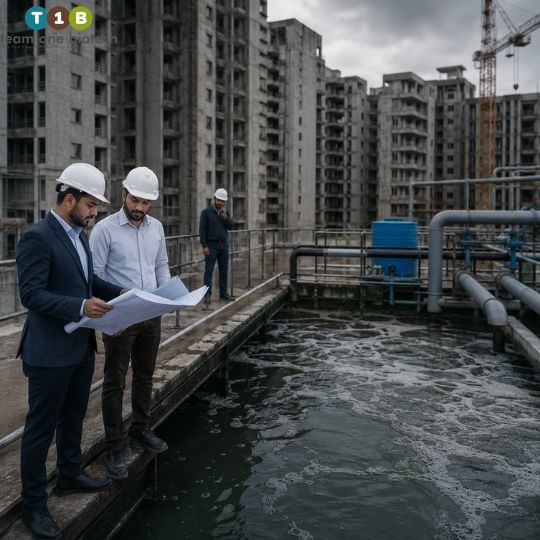
The financial pressure of a stalled OC is obvious. What developers sometimes underestimate is the legal exposure running parallel to it.
Under RERA Section 14, a promoter is legally obligated to deliver a unit along with all common amenities and infrastructure in full working condition, as per the specifications registered with the authority. A non-functional or non-compliant STP is not a minor snag, it is a breach of that obligation. Buyers have legal standing to file complaints, demand compensation for delayed possession, and escalate to the RERA appellate authority.
Local municipal and development bodies add another layer of accountability. In Bengaluru, both BBMP and BDA require verified STP compliance before releasing the OC for residential and commercial projects beyond a specified floor area threshold. In Mumbai, MCGM has progressively tightened its wastewater discharge verification protocols for large residential complexes. In Pune, PMRDA enforces STP standards as a hard gate in the occupancy sign-off process. In Hyderabad, GHMC has aligned its OC procedures with the National Green Tribunal’s broader push to enforce treated effluent standards across urban developments.
What this means practically is that an STP compliance failure is not a conversation you can defer. Every week of delay is a week of compounding RERA liability, buyer attrition risk, and financing cost on capital that should already have been recovered through possession handovers.
Why Newly Built STPs Fail the Consent to Operate Test
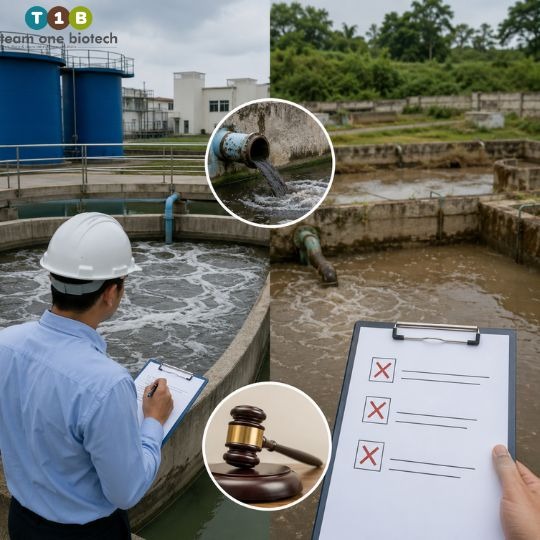
This is the question most developers never get a straight answer to, and it is worth understanding properly, because the answer changes your remediation strategy entirely.
A Sewage Treatment Plant does not operate on chemistry alone. It operates on biology. The core treatment process, particularly in activated sludge and sequential batch reactor systems, depends on a living, thriving microbial ecosystem. These microorganisms break down organic matter, reduce biochemical oxygen demand (BOD), chemical oxygen demand (COD), and total suspended solids (TSS) to the levels required under the Consent to Operate (CTO) issued by the State Pollution Control Board (SPCB).
When a new STP goes through its first official inspection, it almost always fails, not because the civil structure is wrong, but because the biology is absent or severely underdeveloped. A brand-new STP has not had the time or organic loading to cultivate a stable, high-density biomass. The microorganisms responsible for treatment simply are not present in sufficient numbers to process wastewater effectively.
Compounding this is what happens when a residential community begins occupancy. Dozens of families moving in simultaneously creates a sudden, dramatic spike in organic load, what engineers call a shock load. Traditional chemical and mechanical STP systems are particularly vulnerable to these spikes. The incoming wastewater overwhelms the existing microbial population before it has had a chance to establish itself, and treatment performance collapses exactly when the system is being tested most rigorously.
Add to this the reality that many Indian residential STPs are designed for average daily loads but commissioned and inspected during periods of maximum variance, and you have a structurally predictable failure pattern that the industry has not adequately addressed.
Note: These are general values and operational outcomes will vary based on the specific engineering design, current microbial health, and unique load parameters of individual Sewage Treatment Plants (STPs) or Effluent Treatment Plants (ETPs).
The Developer’s Emergency Action Guide
When an STP fails a compliance inspection, most developers lose critical time pursuing the wrong remedies, calling civil contractors, debating infrastructure upgrades, or waiting for the existing microbial population to mature on its own. None of these approaches deliver the speed the situation demands.
The correct emergency framework has three phases:
Phase One: Rapid Diagnostic Assessment. Before any intervention, a qualified wastewater specialist must conduct an on-site audit of the STP. This covers inlet and outlet water quality sampling, sludge health evaluation, aeration system performance, and a review of the current operational protocol. The goal is to distinguish between a biological failure, a mechanical failure, and an operational failure, because each has a different remedy.
Phase Two: Biological Seeding and Augmentation. If the root cause is low biomass, which it most commonly is in new and recently commissioned STPs, the fastest intervention is the direct introduction of high-concentration, application-specific microbial cultures. These bioenzyme and bioremediation cultures are developed to rapidly colonize the STP, accelerate the breakdown of organic waste, and bring BOD, COD, and TSS reduction to within the compliance range across a substantially compressed timeframe. Reductions in key parameters can move across a wide range in a matter of days rather than weeks, when the right cultures are introduced under proper operational supervision.
Phase Three: Operational Stabilization. Introducing biology is only part of the answer. The STP’s aeration schedule, sludge return rates, and retention times must be recalibrated to support the new microbial population. This operational tuning is what sustains performance through the next official inspection, and beyond.
Done correctly, this sequence can bring a failed STP to compliance within a window of days to a few weeks, depending on current system health and incoming load conditions.
Note: These are general values and operational outcomes will vary based on the specific engineering design, current microbial health, and unique load parameters of individual Sewage Treatment Plants (STPs) or Effluent Treatment Plants (ETPs).
Civil Overhaul vs. Bioremediation: Understanding the Real Tradeoff
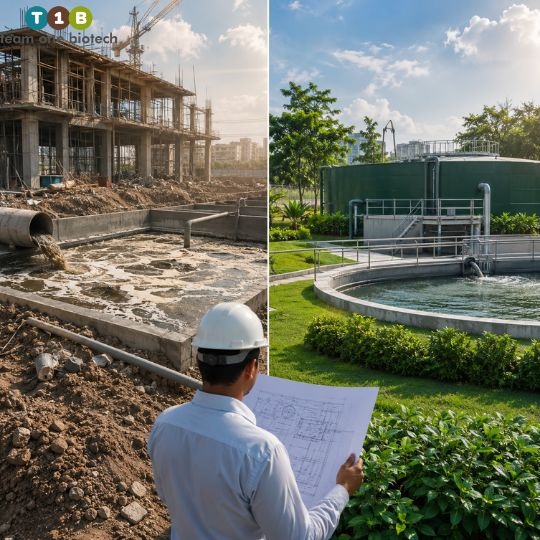
When an STP fails inspection, the instinct of many MEP consultants is to recommend civil modifications, expanding tank volumes, adding filtration stages, replacing aeration systems. In some cases, structural changes are genuinely necessary. But in the majority of new-project OC failures, they are not.
Civil modifications come with a compounding set of problems in this context. They require SPCB approval before work begins. They introduce construction activity into a system that needs to be running. They take months to complete and commission. And they cost multiples of what a biological remediation program would cost, while delivering results on a timeline that makes RERA compliance functionally impossible to maintain.
Biological augmentation, by contrast, is non-invasive. It works within the existing civil structure. It can be initiated within days of a diagnostic assessment. It does not require regulatory clearance to begin. And its costs run at a fraction of what structural modifications demand. For a developer facing an OC bottleneck, the math is not particularly complicated, but only if the right expertise is brought in early.
STP Vendor Selection Criteria for Fast-Track Approvals

One of the most preventable causes of OC delays is the wrong STP maintenance vendor being retained post-construction. Developers often hand over STP operations to a facility management company that lacks the specialized knowledge to manage biological treatment systems under variable loading conditions.
When evaluating vendors in a compliance emergency, or before you reach that point, the criteria must include demonstrated experience with biological treatment systems, not just mechanical or chemical ones. The vendor must be able to provide specific microbial cultures suited to your STP’s design, not generic off-the-shelf products. They should have documented experience supporting regulatory inspections and preparing technical compliance reports for SPCB and NGT-aligned assessments. And critically, they must offer rapid mobilization, a vendor who needs two weeks of lead time is not the right partner when your OC is already stalled.
Experience with multi-storey residential STPs and commercial real estate wastewater systems at scale, under the specific loading dynamics of Indian urban developments, is non-negotiable in this selection.
Protecting Your Brand Equity and Freeing Locked Capital
There is a longer-term consideration beyond the immediate OC crisis that developers in this position should not lose sight of.
Every month a project sits in compliance limbo is a month that word-of-mouth about your brand deteriorates. Buyers talk. Industry contacts notice. Future project financing conversations happen in the context of your track record, and a high-profile RERA complaint or delayed possession on a flagship project follows a developer’s reputation far longer than the crisis itself lasts.
Resolving an STP compliance failure quickly and decisively is not just about unblocking this project. It is about demonstrating to your buyers, your lenders, and your own organization that you have the operational depth to handle complex problems under pressure. That is brand equity. And it is worth protecting with the same urgency you would bring to any other high-stakes project decision.
Act Now: Book Your Emergency STP Compliance Audit
If your Occupancy Certificate is being withheld due to STP non-compliance, the window to act is now, not after the next failed inspection.
Team One Biotech specializes in rapid biological remediation for Sewage Treatment Plants and Effluent Treatment Plants across Indian residential and commercial real estate projects. Our bioenzyme and microbial culture solutions are specifically engineered for the high-variance, shock-load conditions that characterize new project commissioning in Indian urban developments.
We offer an Emergency STP Compliance Audit designed to assess your current system, identify the precise failure points, and deploy a targeted biological remediation protocol, all on a timeline designed to align with your next regulatory inspection window.
Contact Team One Biotech today to schedule your audit. Your buyers are waiting. Your capital is locked. The solution is closer than you think.
Book Your Emergency STP Compliance Audit
Looking to improve your ETP/STP efficiency with the right bioculture?
Talk to our experts at Team One Biotech for customised microbial solutions.
Contact: +91 8855050575
Email: sales@teamonebiotech.com
Visit: www.teamonebiotech.com
Discover More on YouTube – Watch our latest insights & innovations!-
Connect with Us on LinkedIn – Stay updated with expert content & trends!