
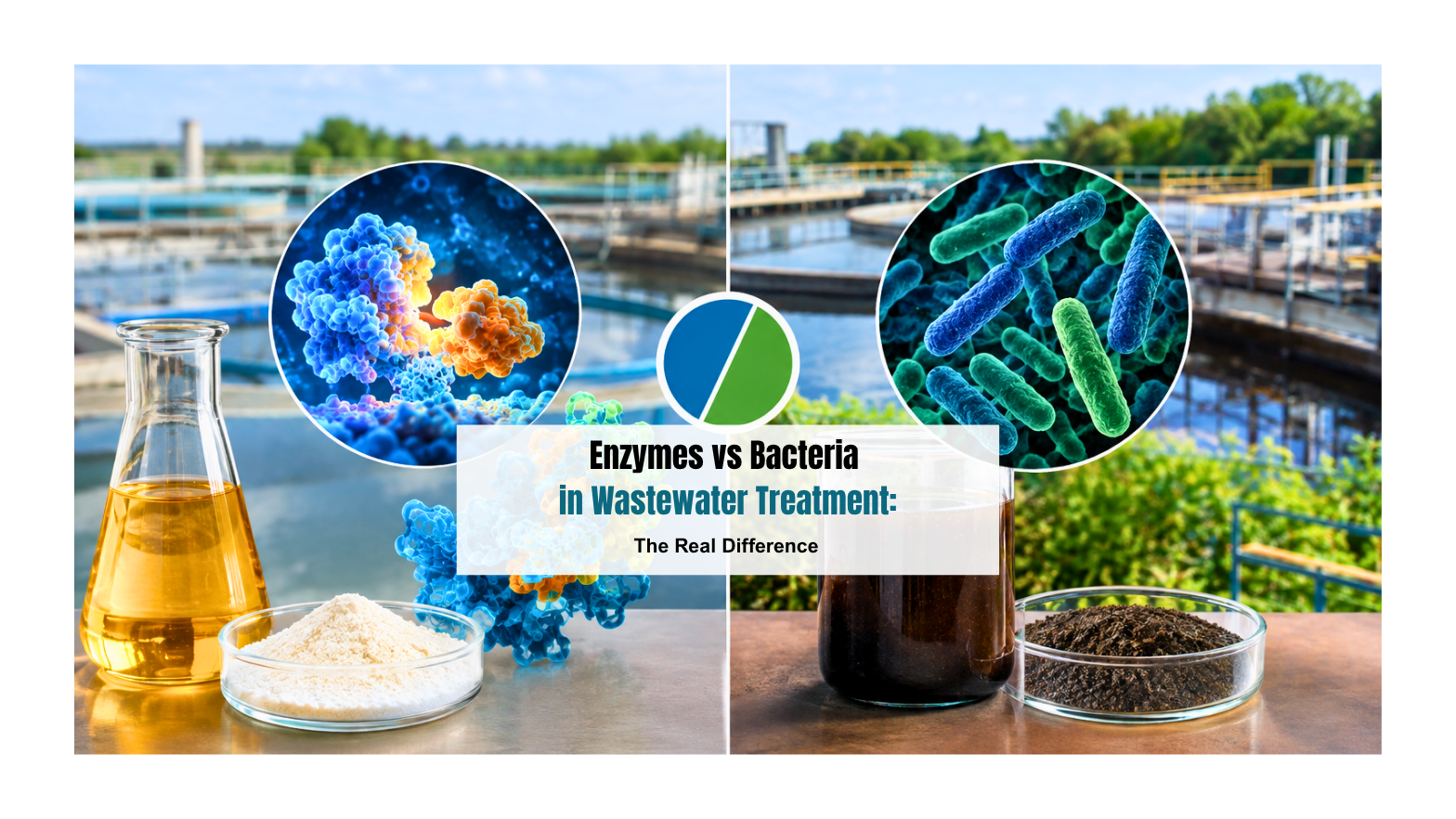
Enzymes vs Bacteria in Wastewater Treatment: The Real Difference
It is two weeks before your CPCB compliance audit. Your BOD readings have spiked. Your COD is running higher than it should. Someone on your team suggests adding an enzyme-based product because they heard it works fast. Someone else insists you need a fresh bacterial dosing cycle. You are standing in front of your aeration tank trying to decide which advice to follow, and the clock is ticking.
This is not a hypothetical. This is Tuesday morning at hundreds of industrial ETPs across India.
The problem is not that plant managers make bad decisions under pressure. The problem is that most people in the industry have never been clearly told what enzymes actually do versus what bacteria actually do inside a treatment system. They are sold as alternatives. They are marketed in similar-looking packaging. But they are fundamentally different tools that serve fundamentally different purposes.
This article will give you a technically honest, operator-level explanation of the enzymes vs bacteria wastewater debate, what each one does, where each one works, where each one fails, and how to combine them when your ETP design calls for it.
What Enzymes Actually Do in Wastewater Treatment
Enzymes Are Catalysts, Not Organisms
Let us start with the most important thing to understand about enzymes: they are not alive.
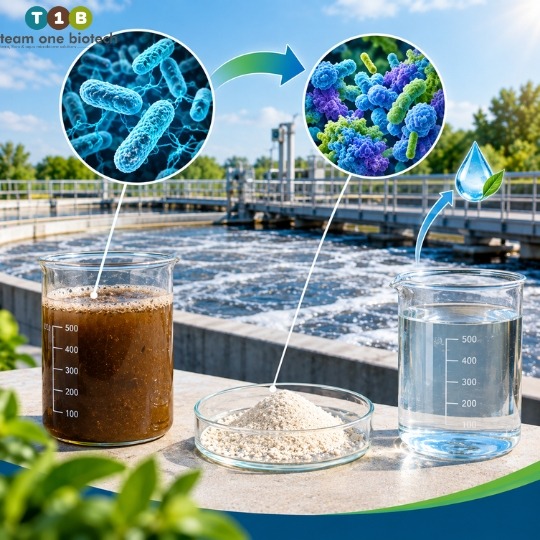
Enzymes are biological molecules, specifically, proteins, that speed up chemical reactions. In a wastewater context, they work by binding to specific organic compounds and breaking them apart into simpler molecules. A lipase enzyme attacks fats. A protease targets proteins. An amylase goes after starches. Each enzyme has a specific job, and it can only do that job.
Here is the critical limitation: enzymes do not reproduce. Once an enzyme has done its work, it either gets consumed in the reaction, washed out of the system, or, and this is the part that catches most operators off guard, it gets denatured.
Denaturation is what happens when an enzyme loses its functional shape due to changes in temperature, pH, or chemical exposure. Think of it like this: if an enzyme is a specialized wrench designed to fit a specific bolt, denaturation means the wrench gets bent. It no longer fits. It no longer works. And unlike a bacterial population, it cannot grow a replacement.
In plant-floor language: if your effluent temperature runs high, if your pH swings outside the operating window, or if a toxic chemical hit enters your inlet, your enzyme dose is gone. You are starting from zero again at the next dosing cycle.
A useful way to think about enzymes is this: they are specialized tools, not workers. They do one job fast, but they wear out, they cannot adapt, and they cannot replace themselves.
Where Enzymes Deliver Real Value
That said, dismissing enzymes entirely would be a mistake. Used correctly and in the right location within your treatment system, they deliver genuine value.
Enzymes excel in pre-treatment applications, grease traps, screen channels, and inlet zones where you need fast breakdown of specific compounds before the effluent reaches your biological treatment stage. In food processing ETPs, dairy effluent systems, slaughterhouse waste treatment, and textile facilities dealing with heavy grease loads, enzymatic pre-treatment can significantly reduce the burden on downstream bacterial systems.
They are also useful for short-term shock load management. If your plant receives an unexpected slug of high-fat or high-protein effluent, a batch discharge from a production line that ran over, for example, targeted enzyme dosing at the inlet can begin breaking down those compounds quickly, buying time for your biological system to absorb the load without crashing.
But the operative phrase in both of these use cases is targeted and temporary. Enzymes solve a specific problem at a specific point. They do not build anything lasting inside your treatment system.
Not sure which enzyme type suits your effluent profile? Talk to Team One Biotech’s technical team for a site-specific recommendation.
What Live Bacteria Do Differently, and Why It Matters for Long-Term Compliance
Bacteria Are Self-Replicating Biological Systems
Now here is where biological wastewater treatment fundamentally changes character.
Live bacteria are not tools. They are workers, and workers who train themselves on your specific waste composition over time.
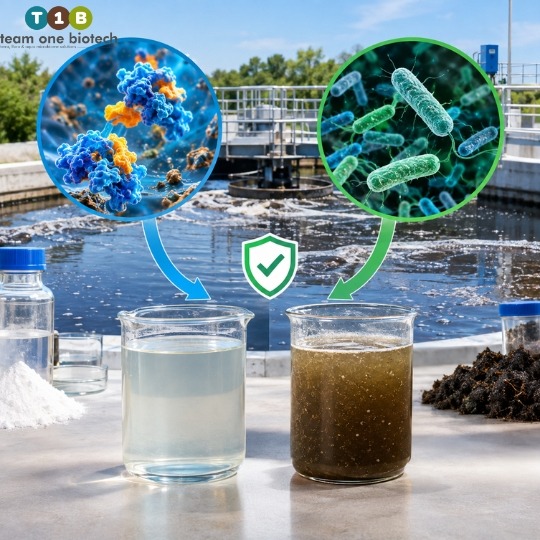
Bacteria consume organic matter in your effluent as a food source. As they consume, they reproduce. As they reproduce, they establish a living biomass, the activated sludge, biofilm, or suspended microbial community that does the sustained treatment work inside your biological tank. This biomass, once established, becomes a biological infrastructure. It does not disappear between dosing cycles. It does not get consumed. It grows, adapts, and, under the right operating conditions, becomes increasingly effective at processing your specific effluent stream.
Here is the distinction that most procurement teams miss entirely: bacteria produce their own enzymes as part of their metabolic process. A thriving bacterial population inside your treatment system is not just consuming organic matter, it is continuously synthesizing and secreting the specific enzymes needed to break down whatever it is feeding on. The bacteria read your effluent, adapt their metabolic toolkit, and produce exactly what is needed.
This is why a well-established bacterial consortium consistently outperforms standalone enzyme dosing in long-term biological wastewater treatment. You are not adding a fixed amount of one type of catalyst and hoping it covers everything. You are building a living, self-sustaining biological system that continuously generates its own catalytic capacity.
The process of acclimatization matters enormously here. When you introduce the right bacterial strains into an ETP and maintain appropriate operating conditions, those bacteria gradually adapt to the specific chemical composition of your effluent. Over weeks, the biomass becomes increasingly efficient at handling your particular mix of organics, pH fluctuations, and industrial contaminants. That adaptive capacity is something no enzyme product can replicate.
Why Bacteria Sustain BOD, COD, and TSS Reduction Under Load Fluctuations
This brings us to the compliance dimension, which, for most ETP operators reading this, is the one that matters most.
CPCB and SPCB discharge norms are not evaluated on your best day. They are evaluated consistently, across inspection windows, across seasonal load variations, and across production cycle fluctuations. Consistent BOD, COD, and TSS reduction is not something you can achieve with a product that resets between applications.
A well-established microbial population handles fluctuating organic loads far better than enzyme dosing alone, precisely because the bacteria can respond dynamically to changing conditions. When your organic load increases, a healthy biomass has the capacity to accelerate its metabolic activity. When load drops, the population adjusts. This is biological buffering, and it is the mechanism behind reliably meeting CPCB and SPCB discharge norms month after month.
Understanding which bacterial types are working in your system also matters for ETP bacteria dosing decisions. Aerobic bacteria, operating in the presence of oxygen, are the primary drivers of BOD reduction in aeration tanks. Facultative bacteria can operate under both aerobic and low-oxygen conditions, giving them versatility in systems with variable aeration. Anaerobic bacteria, operating without oxygen, play a critical role in sludge digestion and the breakdown of more complex organic compounds in specific treatment zones. The right bacterial consortium brings all of these functional groups together in proportions matched to your treatment design and effluent characteristics.
Team One Biotech’s consortium bacterial formulations are designed for Indian industrial effluent conditions. Get in touch to understand what your ETP needs.
Enzymes vs Bacteria Wastewater, A Direct Functional Comparison
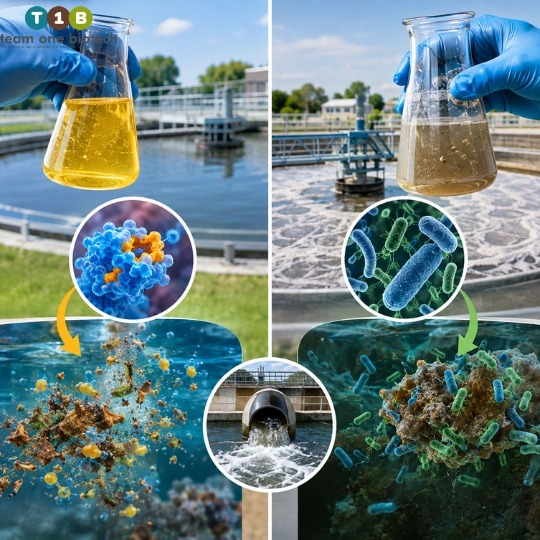
Let us put the two approaches side by side in terms that matter on the plant floor.
Mechanism of action: Enzymes work through catalysis, they accelerate the breakdown of specific compounds without consuming them directly and without being alive. Bacteria work through biological consumption, they eat organic matter, reproduce, and sustain a living treatment system.
Duration of effect: Enzyme activity is short-term and tied directly to each dosing event. Once the dose is consumed, degraded, or washed out, the effect ends. Bacteria, once established, provide sustained treatment that continues and improves over time.
Self-replication: Enzymes do not reproduce. Their concentration in your system only goes up with dosing and only goes down with time, temperature, pH, or chemical exposure. Bacteria reproduce under favorable conditions, meaning your biological capacity can grow and self-sustain.
Adaptability to load changes: Enzymes have fixed specificity. A lipase dose added in response to a fat load does nothing when the next shock load carries primarily protein compounds. Bacteria, particularly diverse consortium formulations, adapt metabolically to shifting influent compositions over time.
Substrate range: Enzyme products target narrow compound classes, this specificity is useful in pre-treatment but limiting in full biological treatment. Bacterial consortia handle a broad range of organic substrates simultaneously, including many complex industrial compounds.
Compliance sustainability: Enzyme-only treatment strategies produce episodic results. They can bring numbers down before an inspection but cannot maintain consistent performance across the full compliance period. A properly seeded and maintained bacterial population provides the consistent, sustained BOD COD TSS reduction that CPCB and SPCB discharge norms require.
Ideal use case: Enzymes belong in pre-treatment, grease traps, shock load response, and targeted compound breakdown at specific process points. Bacteria belong in the core biological treatment stage, and in any situation where long-term, compliant, stable effluent quality is the objective.
Cost structure: Enzyme products often carry higher per-application costs and require repeated purchase cycles because the effect does not compound. Bacterial products, invested in properly at startup and maintained with periodic dosing, deliver progressively better performance at lower per-unit cost as the biomass establishes and strengthens.
Mistake: Using Enzymes as a Long-Term Compliance Strategy
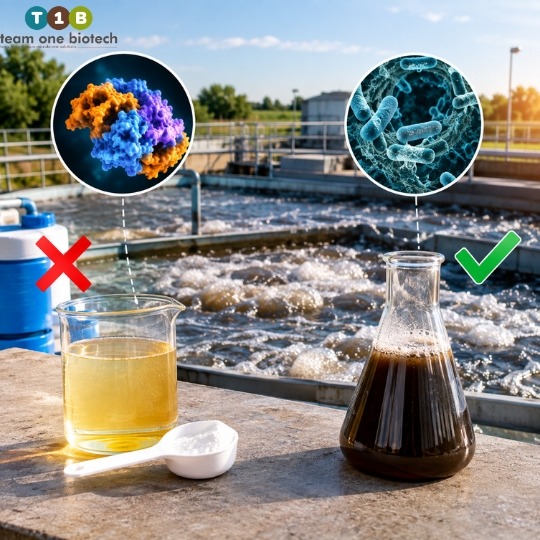
This is worth saying directly because it happens all the time, particularly in the weeks before a regulatory inspection.
A plant is struggling. BOD and COD are elevated. An enzyme-based product gets recommended because the results are visible and fast. Numbers improve. The inspection passes. And then, over the following weeks and months, the numbers creep back up, because nothing was built, nothing adapted, and nothing sustained.
The fundamental risk is this: enzymes provide visible short-term improvement but they do not build the biological resilience your ETP needs for sustained, consistent compliance. They treat the symptom without addressing the underlying biological treatment capacity of your system.
CPCB and SPCB discharge norms exist to ensure that effluent quality is consistently maintained, not just managed during audit windows. A system that performs well for three weeks around an inspection and struggles for the remaining forty-nine weeks of the year is a compliance liability, not a compliant operation.
The decision between an enzyme based cleaner vs bacteria is not always a binary choice, but the roles must be correctly understood and correctly assigned. Enzymes applied to the pre-treatment stage while a strong bacterial consortium manages the biological stage, that is a treatment design, and it works. Enzymes substituting for bacteria in the biological stage because they are faster to show results, that is a risk strategy, and regulators eventually see through it.
The industry-standard approach for compliant, stable ETP performance is a properly designed bacterial consortium, supported by strategic enzyme application where pre-treatment conditions genuinely call for it. Everything else is a workaround.
If your ETP is struggling to maintain stable effluent quality ahead of compliance checks, do not rely on enzyme applications alone. Speak with Team One Biotech’s bioremediation experts to design a treatment protocol built for your load profile.
When to Use Enzymes, When to Use Bacteria, and When to Use Both
This is the practical decision framework that most content on this topic fails to provide clearly. Here it is.
Use Enzymes When:
- You need rapid breakdown at the inlet or pre-treatment stage, before biological treatment begins
- You are managing a one-time shock load from a high-fat, high-protein, or high-starch effluent event
- Your grease trap or screen channel requires targeted, fast-acting intervention
- You need to reduce solids or odor at a specific process point without waiting for biological establishment
Use Bacteria When:
- You need consistent, long-term BOD, COD, and TSS reduction that holds up across production cycles and inspection periods
- Your ETP must reliably meet CPCB and SPCB discharge norms on an ongoing basis, not just during audits
- You are starting up a new biological treatment system or restarting one after a shutdown
- Your existing biomass has crashed, due to a chemical shock, an antibiotic-carrying effluent stream, a toxic load, or system neglect, and needs to be rebuilt from a reliable seed culture
Use Both When:
- Your influent carries complex compounds, heavy fats, recalcitrant proteins, industrial surfactants, that benefit from enzymatic pre-breakdown before the bacterial stage can process them efficiently
- You are managing a multi-stage ETP where distinct pre-treatment and biological treatment zones exist and each can be optimized separately
- You are dealing with a severe organic load that temporarily exceeds your biomass capacity, and enzymatic support at the inlet gives your bacterial system the breathing room it needs to recover
Frequently Asked Questions
Q1: Can enzymes replace bacteria in wastewater treatment?
No. Enzymes catalyze specific reactions but they do not replicate, they do not adapt, and they do not build a stable biological infrastructure inside your treatment system. Bacteria are the core of sustained biological wastewater treatment. Enzymes can support and enhance bacterial activity, particularly in pre-treatment stages, but they cannot substitute for a live, established microbial population in a compliant ETP. Any strategy that uses enzymes in place of bacteria in the biological treatment stage is a short-term workaround, not a treatment solution.
Q2: How long does it take for bacteria to establish in an ETP?
Establishment timelines depend on the bacterial strain, the operating conditions in your system, temperature, influent composition, and the health of any existing biomass. Every ETP is different, and a meaningful answer requires a site-specific assessment. What is consistent across most industrial systems is that proper bacterial seeding followed by a managed acclimatization period produces a significantly more stable and effective biomass than unplanned or reactive dosing.
Q3: Are enzyme based cleaners and bacteria the same product?
No. Enzyme-based cleaners contain isolated biological catalysts, proteins that perform specific chemical breakdown functions. Bacterial products contain live or spore-forming microorganisms that, once introduced into your treatment system, establish themselves, reproduce, and build a self-sustaining biological treatment community. They serve different functional roles at different stages of treatment and are not interchangeable. Using one in place of the other, without understanding this distinction, is one of the most common and costly mistakes in industrial ETP management.
Q4: Do bacteria produce enzymes naturally?
Yes, and this is one of the most important points in the entire enzymes vs bacteria wastewater discussion. Live bacteria synthesize and secrete enzymes as part of their normal metabolic activity. When you build a healthy bacterial consortium inside your treatment system, you are not just adding organisms that consume organic matter. You are building a biological system that continuously produces exactly the enzymes it needs, calibrated to the specific compounds in your effluent. This is why a well-established bacterial population consistently outperforms standalone enzyme dosing over any sustained treatment period.
Q5: How do I know if my ETP needs enzymes, bacteria, or both?
The right approach depends on your effluent characteristics, your treatment stage design, the current health of your biomass, your hydraulic retention time, and your specific CPCB or SPCB compliance targets. There is no universal answer that applies across all industrial ETPs. A technical assessment from a qualified bioremediation specialist, one who understands Indian industrial effluent conditions and regulatory requirements, is the most reliable way to determine the optimal treatment protocol for your specific operation.
Know What You Are Treating Before You Choose What to Add
Enzymes and bacteria are not rivals competing for the same role in your ETP. They are fundamentally different tools with different mechanisms, different timescales, and different outcomes.
Enzymes are fast, specific, and temporary. They belong in the right places, pre-treatment, grease management, shock load response, and they deliver real value there. But they do not build anything, they do not adapt, and they cannot carry the compliance burden of sustained biological wastewater treatment.
Bacteria are slower to establish but they build something real: a living, self-sustaining biological system that improves over time, adapts to your specific effluent composition, and delivers the consistent BOD, COD, and TSS reduction that CPCB and SPCB discharge norms require. ETP bacteria dosing, done correctly with the right consortium formulations and a proper acclimatization plan, is not a quick fix, it is a treatment infrastructure.
Using the wrong tool for the wrong stage of treatment is not just a technical inefficiency. It is a compliance risk. And in a regulatory environment where discharge norms are tightening and inspection frequency is increasing, understanding this distinction is no longer optional for serious ETP and STP operators.
Team One Biotech manufactures bioremediation solutions built for Indian industrial effluent realities. Whether you need a bacterial consortium, enzymatic pre-treatment support, or a combined protocol, our technical team will assess your ETP and recommend what actually works. Contact us today.
Looking to improve your ETP/STP efficiency with the right bioculture?
Talk to our experts at Team One Biotech for customised microbial solutions.
Contact: +91 8855050575
Email: sales@teamonebiotech.com
Visit: www.teamonebiotech.com
Discover More on YouTube – Watch our latest insights & innovations!-
Connect with Us on LinkedIn – Stay updated with expert content & trends!