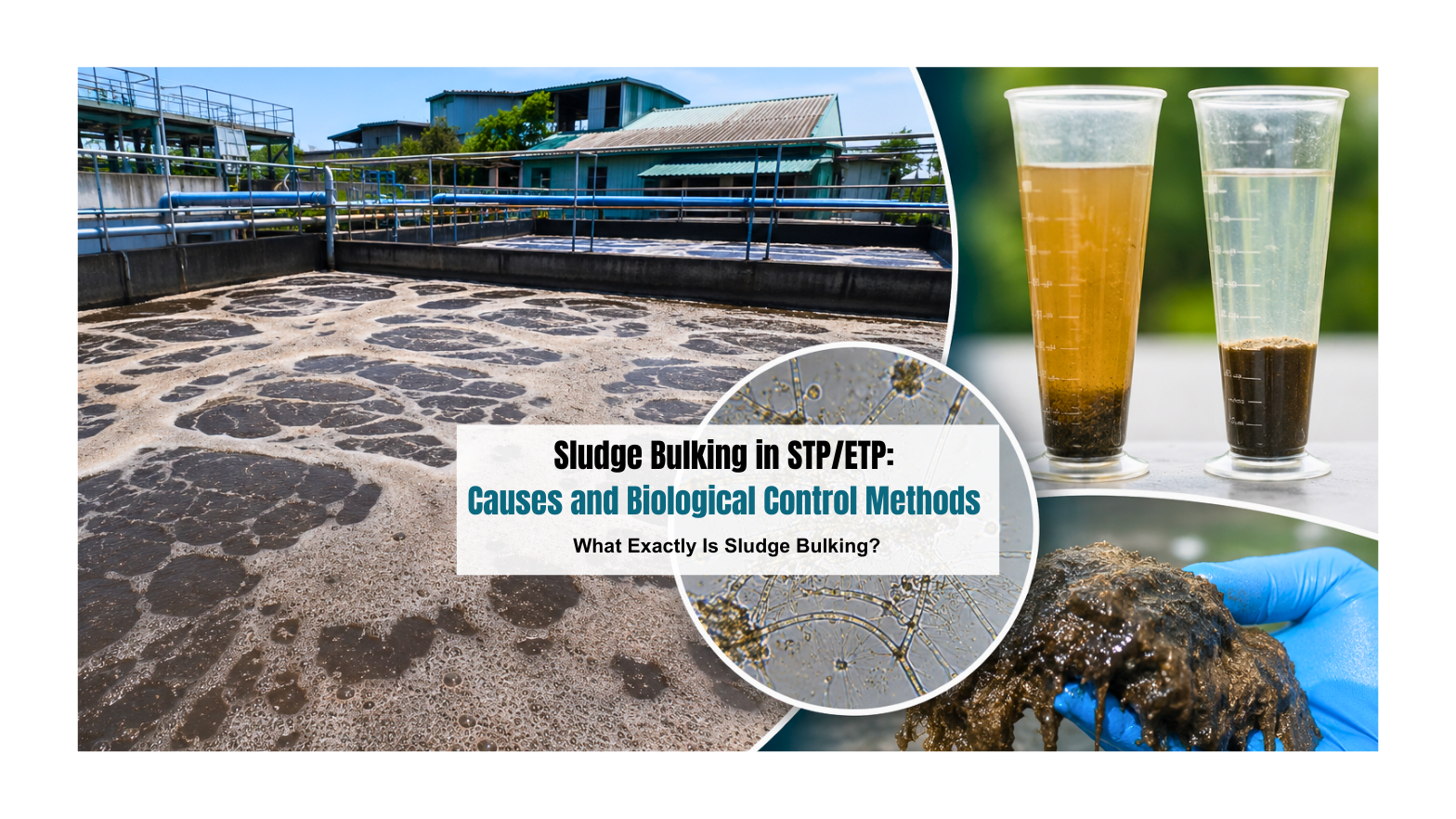
Sludge Bulking in STP/ETP: Causes and Biological Control Methods
Few things frustrate an STP or ETP operator quite like walking up to a secondary clarifier and realizing the sludge has stopped behaving. The aeration system appears to be running, dosing has been done, pumps are operating, and yet the sludge blanket is climbing, foam is gathering at the surface, or cloudy solids are escaping with the final effluent. If an inspection or compliance sampling is approaching, what looked like another process fluctuation suddenly becomes a much bigger problem. Sludge bulking is one of those activated sludge process problems that can turn an apparently stable biological plant into a troubleshooting exercise very quickly.
The important thing to understand is that bulking is usually a symptom rather than the disease itself. Something in the biological environment has shifted enough to change which microorganisms dominate and how the biomass forms flocs. Low oxygen, nutrient deficiency, inappropriate F/M conditions, septic zones, shock loading, temperature changes, or combinations of these stresses can create conditions in which poor-settling biomass gains an advantage. The solution, therefore, is rarely to attack the clarifier alone. You have to trace the problem back through the biology and operating conditions that produced the sludge in the first place.
This guide explains how to control sludge bulking from that practical, biological perspective. We will look at what causes poor settling, how SVI fits into diagnosis, why filamentous microorganisms become dominant, and how bioaugmentation, aeration optimization, nutrient balancing, selector conditions, and MLSS regulation in STP operations can bring the system back toward stable settling.
When Good Sludge Goes Bad: Why Bulking Demands Immediate Attention
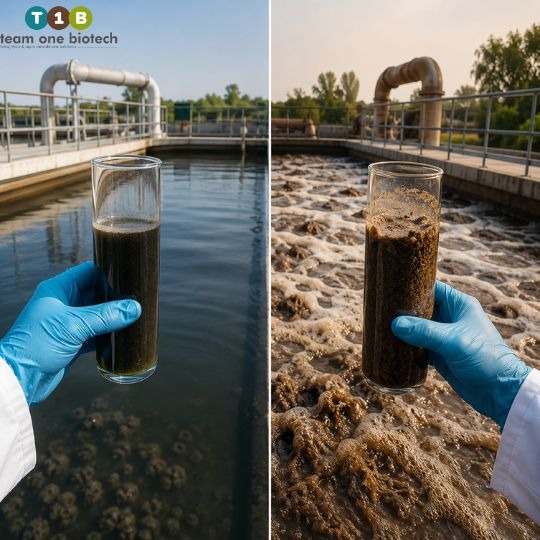
Healthy activated sludge should form flocs with enough density and structure to separate efficiently from treated water in the secondary clarifier. When that structure changes, the clarifier is often where the problem becomes visible even though the cause may have developed hours or days earlier in the aeration basin. Operators may notice a rising sludge blanket, fluffy settling, pin floc, excessive foam, poor compaction, or solids moving toward the outlet. The natural reaction is to focus on the clarifier because that is where the failure can be seen, but the clarifier is often only displaying a biological imbalance created upstream.
That distinction matters because a settling problem can quickly affect the rest of the plant. Solids lost in the treated water reduce the amount of active biomass retained in the biological system. Biomass loss can then weaken organic removal, which puts additional pressure on the remaining microbial population and may accelerate the instability. What began as poor settling can therefore become a feedback loop: weak settling causes biomass washout, biomass washout reduces biological stability, and reduced stability makes settling even harder to recover.
This is why experienced operators look beyond the surface appearance. They examine settling trends, aeration distribution, loading history, return sludge behaviour, wasting practices, nutrient availability, influent characteristics, and microscopic observations where available. The goal is not simply to make the sludge sink today. It is to restore the microbial conditions that allow it to keep settling tomorrow.
What Exactly Is Sludge Bulking?
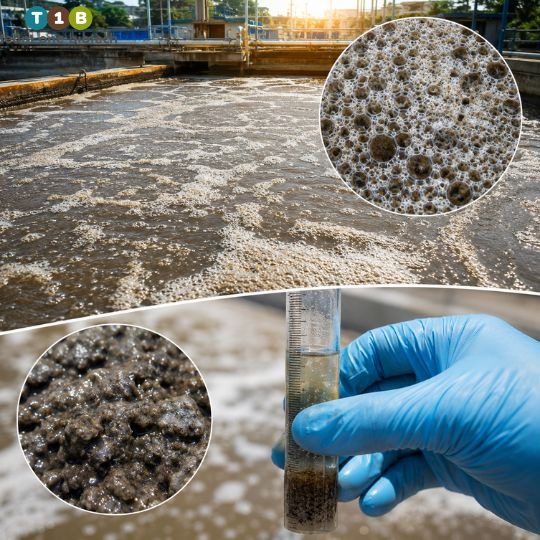
Sludge bulking describes a condition in which activated sludge does not settle and compact properly during secondary clarification. Instead of forming a dense blanket with clear supernatant above it, the biomass occupies excessive volume or remains suspended, making solid-liquid separation difficult. One of the most useful operational indicators is the sludge volume index in wastewater treatment, because SVI connects settled sludge volume with the solids concentration of the mixed liquor. Operators should pay more attention to the direction and persistence of the SVI trend than to a single isolated reading.
A worsening SVI trend should trigger investigation rather than an automatic treatment response. Look at the settleability test itself: Is the sludge fluffy? Does it settle initially but fail to compact? Is the supernatant cloudy? Is there floating sludge later in the test? These observations can help distinguish filament-related settling problems from other conditions such as dispersed growth, denitrification in the clarifier, hydraulic overloading, or weak floc formation.
Important operating disclaimer: SVI, DO, MLSS, nutrient ratios, F/M ratio, and similar process values should be interpreted as plant-specific operating ranges rather than universal targets. Appropriate ranges vary significantly with influent characteristics, process configuration, design capacity, industrial sector, temperature, sludge age, and historical plant performance. Always validate operating decisions against your plant’s baseline data and, where necessary, a wastewater process specialist.
Filamentous Bulking vs. Viscous Bulking
Not every bulky sludge has the same biological structure. Filamentous bulking occurs when filamentous organisms extend beyond the floc structure in excessive numbers, producing an open network that prevents compact settling. Think of a healthy floc as a compact ball and heavily filamentous sludge as a ball covered with long fibres that catch against neighbouring particles. Those fibres can give the biomass structure in moderate populations, but excessive growth produces a loose matrix that occupies too much volume.
Viscous or non-filamentous bulking is different. It is commonly associated with excessive extracellular material and highly hydrated biomass, which creates a gelatinous sludge that also settles and compacts poorly. The visual symptom may look similar from the clarifier walkway, but the corrective action can be different. This is why microscopy, when available, is valuable before making aggressive process changes. Sludge bulking can often be controlled by managing the environmental conditions that allow filamentous bacteria in activated sludge to dominate, but that approach only works well when filament overgrowth is actually the problem.
Root Causes of Sludge Bulking in STP and ETP
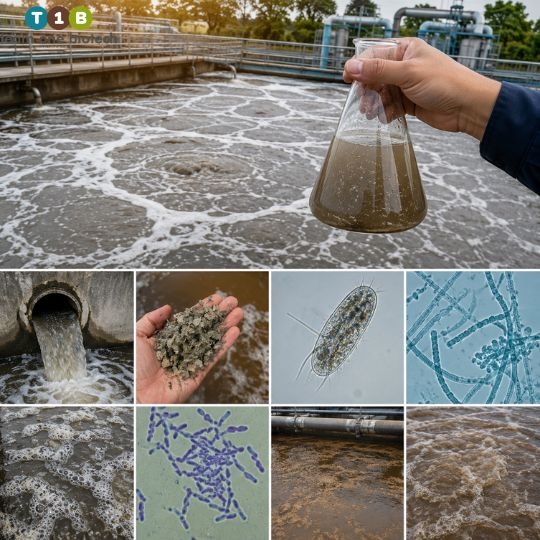
Bulking rarely has a single universal cause. Activated sludge is a living ecosystem, and the microbial community responds continuously to what the plant feeds it and to the environment operators create around it. Change the oxygen profile, nutrient availability, organic loading, temperature, pH, sludge age, or presence of toxic compounds and you change the competitive balance between microorganisms. That is why copying another plant’s corrective action can fail even when both clarifiers appear to have the same problem.
For practical troubleshooting, think in terms of microbial selection pressure. Ask what conditions have recently changed and which organisms those conditions favour. Review influent loading trends, production schedules in industrial plants, blower performance, nutrient dosing, RAS and wasting practices, upstream holding tanks, equalization performance, and any periods of stagnation. The more accurately you identify the selective pressure behind the bulking, the less trial-and-error you need during recovery.
Filamentous Bacteria Overgrowth
Filamentous organisms are not automatically harmful. A controlled filament population can contribute to floc structure, but excessive filament growth prevents biomass from compacting efficiently. Problems develop when plant conditions repeatedly favour filamentous organisms over compact floc-forming populations. Low-oxygen microenvironments, nutrient limitations, septic influent, inappropriate loading conditions, and prolonged biological stress can all contribute depending on the organisms present.
This is why “kill the filaments” is often the wrong first objective. If the underlying environment still favours them, suppressing the existing population without correcting that environment can simply create room for the same problem to return. A more durable strategy changes the competitive conditions inside the biological system. Restore oxygen where it is deficient, correct nutrient limitations, stabilize organic loading, remove septic pockets, manage biomass inventory, and reinforce desirable microbial populations when necessary.
Microscopic identification can make this troubleshooting far more precise. If microscopy confirms excessive filament bridging, combine that information with process data rather than treating the microscope result in isolation. Biology tells you what is dominating; operating history helps tell you why.
Low Dissolved Oxygen and Poor Aeration Distribution
Low dissolved oxygen is one of the first conditions worth investigating when sludge settling begins deteriorating, but a single DO reading can be misleading. An aeration basin is not a perfectly mixed laboratory vessel. One probe may show acceptable oxygen while another part of the tank experiences an oxygen-limited zone because of diffuser fouling, uneven airflow, mixing problems, high localized oxygen demand, or hydraulic short-circuiting. For that reason, DO mapping across the basin provides much better information than repeatedly measuring one convenient location.
Look at the mechanical side as well as the biology. Are blowers delivering what operators expect? Have diffusers become fouled? Are certain sections mixing poorly? Has organic loading increased without a corresponding increase in oxygen-transfer demand? An aeration problem can masquerade as a purely microbial problem because microorganisms simply respond to the environment the equipment creates.
Correcting aeration distribution can therefore be one of the most cost-effective biological control measures available. The objective is not blindly increasing airflow. It is creating an oxygen environment appropriate to the plant’s actual loading and process configuration while avoiding unnecessary energy consumption.
Nutrient Imbalance in Biological Treatment
Microorganisms need more than carbonaceous organic matter. They also require nitrogen, phosphorus, trace elements, and other nutrients to build cells and maintain metabolism. Municipal sewage often supplies many of these nutrients naturally, but industrial effluent can be very different. A wastewater stream may carry substantial COD or BOD while remaining deficient in one or more nutrients needed for stable biological growth.
When that balance is disturbed, floc-forming organisms may become stressed and the microbial community can shift. Simply increasing aeration will not correct a nutritional limitation any more than giving someone more air would fix an empty dinner plate. The sensible approach is to characterize the wastewater, examine nutrient availability in relation to biodegradable organic loading, and supplement only where the data shows a deficiency.
For plants dealing with recurring nutrient limitations, targeted nutrient balancing solutions for wastewater treatment can support a more stable microbial environment. Team One Biotech’s SustainX, for example, is positioned as a nutrient supplement intended to provide biologically available nutrients for wastewater microorganisms. Nutrient addition should still be based on process assessment rather than routine overfeeding.
Low F/M Ratio, Shock Loads, and Changing Influent Conditions
The food-to-microorganism ratio, or F/M ratio, is another useful lens for understanding bulking. If a plant retains a large biomass inventory while readily biodegradable food becomes limited, organisms adapted to low-food conditions may gain a competitive advantage. At the opposite extreme, sudden organic loading can overwhelm oxygen-transfer capacity and create temporary stressed or oxygen-deficient conditions. Both situations illustrate why the biological process needs balance rather than simply “more biomass” or “more aeration.”
Industrial ETPs are particularly vulnerable because production changes can transform the influent almost overnight. A new product campaign, cleaning cycle, batch discharge, temperature increase, pH swing, toxic compound, or hydraulic surge may disturb a microbial population that looked perfectly stable the previous week. Equalization helps, but operators should still correlate biological changes with production and influent records.
When bulking appears suddenly, ask what changed before asking what should be dosed. That simple question often saves days of troubleshooting.
Why Sludge Bulking Becomes a Compliance Risk
Poor settling is not merely an untidy clarifier. When biological solids escape with treated water, final effluent TSS can increase, and the organic matter associated with those solids can also contribute to poorer BOD performance. That creates a direct link between sludge settleability and discharge compliance. India’s CPCB publishes general standards for discharge of environmental pollutants, while applicable requirements can also depend on discharge route, plant category, consent conditions, and state-level requirements. Plant managers should therefore verify the standards and consent conditions that specifically apply to their facility rather than relying on a generic target.
The risk becomes more serious if solids washout begins reducing biomass inventory in the biological reactor. Now the plant is facing two problems at once: deteriorating clarification and reduced biological treatment capacity. If the condition continues, operators can find themselves chasing TSS, BOD, COD, ammonia, or other performance indicators while the biological system becomes progressively less resilient.
This is why CPCB/SPCB compliance should be part of bulking diagnosis from the beginning. Don’t wait for the laboratory report to confirm that poor settling has become a compliance problem. If the sludge blanket is rising and solids are visibly carrying over, treat it as an early warning that deserves immediate process investigation.
How to Control Sludge Bulking Biologically
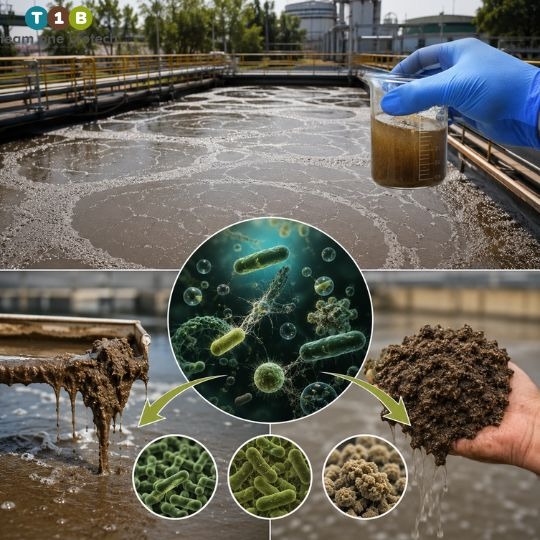
There is no universal bottle, blower setting, or wasting rate that fixes every bulking event. Effective biological control is usually a sequence: identify the dominant failure mechanism, remove the condition favouring poor-settling organisms, strengthen desirable biomass, and then monitor the settling response. This is slower than reaching for a random corrective dose, but it is much more likely to produce stable recovery.
Start with evidence. Review SVI and settling trends, map DO, inspect aeration, examine recent loading changes, check nutrient sufficiency, assess RAS and wasting behaviour, and use microscopy if available. Once you understand the likely cause, choose the smallest set of changes capable of correcting it. Multiple simultaneous changes may make recovery harder to interpret because you will not know which intervention actually worked.
Bioaugmentation with Selected Microbial Cultures
Bioaugmentation introduces selected microbial cultures into a biological treatment system to reinforce degradation capability and microbial stability. In a bulking situation, the objective is not merely to pour bacteria into the aeration basin. A well-designed program aims to strengthen desirable biological activity while operating conditions are simultaneously adjusted so those organisms can establish themselves and compete effectively.
Team One Biotech’s T1B Aerobio is positioned for aerobic wastewater treatment and includes microbial cultures intended to support floc formation, biological degradation, shock-load resistance, and control of excessive foaming and sludge bulking. Team One Biotech also reports industrial case studies in which customized bioaugmentation programs were paired with process analysis and dosing schedules rather than used as isolated additions. That process-first approach is important because even a well-selected microbial consortium cannot permanently compensate for severe oxygen limitation, uncontrolled toxic shocks, or persistent nutrient starvation.
If your plant has confirmed filament overgrowth or repeatedly loses settling stability after shock loads, talk to Team One Biotech about its bioaugmentation solutions for activated sludge systems. A plant-specific dosing plan should be based on wastewater characteristics, process configuration, biomass condition, and the actual bulking pattern rather than a generic dose copied from another facility.
DO and Aeration Optimization
Before making complicated changes, verify that oxygen is reaching the biology where it is needed. Walk the basin and measure DO at multiple representative locations and operating periods. Compare those observations with airflow, loading, mixing, and diffuser condition. A plant can have adequate blower capacity on paper while still creating localized low-oxygen zones in practice.
Correcting those zones may require diffuser cleaning, airflow redistribution, blower scheduling changes, mixing improvements, or addressing an unexpected increase in oxygen demand. The exact response depends on plant design, which is why a universal DO number is less useful than a stable plant-specific operating range supported by performance trends.
After making changes, monitor settleability and biological performance rather than expecting an instant visual transformation. Microbial populations need time to respond to their new environment. The goal is sustained ecological selection, not a one-hour cosmetic improvement in the clarifier.
Nutrient Balancing and Biostimulation
If testing shows that the wastewater is nutrient deficient, controlled supplementation can help restore microbial growth and floc quality. This is especially relevant in ETPs receiving carbon-rich but nitrogen- or phosphorus-poor industrial streams. The correct nutrient requirement should be determined from actual biodegradable loading and plant behaviour, not from a fixed recipe applied regardless of influent composition.
Overdosing nutrients is not a harmless insurance policy. Excess nutrients can create additional effluent-management problems and increase operating cost without correcting the real cause of bulking. Supplementation works best when it addresses a demonstrated limitation and is monitored through biological response, effluent quality, and sludge behaviour.
For plants where nutrient deficiency is suspected, Team One Biotech’s nutrient balancing solutions for wastewater treatment provide one route for targeted supplementation. The decision should still begin with wastewater characterization and process diagnosis.
F/M Correction and Selector Tanks
Managing F/M conditions means managing the relationship between biodegradable food and active biomass. Operators influence that relationship through sludge wasting, RAS management, biomass inventory, equalization, loading distribution, and other process controls. If too much old biomass is being retained relative to available food, controlled wasting may help shift the system. If shock loading is the problem, equalization and feed management may be more important.
Selector zones can also be useful in plants designed or configured to use them. A selector creates controlled conditions in which desirable floc-forming organisms rapidly take up available substrate before the mixed liquor moves through the rest of the biological process. In simple terms, you are changing who gets first access to the buffet. When properly designed and operated, that competitive advantage can help suppress certain filamentous populations.
Selector performance depends heavily on plant configuration and the organisms involved, so it should not be treated as a universal retrofit. Use process engineering and microbial evidence before changing basin configuration or operating strategy.
MLSS Regulation in STP and ETP
MLSS regulation in STP operation is not about chasing a fashionable target. MLSS represents biomass inventory, and the appropriate operating range depends on the treatment process, influent loading, sludge age, oxygen-transfer capability, clarifier capacity, and desired treatment objectives. Too much biomass can contribute to low-F/M conditions and clarification pressure, while excessive wasting can leave the system without enough active organisms to handle incoming load.
Operators should therefore manage MLSS alongside SVI, sludge age, RAS, wasting rates, effluent quality, and loading trends. These measurements form a feedback loop. If settling deteriorates while MLSS rises and F/M shifts downward, that combination tells a different story from a plant experiencing sudden solids loss after a hydraulic shock.
If your SVI and MLSS trends are moving in the wrong direction before an audit or compliance sampling cycle, request a plant-specific process assessment rather than making several aggressive changes at once. Team One Biotech can support wastewater diagnosis, bioaugmentation planning, and process optimization based on the plant’s actual operating conditions.
A Practical Field Checklist for Operators
When sludge starts bulking, resist the temptation to change everything simultaneously. Work through the plant logically and document what you find. A useful field sequence is:
- Check DO at several representative locations rather than relying on one aeration-basin reading.
- Review recent hydraulic and organic loading for shock loads, production changes, cleaning discharges, or flow surges.
- Examine nutrient availability where industrial wastewater may be nutrient deficient.
- Inspect channels, equalization tanks, aeration zones, and sludge lines for septic or poorly mixed pockets.
- Review RAS and wasting practices together with the current MLSS trend.
- Track sludge volume index wastewater trends and settling observations over time rather than reacting to one test.
- Use microscopy, where available, to confirm whether filamentous organisms are actually dominating.
- Consider targeted bioaugmentation after correcting the environmental conditions that created the biological imbalance.
Record each intervention and its timing. Biological systems rarely respond like switches; they behave more like ecosystems recovering after a disturbance. Good records let you connect operational changes with settling improvement and build a plant-specific troubleshooting playbook for the next upset.
Treat the Cause, Not Just the Clarifier
Sludge bulking becomes manageable when you stop seeing it purely as a settling failure and start treating it as a biological signal. Filament overgrowth, oxygen limitation, nutrient deficiency, inappropriate F/M conditions, shock loads, septic zones, and unstable biomass management all change the microbial competition taking place inside an activated sludge system. The secondary clarifier simply reveals the result.
The most reliable answer to how to control sludge bulking is therefore a coordinated biological strategy: diagnose the organism and environmental cause, optimize aeration, restore nutrient balance, correct loading and biomass conditions, use selectors where appropriate, maintain disciplined MLSS regulation in STP, and reinforce beneficial populations through targeted bioaugmentation when justified. Keep SVI and settling behaviour in the feedback loop so you can see whether the biology is genuinely recovering.
If recurring bulking is threatening TSS/BOD performance or making compliance unpredictable, Team One Biotech can help evaluate the biological process and develop a customized bioaugmentation and optimization plan. Visit Team One Biotech to discuss wastewater process assessment, microbial treatment options, and dosing support suited to your STP or ETP.
Operating disclaimer: All references in this article to SVI, DO, MLSS, nutrient ratios, F/M ratio, and related operating conditions are general guidance for typical activated sludge systems. Actual operating ranges vary significantly according to influent characteristics, design capacity, process configuration, industrial sector, temperature, loading pattern, and site-specific conditions. Validate operational changes against your plant’s historical baseline, applicable CPCB/SPCB requirements, consent conditions, and qualified process guidance.
FAQs
1: Can sludge bulking be controlled without chemicals?
Yes, many bulking problems can be addressed primarily through biological and operational control when the root cause is correctly identified. Aeration optimization, nutrient balancing, loading stabilization, selector operation, MLSS management, RAS and wasting adjustments, and targeted bioaugmentation can all alter the microbial conditions that favour poor-settling organisms. The key is diagnosis: a treatment that works for oxygen-related filament growth may not solve viscous bulking or clarifier denitrification. Chemical intervention should not substitute for understanding the biological cause.
2: Does a high sludge volume index always mean filamentous bulking?
No. A deteriorating sludge volume index wastewater trend tells you that settling or compaction is becoming poorer, but it does not identify the organism or mechanism responsible. Filamentous growth is an important cause, yet viscous bulking, weak floc formation, dispersed growth, hydraulic problems, or other process disturbances can also affect settling behaviour. Use SVI alongside settleability observations, MLSS, operating history, effluent appearance, and microscopy where possible. Think of SVI as an alarm bell, not a complete diagnosis.
3: How quickly can sludge bulking be corrected?
Recovery time varies because activated sludge is biological. A minor problem caused by a recent operating change may respond relatively quickly once that condition is corrected, while an established filamentous population may require a longer period of stable selective pressure before the floc structure improves. Plant configuration, wastewater characteristics, temperature, sludge age, shock loading, nutrient status, and the severity of biomass loss all influence recovery. Rather than promising a fixed timeline, monitor SVI trend, blanket behaviour, effluent solids, microscopic appearance, and overall biological performance.
4: Can bioaugmentation help control filamentous bacteria?
It can be useful when it is part of a properly diagnosed process strategy. Selected cultures can strengthen desirable microbial activity and help rebuild stable biological performance, but bioaugmentation works best when operators simultaneously correct the conditions that allowed unwanted organisms to dominate. Team One Biotech describes its aerobic bioculture solutions as supporting floc formation, organic degradation, shock-load resilience, and control of excessive filament growth and sludge bulking. Treat bioaugmentation as a tool for ecological recovery, not a substitute for adequate oxygen, nutrients, loading control, and biomass management.
5: What should operators monitor after sludge bulking is controlled?
Keep watching the same variables that helped diagnose the upset. Track SVI and settling characteristics, MLSS and biomass trends, RAS and wasting behaviour, DO distribution, influent loading, nutrient conditions, sludge blanket behaviour, and final effluent performance. Where recurring filament problems have occurred, periodic microscopy can provide an early warning before the clarifier visibly deteriorates. Most importantly, establish your own plant’s stable baseline so operators can recognize a slow drift before it becomes a compliance-threatening event.
Looking to improve your ETP/STP efficiency with the right bioculture?
Talk to our experts at Team One Biotech for customised microbial solutions.
Contact: +91 8855050575
Email: sales@teamonebiotech.com
Visit: www.teamonebiotech.com
Discover More on YouTube – Watch our latest insights & innovations!-
Connect with Us on LinkedIn – Stay updated with expert content & trends!