


SPCB Show-Cause Notice for Your STP? A 30-Day Response Framework
You know the feeling. The email lands, or the courier hands over the envelope, and your stomach drops. A show-cause notice. Your mind jumps straight to the worst outcomes: power or water disconnection, action on your bank guarantee, a direction of closure, and a very uncomfortable conversation with residents, tenants, or management.
Take a breath. A notice is serious, but it isn’t the end of the road. A show-cause notice is a formal request from your State Pollution Control Board (SPCB) asking you to explain, in writing, why action shouldn’t be taken for non-compliance. It sits within the powers the board holds under Section 33A of the Water (Prevention and Control of Pollution) Act, 1974. In general terms, that includes issuing directions, including closure and the stoppage or regulation of electricity or water supply.
This guide gives you a clear, week-by-week plan to fix what’s failing and build a strong SPCB show cause notice reply. It’s a general compliance framework, so please involve your legal or compliance team from day one.
The 30-Day Roadmap at a Glance

| Week | Goal | Key Output |
| Week 1 (Days 1 to 7) | Stabilize and investigate | Notice analysis, root-cause findings, stabilized operations |
| Week 2 (Days 8 to 14) | Restore biological performance | Bioaugmentation plan, daily monitoring records |
| Week 3 (Days 15 to 21) | Verify with data | NABL-accredited lab reports, organized documentation |
| Week 4 (Days 22 to 30) | Draft and file | Evidence-backed reply, proof of submission |
These are general values. Actual figures differ for every STP and ETP based on design, load, and site conditions.
What an SPCB Show-Cause Notice for an STP Really Means

A notice rarely comes out of nowhere. Usually, something triggered it: a routine inspection, a sampling visit, a complaint from neighbors, or lab results that showed your treated effluent didn’t meet the prescribed standards. This is what we call STP effluent non-compliance.
The parameters most often flagged are BOD (biochemical oxygen demand, the amount of oxygen microbes need to break down organic matter), COD (chemical oxygen demand, a broader measure of pollutants), TSS (total suspended solids), and FOG (fats, oils, and grease). Sometimes pH, ammoniacal nitrogen, and coliform counts appear too. Your treated water is measured against CPCB discharge norms and any specific limits your SPCB has set for your site.
Is a pollution board notice ETP different from an STP notice?
Not in the way that matters. Whether it’s a pollution board notice ETP (effluent treatment plant, usually industrial) or one for an STP (sewage treatment plant, usually residential or commercial), the logic is the same. The board has found a gap between what your plant discharges and what it’s supposed to discharge, and it wants a written explanation and a fix.
Show-cause notice vs. direction of closure
Think of it as an escalation path. A show-cause notice is the board asking you to explain. If the explanation or the corrective action isn’t convincing, the next step can be a formal direction, which may include closure and stoppage or regulation of power or water supply. A direction of closure for an STP is the stage you want to avoid, and this is exactly why your first response matters.
Possible consequences, if things escalate:
- Environmental compensation or penalties
- Action on the bank guarantee
- Stoppage or regulation of electricity or water supply
- A direction of closure
- Reputational damage with residents, tenants, customers, and regulators
Received a notice today? Speak to a Team One Biotech compliance expert before your timeline runs out.
Week 1 (Days 1 to 7): Stabilize and Investigate

The first week is about two things: understanding exactly what the board is saying, and finding out why your plant failed. Don’t skip straight to fixes. A fix without a diagnosis is just a guess.
Read the notice line by line
Sit down with the document and highlight everything. Note the reply deadline, the parameters cited, the sampling dates, the sampling location, and exactly what the board is asking you to submit. Missing a small detail here can cost you later.
Assemble your response team
You need the right people in the room early:
- Your plant operator, who knows the daily reality
- The EHS head or facility director
- Your legal or compliance team
- An external microbial or process expert who can look at the plant with fresh eyes
Run a root-cause audit
This is the heart of the first week. A proper root cause analysis for your STP looks at what changed before the failure. Ask these questions:
- Did the inflow load or flow pattern change, perhaps from new occupancy, a new kitchen, or a seasonal shift?
- Did aeration fail or weaken? Check blowers, diffusers, and dissolved oxygen levels.
- Is sludge age off, or has sludge built up or been wasted too aggressively?
- Is there short-circuiting in tanks, so that water isn’t getting its full treatment time?
- Were there chemical dosing errors?
- Is FOG overloading the system from kitchens, canteens, or food outlets?
Don’t forget equipment health. Pumps, blowers, diffusers, and clarifier mechanisms all need an honest inspection.
Start immediate stabilization
You don’t need to wait for the full audit to stop the bleeding. Keep the steps general and safe:
- Balance the inflow load with an equalization tank where available
- Correct aeration so the biology gets the oxygen it needs
- Manage sludge by removing excess and avoiding carryover
- Control FOG at the source with grease traps and cleaning schedules
- Fix obvious mechanical faults right away
Document everything you do and when you do it. This record becomes part of your reply later.
Week 2 (Days 8 to 14): Biological Recovery with Fast-Track Bioaugmentation
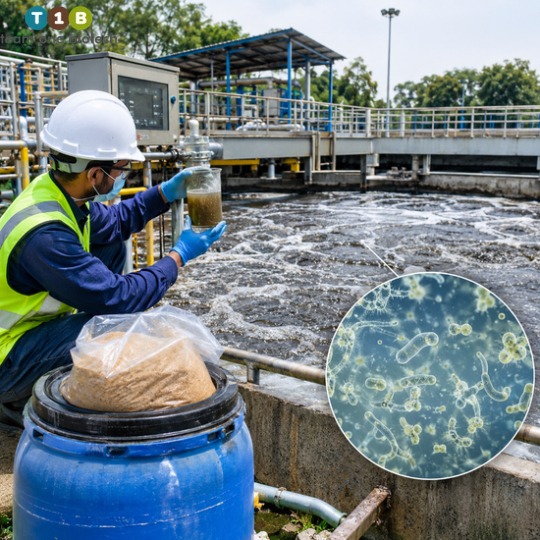
Here’s the plain truth about most STP failures. The machinery is usually fine. The microbes are struggling.
Your plant depends on a living microbial population to break down pollutants. When that population is shocked by a toxic load, starved of oxygen, or simply outnumbered, treatment performance collapses. BOD, COD, TSS, and FOG numbers drift out of limits, and a notice follows.
What bioaugmentation actually does
Bioaugmentation for STP means introducing selected, high-performing microbial cultures into the treatment system to strengthen or rebuild the working population. Microbial re-seeding is closely related. It restores the biology after a shock event, a shutdown, or a major washout. Done properly, these approaches help the system recover its ability to degrade organic load, reduce suspended solids, and break down grease.
How a structured program works
A credible program isn’t a bucket of powder tossed into a tank. It typically follows a clear sequence:
- Baseline testing. Measure current performance and understand the inflow characteristics.
- Tailored strain selection. Choose microbial cultures that suit your wastewater, whether it’s high in grease, high in organic load, or nitrogen-heavy.
- Dosing schedule. Apply cultures at planned intervals, usually over a period of a few days to a couple of weeks depending on conditions.
- Monitoring. Track parameters regularly and adjust the program based on what the data shows.
Many plants begin to see measurable improvement within a window of a few days to a few weeks, but this varies widely.
These are general values. Actual figures differ for every STP and ETP based on design, load, and site conditions.
At Team One Biotech, this is what we do every day as a provider of bioremediation solutions in India. We work with plant teams to design a recovery plan around their specific wastewater, not a generic one. You can explore our bioaugmentation for STP range and our wider effluent treatment solutions for both STP and ETP effluent treatment.
Need a fast-track bioaugmentation plan for your STP? Request a free effluent assessment, Contact a free assessment from Team One Biotech.
What to monitor daily
- Dissolved oxygen in the aeration tank
- pH of the incoming and treated water
- Visual checks: color, odor, foam, and sludge settling
- Sludge volume and settling behavior
- Treated water clarity at the outlet
- Equipment running hours and any faults
For deeper guidance on the numbers themselves, see our related blog on how to reduce BOD and COD in your STP.
Week 3 (Days 15 to 21): Verify with Data and Document Everything
By now your plant should be responding. But the board won’t take your word for it, and honestly, you shouldn’t take your own either. This week is about proof.
Collect samples at defined points, typically the inlet, the aeration tank, and the final outlet. Send them to a NABL-accredited laboratory. NABL stands for the National Accreditation Board for Testing and Calibration Laboratories, and accreditation tells the reader that the lab follows recognized testing standards.
Why does this matter so much? Because in-house readings, however careful, are easy to question. A third-party certified report carries independent weight. It tells the board you’ve measured honestly and that you’re serious about compliance.
Compare your results against the limits that apply to you, meaning the CPCB norms and the specific limits stated in your SPCB notice or consent conditions. Always treat your SPCB’s stated limits as the final reference.
Keep these documents ready:
- NABL lab reports with sampling dates and locations
- Operator logbooks and daily operating data
- Dosing records for any bioaugmentation or chemicals
- Calibration records for meters and instruments
- Dated photographs of equipment, repairs, and the plant
- Maintenance records and work orders
- Any correspondence with the board
If your results show improvement but sit close to the limit, don’t panic. Plants often need a few more days to a couple of weeks to settle into steady performance after biological recovery.
These are general values. Actual figures differ for every STP and ETP based on design, load, and site conditions.
Want a second pair of eyes on your reply and lab data? Share your notice and parameters with our team. We’ll tell you honestly where you stand.
Week 4 (Days 22 to 30): Draft and File a Strong SPCB Show Cause Notice Reply
This is where all your work turns into a document the board will actually read. A strong SPCB show cause notice reply doesn’t need to be long. It needs to be clear, honest, and backed by evidence.
What a credible show cause reply contains
- Acknowledgment. Confirm receipt of the notice and its reference details.
- Root cause. State plainly what went wrong, based on your audit.
- Corrective actions taken. List what you did, with dates.
- Verifiable lab evidence. Attach your NABL-accredited reports.
- An engineering compliance timeline. Share a realistic schedule for any remaining work. This is your STP compliance action plan.
- A preventive maintenance plan. Show how you’ll keep the plant stable going forward.
Tone matters
Keep it factual, respectful, and evidence-led. Don’t make excuses. Don’t blame the board, the contractor, or the residents. Boards respond far better to accountability than to defensiveness. Own the problem, show the fix, and demonstrate the plan.
Submit properly
File within the deadline stated in the notice. Keep proof of submission, whether that’s a stamped copy, a courier receipt, or an email acknowledgment. If your situation calls for it, consider requesting a re-inspection or a hearing so the board can see the improvements for itself. Your legal or compliance team should guide this step.
Before you hit send
- Does the reply address every point raised in the notice?
- Are all lab reports attached, legible, and dated?
- Do the numbers in your text match the lab reports exactly?
- Is the timeline realistic and not overpromised?
- Has your legal or compliance team reviewed it?
- Have you kept a complete copy and proof of submission?
Common Mistakes That Weaken Your Show Cause Reply
After seeing plants go through this process, certain patterns show up again and again. Avoid these:
- Waiting too long to act. Every day spent hoping the problem goes away is a day lost from your response window.
- Relying on in-house readings only. Without independent lab proof, your claims are easy to dismiss.
- Ignoring root causes. If you treat only the symptom, the failure will come back.
- Submitting without lab evidence. A reply with no data is just a promise.
- Overpromising timelines. A deadline you can’t meet damages your credibility more than a realistic, longer one.
- Treating a quick fix as a permanent fix. A short-term improvement isn’t the same as sustained compliance. Plan for the long run.
Frequently Asked Questions
How long do I have to reply to an SPCB show-cause notice?
The deadline is stated in the notice itself, and it varies from one board and one case to another. Many notices allow somewhere from a few days to a few weeks. Always follow the exact timeline in your notice. If you need more time, speak to your legal team about requesting an extension in writing before the deadline passes.
Can bioaugmentation help bring my STP within limits quickly?
It can help, especially when the root cause is a weakened or shocked microbial population. Many plants see early improvement within a few days to a few weeks. However, results depend on your design, load, and site conditions, and bioaugmentation works best alongside proper mechanical and operational fixes. It supports compliance but doesn’t guarantee a specific outcome.
Do I need a NABL-accredited lab report for my reply?
It’s strongly advisable. Independent, accredited lab results make your reply far more credible than in-house readings. Check your notice and consent conditions for any specific laboratory requirements, and follow what your SPCB asks.
What happens if my STP still fails after the reply?
The board may review your reply, order a re-inspection, ask for further action, or escalate to formal directions under its powers, which in general terms can include closure or stoppage or regulation of utilities. This is why genuine corrective action and clear lab evidence matter. Involve your legal or compliance team and keep the board informed of your progress.
Do Not Let a Notice Become a Closure
Here’s the 30-day framework in a nutshell. Stabilize and investigate in week one. Rebuild your plant’s biology in week two. Prove it with accredited data in week three. File a clear, honest, evidence-backed SPCB show cause notice reply in week four.
A notice feels like a verdict, but it’s really a deadline with a path through it. Plants that act early, document well, and respond with humility give themselves the strongest possible case. You don’t have to figure it out alone.
Your 30-day clock is already ticking. Contact Team One Biotech now and move from notice to compliance with a clear plan.
Disclaimer: The values, ranges, and timelines shared in this article are general indicators only. They differ for every STP and ETP depending on inflow characteristics, treatment technology, capacity, and the specific conditions in your notice. Always follow the limits and directions stated by your SPCB and consult a qualified professional before acting.
Looking to improve your ETP/STP efficiency with the right bioculture?
Talk to our experts at Team One Biotech for customised microbial solutions.
Contact: +91 8855050575
Email: sales@teamonebiotech.com
Visit: www.teamonebiotech.com
Discover More on YouTube – Watch our latest insights & innovations!-
Connect with Us on LinkedIn – Stay updated with expert content & trends!