
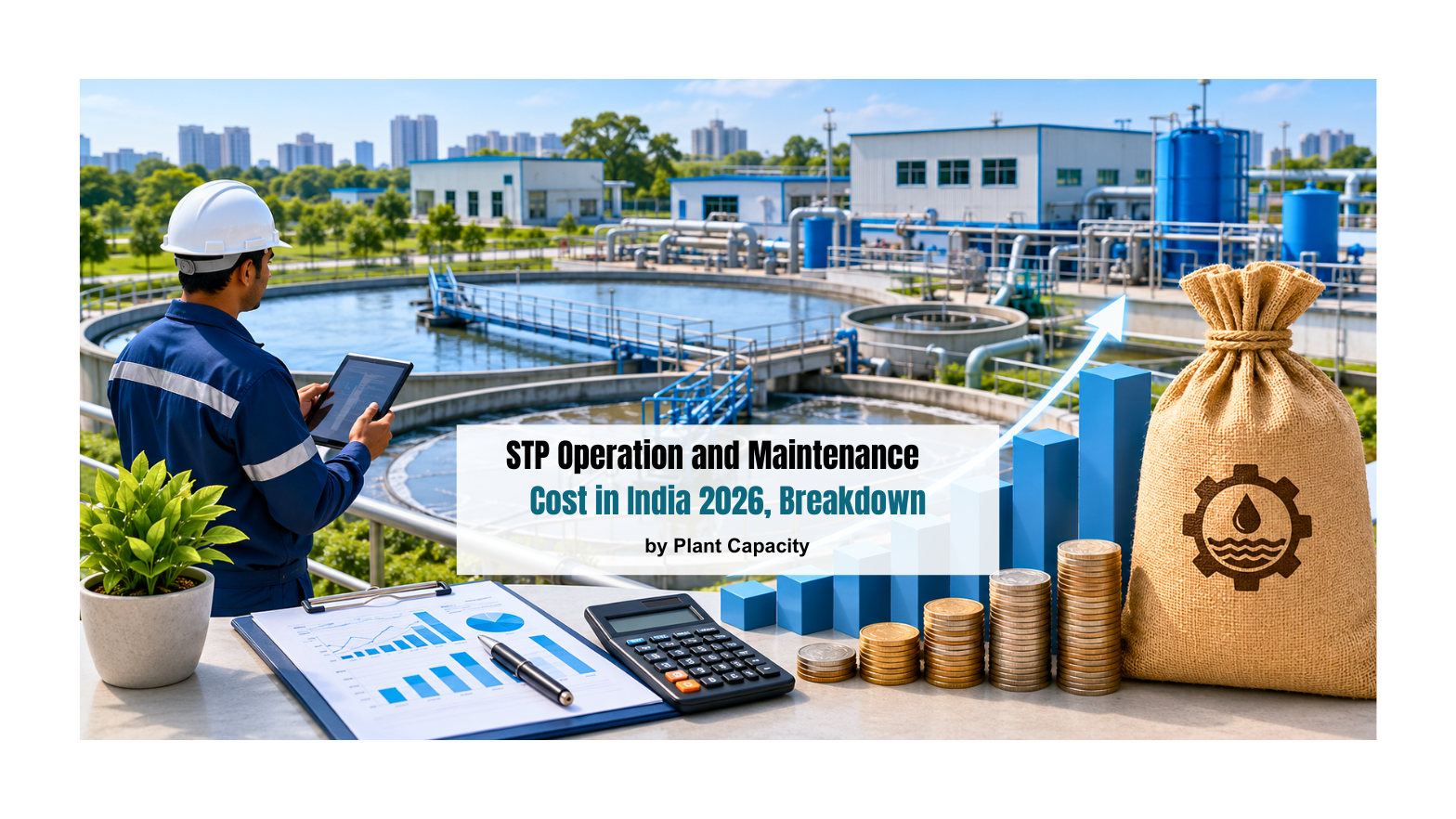

STP Operation and Maintenance Cost in India 2026, Breakdown by Plant Capacity
It usually arrives at the worst possible time. A show-cause notice from the State Pollution Control Board, citing non-compliance with treated effluent parameters. Or worse, an AMC vendor standing at your gate with an “emergency repair” invoice that wasn’t in any quote you signed. For society management committees, factory owners, and procurement heads across India, the sewage treatment plant sitting in the basement or utility yard isn’t just mechanical equipment, it’s the single asset standing between your facility and its legal right to operate.
Your Consent to Operate (CTO), issued under the Water (Prevention and Control of Pollution) Act, is not a one-time formality. It is a continuing obligation, and the STP is how you fulfil it. When people ask about STP operation maintenance cost India-wide, they’re really asking a more pointed question: what does it actually cost to stay compliant, avoid penalties, and stop being surprised by vendor invoices? This guide breaks that down honestly, by capacity, so you can budget for 2026 with your eyes open.
Why the CPCB Framework Makes This Non-Negotiable

The Central Pollution Control Board, through respective SPCBs, mandates that any facility discharging sewage or trade effluent maintain treatment infrastructure in continuous functional condition. This isn’t a suggestion buried in fine print, it’s a licensing condition tied directly to your CTO renewal. A malfunctioning STP, discovered during a routine inspection or a citizen complaint, can trigger:
- Show-cause notices and compliance deadlines
- Monetary penalties under environmental compensation provisions
- In repeated or severe cases, closure directions or CTO suspension
Framing your STP budget as “optional maintenance” is where most facilities go wrong. It should be framed as a compliance line item with the same seriousness as fire safety or electrical certification.
The Anatomy of an STP Bill: Five Pillars of Monthly Cost
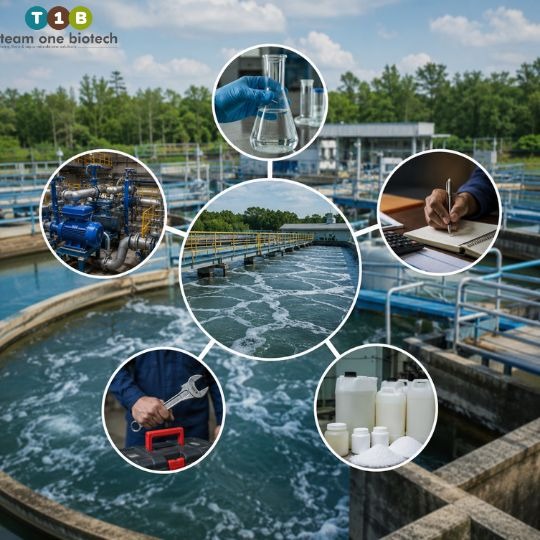
Before looking at capacity-specific numbers, it helps to understand what actually drives a monthly STP running cost. Nearly every invoice, fair or inflated, breaks down into these five components:
- Electricity, Aeration blowers, pumps, and UV/ozone disinfection units are the biggest power draws, often 40-50% of running cost.
- Manpower, Trained operators for daily monitoring, log maintenance, and adjustment of dosing systems.
- Chemicals and consumables, Coagulants, chlorine tablets, pH correction chemicals, and antifoam agents.
- Sludge management, Dewatering, storage, and tanker-based removal to authorized disposal sites.
- Lab testing and compliance documentation, Periodic BOD, COD, TSS testing required for CPCB/SPCB reporting, plus record-keeping for inspections.
Every fair AMC quote should let you see these five pillars separately, not buried into one vague “maintenance fee.”
Capacity-Wise Cost Breakdown (2026 Ranges)
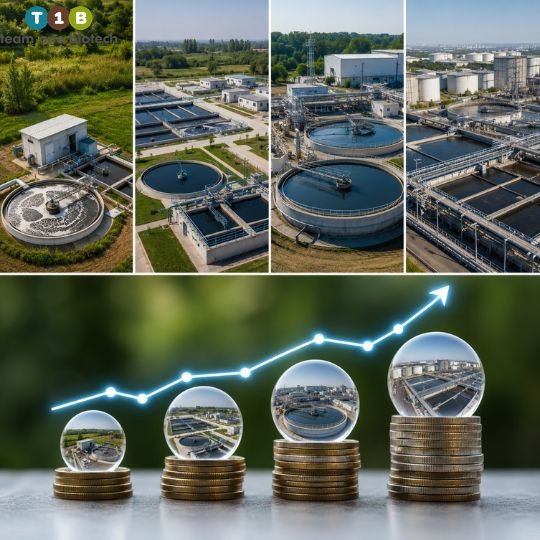
Cost per KLD (kiloliters per day) doesn’t scale linearly, smaller plants carry a higher relative burden because fixed costs like manpower and lab testing don’t shrink proportionally with capacity. Here’s how the numbers generally look for 2026 across three common capacity bands.
| Parameter | 50 KLD STP | 100 KLD STP | 500 KLD STP |
| Monthly AMC charges (2026) | ₹35,000 – ₹55,000 | ₹55,000 – ₹90,000 | ₹1,80,000 – ₹3,20,000 |
| Power cost (monthly, approx.) | ₹15,000 – ₹25,000 | ₹28,000 – ₹45,000 | ₹1,20,000 – ₹2,00,000 |
| Manpower (operator visits/shifts) | Part-time / visit-based | 1 dedicated operator | 2-3 shift operators |
| Chemical & dosing cost (monthly) | ₹4,000 – ₹8,000 | ₹8,000 – ₹15,000 | ₹35,000 – ₹60,000 |
| Sludge handling & tanker removal | ₹3,000 – ₹6,000 | ₹6,000 – ₹12,000 | ₹25,000 – ₹45,000 |
| Lab testing & compliance reporting | ₹2,500 – ₹4,000 | ₹3,500 – ₹6,000 | ₹8,000 – ₹15,000 |
| Approx. running cost per KLD/month | ₹700 – ₹1,100 | ₹550 – ₹900 | ₹360 – ₹640 |
Note: These are general values and operational outcomes will vary based on the specific design, technology used, microbial load, and unique parameters of individual Effluent Treatment Plants (ETPs) and Sewage Treatment Plants (STPs).
If you’re evaluating a 100 KLD STP maintenance cost India quote and it falls well below the lower end of this range, that’s not necessarily good news, it usually means something’s been left out.
Reviewing a quote that looks too good to be true? A quick audit from Team One Biotech can tell you exactly what’s missing before you sign.
Understanding the “Per KLD” Equation
This is the part most procurement teams miss when comparing quotes across different-sized facilities. A 50 KLD plant doesn’t cost half of what a 100 KLD plant costs, it often costs 70-80% as much, because:
- One operator visit costs roughly the same whether the plant treats 50 KLD or 100 KLD
- Lab testing frequency and reporting obligations don’t reduce with smaller volume
- Statutory compliance documentation is a fixed administrative burden regardless of scale
This is why the sewage treatment plant running cost per KLD is consistently higher for smaller societies and factories than for larger industrial campuses. If you’re benchmarking your AMC quote against a neighbouring facility of a different size, adjust your expectations accordingly, direct comparison without capacity context is one of the most common budgeting mistakes RWAs make.
Evaluating AMC Quotes: What’s Fair vs. What’s a Red Flag
A comprehensive, honest AMC for 2026 should transparently include:
- Scheduled operator visits with defined frequency (daily, alternate-day, or weekly depending on capacity)
- Water sample lab testing at a defined periodicity, with reports shared proactively
- Blower and pump preventive maintenance, not just breakdown repair
- Microbial/bio-culture dosing as part of routine treatment, not an add-on
- Clearly stated inclusions for diffuser servicing, membrane cleaning, and sludge tanker costs
Watch for these red flags in unusually cheap quotes:
- A base price that excludes diffuser overhauls or membrane replacement, items that surface as “surprise” costs six months in
- No mention of sludge tanker removal frequency or disposal documentation
- Vague or absent lab testing schedules (a compliance risk in itself)
- Manpower listed as “on-call” rather than scheduled visits, especially for 100 KLD and above
If a vendor’s number seems dramatically lower than the ranges above, ask them directly which of the five cost pillars they’ve reduced or removed. The answer usually reveals the trade-off.
The Biotech Advantage: Lowering Cost Without Cutting Corners
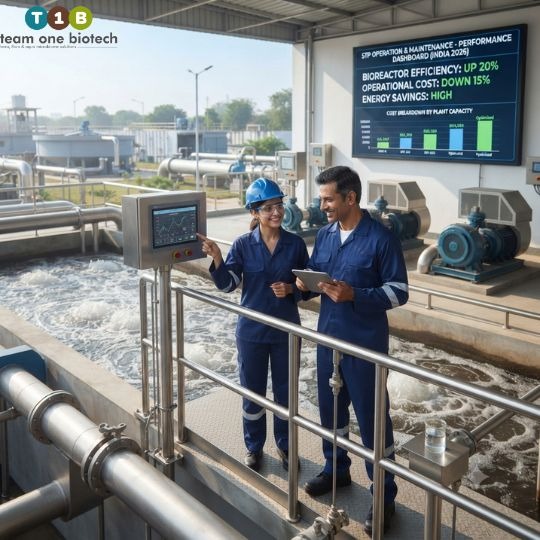
This is where facility owners often assume the only lever available is choosing a cheaper vendor. In reality, the more durable lever is improving what happens inside the tank.
Advanced microbial cultures and targeted bio-augmentation change the cost equation in three concrete ways:
- Faster organic breakdown reduces hydraulic retention time strain and improves consistent BOD/COD reduction, lowering the risk of non-compliance during inspections.
- Reduced sludge volume from optimized microbial digestion directly cuts tanker removal frequency, one of the more variable and often underestimated line items in an AMC.
- Optimized aeration demand means blowers run more efficiently rather than longer, trimming the largest single cost pillar: electricity.
Team One Biotech’s bioremediation approach is built specifically around this principle, treating cost reduction as a byproduct of better biological performance, not a trade-off against compliance.
From Reactive Firefighting to Predictable Budgets
The facilities that struggle most with STP costs are usually the ones managing it reactively, reacting to breakdowns, surprise SPCB notices, and unplanned tanker calls. The facilities that budget confidently for 2026 are the ones that have moved to a planned, transparent AMC structure with a clear view of all five cost pillars, backed by microbial optimization that keeps running costs predictable month to month.
If you’re currently reviewing a quote, budgeting for a new CPCB compliant STP installation, or simply want a second opinion on whether your current AMC charges reflect fair 2026 market rates, don’t wait for the next inspection to find out.
Visit the Team One Biotech Contact Us page today for a customized facility audit and a transparent quote verification, before you sign anything.
Looking to improve your ETP/STP efficiency with the right bioculture?
Talk to our experts at Team One Biotech for customised microbial solutions.
Contact: +91 8855050575
Email: sales@teamonebiotech.com
Visit: www.teamonebiotech.com
Discover More on YouTube – Watch our latest insights & innovations!-
Connect with Us on LinkedIn – Stay updated with expert content & trends!