
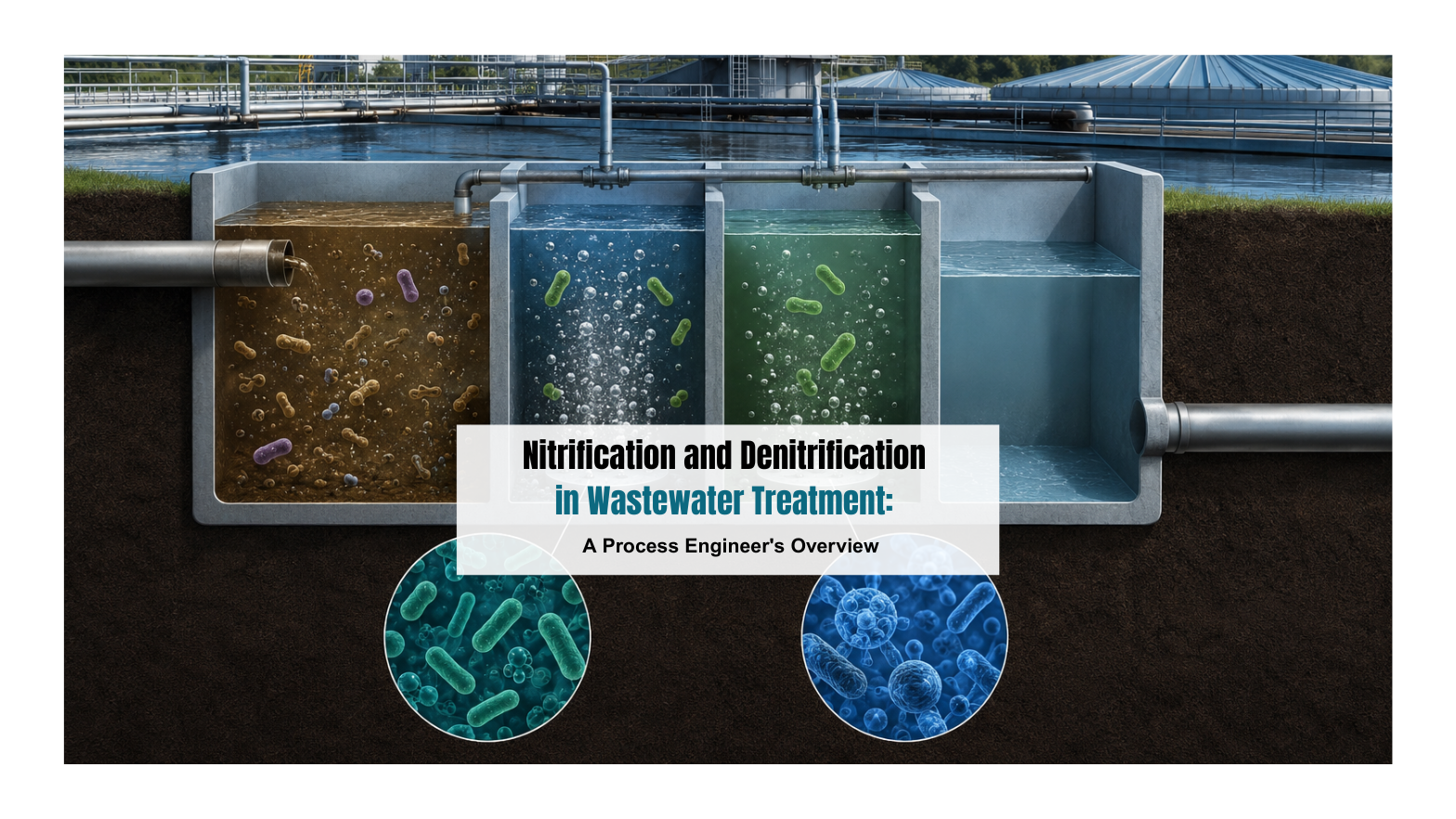
Nitrification and Denitrification in Wastewater Treatment: A Process Engineer’s Overview
There is a particular kind of dread that settles in when a consent violation notice lands on your desk. The ammonia levels in your treated effluent are elevated again. The CPCB or SPCB inspector is scheduled for next week. Your plant’s performance data tells a story you are not proud of, and you know that the next conversation with management is going to be uncomfortable. If you have been in this position, or are in it right now, you understand that nitrogen removal from wastewater is no longer a technical afterthought. It is a compliance imperative.
Biological nitrogen removal through nitrification and denitrification has become the cornerstone of compliant effluent treatment across India’s industrial and municipal sectors. As regulatory limits on total nitrogen, ammonia-nitrogen, and nitrate continue to tighten under CPCB and SPCB frameworks, plants that rely on conventional treatment alone are finding themselves perpetually on the wrong side of the discharge standards. The biology has to work. And for that to happen, the process engineer has to understand the biology.
This article walks through the complete picture, what nitrification and denitrification are, how they work at a biochemical level, what makes them fail, and what it takes to run them reliably under the pressures of industrial wastewater treatment in India.
If your plant is currently struggling to meet CPCB or SPCB nitrogen discharge norms, Team One Biotech’s specialized bioremediation cultures are engineered specifically to help. Reach out to our technical team today for a plant-specific assessment.
Why Nitrogen in Wastewater Is a Regulatory and Environmental Problem
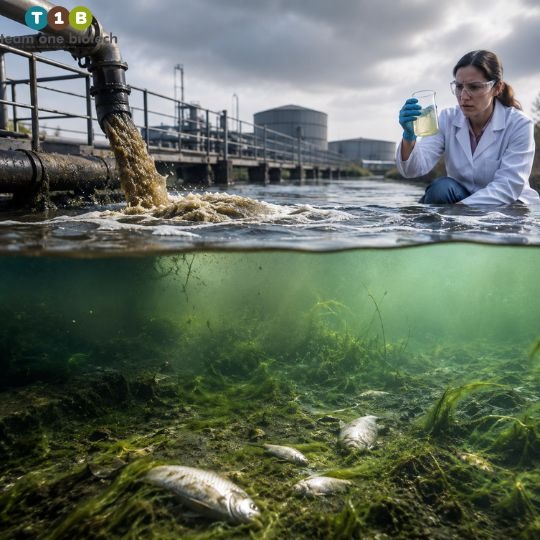
Nitrogen enters wastewater streams in multiple forms, primarily as ammonia (from industrial processes, fertilizer runoff, and domestic sewage), organic nitrogen, nitrate, and nitrite. Left untreated, this nitrogen load creates serious downstream consequences.
When nitrogen-rich effluent discharges into rivers, lakes, or coastal water bodies, it fuels eutrophication, an explosive growth of algae and aquatic plants that depletes dissolved oxygen, suffocates aquatic life, and renders water bodies unusable for irrigation, fisheries, or drinking water abstraction. The ecological damage compounds over time, and in water-stressed regions like much of India, the consequences extend well beyond environmental aesthetics.
From a regulatory standpoint, CPCB and various SPCBs have progressively tightened effluent discharge standards for total nitrogen, ammonia-nitrogen, and nitrate. These are limits that most conventional aerobic treatment systems, designed primarily for BOD and suspended solids removal, simply cannot meet without dedicated biological nitrogen removal. Industries most exposed include pharmaceutical manufacturers, food and beverage processors, fertilizer plants, municipal sewage treatment plants, and tanneries. For these sectors, the cost of non-compliance is not abstract: it includes consent violations, financial penalties, forced plant shutdowns, and reputational damage that is difficult to recover from.
The only sustainable solution, both economically and operationally, is biological nitrogen removal through the sequential processes of nitrification and denitrification.
What Is Nitrification? The Biochemical Mechanism Explained
The Nitrification Reaction, Two-Stage Aerobic Oxidation
Nitrification is a two-stage aerobic biological process in which ammonia-nitrogen is first converted to nitrite, and then nitrite is oxidized to nitrate. Each stage is carried out by distinct groups of highly specialized autotrophic bacteria that derive their energy not from organic carbon, but from the chemical oxidation of inorganic nitrogen compounds.
The first stage is performed by ammonia-oxidizing bacteria (AOB), predominantly species of the genus Nitrosomonas. These organisms oxidize ammonia to nitrite, releasing energy that they use for growth and cell synthesis. The second stage is handled by nitrite-oxidizing bacteria (NOB), primarily Nitrobacter spp., which oxidize nitrite to nitrate.
In simplified terms, the nitrification reaction proceeds as follows:
- Stage 1 (AOB): Ammonia → Nitrite (with consumption of dissolved oxygen and alkalinity)
- Stage 2 (NOB): Nitrite → Nitrate (with further oxygen consumption)
The net result is the conversion of toxic ammonia-nitrogen into nitrate, which is far less immediately toxic but still ecologically harmful and subject to discharge limits. Nitrification alone does not achieve total nitrogen removal from wastewater, it only transforms the form of nitrogen present. Complete removal requires denitrification as the second step.
One operational reality that every plant engineer must internalize: nitrifying bacteria are among the slowest-growing organisms found in activated sludge systems. They grow two to three orders of magnitude more slowly than the heterotrophic bacteria responsible for BOD removal. This makes them extraordinarily sensitive to washout, toxic shock, and process upsets. A nitrifier population that takes weeks to establish can be destroyed in hours.
Operating Conditions That Drive Nitrification Efficiency
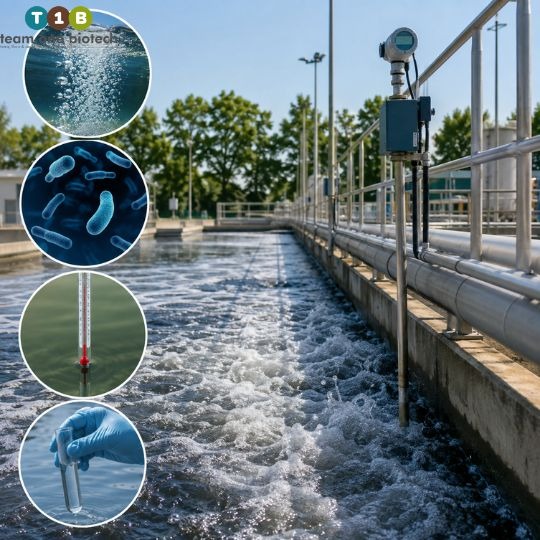
Dissolved Oxygen (DO)
Nitrifiers are obligate aerobes, they cannot function without oxygen. The nitrification process requires dissolved oxygen levels to be maintained above a certain minimum threshold in the aeration tank. Below this threshold, nitrification rates drop sharply and can cease entirely. In practice, DO control in the aeration zone is one of the most direct levers an operator has for managing nitrification performance. (Note: These are general indicative ranges; actual values vary significantly depending on the specific ETP/STP design, influent characteristics, and operating conditions.)
pH
pH exerts a profound influence on nitrification efficiency. The nitrification process ceases at pH levels that fall outside the tolerable range for nitrifying organisms. The optimal pH window for nitrification lies within a moderately alkaline range, and activity drops sharply as pH approaches the acidic or strongly alkaline extremes. Engineers should note that nitrification itself consumes alkalinity, which means systems without adequate buffering capacity are prone to a pH crash that then further suppresses the very biological activity driving that pH shift, a self-reinforcing failure cycle.
(Note: Indicative ranges only; site-specific values will differ based on system design and influent composition.)
Temperature
Nitrification is temperature-sensitive in a way that creates predictable seasonal challenges in many Indian climates. While high ambient temperatures can generally support nitrification, cold winters, particularly in northern India, can significantly reduce nitrifier metabolic rates and effective population density. Process engineers operating STPs and ETPs in these regions should anticipate performance degradation during colder months and plan accordingly, whether through bioaugmentation, extended SRTs, or temperature compensation strategies. (Indicative ranges only.)
Alkalinity
Because nitrification consumes bicarbonate alkalinity as a carbon source for autotrophic growth and as a buffer, systems receiving low-alkalinity influent or operating at high nitrogen loads may experience progressive pH depression. Alkalinity supplementation, typically through sodium bicarbonate or lime addition, is a standard corrective measure, but it must be managed carefully to avoid overcorrection.
Sludge Retention Time (SRT)
The slow growth rate of nitrifying bacteria means that a minimum SRT is required to maintain an active nitrifier population in the system. If the SRT falls below this biological threshold, nitrifiers are washed out of the system faster than they can reproduce. This is one of the most common and most damaging operational errors in plants that have not been specifically designed or adjusted for nitrification. In practice, nitrification-optimized systems require considerably longer SRTs than systems designed only for BOD removal. (Range is system-specific; consult a process specialist.)
Toxic Inhibitors
Industrial ETP operators face a challenge that municipal STP operators rarely encounter at the same scale: toxic influent loads. Heavy metals, free ammonia at elevated concentrations, chlorine residuals, and various industrial solvents and process chemicals can inhibit or outright kill nitrifying communities. Identifying and characterizing the inhibitory components in a plant’s influent is an essential step in any nitrification troubleshooting exercise.
What Is Denitrification? Closing the Nitrogen Loop
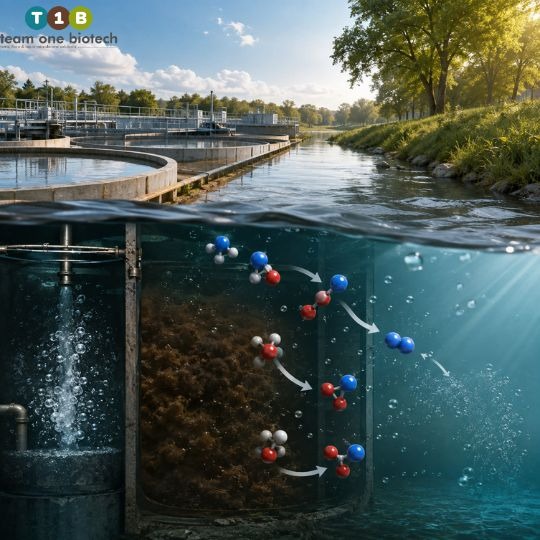
The Biochemistry of Denitrification
If nitrification is the first half of biological nitrogen removal, denitrification is the step that completes it. Denitrification is the microbial reduction of nitrate and nitrite to nitrogen gas, which escapes harmlessly from the liquid phase into the atmosphere. It is the only biological mechanism that achieves actual removal of nitrogen from the wastewater system, not merely a transformation of its chemical form.
The organisms responsible for denitrification are fundamentally different from nitrifiers in their physiology and ecology. Denitrification bacteria in STP environments are facultative heterotrophs, organisms capable of switching their metabolic strategy depending on the availability of oxygen. Under anoxic conditions (where dissolved oxygen is absent or minimal, but the environment is not fully anaerobic), these bacteria use nitrate or nitrite as their terminal electron acceptor in place of oxygen, reducing them stepwise to nitrogen gas.
Key genera involved in denitrification include Pseudomonas, Paracoccus, Bacillus, and several others. Unlike nitrifiers, these organisms are not slow-growing specialists, they are metabolically flexible and relatively robust, which makes them somewhat easier to manage operationally. However, their effectiveness is still contingent on specific process conditions being met.
Without denitrification, a plant achieving full nitrification will simply accumulate nitrate in its treated effluent. This satisfies ammonia discharge limits but may still violate total nitrogen or nitrate-specific limits, and it represents an incomplete treatment outcome from both regulatory and environmental standpoints.
Key Operating Conditions for Denitrification
Carbon-to-Nitrogen (C:N) Ratio
Denitrification is fundamentally a heterotrophic process, the organisms require an organic carbon source as the electron donor to drive the reduction of nitrate. This creates a significant operational challenge in many industrial effluents, where the carbon-to-nitrogen ratio may be too low to support adequate denitrification rates. When influent BOD or COD is insufficient relative to the nitrogen load, denitrification stalls and nitrate accumulates in the final effluent. In such cases, external carbon sources, such as methanol, acetate, or other readily biodegradable organics, may need to be dosed into the anoxic zone to supplement the available carbon.
(Note: Required C:N ratios are indicative and vary significantly with system configuration and influent characteristics.)
Anoxic Zone Design
Denitrification requires an environment where oxygen is absent but nitrate is available. This is the anoxic zone, a specific volume within the biological treatment system where dissolved oxygen is maintained at near-zero levels. In conventional activated sludge systems, MBRs, and SBRs, the configuration and sequencing of aerobic and anoxic zones is a critical design and operational variable. Both the volume of the anoxic zone and its hydraulic retention time (HRT) within that zone determine how completely denitrification can proceed.
Temperature
Like nitrification, denitrification rates are temperature-dependent. Cold conditions slow microbial metabolism and can cause denitrification performance to degrade seasonally. (Site-specific ranges apply; consult a qualified engineer.)
Nitrate Recycling
In pre-denitrification systems, where the anoxic zone precedes the aerobic nitrification zone, nitrate must be recycled from the aerobic effluent back into the anoxic zone through an internal recycle stream. The recycle ratio directly controls how much nitrate is available for denitrification and therefore how completely total nitrogen can be removed. Getting the recycle ratio right is one of the more nuanced operational adjustments in a BNR system.
Difference Between Nitrification and Denitrification, A Practical Comparison
For engineers who need to communicate this distinction clearly, whether in internal reports, client briefings, or regulatory documentation, the following comparison captures the essential differences:
| Parameter | Nitrification | Denitrification |
| Primary organisms | Autotrophic bacteria (AOB, NOB) | Facultative heterotrophic bacteria |
| Electron acceptor | Dissolved oxygen (O₂) | Nitrate / Nitrite (NO₃⁻ / NO₂⁻) |
| Environmental condition | Aerobic | Anoxic |
| Carbon requirement | None (autotrophic) | Yes (BOD/COD required) |
| End product | Nitrate (NO₃⁻) | Nitrogen gas (N₂) |
| Role in nitrogen removal | Converts ammonia to nitrate | Removes nitrate as N₂ gas |
| Rate sensitivity | Highly sensitive (slow-growing) | Moderately sensitive |
The key takeaway: nitrification transforms nitrogen; denitrification removes it. Both processes are required for true total nitrogen removal from wastewater.
Common Process Failures and How Engineers Diagnose Them
Process failures in biological nitrogen removal are frustratingly common, and they rarely announce themselves clearly. Here are the most frequently encountered failure modes and their diagnostic indicators:
Rising effluent ammonia despite adequate aeration
This typically points to nitrifier inhibition, nitrifier washout due to insufficient SRT, or a toxic loading event. The first diagnostic step is to verify DO levels in the aeration zone, confirm the actual SRT being achieved in the system, and review whether any unusual influent characteristics coincided with the performance decline.
Incomplete denitrification and rising effluent nitrate
When ammonia is adequately removed but nitrate climbs in the final effluent, the anoxic zone is underperforming. Common causes include insufficient carbon source (low C:N ratio), inadequate anoxic zone HRT, excessive internal recycle oxygen carry-over, or temperature suppression during cold months.
pH instability affecting both processes simultaneously
If pH is oscillating or trending downward, the first place to look is alkalinity balance. Nitrification consumes alkalinity; if the system’s buffering capacity is overwhelmed, pH destabilization can suppress nitrification directly, which then creates ammonia accumulation, a compound failure that can be difficult to reverse without systematic intervention.
Seasonal performance collapse
Temperature-driven performance drops in winter are predictable but still catch operators off guard. The response toolbox includes extending SRT where possible, reducing hydraulic loading temporarily, and in more severe cases, supplementing with external nitrifying and denitrifying bacterial cultures through bioaugmentation.
Many of these failures are rooted not in equipment design but in the biology, specifically, in the health, population density, and metabolic activity of the nitrifying and denitrifying microbial communities. A plant with well-designed infrastructure but a compromised biological community will consistently underperform.
Team One Biotech offers specialized nitrification and denitrification bacterial consortia, formulated for Indian effluent characteristics and CPCB compliance targets. Contact our technical team for a plant-specific recommendation.
Bioaugmentation as a Solution, When Native Microbiology Is Not Enough
Industrial ETPs operate under conditions that are genuinely hostile to biological communities. High and variable toxic loads, temperature swings, intermittent operation, shock loads from batch processes, these conditions suppress native nitrifier and denitrifier populations chronically, not just during acute upset events.
Bioaugmentation is the practice of adding concentrated, pre-adapted microbial cultures to an existing biological treatment system to reinforce or re-establish the microbial communities responsible for specific treatment functions. It is not a replacement for sound process design, but it is a highly effective tool for bridging the gap between what a system’s native biology can achieve and what CPCB or SPCB compliance requires.
For nitrification specifically, bioaugmentation allows plants to rebuild nitrifier populations far faster than natural growth rates would allow, reducing the time to stable compliance after a washout event from weeks to days. For denitrification, inoculating with robust denitrifying consortia adapted to low C:N industrial effluents can substantially improve nitrate removal rates without requiring major infrastructure changes.
Team One Biotech develops and supplies specialized nitrification and denitrification cultures engineered for the specific influent matrices, temperature ranges, and regulatory targets that Indian ETP and STP operators face. Our formulations have supported process recovery and compliance establishment across pharmaceutical, food processing, municipal, and specialty chemical sectors.
Frequently Asked Questions
What is the nitrification process in wastewater treatment?
The nitrification process is a two-stage aerobic biological conversion in which ammonia-nitrogen is first oxidized to nitrite and then further oxidized to nitrate by specialized autotrophic bacteria. It is a critical first step in biological nitrogen removal, though it does not by itself remove nitrogen from the system.
What organisms carry out nitrification?
Nitrification is carried out by two distinct groups of autotrophic bacteria. Ammonia-oxidizing bacteria (AOB), primarily Nitrosomonas spp., perform the first stage (ammonia to nitrite). Nitrite-oxidizing bacteria (NOB), primarily Nitrobacter spp., complete the second stage (nitrite to nitrate).
At what pH does the nitrification process cease?
The nitrification process operates within a specific pH window, and activity drops sharply outside of this range. At strongly acidic pH levels or highly alkaline conditions, nitrifier activity can cease almost entirely. The optimal range falls within moderate alkalinity, though the exact threshold at which nitrification process ceases at pH extremes is system-specific. (Note: Indicative only; actual thresholds depend on specific organism populations and operating conditions.)
What is the difference between nitrification and denitrification?
Nitrification converts ammonia to nitrate under aerobic conditions using autotrophic bacteria, while denitrification reduces nitrate to nitrogen gas under anoxic conditions using heterotrophic bacteria. Nitrification changes the form of nitrogen in the system; denitrification achieves actual removal of nitrogen from the wastewater.
What are denitrification bacteria in STP?
Denitrification bacteria in STP environments are facultative heterotrophs, organisms that can use either oxygen or nitrate as their terminal electron acceptor depending on the conditions. Key genera include Pseudomonas, Paracoccus, and Bacillus. These bacteria reduce nitrate and nitrite stepwise to nitrogen gas under anoxic conditions.
How does the carbon-to-nitrogen ratio affect nitrogen removal from wastewater?
Denitrification is a heterotrophic process that requires organic carbon as the electron donor. If the C:N ratio in the influent is too low, denitrification becomes carbon-limited and fails to reduce nitrate adequately, resulting in elevated nitrate in the treated effluent. External carbon dosing may be required in low-C:N industrial effluents.
Can nitrification and denitrification happen in the same tank?
Yes, this is the principle behind simultaneous nitrification and denitrification (SND), which is intentionally exploited in systems like sequencing batch reactors (SBRs) and certain MBR configurations. By creating micro-aerobic conditions or alternating aerobic and anoxic phases within a single vessel, both processes can be achieved in the same physical space, simplifying plant footprint requirements.
Compliance Is a Biology Problem as Much as an Engineering One
Nitrogen removal from wastewater through nitrification and denitrification is, at its core, a biological problem. The hydraulics can be right, the aeration equipment can be well-maintained, and the instrumentation can be calibrated perfectly, but if the microbial communities carrying out these processes are compromised, the plant will not achieve compliance.
Process engineers who understand the biochemistry of nitrification and denitrification, who know why nitrifiers wash out, why denitrification stalls when carbon is insufficient, and why pH instability cascades through both processes simultaneously, are far better equipped to maintain consistent performance and defend their effluent quality in front of a regulatory inspector.
The biology must be respected on its own terms. These organisms have requirements, sensitivities, and growth dynamics that do not bend to operational convenience. Meeting them consistently requires both good process design and a commitment to monitoring and maintaining the biological communities that do the actual work.
Team One Biotech has helped industrial and municipal plants across India achieve consistent CPCB and SPCB nitrogen compliance through our engineered bioremediation products. If your plant is facing nitrification failures, incomplete denitrification, or total nitrogen exceedances, talk to our specialists today. We will assess your current process and recommend a targeted biological solution, one designed for your specific effluent characteristics, regulatory targets, and operational constraints.
Visit our website or speak to a technical expert today.
Disclaimer: The values, ranges, and parameters discussed in this article are general indicative figures for reference and educational purposes only. Actual operating parameters, thresholds, and performance outcomes vary significantly based on the specific ETP/STP design, influent composition, hydraulic loading, temperature, and site-specific conditions. Always consult a qualified process engineer or technical specialist before making operational adjustments.
Looking to improve your ETP/STP efficiency with the right bioculture?
Talk to our experts at Team One Biotech for customised microbial solutions.
Contact: +91 8855050575
Email: sales@teamonebiotech.com
Visit: www.teamonebiotech.com
Discover More on YouTube – Watch our latest insights & innovations!-
Connect with Us on LinkedIn – Stay updated with expert content & trends!
