
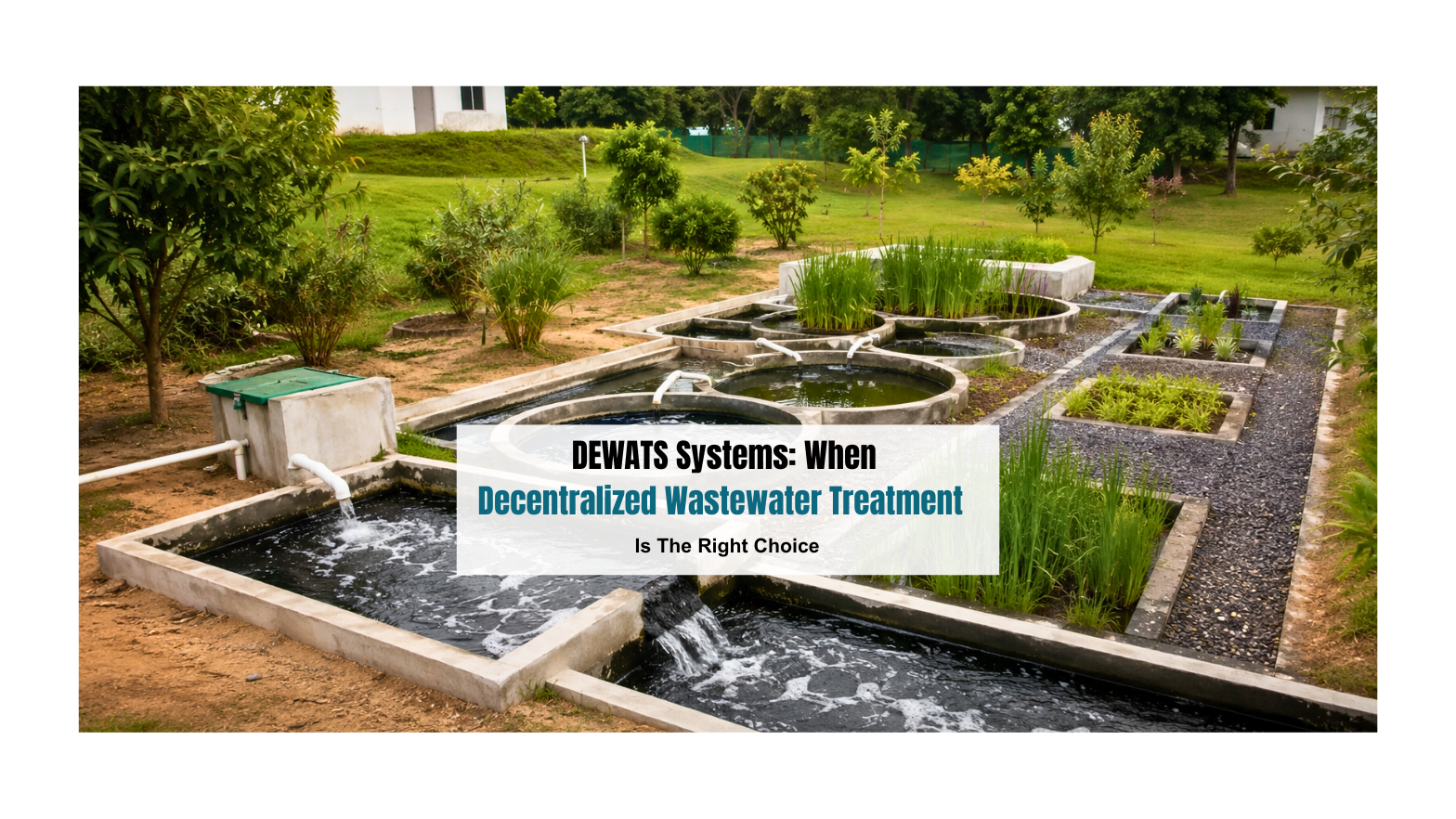

DEWATS Systems: When Decentralized Wastewater Treatment Is The Right Choice
You’ve got a residential project half-built, occupancy certificates are pending, and the municipal sewage line your project was supposed to connect to is still years away from actually reaching your site. Or maybe you’re running a hospital campus and you’ve just received a compliance notice because your existing treatment setup can’t keep pace with the load. Or you’re a facility manager fielding complaints from residents about tanker trucks rumbling through the gate every other day, kicking up dust and leaving behind that unmistakable smell.
These aren’t rare scenarios. They’re the everyday reality for a lot of developers, campus managers, and municipal planners across India who assumed centralized sewage infrastructure would simply be there when they needed it, and then discovered it wasn’t, or wouldn’t be for a long while.
This is where DEWATS systems enter the conversation. DEWATS stands for Decentralized Wastewater Treatment System, and at its core, it’s a philosophy as much as a technology: treat wastewater close to where it’s generated, using biological and gravity-driven processes instead of leaning on heavy machinery, constant electricity, or a sprawling network of pipes connecting back to a central plant.
In this article, we’ll walk through how DEWATS systems actually work, when they make more sense than a centralized treatment plant, how they help you stay compliant with CPCB and SPCB norms, and what to look for when picking a provider. If you’re weighing your options for a new project, a campus expansion, or a township that’s outgrown its current setup, this should give you a clear, practical starting point.
What Is a DEWATS System, and How Does It Actually Work
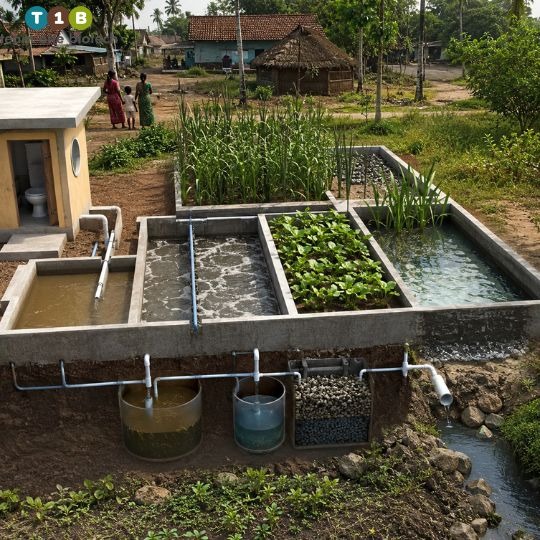
The DEWATS full form, Decentralized Wastewater Treatment System, tells you most of what you need to know upfront. It’s decentralized, meaning treatment happens on-site or close to the source rather than being piped miles away to a centralized municipal plant. And it’s designed around a simple idea: let natural biological processes, combined with smart engineering, do the heavy lifting instead of pumps, blowers, and constant power draw.
A typical DEWATS setup moves wastewater through a series of stages, each one doing a specific job:
- Settling and primary treatment (often an anaerobic baffled reactor): Wastewater first passes through chambers where solids settle out and anaerobic bacteria begin breaking down organic matter, all without any mechanical agitation.
- Anaerobic filtration: The partially treated water then moves through filter media, where bacteria attached to the filter surface continue digesting remaining organic pollutants.
- Root zone treatment, also called constructed wetland treatment: Water is directed through a planted gravel bed, where plant roots and the surrounding microbial ecosystem absorb and break down nutrients and remaining contaminants.
- Polishing pond or final treatment stage: A final holding stage allows further natural purification before the water is discharged or reused, often for irrigation or landscaping.
What makes this approach genuinely appealing to developers and facility managers is what’s absent from the process. There’s no dependency on continuous electricity, no complex array of moving mechanical parts that need constant servicing, and no requirement for specialized operators running the plant around the clock. That translates into a system that’s far less likely to break down, far cheaper to keep running, and far more forgiving if your site experiences power cuts, which, let’s be honest, is not exactly a rare occurrence in a lot of semi-urban and rural parts of the country.
Root Zone Treatment and Constructed Wetlands Explained
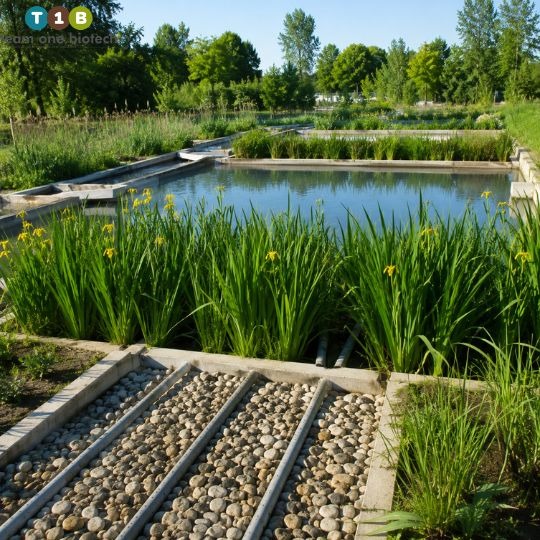
Root zone treatment deserves its own spotlight because it’s genuinely one of the more elegant pieces of this whole system, and it’s also the part that tends to win over clients who care about sustainability.
Here’s the basic concept: wastewater flows horizontally or vertically through a bed of gravel planted with specific wetland species, think reeds, canna, or similar hardy plants. The plant roots create a dense underground network that hosts a thriving community of microorganisms. Those microorganisms do the actual pollutant breakdown, while the plants themselves absorb nutrients and help maintain the right conditions for the biological process to keep working efficiently.
From the outside, a constructed wetland doesn’t look like a treatment plant at all, it looks like a landscaped garden bed. That’s a real selling point for real estate developers who don’t want an eyesore near their clubhouse or entrance, and for campus managers who’d rather have a green space than a mechanical structure humming away in the background.
There’s also a quieter appeal here for the more eco-conscious client. Root zone treatment leans almost entirely on natural processes, produces minimal sludge compared to conventional mechanical systems, and generally requires far less day-to-day intervention. For a project head managing a rural township or a campus with a small maintenance team, that lower-maintenance profile can be the deciding factor over a system that demands specialized technicians and constant monitoring of mechanical components.
DEWATS vs Centralized Treatment: When Decentralized Wins
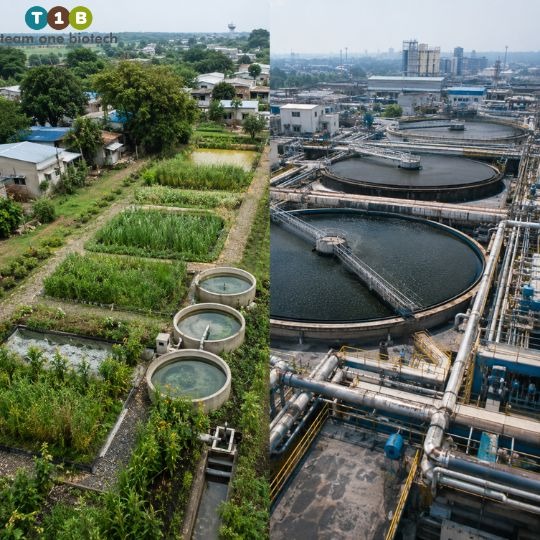
This is usually the question that actually brings people to an article like this one: should we go decentralized, or should we wait for or invest in a centralized system? The honest answer is that it depends on your specific project, but there are some decision factors that consistently tip the scale one way or the other.
Site location and distance from municipal sewer lines. If your project sits well outside the existing municipal sewage network, which is common for townships on the outskirts of growing cities, or for campuses in semi-urban areas, running a connecting pipeline can involve a long wait and a significant capital outlay. A DEWATS system sidesteps that dependency entirely.
Land availability and layout flexibility. Centralized plants typically need a sizeable, dedicated plot, often at a specific point in the drainage layout. DEWATS systems, by contrast, can often be designed to fit into irregular or constrained plots, and in the case of root zone treatment, can even double as usable green space.
Budget and phased development. Many real estate projects are built and occupied in phases. A decentralized system can often be scaled or expanded in step with construction phases, whereas a centralized plant usually requires the full design capacity to be committed to upfront.
Community size and scalability needs. For scattered residential clusters, smaller townships, or campuses with a defined and fairly stable population, a decentralized approach avoids the inefficiency of over-building a large centralized plant for a population that doesn’t need that scale.
Energy and grid reliability concerns. In areas where power supply is inconsistent, a system that doesn’t lean heavily on electricity for its core treatment stages is a genuinely practical advantage, not just a sustainability talking point.
To be clear, centralized systems absolutely have their place. For large, dense urban developments with strong grid reliability and an existing municipal network close at hand, a well-designed centralized plant can offer economies of scale that a decentralized approach won’t match. The point isn’t that one approach is universally superior, it’s that the right choice depends on where your project sits, how it’s phased, and what your site conditions actually look like. A credible design partner should be willing to have that honest conversation with you rather than pushing one solution regardless of fit.
Compliance Angle: Staying on the Right Side of CPCB/SPCB Norms
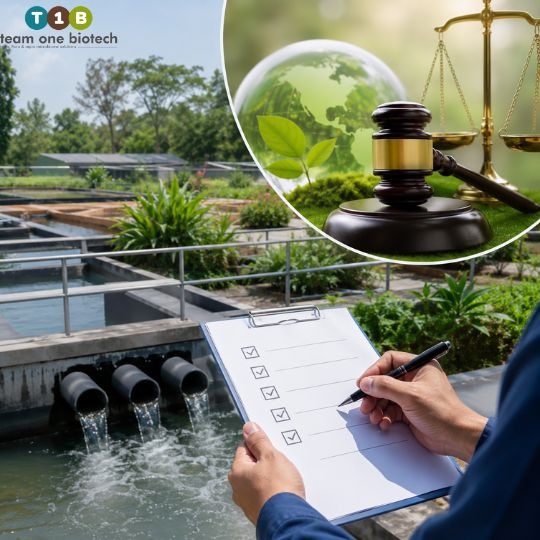
Here’s the part that often gets underestimated until it becomes a crisis: compliance with CPCB and SPCB discharge and reuse standards isn’t a paperwork formality. It’s a real operational and legal risk. Developers have seen occupancy certificates delayed over treatment plant compliance issues. Facility managers have had to explain to leadership why a routine inspection turned into a legal notice. Municipal planners have watched community trust erode after a poorly maintained system led to visible or reported violations.
A well-designed DEWATS system is built with these standards in mind from the outset, aiming to consistently deliver treated water quality that falls within the ranges expected for discharge or reuse under applicable municipal and pollution control board guidelines. But, and this is important, the design alone doesn’t guarantee ongoing compliance. Consistency comes from proper commissioning, periodic monitoring, and a maintenance routine that doesn’t get neglected once the initial excitement of the project fades.
This is also where choosing a credible manufacturer or design partner really matters. A system built by a team with a genuine track record in compliance-focused design, and one that offers structured monitoring support after installation, meaningfully reduces the risk of the kind of surprises that lead to legal liability or reputational damage down the line.
A quick but important note: any performance figures, treatment efficiency ranges, or capacity numbers referenced in discussions around DEWATS or centralized systems are general and indicative only. Actual outcomes vary considerably from one installation to another, depending on factors like influent load, site conditions, climate, and how consistently the system is maintained. Anyone evaluating a system for a specific project should treat broad ranges as a starting point for conversation, not a guarantee, and should work with their design partner to understand what’s realistic for their particular site.
Who Should Consider DEWATS
DEWATS systems tend to make the most sense for a fairly specific set of readers, and if you fall into one of these categories, it’s worth a closer look:
- Real estate developers working on projects located away from established municipal sewage infrastructure, or building in phases where a scalable, on-site solution avoids upfront over-investment.
- Campus and facility managers, schools, hospitals, corporate parks, who need a low-maintenance system that won’t demand a large dedicated technical team and can operate reliably even through power interruptions.
- Municipal planners assessing options for townships or peri-urban developments where extending centralized sewage lines isn’t currently practical or cost-effective.
- Rural and semi-urban project heads who need a treatment solution that’s rugged, low-tech in the right ways, and doesn’t fall apart the moment the local grid goes down.
If your project fits any of these profiles, a decentralized approach is worth serious evaluation rather than being treated as a fallback option only used when a centralized connection isn’t available.
What to Evaluate Before Choosing a DEWATS Provider
Not all DEWATS providers are equal, and the difference between a system that runs smoothly for years and one that becomes a recurring headache often comes down to who designed and built it. Before committing to a provider, it’s worth working through a short checklist:
- Design experience across varied site conditions. Ask whether the provider has handled projects with similar land constraints, population sizes, and soil or terrain conditions to yours.
- Compliance track record. Look for a provider who can speak knowledgeably and specifically about CPCB and SPCB requirements relevant to your region, not just generic assurances.
- After-installation support. A system is only as reliable as the maintenance and monitoring behind it. Ask what ongoing support looks like, inspections, troubleshooting, and responsiveness when something needs attention.
- Material and construction quality. Reactor chambers, filter media, and wetland bed construction all need to be built to last; ask about the materials and construction standards being used.
- Site assessment approach. A provider who takes the time to properly assess your soil, water table, expected load, and layout before proposing a design is signaling that they’re not just selling a one-size-fits-all package.
This is an area where Team One Biotech has spent considerable time refining its approach, not because every project looks the same, but because every project doesn’t, and a design that ignores that tends to underperform.
Bringing It Together: Peace of Mind, Not Just a Treatment Plant
Going back to where we started, the stalled project, the compliance notice, the tanker trucks nobody wants rolling through the gate, the underlying thread across all of these situations is the same. A wastewater treatment decision isn’t just an engineering choice; it’s a decision about risk, reliability, and how much of your attention you want this system to demand over the years ahead.
A thoughtfully designed DEWATS system offers a path to sidestep a lot of that friction: no dependency on an uncertain municipal connection, a lower ongoing maintenance burden, and a design built with compliance in mind rather than as an afterthought. That doesn’t mean it’s the right fit for every project, but for scattered developments, campuses, townships, and rural or semi-urban sites, it’s very often the more practical answer.
If you’re currently weighing your options, whether you’re planning a new project, dealing with a compliance concern, or simply trying to figure out whether decentralized treatment makes sense for your site, schedule a site assessment with Team One Biotech. Our team can walk through your specific land, load, and compliance requirements and help you figure out what actually fits, rather than pushing a generic solution.
And if you’re not ready for a full consultation just yet, feel free to reach out for more detail on how our DEWATS systems are designed, or get in touch through our contact page to have an informal conversation about your project.
Frequently Asked Questions
What is the full form of DEWATS?
DEWATS stands for Decentralized Wastewater Treatment System, an approach to treating sewage on-site or close to its source, using low-energy, largely biological treatment stages instead of a centralized municipal plant.
Is DEWATS suitable for large housing societies, or only small sites?
DEWATS systems are flexible in scale. While they’re a natural fit for smaller or scattered developments, they can also be designed for larger housing societies and townships, particularly when a project is built out in phases or sits far from municipal sewage infrastructure.
Does a DEWATS system require electricity to run?
One of the defining features of DEWATS is that the core treatment stages, settling, anaerobic filtration, and root zone treatment, operate without a continuous electricity supply, relying instead on gravity flow and biological processes. Some ancillary components may use minimal power, but the system isn’t dependent on constant electricity to function.
How is compliance with CPCB/SPCB norms ensured in a decentralized system?
Compliance comes from a combination of sound initial design, proper commissioning, and consistent ongoing monitoring and maintenance. A well-designed DEWATS system aims to keep treated water quality within applicable discharge or reuse standards, but this needs to be paired with regular checks rather than assumed to be automatic.
What is the difference between root zone treatment and conventional STPs?
Root zone treatment relies on planted gravel beds and natural microbial activity to break down pollutants, with minimal mechanical equipment involved. Conventional STPs typically use mechanical aeration, pumps, and other electrically driven processes to achieve treatment, which generally means higher energy use and a greater maintenance burden.
Note: All figures, ranges, and comparisons discussed in this article are general and indicative only. Actual performance, costs, and design parameters vary from one installation to another depending on site-specific factors, and should be assessed individually with a qualified design partner.
Looking to improve your ETP/STP efficiency with the right bioculture?
Talk to our experts at Team One Biotech for customised microbial solutions.
Contact: +91 8855050575
Email: sales@teamonebiotech.com
Visit: www.teamonebiotech.com
Discover More on YouTube – Watch our latest insights & innovations!-
Connect with Us on LinkedIn – Stay updated with expert content & trends!