
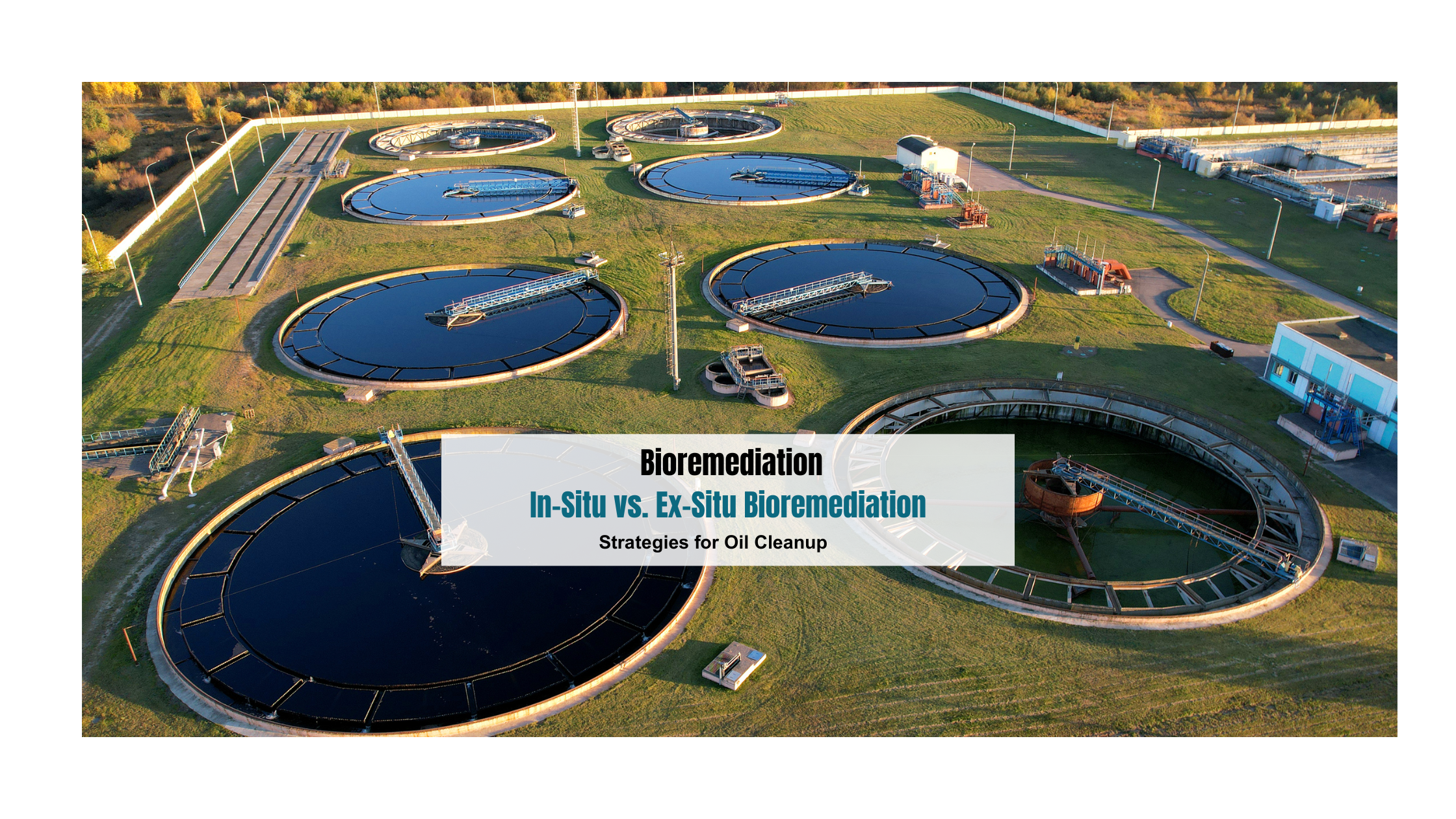
In-Situ vs. Ex-Situ Bioremediation: Strategies for Oil Cleanup

Oil spills are among the most damaging environmental incidents, contaminating soil and water while threatening marine ecosystems. Among various cleanup approaches, bioremediation for oil spills stands out as a sustainable and highly effective option. This process leverages specialized microorganisms to degrade petroleum hydrocarbons into harmless byproducts such as water and carbon dioxide.

If you’re exploring the benefits of bioremediation solutions in India, key advantages include lower toxicity, reduced secondary waste generation, and the ability to remediate large areas impacted by petroleum hydrocarbons.

At Team One Biotech, we deliver sustainable bioremediation services in India for wastewater treatment, soil remediation, and marine oil spill cleanup. Our advanced product, T1B OS, is a next-generation microbial formulation designed to accelerate hydrocarbon breakdown, making remediation faster, safer, and more cost-effective.

Among our flagship bioremediation products, T1B OS offers rapid degradation of heavy and light petroleum fractions while remaining non-toxic and eco-friendly, supporting industries in achieving compliance and sustainability goals.

In-Situ Bioremediation

In-Situ Bioremediation treats contamination directly at the site without removing affected soil or water. Microorganisms—whether naturally present or externally introduced—degrade hydrocarbons on-site.

Common Techniques: Bioventing, Biosparging, Natural Attenuation, and in-situ groundwater bioremediation.

Advantages:

  • Reduced operational expenses
  • Minimal site disturbance
  • Ideal for low to medium contamination levels
  • Well-suited for industrial wastewater treatment where excavation is not practical

Limitations:

  • Slower remediation rate
  • Site conditions such as oxygen, temperature, and nutrients are harder to control
  • May require nutrient supplementation to enhance microbial activity
Ex-Situ Bioremediation

Ex-Situ Bioremediation involves removing contaminated materials and treating them under controlled conditions.

Common Techniques: Biopiles, Landfarming, Composting, and Slurry Bioreactors.

Advantages:

  • Faster degradation due to optimized conditions
  • Easier monitoring of microbial activity and performance
  • Widely applied in soil remediation for refineries, petrochemical plants, and municipal waste sites

Limitations:

  • Higher costs due to excavation and transport
  • Site disturbance during removal

Real-World Case Studies

  • Bioremediation of aldehyde-rich wastewater from a pharmaceutical unit: Read Here
  • Saving Opex for a reputed pharma giant using bioremediation: Read Here

Where T1B OS Fits In

The right microbial solution is critical for bioremediation success, whether in-situ or ex-situ bioremediation is applied. T1B OS is specifically designed to degrade a wide spectrum of hydrocarbons, from heavy oils to light petroleum fractions.

Key Features:

Fast-acting microbes effective in soil and water

  • Non-toxic, safe for the environment
  • Applicable in marine oil spills, refinery effluent treatment, STP/ETP plants, and industrial contamination
  • Shortens cleanup time compared to natural attenuation alone

By integrating bioremediation into ETP and STP plant operations, T1B OS not only addresses oil spill remediation but also enhances COD, BOD, and hydrocarbon removal efficiency in industrial wastewater treatment.

Expertise in Bioremediation Services

With years of proven expertise in bioremediation services in India for wastewater, soil, and oil spill cleanup, Team One Biotech provides microbial formulations and technical support tailored to site-specific challenges. Our mission is to restore polluted environments with minimal ecological footprint, driving forward sustainable industrial practices.

Key Takeaway

Choosing between in-situ and ex-situ bioremediation depends on contamination level, site accessibility, and budget considerations. With the right approach and advanced microbial solutions like T1B OS, oil spill cleanup becomes faster, safer, and more sustainable.

Among specialized Bioculture companies in India, Team One Biotech focuses on robust consortia for tough industrial effluents. Contact us here.

Email: sales@teamonebiotech.com

Visit: www.teamonebiotech.com

Discover More on YouTube – Watch our latest insights & innovations!-

Connect with Us on LinkedIn – Stay updated with expert content & trends!
 

Capturing Innovation in Action

Just like the monsoon in July, which brings the purest form of water in the form of rain, that chases away the heat and makes the earth wear a green blanket. Team One Biotech also experiences the monsoon with a rain of new opportunity and exploration, not just from India but from all over the world.

July 2025

Stay updated with the latest news, insights, and solutions from the world of wastewater treatment.

In This Issue
  1. Zydus’ trust in our technology
  2. Conquering the fort of High TDS.
  3. Our testament of technology echoed in Spain
  4. Angry Pink-Launching
  5. Pro-tip from the field
  6. Get in touch 
Accepting the challenge of the menacing Ammoniacal Nitrogen

Zydus- The juggernaut of pharma, already bears in name of being compliant with the environment and adhering to a similar vision, they have shown trust in our technology and technical expertise and have asked us to work on one of their effluents with high levels of ammoniacal nitrogen. With giants like Zydus showing trust in us, our confidence is sky-high, motivating us to tackle tough-to-degrade effluents more.

Conquering the fort of High TDS

One of the biggest enemies of microbes in an effluent treatment plant is high TDS, as it ruptures the cell wall, making the most concentrated biocultures ineffective. However, one of our trusted partners who are manufacturer of organic chemicals, gave us the task to reduce COD as High as 30000 ppm in an effluent with TDS of 1,50,000 and above. The task looked very stringent and tough for us, but owing the the largest and most vibrant bank of microbes we have, we were able to formulate a bioculture which not only survived in such high TDS, but also was able to reduce COD, thereby helping industry to reduce its reliance on MEE and saving OPEX.

Check out the case study:

Our testament of technology echoed in Spain

One of our clients in Spain tested our products for solid waste, and this is what he has to say. The biggest achievements are not just orders or payments, but rather testimonials from clients who have received the desired results, which bring real satisfaction.

Angry Pink Launched

As promised in the previous newsletter, we launched one of the biggest disruptions in B2C,

The Angry Pink

Pro Tip from the Field

What does the foam in your Aeration Tank say?

  1. If it is white or light brown
  • No or low biomass
  1. Medium or dark brown with good settling
  • Strong biomass presence.
  1. Black with no settling and septic-like odour
  • Dead Biomass
Let’s Talk

Questions? Need site-specific help?
Write to us: [sales@teamonebiotech.com]
Call us: +91-7769862121
Visit: www.teamonebiotech.com

Follow Us on LinkedIn | YouTube | Facebook

Among specialized Bioculture companies in India, Team One Biotech focuses on robust consortia for tough industrial effluents. Email: sales@teamonebiotech.com Visit: www.teamonebiotech.com Discover More on YouTube – Watch our latest insights & innovations!- Connect with Us on LinkedIn – Stay updated with expert content & trends!
Tannery Effluent Treatment with Aerobic System (Flow Rate: 950 KLD)

Key Problems in Handling Tannery Effluent:

High COD and BOD:
Organic matter from hides and chemicals used in tanning lead to very high COD and BOD, making biological treatment challenging and energy-intensive.

Salinity and TDS Issues:
Large quantities of salt used in hide preservation and soaking stages significantly raise the TDS, which affects microbial health and limits reuse potential, requiring high TDS wastewater solutions.

Toxicity from Sulfides and Solvents:
Effluents often carry toxic sulfides and various solvents or dyes that can inhibit biological activity, corrode equipment, and pose environmental hazards.

Reach out to us today to explore effective, sustainable solutions for managing tannery effluent and ensuring compliance with environmental standards.

Sludge Handling and Disposal:
The treatment of tannery wastewater generates hazardous sludge, especially with high chromium content, requiring safe disposal as per hazardous waste norms. This highlights the importance of chromium removal technology in modern industrial effluent treatment solutions.

A tannery ETP with a flow rate of 950 KLD had several basic issues in its aerobic treatment plant. The plant was equipped with a single aeration tank with one partition and a single clarifier. Due to multiple streams and heavy ammoniacal nitrogen, the plant was facing operational inefficiencies.

The Initial Approach

Our team conducted a comprehensive site evaluation to identify issues and areas of improvement. The following key challenges were observed:

  • High COD levels (>10,000 ppm) due to sulfides and other pollutants.
  • BOD levels exceeding discharge standards (>5,000 ppm).
  • Higher Ammoniacal Nitrogen Levels at the outlet of the aeration tank (<450 ppm).
  • Very high MLSS and poor settling.
  • High SRT.

T1B Aerobio: Enhancing Aerobic Treatment Performance

T1B Aerobio is a scientifically formulated microbial consortium designed to optimize aerobic wastewater treatment. Its robust strains have the ability to survive in high TDS wastewater solutions with halophilic strains, degrade ammoniacal nitrogen, sodium acetate, and other nutrients, and perform under variable pH & temperature. The bioculture also secretes various enzymes, regulates sludge levels, and supports sustainable ETP plant operations.

Execution

Plant Optimization:

  • Removal of excess sludge to improve oxygen transfer and microbial activity.
  • The recirculation rate was adjusted, and its stream was uniformly distributed in both sections.

Dosing Regime:
A 60-day dosing schedule was implemented:

  • Phase 1 (Days 1–30): High initial dose to establish microbial dominance.
  • Phase 2 (Days 31–60): Maintenance dose to sustain treatment efficiency.

Monitoring Parameters:

  • COD and BOD reduction.
  • Ammoniacal Nitrogen levels in both aeration tanks.
  • Sludge volume index (SVI) and microbial activity.

Observations

The addition of T1B Aerobio resulted in significant improvements in the aerobic system’s performance. Key observations are summarized below:

Parameters Day 1 Day 15 Day 30 Day 45 Day 60
COD (ppm) 8500 7469 4331 1345 423
BOD (ppm) 3770 2891 1761 760 181
AN (ppm) 652 545 291 166 82

Results

  • COD Reduction: Achieved a 95.02% reduction by Day 60, ensuring compliance with regulatory standards.
  • BOD Reduction: Achieved a 95.19% reduction, meeting safe discharge norms.
  • AN Reduction: Achieved an 87.42% reduction by Day 60, aligning with discharge compliance.
  • Improved Sludge Quality: Enhanced microbial flocculation reduced SVI and improved sludge settling.
  • MLSS Levels: Controlled effectively, improving sludge settling quality.

Conclusion

The application of T1B Aerobio significantly enhanced the performance of the tannery’s aerobic treatment system. The plant achieved regulatory compliance for COD and BOD levels, stabilized DO levels, and improved sludge quality. 

By leveraging trusted bioculture suppliers for industrial wastewater, partnering with reputed ETP and STP plant manufacturers in India, and integrating biocultures for wastewater treatment, Team One Biotech demonstrates leadership among industrial wastewater treatment companies in delivering sustainable, high-performance solutions for the industry.

industrial effluent treatment solutions ,tannery wastewater treatment ,high TDS wastewater solutions ,chromium removal technology, sustainable ETP plant operations, ETP and STP plant manufacturers in India ,bioculture suppliers for industrial wastewater ,industrial wastewater recycling and reuse leather industry ,effluent treatment biocultures for wastewater treatment, industrial wastewater treatment companies. 

Among specialized Bioculture companies in India, Team One Biotech focuses on robust consortia for tough industrial effluents.

Email: sales@teamonebiotech.com

Visit: www.teamonebiotech.com

Discover More on YouTube – Watch our latest insights & innovations!-

Connect with Us on LinkedIn – Stay updated with expert content & trends!

GREEN-ENERGY-FROM-WASTEWATER-Biogas-and-Beyond.
Green Energy from Wastewater: How Anaerobic Biocultures Drive Biogas Production in India

The best word that can be an example of a paradox would be ‘Wastewater’. The word itself suggests it’s a waste, and one needs to get rid of it for the sake of saving the environment. But what if I say that this very wastewater can be “useful” too? in chemical energy (think COD/BOD). With the right biology and engineering, you can convert that into biogas, electricity, heat, biomethane (RNG), even hydrogen-and push your plant towards energy neutrality or better.

As one of the agile biotech companies in India, we blend R&D with field deployment for measurable outcomes. We supply targeted biocultures for wastewater treatment to accelerate digestion and reduce operating costs. Our Bioculture programs are designed for both etp and stp facilities, covering shock‑load resilience and sludge reduction. Contact us here.

Why wastewater = energy

Conventional aerobic treatment spends energy on aeration. Anaerobic digestion (AD) flips the script: microbes break down organics in the absence of oxygen and produce biogas (≈55–65% methane) you can burn in CHP engines of oxygen for electricity + heat, or upgrade to biomethane for grid/CNG use. Numerous facilities have demonstrated energy-neutral to energy-positive operation using AD, process efficiency, and on-site generation like the Strass in Austria or Sheboygan in US.

Why going the nature’s way is a game changer?

While anaerobic digestion (AD) is the technology, biocultures are the heart of the process. In AD, specialized microbes break down organics in the absence of oxygen to produce biogas (55-65% methane). The quality and productivity of this gas depend on the microbial community’s health and efficiency. Optimized inoculation and co‑digestion increase biogas production while improving digester stability and dewatering.

Team One Biotech’s anaerobic biocultures are designed to:

  • Rapidly adapt to different waste loads and compositions
  • Boost methane yield and volatile solids reduction
  • Stabilize digestion during shock loads pr toxic events
  • Minimize foaming and scum formation
  • Improve sludge dewaterability, reducing disposal costs

Without strong microbial activity, digestion slows, gas yields drop, and energy recovery becomes uneconomical. We partner with etp stp plant manufacturers to integrate anaerobic digesters, gas handling, and CHP in new builds.

Turning wastewater into Energy: How it works
  1. Anaerobic Digestion + Biocultures

Our Anaerobio biocultures accelerate the breakdown of organics in wastewater and sludge, converting them into methane-rich biogas efficiently and consistently. For plants evaluating anaerobic bioculture price, we provide transparent quotations based on COD load, flow, dosing plan, and target methane yield. We are among reliable anaerobic bioculture suppliers offering consistent strains, QA/QC documentation, and startup support.

  1. Co-Digestion for More Gas

Feeding digesters with FOG (fats, oils, grease), food waste, or dairy residues alongside sludge boosts biogas yields significantly. Our targeted microbial blends handle these high-strength wastes without process instability, giving you more gas from the same infrastructure. Optimized inoculation and co‑digestion increase biogas production while improving digester stability and dewatering.

  1. Biogas Utilize Pathways
  • CHP (Combined Heat & Power) – Run engines on biogas to power blowers, pumps, and heat digesters, cutting energy bills.
  • Biomethane (RNG)-Upgrade biogas for grid injection or CNG vehicles, accessing renewable energy credits and new revenue streams.
  1. Beyond Biogas

Advanced microbial and electrochemical processes are enabling hydrogen production, while wastewater heat recovery systems are capturing thermal energy for building use.

The Business Case

Energy Savings: Reduce grid electricity dependence by up to 80-100% in optimized systems.

Revenue Generation: Sell excess power, biomethane, or renewable energy certificates.

Lower OPEX:  Minimize Sludge disposal costs through higher volatile solids destruction

Sustainability Goals: Lower greenhouse gas emissions and improve ESG scores.

A Practical Roadmap for ETP/STP Owners
  1. Assess your biogas potential — measure COD load and sludge availability.
  2. Strengthen your microbial engine — dose Anaerobio biocultures for faster, more stable digestion.
  3. Explore co-digestion — partner with food industries for high-energy wastes.
  4. Decide your offtake model — CHP for self-powering, or biomethane for revenue.
  5. Plan for future add-ons — hydrogen, nutrient recovery, and heat reuse.
Bottom Line

Wastewater isn’t waste — it’s renewable energy in disguise.
If you operate a biogas generator, gas cleaning (H2S/moisture) and steady feed improve uptime and efficiency. We collaborate with leading green energy companies in india to deliver waste‑to‑energy and biomethane projects. Our portfolio includes end‑to‑end green energy solutions from feasibility to commissioning and operator training.

With the right biocultures, you can turn your plant from an energy consumer into an energy producer, cut operating costs, and generate new revenue streams — all while meeting sustainability goals. Beyond energy recovery, our Bioremediation services address phenols, PAHs, sulfides, FOG, and color bodies.

Among specialized Bioculture companies in India, Team One Biotech focuses on robust consortia for tough industrial effluents.

Email: sales@teamonebiotech.com

Visit: www.teamonebiotech.com

Discover More on YouTube – Watch our latest insights & innovations!-

Connect with Us on LinkedIn – Stay updated with expert content & trends!

ReducingReplacing RELIANCE ON MEE in HIGH TDS Effluents
Reducing/Replacing RELIANCE ON MEE in HIGH TDS Effluents

Multi-effect evaporators (MEEs) are widely used in industries dealing with high TDS effluent COD testing. They are highly effective—reducing COD by up to 90–95% even when the TDS of effluent water is extremely high. However, the shine of MEE’s efficiency often masks the significant operational costs that come with it. This blog explores whether MEEs can be replaced or minimized and the role of biological systems in reducing reliance.

This blog explores all sides of this technology and how its usage can be reduced or replaced. Get in touch to learn how innovative bioculture-based treatments can optimize COD reduction and lower operational costs in your effluent systems.

What is an MEE- How it works?

A Multi-effect evaporator (MEE) is an energy–efficient system used to concentrate high-TDS effluents by evaporating water in multiple stages or “effects”. It utilizes steam in the first stage to heat the effluent, causing water to evaporate. The vapor generated is then reused as a heating source for the next stage, progressively reducing energy consumption. This cascading use of steam maximizes thermal efficiency and minimizes operational cost. MEEs are widely used in zero liquid discharge (ZLD) systems, especially in industries with high salinity wastewater. The result is a concentrated brine and distilled water, both of which can be handled or reused appropriately.

Why is MEE in trends?

MEE is one of the most trending technologies in wastewater treatment, owing to its high efficiency in reducing higher levels of COD and tackling tough and toxic effluents with compounds like Cyanide, Toluene, Phenols, and aldehydes. Also, the condensate quality is top-notch. MEE is very popular in industries located near the sea, as it has excellent efficiency up to 98% in effluents with COD up to 150000 PPM and above, and delivers in TDS above 100000 PPM as the sea discharge with higher TDS is permissible.

Technology comes at a Cost

Multiple Effect Evaporator (MEE) systems, while highly efficient in reducing wastewater volume and achieving zero liquid discharge (ZLD), are often cost-prohibitive for many industries. The initial capital investment for an MEE plant typically ranges from Rs 50 lakh to Rs 2 crore, depending on capacity and design complexity.

Operational costs are also steep—electricity and fuel expenses can exceed Rs. 3-5 per liter of treated effluent, especially when steam boilers or thermic fluid heaters are involved. Despite incorporating energy recovery through multiple effects, MEEs still consume 1.2-1.5 kg of steam per liter of evaporated water.

Maintenance adds another layer of expense; anti-scalant chemicals, descaling routines, and part replacements can cost Rs. 5-10 lakh annually for a mid-sized plant. Skilled manpower and automation support further raise the cost.

Additionally, industries must manage the disposal of high-TDS concentrate or salts, which may cost Rs. 2-3 per kg in transport and treatment. Pre-treatment requirements—like neutralization, oil removal, or biological treatment-can add another Rs. 0.5-1 per litre.

While MEE ensures regulatory compliance and high performance, the total cost of ownership makes it unviable for many small and medium enterprises. Hence, despite its technical merits, MEE remains financially challenging, pushing industries to explore cost-effective biological or hybrid solutions.


What are the alternatives?

MEEs are known to reduce high COD values in effluents with high TDS values. Hence, it may sound ridiculous, but the best alternatives are BIOCULTURES. Now, the first question coming into the readers’ minds will be Why & How?

Well, let’s first answer Why? There is a certain class of bacteria that survives and thrives in extremely high saline conditions called Halophilic bacteria. These bacteria, when combined with other strains, as biocultures, can effectively work in high TDS effluents and reduce COD with great efficiency.

Now, let’s find out how?

The best way is to gradually divert the primary treated influent stream/inlet stream to MEE to the aeration tank.

Suppose A MEE has a capacity of 30 KLD that treats a stream with COD 75000 and TDS 50000, and the ETP is of 200 KLD that handles an inlet COD of 10000 PPM. In this case, initially, a stream of 5 KLD inlet to MEE can be diverted to the 200 KLD ETP. Then the average COD can be calculated by the below formula:

formula

Hence, the average inlet of 200 KLD ETP after diverting 5 KLD ETP will be approximately 12000 PPM, which can be treated by effective biocultures with strains of halophilic bacteria.

The 5 KLD stream can be increased to 10 KLD and 15 KLD, depending on the performance of the ETP.

How can this strategy be a game-changer?

Well, it is self-explanatory from the above information that diverting the MEE stream can reduce OPEX up to 30-35% straightaway, along with increasing the efficiency of the ETP. However, this strategy is more applicable in industries where sea discharge with High TDS effluent is permitted. But, it is not restricted also; options can be analysed too in other cases.

Technical efficiency and product viability is a must

While, the strategy looks very easy on paper but it is very tough to execute. It requires technical know-how of the whole plant, analysis of trends, and effective identification of strains and its amalgamation into an effective bioculture, its dosing and most important acumen of troubleshooting in real-time as we will be handling a stream which is very toxic , filled with tough-to degrade and shock load inducing compounds.

Team One Biotech is one of the leading Biotech Companies in India, providing advanced microbial solutions like bacteria for ETP treatment and bacteria culture for wastewater treatment.
???? Reach out now to enhance your wastewater treatment efficiency.

???? Email: sales@teamonebiotech.com

???? Visit: www.teamonebiotech.com

???? Discover More on YouTube – Watch our latest insights & innovations!-

???? Connect with Us on LinkedIn – Stay updated with expert content & trends!

Scan the code