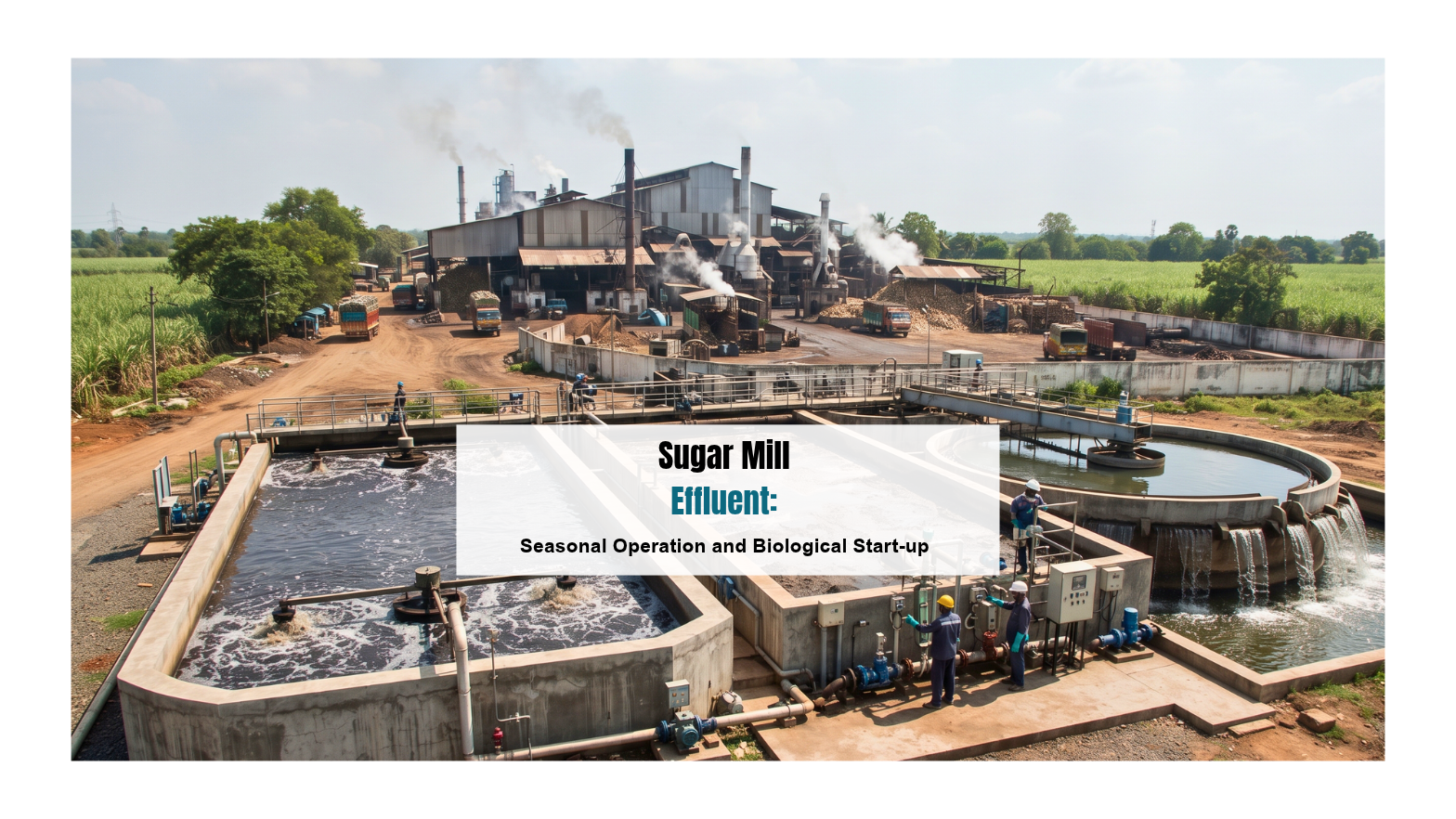
Sugar Mill Effluent: Seasonal Operation and Biological Start-up
The crushing season is days away. The cane yard is filling, the boilers are being lit, and the mill is coming back to life. Down at the effluent plant, the aeration basin has sat still for months. The surface is dull, the walls are crusted, and nobody is quite sure what’s living in the bottom layer.
If you run the ETP, you already know what’s coming. The first week of effluent will test the biology and your compliance record at the same time. You can almost smell the complaints: a septic odour drifting towards the nearest village, a phone call from the board, an inspection at the worst possible moment. Then there’s the fear every ETP manager carries, a washout on the first day, with the basin turning sour before the biomass has a chance to establish.
This article is about getting through that moment. We’ll look at why sugar mill effluent treatment behaves so differently from other industries, where a sugar industry ETP usually stumbles at start-up, and how a structured biological start-up protocol can get a dormant basin working reliably, without weeks of anxious waiting.
A note before we begin: wherever we give numbers in this article, they are ranges and general values. They will differ from ETP to ETP depending on design, load, and site conditions.
Why Sugar Mill Effluent Treatment Is Different From Other Industries
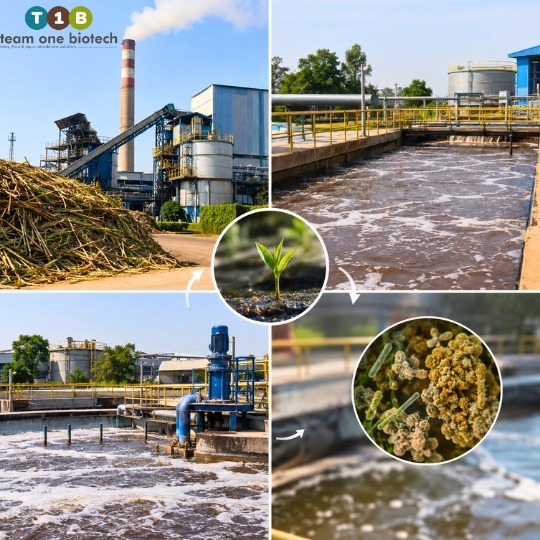
Most industrial plants discharge effluent at a fairly steady rate all year. A sugar mill doesn’t. It runs hard for the length of the crushing season, then goes quiet for the long off-season. Your ETP has to wake up from near-zero activity and take a full load almost immediately. That’s the first thing that sets sugar mill wastewater treatment apart.
Seasonal swings are extreme
During the off-season, the biomass in the basin starves, dies off, or turns dormant. When crushing begins, effluent arrives in volume, and there is no gentle ramp-up on the mill side. The cane doesn’t wait for your biology.
The organic load moves constantly
Even within the season, high BOD COD effluent is the norm, and it doesn’t arrive evenly. The main contributors include:
- Juice spillage and leakage from the extraction and clarification area
- Floor and equipment washings, which can spike sharply during cleaning shifts
- Barometric condenser water, which carries sugars and organics when entrainment occurs
- Press mud contact wastewater, rich in dissolved and suspended organics
Any one of these can push a sudden seasonal shock load into the basin. In a mill where several things go wrong in the same shift, the combined load can be several times the usual level.
Plenty of carbon, almost no nitrogen or phosphorus
Sugar effluent is mostly sugars, which means carbon. What it lacks is nitrogen and phosphorus, the nutrients bacteria need to build new cells. Without proper N:P nutrient balancing, the biomass can’t grow in step with the load. You end up with weak, slimy, poorly settling sludge, or no real growth at all.
Anaerobic acidification happens fast
Sugars ferment quickly. If effluent sits in the equalisation tank or arrives in a basin without enough active biomass and oxygen, anaerobic acidification sets in. Volatile fatty acids build up and pH drops. That stresses whatever biomass is present, and the characteristic sour, septic smell follows. Once the basin has gone acidic, recovery is slow and painful.
Put these four problems together and you can see why a generic start-up approach fails here. Treating this as ordinary industrial wastewater is how most start-up trouble begins.
The Compliance Clock Starts on Day One of Crushing
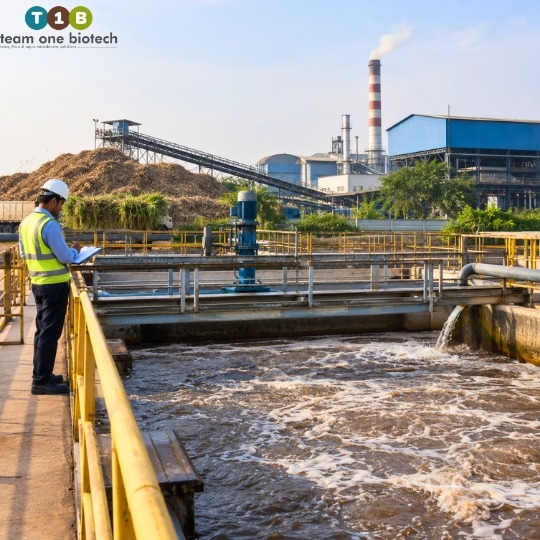
Here’s the uncomfortable reality. Regulators don’t give sugar mills a grace period for biological stabilisation. Your consent conditions apply from the first day effluent leaves the plant, and many mills also operate under Zero Liquid Discharge expectations for the sugar mill and its associated units.
In general terms, the CPCB SPCB discharge norms and your state’s consent conditions expect treated effluent to meet specified limits for parameters such as BOD, COD, suspended solids, and pH. Because limits and conditions vary by state, unit, and consent, we won’t quote values here. Please check your current consent to operate and any recent directions issued to your unit.
What happens when the early season goes wrong?
- Biological washout, where the biomass is flushed or killed before it can establish, and the basin has to be re-seeded from scratch
- Foul septic odour, which is often the first thing neighbours and local officials notice
- Statutory penalties and environmental compensation
- Show-cause notices, and in serious or repeated cases, closure directions
None of this is theoretical. A few bad days at the start of the season can leave a mark on a compliance record for the whole year, and it takes weeks of good performance to rebuild trust with the board.
Don’t let the first week of crushing decide your compliance record. If you’d like a second pair of eyes on your basin before the season begins, talk to the Team One Biotech technical team about a pre-season ETP assessment. It’s far easier to fix readiness issues in the off-season than during a washout.
Where Sugar Industry ETP Start-ups Usually Go Wrong
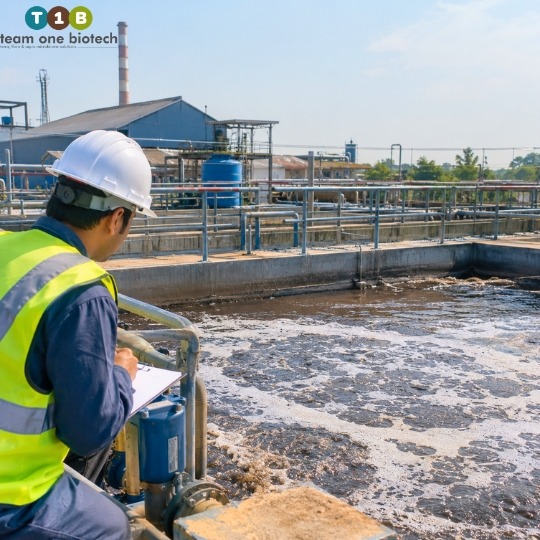
After enough seasons, the same mistakes show up again and again. Most of them come from reasonable assumptions that don’t hold in a sugar effluent system.
- Waiting for the effluent to “seed itself.” Some plants fill the basin and hope the incoming wastewater carries enough microbes to get going. It might, eventually. But sugar effluent acidifies faster than a natural population can establish, so the basin often sours before the right organisms take hold.
- Relying only on old sludge or cow dung seeding. These are familiar, and they do provide some biomass. But old sludge from a long-idle basin is often weak and mixed in quality, and cow dung is a general-purpose seed that isn’t selected for high-carbon sugar wastewater. Both can work as part of a plan. On their own, they’re unreliable.
- Ignoring nutrient dosing. This one is common. The basin is full, the aerators are running, and the biomass still doesn’t thrive, because there isn’t enough nitrogen and phosphorus to support growth against the carbon load.
- Loading the basin too fast. The mill is running, the pressure is on, and the full effluent flow goes in before the biomass is ready. A young culture can’t handle a full load, and the result is a crash.
- Skipping the pre-season inspection. Choked diffusers, damaged aerators, silted channels, and blocked lines turn up at the worst moment if nobody has checked them earlier.
Does any of this sound familiar? If so, you’re in good company. The good news is that each of these has a practical fix.
A Structured Biological Start-up Protocol That Works
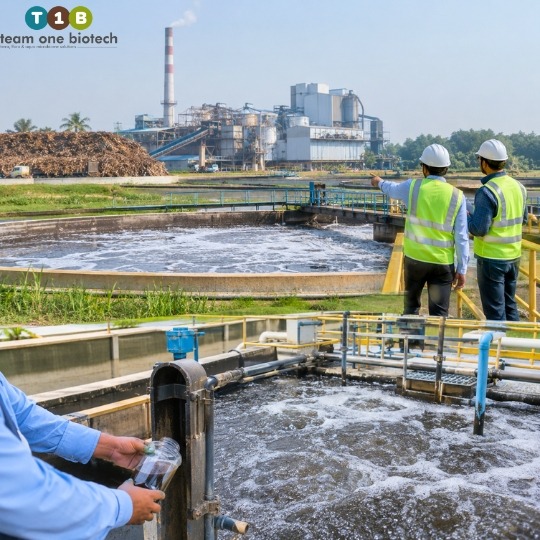
A good biological start-up protocol isn’t complicated. It’s disciplined. Each step prepares the ground for the next, and skipping one tends to cost more time than it saves.
Step 1: Pre-season basin readiness
Start well before the first cane is crushed. Walk the entire treatment train and check:
- Aeration system: diffusers, blowers, surface aerators, and air lines for fouling, damage, and uniform mixing
- Basin condition: accumulated sludge, grit, scum, and any dead zones that won’t mix
- Equalisation and buffer tanks: capacity, mixing, and condition, since these protect the basin from sudden spikes
- Pumps, valves, and flow measurement: you can’t control a load ramp-up you can’t measure
- Dosing systems: nutrient and bioculture dosing points should be ready and calibrated
- Lab readiness: meters for pH and DO, tools for SV30 and MLSS, and a microscope if available
Fix what’s broken now. A failed aerator in the first week of crushing is a problem you can avoid entirely.
Step 2: Rapid-activation bioaugmentation
This is where bioaugmentation for sugar industry effluent earns its place. Instead of waiting for a suitable population to develop on its own, you introduce a specialised microbial consortium selected to work on high-carbon, sugar-rich wastewater.
A well-matched consortium helps in three ways:
- It establishes quickly, shortening the usual stabilisation period
- It handles sugars and organic acids efficiently, which reduces the risk of acidification
- It builds a stable, well-settling floc instead of weak, slimy growth
The consortium is typically dosed during the initial charging of the basin and then maintained at a lower level through the early weeks. Dosing rates depend on basin volume, available seed, and expected load, so they should be worked out with your technical team rather than copied from another plant.
Many mills find that combining bioaugmentation with a small amount of good-quality seed sludge gives the best result. The sludge provides biomass and the consortium provides the targeted capability.
Step 3: N:P balancing
Because sugar effluent is so carbon-rich, nutrient dosing is not optional. The aim is to keep nitrogen and phosphorus available in a proportion that matches the incoming organic load, so the biomass can grow and not merely survive.
In practice, N:P ratios are commonly targeted within a defined range relative to the BOD load, and the exact figures depend on your effluent characteristics and treatment configuration. Typical nutrient sources include urea or ammonium compounds for nitrogen and phosphate salts for phosphorus.
A few practical points:
- Dose based on measured load, not a fixed routine
- Check residual nutrients in the treated water, since too little starves the biomass and too much wastes money and adds to downstream load
- Adjust as the load changes through the season
As always, ratios and doses are general and will differ from ETP to ETP depending on design, load, and site conditions.
Step 4: Controlled load ramp-up
Patience here pays off. Rather than sending the full flow in on day one, bring the load up in stages while the biomass builds.
- Begin with a fraction of the design load, often somewhere in the range of a quarter to a half
- Increase in steps once the basin shows stable pH, healthy DO, and improving settling
- Use equalisation to smooth out peaks while the culture is still young
- Expect a stabilisation period of roughly 5 to 10 days for many plants, though some settle sooner and some take longer
If the mill can divert or hold back the strongest streams, such as concentrated washings, during the first days, that helps considerably. A short conversation between the ETP team and the process team before start-up is worth more than most people expect.
These figures are general. Your own ramp-up schedule should reflect your design and the condition of your basin.
Step 5: Monitoring and shock load buffering
Once the basin is running, monitoring tells you whether the biology is healthy. Check these regularly during stabilisation, and more often when the load is changing:
- pH: typically maintained between 6.5 and 8.0, with early warning of acidification if it begins to fall
- Dissolved oxygen (DO): enough in the aeration basin to support aerobic activity throughout, with attention to dead zones
- MLSS: a measure of how much biomass you’re carrying, expected to build steadily through start-up
- SV30: a quick settling test that reveals sludge quality, with trends more useful than single readings
- F/M ratio: keeps the food-to-microorganism balance within a workable range as load increases
- Microscopic observation: healthy floc, active protozoa, and filament levels tell you things no meter can
Microscopy is often the first place trouble shows. A change in the microbial picture can appear a day or two before parameters shift, which gives you time to act.
For the rest of the campaign, plan for shocks. Maintain a bioculture top-up dose during the season, keep the equalisation tank mixed and in use, watch the weak points in the mill that generate spills, and have a response plan ready when pH starts to drop. A basin with a healthy, well-fed population recovers from a shock load far faster than one running on the edge.
Ranges for pH, DO, MLSS, and F/M are general guidance. Your own targets should be set from your ETP’s design and operating history.
Ready to plan your own start-up? Contact Team One Biotech to talk through your basin, your expected load, and the timeline to crushing. A short technical discussion now can save you a very long first week.
A Season-Wise Operating Snapshot
Here’s the whole year at a glance. Treat it as a planning aid, not a rulebook.
| Stage | Main focus | Key actions |
| Pre-season (weeks before crushing) | Readiness | Inspect aerators, diffusers, pumps, and tanks; clean and repair; calibrate dosing and monitoring; plan seed, bioculture, and nutrient supply |
| Start-up week (first days of crushing) | Establish the biology | Charge basin with bioculture and seed; begin N:P dosing; start at a partial load; monitor pH, DO, and SV30 closely; observe under the microscope |
| Mid-season (stable campaign) | Hold and protect | Ramp to design load as the basin allows; maintain bioculture top-ups; adjust nutrients to load; use equalisation to buffer spikes; track MLSS, F/M, and settling |
| End-of-season (closing weeks) | Preservation | Reduce load gradually; keep the basin aerated at a low level where possible; avoid abrupt shutdown; remove excess sludge; plan the off-season care |
All timelines are approximate and depend on the mill’s crushing schedule and ETP design.
The last stage is one that many plants overlook. How you close the season largely determines how easy next season’s start-up will be. A basin that is gently wound down and kept in reasonable condition is far easier to revive than one abandoned to rot over the off-season.
How Team One Biotech Supports Your Crushing Season Start-up
We make bioremediation solutions, and we work with plants that face exactly these problems every year. Our approach is practical. We’d rather help you avoid a crisis than rescue you from one.
Here’s what that support looks like:
- Bioremediation solutions for sugar effluent: microbial products suited to high-carbon wastewater, applied through bioaugmentation as part of a planned start-up
- Technical guidance on commissioning or reviving dormant aeration basins, from readiness checks through load ramp-up
- Help with nutrient planning so your N:P balance matches your actual load
- Advice on shock load management during the campaign, including what to do when pH or odour trends go the wrong way
- Site-level discussion, because no two plants are alike, and what works at one mill may need adjusting at another
The goal is simple: to bring your aeration basin revival forward so you aren’t left waiting through a long, uncertain stabilisation period or watching a crash unfold. For ETP start-up for sugar mills, speed matters, but reliability matters more.
If your plant also includes a distillery, co-generation unit, or other linked processes, we can look at the full picture, because effluent streams from these units affect each other.
Frequently Asked Questions
How long does a sugar industry ETP take to stabilise at the start of the season?
It varies with design, seed quality, temperature, and how carefully the load is ramped. Many plants stabilise in roughly 5 to 10 days when bioaugmentation, nutrient balancing, and staged loading are done properly. Plants relying on natural seeding often take longer. These are general ranges and differ from site to site.
Is cow dung or old sludge enough to start a sugar mill ETP?
They can supply some biomass, but they rarely deliver the speed or consistency needed for sugar effluent. The organisms in them aren’t selected for high-carbon wastewater, and old sludge is often weak. Most plants get better results combining seed with a targeted microbial consortium and proper nutrient dosing.
Why is nutrient dosing so important in sugar mill wastewater treatment?
Sugar effluent is rich in carbon but short on nitrogen and phosphorus. Without enough of both, biomass can’t grow properly, settling suffers, and treatment efficiency drops. Nutrient dosing based on measured load keeps the biology healthy and helps the plant meet its consent conditions throughout the campaign.
What causes foul odour in a sugar mill ETP?
Mostly anaerobic acidification. Sugars ferment quickly when oxygen or active biomass is short, producing volatile acids and sulphide compounds that smell sour and septic. Common triggers include sudden shock loads, weak biomass, poor mixing, and equalisation tanks left standing. Good aeration, buffering, and active bioculture usually bring it under control.
Can a dormant aeration basin be revived quickly before crushing?
Yes, in most cases, provided the mechanical equipment is sound. Revival usually involves clearing accumulated solids, checking aeration, charging the basin with a suitable microbial consortium and seed, dosing nutrients, and ramping up load in stages. Starting preparation well before crushing gives the best outcome.
Plan the Start-up Before the Cane Arrives
The first week of crushing is where a sugar mill’s effluent record is quietly decided. A dormant basin, a carbon-heavy load, missing nutrients, and fast-souring effluent are a hard combination to meet without preparation. With a structured start-up, though, it’s a very manageable one.
To recap the essentials of good sugar mill effluent treatment:
- Inspect and repair before the season, not during it
- Introduce a suitable microbial consortium instead of waiting for natural seeding
- Balance nitrogen and phosphorus against the carbon load
- Ramp up gradually and watch the biology closely
- Buffer shocks and wind the season down with next year in mind
A dependable sugar industry ETP is built in the weeks before crushing begins. Book a pre-season ETP assessment with Team One Biotech before the crushing starts. Call or write to our technical team, share your basin details and expected load, and plan your biological start-up now. Don’t let the first week decide your compliance record.
Disclaimer: The values, ranges, and timelines mentioned in this article are general in nature. Actual figures vary from one ETP to another based on design, effluent characteristics, seasonal load, and operating conditions. Please consult our technical team for a site-specific assessment.
Looking to improve your ETP/STP efficiency with the right bioculture?
Talk to our experts at Team One Biotech for customised microbial solutions.
Contact: +91 8855050575
Email: sales@teamonebiotech.com
Visit: www.teamonebiotech.com
Discover More on YouTube – Watch our latest insights & innovations!-
Connect with Us on LinkedIn – Stay updated with expert content & trends!