
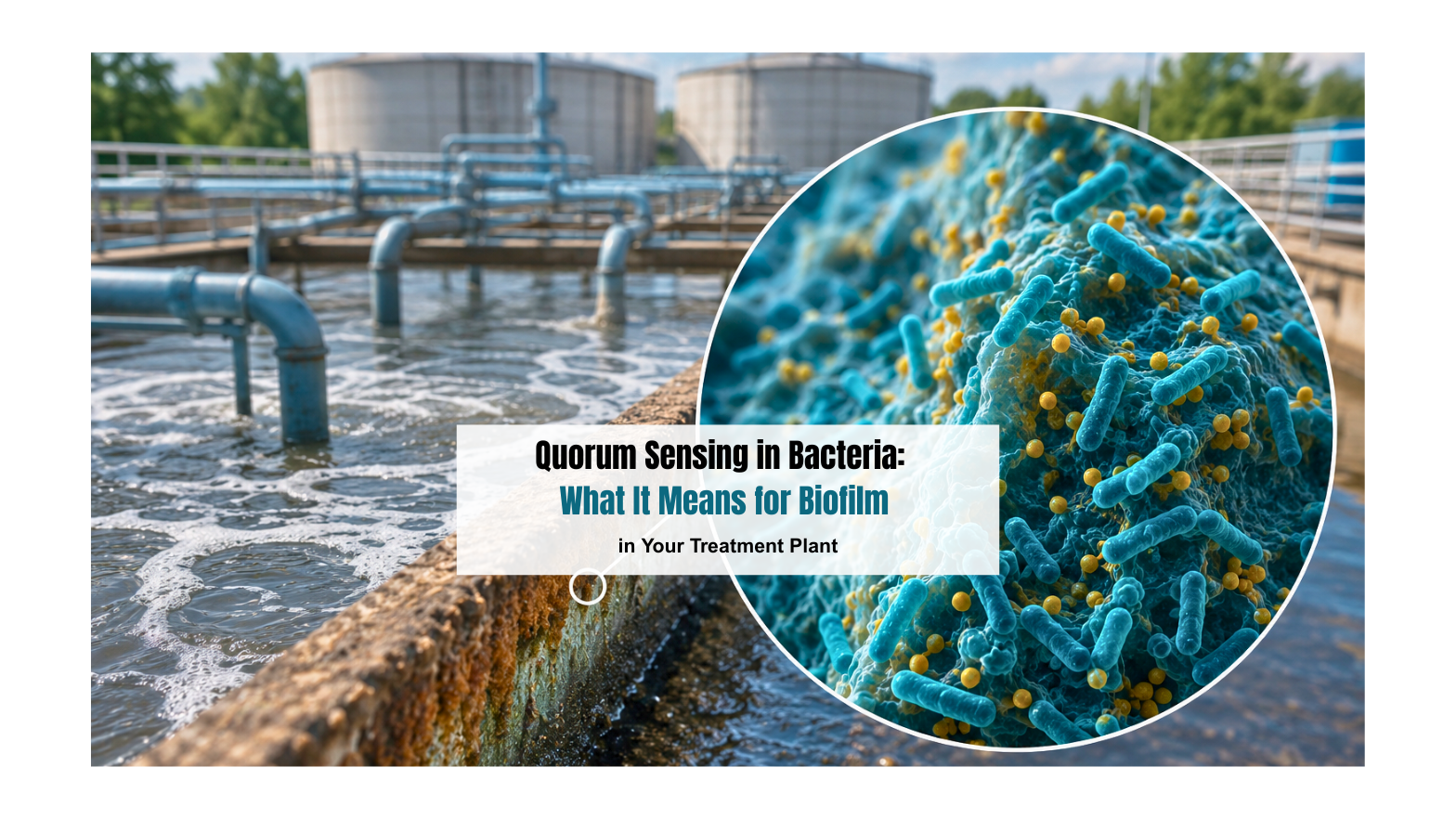
Quorum Sensing in Bacteria: What It Means for Biofilm in Your Treatment Plant
If your secondary clarifier has been acting up, your membranes are clogging faster than usual, or your effluent quality keeps slipping despite doing everything right, the problem may not be in your dosing chart. It may be in how your bacteria are talking to each other.
Most operators spend their shift monitoring dissolved oxygen, MLSS, sludge volume index, and HRT. These are the right things to watch. But there is a layer of biological activity happening beneath all of those parameters that almost no one monitors, and it is directly responsible for some of the most stubborn operational problems in biological treatment systems.
Bacteria in your plant are not passive organisms waiting to be managed. They are active, communicating, and making collective decisions based on what they sense around them. They coordinate biofilm formation, regulate metabolic activity, and respond to environmental stress in ways that are far more sophisticated than most process models account for. Understanding quorum sensing in bacteria is the starting point for understanding why your plant behaves the way it does, and why some problems refuse to go away no matter how well you operate your conventional parameters.
This is not a laboratory concept. Quorum sensing is happening right now in your activated sludge tank, your clarifier, your membrane modules, and your return sludge lines. The operators who understand it will be better positioned to manage their plants proactively rather than reacting to the symptoms after the damage is done.
What Is Quorum Sensing? Definition and Core Concept

Quorum sensing is the mechanism by which bacteria monitor their own population density and coordinate group behavior in response to it. The term was coined to describe what researchers observed: bacteria behave differently alone than they do in a crowd, and they always seem to know which situation they are in.
The quorum sensing definition, stripped of academic language, is this: bacteria communicate with each other using chemical signal molecules, and when enough of those signals accumulate to cross a threshold, the entire population switches on a new set of behaviors simultaneously.
The chemical signals responsible for this are called autoinducers. Each bacterial cell continuously produces and releases small amounts of these molecules into its surrounding environment. As the bacterial population grows, the concentration of autoinducers in the local environment increases proportionally. Individual cells are constantly sampling that concentration. When it crosses a critical threshold, it tells each cell that the population has reached a sufficient density, a quorum, and that it is time to act collectively.
This is the quorum sensing meaning in operational terms: a population-level decision made through chemical consensus, not through any central coordination.
The three-stage process works as follows:
- Signal release, Individual bacterial cells produce and secrete autoinducer molecules at low, continuous rates throughout their lifecycle
- Signal accumulation, As population density increases, autoinducer concentration in the surrounding environment rises in proportion; each cell is simultaneously detecting and contributing to this signal
- Collective gene expression, Once the autoinducer concentration crosses a threshold specific to that microbial community, bacteria collectively activate gene clusters that change their behavior, including the genes responsible for biofilm formation
One important note: these thresholds vary widely depending on microbial community composition, temperature, organic load, and environmental conditions, values in your plant may differ significantly from anything published in research literature.
How Quorum Sensing Drives Biofilm Formation in Bacteria

This is where science connects directly to what you see on the plant floor.
When quorum sensing signals reach their threshold, one of the most significant downstream consequences is the activation of genes that produce the EPS matrix, the exopolysaccharide matrix that forms the physical scaffold of a biofilm. This sticky, gel-like structure is what transforms a collection of free-swimming individual bacteria into an organized, surface-attached community that is structurally and functionally very different from what your aeration models and BOD calculations were designed around.
From Free-Swimming to Firmly Attached, The Transition That Changes Everything
Bacteria in biological treatment systems exist in two primary states: planktonic and sessile. Planktonic bacteria are free-swimming, dispersed throughout the bulk liquid, and are the form that most wastewater process models are built around. They respond to shear forces, are relatively accessible to dissolved oxygen and nutrients, and can be managed through conventional means like aeration, mixing, and chemical addition.
Sessile bacteria are the opposite. They are surface-attached, embedded in the EPS matrix, and operating under a fundamentally different set of conditions. The transition from planktonic to sessile is not random, it is triggered and coordinated by quorum sensing signals.
Once the autoinducer threshold is reached, QS signals switch on the genetic machinery for EPS production. The bacteria begin secreting the components of the matrix, attaching to available surfaces, membrane fibres, pipe walls, carrier media, clarifier internals, and recruiting additional cells into the growing structure. What begins as a thin conditioning layer on a surface progresses, over a range of hours to days depending on conditions, into a structured, multi-layered biofilm.
What a Mature Biofilm Looks Like Inside Your Treatment System
A mature biofilm is not simply a layer of bacteria stuck to a surface. It is a structured, differentiated community with a complex internal architecture that gives it properties very different from the same bacteria in planktonic form.
The outer layers of a mature biofilm remain metabolically active and in contact with the bulk liquid. Deeper layers experience steep diffusion gradients, dissolved oxygen, nutrients, and even chemical agents penetrate into the biofilm at progressively lower concentrations the further they travel from the surface. The innermost cells may be operating under near-anaerobic conditions even when bulk liquid DO readings appear adequate.
This architecture has two major consequences for your operation. First, the cells in the protected inner core are effectively shielded from both shear forces and conventional disinfectants. The EPS matrix blocks penetration, and even where penetration occurs, the outer cells are sacrificed while the inner community survives. Second, the metabolic activity of these sessile cells is fundamentally different from planktonic bacteria, their oxygen demand, nutrient uptake, and reaction rates do not match the assumptions built into standard BOD and COD models.
Periodically, sections of the mature biofilm will detach, a process also regulated, in part, by quorum sensing signals, and enter the bulk liquid as large aggregates. These detachment events are a key source of operational instability.
Beneficial vs. Problematic Biofilm, Two Sides of the Same Signal
Here is where the nuance matters, and where many discussions of biofilm get it wrong.
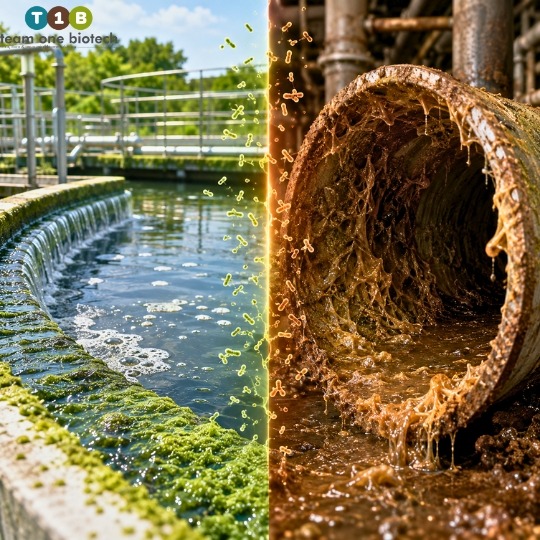
Biofilm is not inherently a problem. In fact, in a significant proportion of modern biological treatment systems, biofilm is the entire point. Fixed-film systems, moving bed biofilm reactors (MBBR), integrated fixed-film activated sludge (IFAS) systems, trickling filters, rotating biological contactors, are designed around the deliberate cultivation of biofilm on carrier media. In these systems, the dense, metabolically active biofilm community is what delivers the treatment performance. QS-driven biofilm formation is the mechanism that makes these systems work.
The problem is not biofilm itself. The problem is uncontrolled biofilm in locations where it does not belong, or biofilm that has overgrown to a point where it disrupts the process it is supposed to support.
In secondary clarifiers, biofilm growth on internal surfaces and weirs creates attachment points for sludge accumulation and introduces turbulence that disrupts settling. Detachment events from these surfaces cause sudden TSS spikes in clarifier effluent. In membrane bioreactor systems, biofilm formation on membrane fibres, driven by the same quorum sensing signals that are doing useful work in your MBBR, is the primary mechanism of biofouling. As the biofilm layer develops on membrane surfaces, it increases resistance to flow, driving up transmembrane pressure (TMP) and reducing filtration capacity. In return sludge and mixed liquor lines, unchecked biofilm can progressively restrict flow and alter the hydraulic behavior of the system in ways that are difficult to diagnose from surface-level monitoring.
The same bacterial communication mechanism that runs your biofilm reactor can, if left unmanaged, destroy your membrane integrity and destabilize your clarifier performance.
Understanding which biofilm you are cultivating, and which one is working against you, is the first step toward intelligent biofilm management. If you are unsure how your plant’s microbial community is behaving, our team at Team One Biotech can help you assess it.
Quorum Sensing in Wastewater Biofilm, What It Means for Compliance
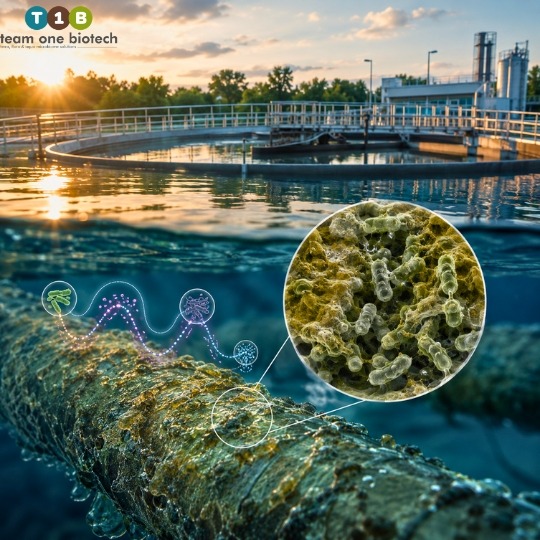
The connection between quorum sensing in wastewater biofilm and regulatory compliance is direct, and it runs through several distinct pathways.
When biofilm grows unchecked on membrane surfaces in MBR systems, the result is a progressive increase in transmembrane pressure. As TMP rises, permeate flux drops, and the system requires more energy and more frequent chemical cleaning cycles to maintain output. Eventually, if the biofouling is severe enough, membrane integrity is compromised and effluent quality deteriorates. This is not a slow or theoretical risk, it is one of the most common causes of MBR underperformance in industrial and municipal applications.
In secondary clarifiers, biofilm detachment events introduce sudden, unpredictable loads of suspended solids into the effluent stream. These TSS spikes are among the most common causes of discharge compliance failures under CPCB and SPCB norms, and they are particularly frustrating because they occur without any obvious change in influent load or process parameters. The process looks stable right up until the clarifier effluent quality drops.
There is also a subtler compliance risk that receives less attention. Sessile bacteria in mature biofilm communities are metabolically different from the planktonic bacteria that BOD and COD process models are designed around. Their oxygen uptake rates, substrate utilization patterns, and response times differ from what standard models predict. When a significant portion of your active biomass is operating in sessile form, particularly in systems with uncontrolled biofilm growth on surfaces, your actual treatment performance may diverge from your process model in ways that are difficult to diagnose without understanding the microbial ecology involved.
Key compliance risks associated with uncontrolled QS-driven biofilm include:
- Effluent TSS exceedances caused by biofilm detachment events in secondary clarifiers and pipe systems
- Degraded effluent quality in MBR systems resulting from progressive membrane biofouling and increased TMP
- Inconsistent BOD and COD removal performance when sessile bacteria dominate active biomass fractions
- Elevated chemical oxygen demand in effluent during high-detachment periods, particularly following process disturbances or cleaning events
Disclaimer: The operational impacts described above are indicative and based on general biofilm behavior in biological treatment systems. Actual impacts on effluent quality, membrane performance, and compliance parameters will vary depending on your plant’s configuration, microbial community, influent characteristics, and operating conditions. Always conduct site-specific assessments before drawing conclusions or making process changes.
Can You Interrupt Quorum Sensing? Emerging Control Strategies
The recognition that quorum sensing drives biofilm formation has opened a new category of intervention strategies that go beyond conventional chemical biocide approaches, and understanding why that distinction matters is important for anyone responsible for managing a biological treatment system.
Conventional chemical biocides act on bacteria that are already present, and their effectiveness against mature biofilm is limited for a reason that is structural, not chemical. The EPS matrix that forms the scaffold of a mature biofilm physically blocks penetration of disinfectants and biocides. The outer cell layers are killed or inhibited, but the inner core of the biofilm community, protected by the matrix and operating in a state of reduced metabolic activity, survives. The biofilm recovers, and the problem returns.
A more fundamentally targeted approach is quorum quenching (QQ), the disruption of bacterial communication signals before the threshold for coordinated biofilm formation is reached. Quorum quenching works by degrading autoinducer molecules in the environment, preventing them from accumulating to the threshold concentration that triggers collective gene expression. Without the signal, the bacteria do not receive the instruction to form biofilm. The population remains in a more planktonic, dispersed state, which is more accessible to physical and chemical management and more consistent with the process assumptions in your treatment model.
Quorum quenching can be implemented through several approaches:
Biological quorum quenching involves inoculating the treatment system with microbial strains that produce enzymes capable of degrading autoinducer molecules. Some bacterial species naturally produce quorum quenching enzymes as a competitive strategy, by introducing or enriching these organisms within your treatment system, it is possible to shift the microbial community balance in a way that suppresses uncontrolled biofilm formation without disrupting the beneficial biofilm in fixed-film zones.
Process-based disruption, optimizing hydraulic retention time, aeration patterns, and shear stress within the system, can destabilize biofilm before it matures into a treatment problem. Periodic high-shear events, careful management of carrier media loading in MBBR systems, and controlled backwash cycles in MBR applications are all examples of process-level interventions that address biofilm stability without chemical addition.
Bioremediation-based microbial solutions represent an emerging approach in which the microbial community itself is managed proactively, introducing organisms selected for their ability to compete with biofilm-forming bacteria, degrade autoinducers, or occupy the ecological niches that would otherwise be filled by problematic biofilm communities.
What all of these approaches have in common is that they address the problem at the signaling level, before the biofilm is established, rather than trying to remove or destroy a mature biofilm structure after the fact.
At Team One Biotech, we develop bioremediation solutions that work with your plant’s microbial ecology, not against it. If biofilm management is a recurring challenge in your system, speak with our biological process specialists to explore science-backed intervention strategies tailored to your treatment configuration.
Frequently Asked Questions
What is quorum sensing in simple terms?
Bacteria count their own population using chemical signal molecules called autoinducers. As the bacterial population grows, these signals accumulate in the surrounding environment. When the concentration crosses a threshold, the entire bacterial community changes its behavior together, including switching on the genes responsible for biofilm formation. The quorum sensing definition, in the simplest possible terms, is a population-level decision made through chemical consensus.
How does quorum sensing lead to biofilm formation in bacteria?
Quorum sensing signals, once they reach the threshold concentration, activate gene clusters that produce the exopolysaccharide matrix, the physical scaffold that holds a biofilm together. Without QS reaching threshold, most bacteria remain planktonic and dispersed. It is the accumulation of autoinducer signals, and the collective gene expression that follows, that converts a free-swimming bacterial population into an organized, surface-attached biofilm community.
Is biofilm always bad in a wastewater treatment plant?
No. In fixed-film biological systems, MBBR, IFAS, trickling filters, biofilm is the desired treatment mechanism, and its formation is the goal of system design. The problem is uncontrolled biofilm in clarifiers, membrane systems, and pipe infrastructure, where it causes fouling, compliance failures, and increased operational costs. The challenge is not eliminating biofilm but managing where it grows and how dense it becomes.
What is quorum quenching and can it help my plant?
Quorum quenching refers to the disruption of bacterial communication signals, specifically the degradation of autoinducer molecules, before they accumulate to the threshold that triggers coordinated biofilm formation. It is an emerging biological control strategy being applied in advanced MBR and STP systems. By interrupting the signal before the behavioral switch is flipped, quorum quenching keeps bacteria in a more planktonic, manageable state without the limitations of chemical biocides against mature biofilm.
How does uncontrolled biofilm affect CPCB compliance?
Biofilm detachment events introduce suspended solids spikes into effluent that are difficult to predict or prevent using conventional process monitoring. In membrane systems, biofouling degrades filtration performance and effluent quality over time. Both pathways can result in deviation from discharge norms set by CPCB and SPCBs, and because these events are driven by microbial community behavior rather than influent load changes, they are often misdiagnosed as process upsets when the root cause is biological.
The Bottom Line, Know What Your Bacteria Are Planning
Quorum sensing is not a laboratory curiosity. It is a fundamental mechanism of microbial behavior that is operating in every active biological treatment system, continuously, around the clock. The biofilm growing on your membrane fibres, your clarifier internals, and your pipe walls is not appearing randomly, it is the result of coordinated bacterial decision-making driven by chemical signaling that your control panel does not measure and your process model does not account for.
The operators and engineers who understand this will approach biofilm differently. Instead of treating membrane fouling as a maintenance inconvenience or clarifier instability as an unexplained process upset, they will recognize these as downstream consequences of microbial community behavior that can be managed, and ideally, interrupted, before the symptoms appear in the effluent reports.
Microbial communication is not something you can see on your control panel, but its effects show up in your effluent reports, your maintenance schedules, and your compliance records. Team One Biotech specializes in bioremediation solutions that address biological treatment challenges at their root. Reach out to our team today to understand how targeted microbial management can improve the stability and compliance performance of your plant.
Looking to improve your ETP/STP efficiency with the right bioculture?
Talk to our experts at Team One Biotech for customised microbial solutions.
Contact: +91 8855050575
Email: sales@teamonebiotech.com
Visit: www.teamonebiotech.com
Discover More on YouTube – Watch our latest insights & innovations!-
Connect with Us on LinkedIn – Stay updated with expert content & trends!