

10-Point Checklist for passing SPCB/CPCB Audits in 2026
The anxiety that grips every factory manager in India isn’t about production targets anymore, it’s about compliance. The Polluter Pays principle isn’t just a headline in The Hindu or Economic Times. It’s a direct debit from your company’s bank account when the State Pollution Control Board slaps a show-cause notice on your facility.
The new Solid Waste Management Rules 2026 and stricter CPCB guidelines have fundamentally altered the industrial compliance landscape. Online Continuous Emission Monitoring Systems (OCEMS) are watching your discharge parameters 24/7. The grace period for “we’ll fix it next quarter” is over. The Central Pollution Control Board isn’t just auditing paperwork, they’re auditing your real-time data streams, your chemical procurement patterns, and even your groundwater quality.
Meanwhile, your chemical supplier just increased prices on Ferrous Sulfate and Poly Aluminium Chloride (PAC) by 18% this year. Your ETP is hemorrhaging money, producing mountains of hazardous sludge, and still barely meeting the discharge standards for COD and BOD, highlighting the urgent need for Environmental Compliance & Bioremediation Solutions for Industrial Wastewater Treatment that reduce chemical dependency and long-term operating costs.
If this sounds familiar, you’re not alone. But you are running out of time.
This is your 10-point survival guide, not from a textbook, but from the field. From factories that have passed their audits without a single rupee in fines, and from those who’ve transformed their ETPs from cost centers into strategic assets.
The 10-Point Checklist: Your SPCB/CPCB Audit Armor

1. Valid CTE/CTO Status: The Digital Renewal Trap
Consent to Establish (CTE) and Consent to Operate (CTO) are no longer manila folders gathering dust in your compliance office. In 2026, SPCBs across Maharashtra, Tamil Nadu, Gujarat, and Karnataka have moved to digital consent management systems. Your renewal isn’t valid until it’s reflected in the online portal.
Action Item: Log into your state’s SPCB portal (e.g., Maharashtra’s MPCB OCMMS) 60 days before expiry. Upload your annual environmental statement, stack monitoring reports, and effluent analysis certificates. Don’t wait for the reminder email, it doesn’t always arrive.
Red Flag: Expired CTO means your operations are legally non-compliant from Day One of the audit. No auditor will overlook this, regardless of how pristine your ETP looks.
2. OCEMS Calibration: The “Data Tampering” Accusation You Can’t Afford
The CPCB’s 2025 directive mandates that all industries with liquid discharge above 100 KLD must have OCEMS for pH, flow, COD, and TSS. The real trap? Calibration drift.
When your OCEMS shows pH 7.2 but the auditor’s handheld meter reads 8.9, you’re not just facing a fine, you’re facing accusations of data manipulation, which can trigger criminal provisions under the Water (Prevention and Control of Pollution) Act, 1974.
Action Item: Implement monthly third-party calibration (not just the quarterly mandate). Maintain a log with calibration certificates from NABL-accredited labs. Cross-verify OCEMS readings with manual grab samples every shift.
Cost Reality: Monthly calibration costs ₹8,000-₹12,000. A single “data tampering” notice costs you ₹5-10 lakhs in legal fees and potential operational closure.
3. The New 2026 Segregation: Four-Stream Waste Management at Source
The updated Solid Waste Management Rules 2026 mandate four-stream segregation: biodegradable, recyclable, hazardous, and domestic. This isn’t just about dustbins in the canteen. It’s about segregating process wastewater streams before they enter your ETP.
Why This Matters: When you mix high-COD food processing effluent with electroplating wastewater, you force your ETP to handle incompatible chemistry. Result? Chemical overdosing, unstable biological processes, and an audit report that reads like a charge sheet.
Action Item: Conduct a wastewater characterization study for each production line. Install dedicated collection sumps. Treat hazardous streams (hexavalent chromium, cyanide) separately before co-mingling.
4. ETP Efficiency vs. Chemical Overdosing: The Red Flag Auditors Always Spot
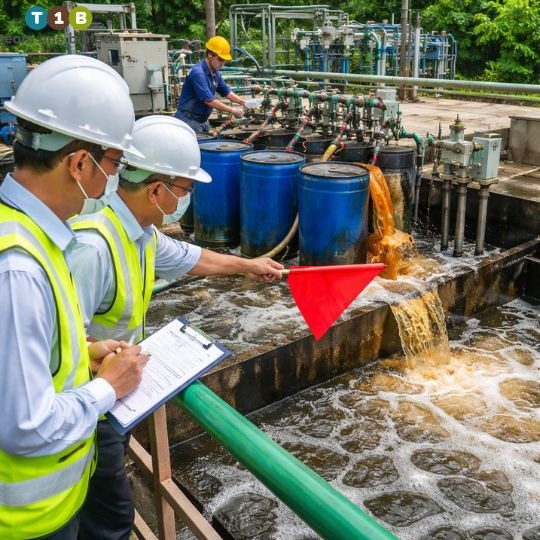
Here’s what auditors know that factory managers often don’t: excessive chemical consumption is a confession of ETP inefficiency.
When your monthly procurement shows 15 tons of Alum and 8 tons of Ferrous Sulfate for a 200 KLD plant, the auditor doesn’t think “this plant is well-stocked.” They think “this plant is chemically shocking the system to force compliance, and it’s probably generating 3-4 tons of hazardous sludge monthly.”
The Math You Need to Know:
| Parameter | Chemical Treatment | Bioremediation |
| COD Reduction Cost (per kg) | ₹45-₹60 | ₹12-₹18 |
| Sludge Generation | 3-5% of flow | 0.5-1% of flow |
| pH Stability | Requires constant adjustment | Self-regulating (6.5-7.5) |
| Operator Dependency | High (dosing errors common) | Low (biological buffer) |
Action Item: If your chemical cost per KLD exceeds ₹200/day, you’re over-treating. Transition to bioremediation (more on this in Point 5) to stabilize the system biologically, not chemically.
5. Bioremediation Integration: The Chemical-Free Compliance Path
Let’s address the elephant in the ETP. You’ve been told biological treatment is “slow” or “unreliable” for high-strength industrial effluent. That was true in 2015. It’s not true in 2026.
Modern microbial consortia, like Team One Biotech’s Aerobio cultures, are engineered for Indian industrial conditions. They handle COD loads up to 8,000 mg/L, tolerate pH fluctuations, and don’t “die” when production shuts down on Sundays.
How Bioremediation Passes the Audit:
- Stable Discharge Parameters: Biological systems buffer shocks. Your effluent quality doesn’t swing wildly day-to-day, which OCEMS loves.
- Reduced Hazardous Sludge: Microbial cultures reduce sludge by 60-70% compared to chemical coagulation. Less Form IV/V paperwork.
- Lower Carbon Footprint: The CPCB’s 2026 guidelines now include energy consumption audits for ETPs. Aeration is cheaper than chemical dosing pumps and sludge dewatering.
Case Study (Anonymized): A textile dyeing unit in Tiruppur switched to bioremediation in Q3 2025. Chemical costs dropped from ₹4.2 lakhs/month to ₹1.1 lakhs/month. Sludge disposal costs (₹8,500/ton) reduced by 65%. They passed their TNPCB audit with zero non-conformances.
Action Item: Start with a pilot trial. Introduce microbial cultures in your aeration tank for 21 days. Monitor BOD/COD reduction without chemicals. Scale up post-validation.
6. Hazardous Waste Logbooks: The Audit Within the Audit
Your ETP sludge is classified as hazardous waste if it contains heavy metals, toxic organics, or exceeds TCLP limits. The Hazardous and Other Wastes (Management and Transboundary Movement) Rules, 2016 require meticulous record-keeping.
What Auditors Check:
- Form IV: Monthly hazardous waste generation data (submitted online to SPCB by 10th of next month).
- Form V: Annual compliance report.
- Logbook Accuracy: Cross-verification between your logbook, transporter manifests, and TSDF receipts.
Common Mistake: Factory managers treat the logbook as a “to-do after production targets.” One missing TSDF receipt can invalidate 6 months of compliance.
Action Item: Assign a dedicated compliance officer (not the ETP operator’s “extra duty”). Use digital tools like CPCB’s Centralized Hazardous Waste Portal for real-time tracking.
7. Groundwater & Soil Health: The Hidden Audit Point for 2026
This is new and critical. SPCBs are now conducting groundwater sampling within 500 meters of industrial discharge points as part of surprise inspections.
If your ETP’s percolation or “evaporation pond” has been leaking COD, ammonia, or chlorides into the water table, you’re liable under the Environment (Protection) Act, 1986 for groundwater contamination, even if your effluent discharge meets standards.
Action Item: Install piezometers (groundwater monitoring wells) at three points: upgradient, at ETP boundary, and downgradient. Test quarterly for pH, TDS, nitrates, and heavy metals. Include reports in your “Green File” (Point 10).
Cost: ₹25,000 for installation, ₹3,500 per quarterly test. Non-compliance penalty: ₹10-50 lakhs plus remediation costs.
8. Staff Training: The “Why” Behind the “How”
Your ETP operator knows how to dose Alum. Does he know why excessive Alum creates hydroxide sludge that’s harder to dewater? Does he understand that a pH spike to 9.5 kills nitrifying bacteria in the aeration tank?
Auditors interview your staff. If your operator can’t explain the logic behind his daily checklist, the auditor assumes the plant runs on autopilot, or worse, isn’t run at all.
Action Item: Conduct monthly training sessions (2 hours). Cover: principles of biological treatment, OCEMS troubleshooting, emergency response for chemical spills, and regulatory updates. Document attendance. Show the auditor you invest in competence, not just compliance.
9. Energy Consumption in Treatment: The Carbon Footprint Audit

The CPCB’s Perform, Achieve, Trade (PAT) scheme is expanding to include wastewater treatment energy efficiency. If your ETP consumes more than 0.8 kWh per cubic meter of treated effluent, you’re an outlier.
Why This Matters: High energy use signals inefficiency, oversized pumps, continuous aeration without dissolved oxygen control, or chemical overdosing requiring excessive mixing.
Action Item: Install VFD (Variable Frequency Drives) on blowers. Use DO meters to optimize aeration. Switch to energy-efficient submersible pumps. Target: 0.5-0.6 kWh/m³.
Bioremediation Advantage: Biological systems require 30-40% less aeration than chemical precipitation systems.
10. The “Green File” Audit: 15-Minute Readiness
When the SPCB team arrives, you need to produce:
- Last 12 months of stack emission reports (ambient air quality if applicable)
- Last 6 months of effluent analysis (from NABL labs)
- Noise level monitoring (quarterly for diesel generators)
- CTO/CTE certificates
- Hazardous waste manifests and TSDF receipts
- OCEMS calibration certificates
- Groundwater test reports
If this takes you 45 minutes to compile, the auditor’s already writing “poor documentation management” in the report.
Action Item: Maintain a physical and digital Green File. Update it monthly. Keep it in the compliance office, not the ETP operator’s desk drawer.
The Financial Win: Cost-Effective Compliance
Let’s return to the math, because CEOs and CFOs care about the P&L, not just the pollution index.
Typical 200 KLD ETP (Chemical-Heavy):
- Chemical costs: ₹6 lakhs/month
- Sludge disposal: ₹1.2 lakhs/month
- Energy: ₹1.8 lakhs/month
- Total: ₹9 lakhs/month
Same ETP with Bioremediation Integration:
- Microbial cultures: ₹1.5 lakhs/month
- Sludge disposal: ₹0.4 lakhs/month (65% reduction)
- Energy: ₹1.3 lakhs/month (20% reduction via optimized aeration)
- Total: ₹3.2 lakhs/month
Annual Savings: ₹69.6 lakhs. Payback period for bioremediation setup: 4-6 months.
Your ETP stops being a cost center. It becomes a strategic asset that protects your license to operate while improving your bottom line.
About Team One Biotech: India’s Industrial Compliance Partner
Team One Biotech (T1B) isn’t selling you a product. We’re offering you a compliance insurance policy.
For over a decade, T1B has partnered with textile units in Surat, pharmaceutical manufacturers in Hyderabad, food processing plants in Punjab, and automotive component suppliers in Chennai. Our Aerobic Bio Cultures, FOG Degraders, and specialized microbial consortia are formulated for the harsh realities of Indian industrial effluent, not laboratory conditions.
Why Factory Managers Trust T1B:
- Guaranteed COD/BOD Reduction: 70-85% reduction in 21-day cycles.
- Zero Acclimatization Downtime: Our cultures are pre-adapted to high salinity, extreme pH, and fluctuating loads.
- Regulatory Expertise: We don’t just supply microbes. We help you interpret SPCB notices, prepare audit files, and train your ETP staff.
Products include:
- Aerobic Bio Cultures for high-COD industrial streams
- Anaerobic Cultures for distillery and food processing
- FOG Degraders for kitchen and canteen wastewater
- Septic Tank Biologicals for residential and commercial complexes
Don’t Wait for a Show-Cause Notice
The SPCB audit isn’t an “if”, it’s a “when.” And when that inspector walks through your gate, your compliance posture determines whether they leave with a handshake or a penalty order.
This 10-point checklist isn’t theoretical. It’s the distilled experience of factories that have navigated the 2026 regulatory landscape without fines, without shutdowns, and without compromising profitability.
Your move: Audit yourself before the SPCB does. Fix the OCEMS calibration. Clean up the hazardous waste logbook. And most importantly, transition your ETP from chemical dependency to biological stability.
Because in 2026, passing the audit isn’t about luck. It’s about preparation.
Ready to make your ETP audit-proof? Connect with Team One Biotech’s technical team for a free ETP efficiency assessment. Let’s turn compliance from a cost into a competitive advantage.
Team One Biotech – Engineered for India. Proven in the Field.
Looking to improve your ETP/STP efficiency with the right bioculture?
Talk to our experts at Team One Biotech for customised microbial solutions.
Contact: +91 8855050575
Email: sales@teamonebiotech.com
Visit: www.teamonebiotech.com
Discover More on YouTube – Watch our latest insights & innovations!-
Connect with Us on LinkedIn – Stay updated with expert content & trends!
