
Hotel and Hospitality Wastewater: Compliance for the Sector
It is a full-occupancy Saturday. A wedding party is arriving, the kitchen is running flat out, and a guest at the front desk mentions a smell near the lobby. Then the duty manager tells you the pollution control board inspector is at the gate.
Every chief engineer knows that sinking feeling. Hotel wastewater treatment is the quiet system that guests never think about until it fails, and by then the damage reaches reviews, renewals and reputation.
Hotel wastewater treatment is the process of cleaning sewage, kitchen effluent and laundry discharge so it can be reused or released within legal limits. This guide covers the compliance framework, the parameters that matter, the failures we see most often, and the practical steps that keep your plant steady.
Why Hotel Wastewater Is Harder to Treat Than Most Other Sectors
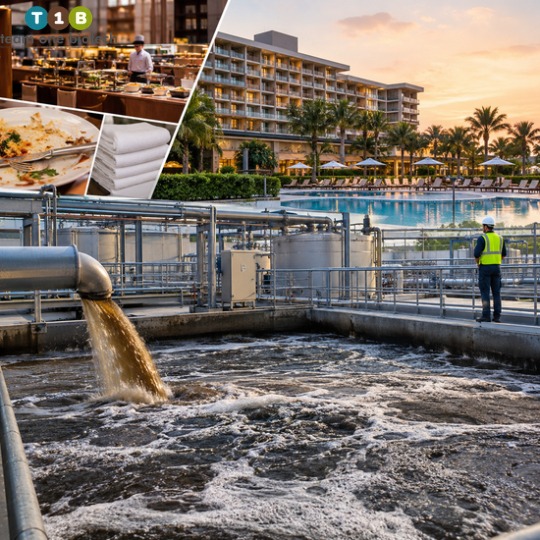
A residential society produces a fairly predictable load. A hotel does not. Your plant has to cope with a mix that changes by the hour and by the season.
- Variable hydraulic loading. Weekend surges, banquets, conferences and festival occupancy can push flow far above the weekday average, then drop it overnight.
- Heavy kitchen FOG. Fats, oils and grease from commercial kitchens coat pipes, choke equalization tanks and starve the biology of oxygen.
- Laundry chemistry. Detergents, bleach, softeners and disinfectants arrive in bursts and can suppress the microbes your plant depends on.
- Tight space. Many hotel STPs sit in basements or close to guest rooms, with little room for large tanks or generous retention.
- Zero tolerance for odor. A farm-side plant can tolerate a whiff. A hotel cannot.
- Staff turnover. Operators change, and undocumented know-how leaves with them.
Put these together and you get a plant that is always one bad weekend from trouble. Hospitality wastewater management is less about one big fix and more about many small disciplines done consistently.
Understanding the Compliance Landscape for Hotels

In India, hotels generally face three layers of rules, and your plant has to satisfy whichever apply to your discharge route.
CPCB and SPCB discharge norms
The Central Pollution Control Board sets national standards for treated sewage from urban STPs, and State Pollution Control Boards apply them through consent to operate conditions. Some states and sensitive zones impose tighter limits than the national baseline. Your consent letter is the document that actually binds you, so read it closely.
Municipal sewer inlet criteria
If you discharge into a city sewer instead of a water body or land, the local authority sets its own acceptable ranges. These are usually more relaxed for organics but can be strict on oil and grease, pH and certain chemicals.
Zero Liquid Discharge for hotels
ZLD mandates are increasingly attached to environmental clearances for larger hospitality projects, water-stressed regions and sites near sensitive water bodies. In practice, ZLD means all treated water is reused on site for flushing, cooling towers, gardening and housekeeping, with nothing leaving the boundary. It raises the bar on reuse water quality because there is no sewer to fall back on.
Here are the parameters that inspectors and your own operators watch most closely.
BOD (Biochemical Oxygen Demand)
BOD tells you how much oxygen microbes consume to break down organic matter. Treated outlet values for surface discharge or reuse commonly fall in the range of 10 to 30 mg/L, while raw hotel wastewater can sit far higher. A creeping BOD is usually the first sign the biology is struggling.
COD (Chemical Oxygen Demand)
COD measures everything that can be chemically oxidized, including compounds microbes cannot easily digest. Treated values are often expected in the range of 50 to 250 mg/L depending on the discharge route. A wide gap between COD and BOD points toward chemical load from laundry or housekeeping.
FOG (Fats, Oils and Grease)
FOG is the hospitality sector’s signature problem. Acceptable levels are typically in the range of 5 to 20 mg/L at discharge, and sewer authorities can be stricter. Beyond compliance, grease forms mats, blocks diffusers and causes foul smells.
Total Coliform
Total coliform indicates pathogen risk. Treated, disinfected water is commonly expected to stay within the range of 100 to 1,000 MPN per 100 mL, and reuse applications can demand the lower end. This matters most to guests and staff who come into contact with reused water.
Turbidity
Turbidity is the haziness of treated water. Reuse water is often targeted in the range of 2 to 10 NTU. Cloudy flush water or discoloured cooling tower makeup is something guests and maintenance teams notice immediately.
These are general values and may vary. Actual parameters differ for every ETP or STP depending on design, load, and local regulatory requirements.
Common Compliance Failures in Hotel ETPs and STPs
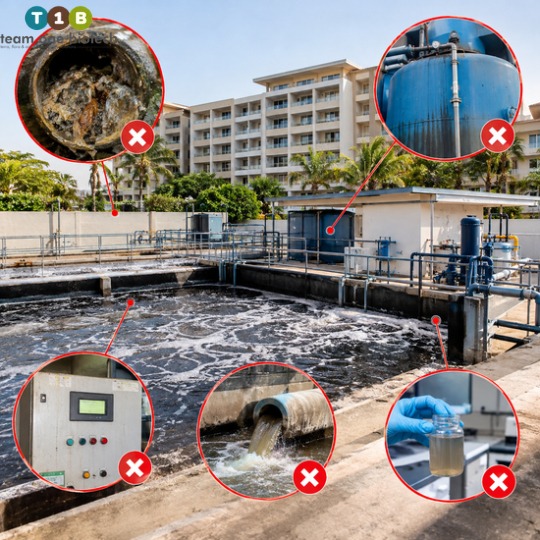
Most failures are not mysterious. They repeat from property to property.
- Grease choking. FOG bypasses a poorly maintained trap, coats pipes and lifts BOD at the outlet.
- Foaming. Often tied to detergents or a stressed, unbalanced microbial population.
- Sludge bulking. Sludge fails to settle, solids carry over to clarifiers and outlet quality drops.
- Microbial shock. A burst of disinfectant or bleach from laundry or housekeeping knocks back the biology for days.
- Persistent odor. Hydrogen sulfide and other gases escape from anaerobic pockets in tanks, sumps and sludge.
- Inconsistent reuse water quality. Turbidity, color or residual smell varies from one day to the next.
- Gaps in records. Missing logs, uncalibrated meters and unclear sampling schedules undermine even a technically sound plant during inspection.
If two or three of these sound familiar, you are in good company. Most plants we are called to look at have a combination.
Not sure where your plant stands? You can request a plant health review from Team One Biotech and get a clear picture of biology, loading and odor risk before an inspector does.
Practical Strategies for Hotel ETP Compliance
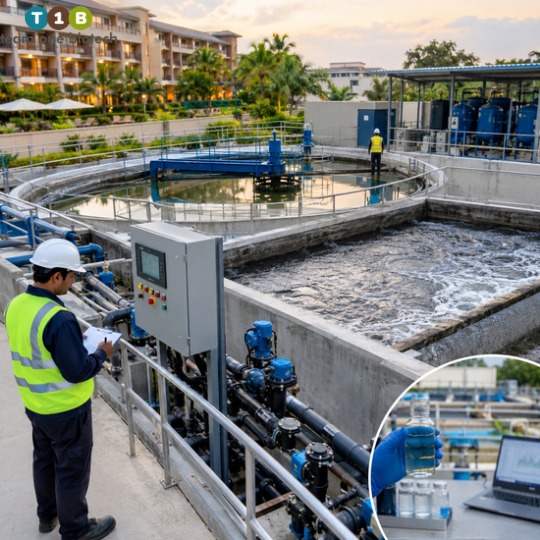
Segregate Greywater and Blackwater
Blackwater from toilets and greywater from showers, basins, laundry and kitchens behave very differently. Mixing them early makes the whole stream harder to treat, because strong organic load, grease and chemicals all land in the same tank.
Where the building design allows, greywater and blackwater segregation at the source lets you treat each stream on its own terms. Greywater can often be treated and reused with simpler processes, while blackwater gets the full biological treatment. Even in existing buildings, separating the kitchen and laundry lines before the main STP can make a visible difference.
Control FOG at the Source
The cheapest grease to treat is the grease that never reaches your plant. FOG management in commercial kitchens starts with discipline, not chemistry.
- Fit properly sized grease traps and clean them on a fixed schedule, not when someone notices a smell.
- Train kitchen staff to scrape plates and wipe pans before washing, and to keep used oil out of drains.
- Check that traps are not being bypassed during peak service.
- Add a biological grease degradation program, using selected microbes that break fats into simpler compounds, to keep traps and lines from turning into solid blocks between cleanings.
Biology supports good housekeeping. It does not replace it.
Manage Peak Hydraulic Loads
Peak load management in STPs is where many hotel plants quietly fail. A plant designed around an average day will struggle on the busiest one.
- Use an equalization tank to smooth surges. Many hotels aim for holding capacity in the range of 4 to 8 hours of average flow, though design varies widely.
- Aerate the equalization tank gently to prevent septic conditions and odor.
- Pace transfer pumps so the biological tank sees a steadier flow.
- Plan ahead for events. Tell the plant operator when large banquets or full-house weekends are coming, so aeration and dosing can be adjusted.
- Build microbial resilience. A healthy, diverse and well-fed culture recovers faster after a surge than a thin one.
These are general values and may vary. Actual parameters differ for every ETP or STP depending on design, load, and local regulatory requirements.
Protect the Biology from Laundry Chemicals
Your plant is a living system. Bleach, quaternary disinfectants and strongly alkaline or acidic wash water do not care how well you designed the aeration.
- Ask the laundry team which chemicals are used and in what quantities.
- Route laundry wastewater through an equalization step so it does not hit the biology in one slug.
- Check pH before the stream enters the main plant. Many biological systems work best in a near-neutral band, often in the range of 6.5 to 8.5.
- Where possible, shift toward lower-toxicity detergents and avoid draining concentrated disinfectant directly.
Laundry wastewater treatment does not have to be elaborate. It needs to be consistent and predictable.
Eliminate Odor at the Root, Not with Masking Agents
Spraying fragrance around the STP room fixes nothing. Hotel STP odor control begins with understanding why the smell exists.
Odor usually comes from anaerobic zones where oxygen runs out and microbes produce sulfur compounds and amines. Look for dead spots in aeration, accumulated sludge, grease mats, overloaded equalization tanks and poorly ventilated sumps.
Fix the oxygen distribution, remove the sludge and grease that feed the problem, and keep the biology active. Odor then falls as a by-product of a healthier plant. Masking agents only hide the symptom until the next inspection.
How Bioremediation Supports Hotel Wastewater Treatment
Bioremediation sounds technical, but the idea is simple. Your STP already relies on microbes to digest waste. Bioremediation for STP and ETP adds carefully selected strains and supporting nutrients so those microbes work harder, recover faster and tolerate stress better.
In a hotel setting, this helps in four practical ways.
It targets what the plant struggles with
Specific microbial blends are chosen to break down fats, oils, proteins and surfactants that standard sewage bacteria handle slowly.
It stabilizes the biology under shock
After a surge in flow or a burst of cleaning chemicals, a reinforced microbial population tends to bounce back sooner, which protects your outlet quality.
It reduces sludge
More complete digestion of organics can mean less sludge to handle, lower disposal frequency and better settling behavior.
It cuts odor at the source
By limiting anaerobic conditions and breaking down the compounds that cause smell, biological wastewater treatment for hotels supports odor control from the inside.
At Team One Biotech, we develop and manufacture bioremediation solutions for STPs and ETPs, and we work with hospitality teams to match products and dosing plans to the actual plant, not a generic brochure. Results depend on design, loading, mechanical condition and operating practice. Bioremediation is one part of a well-run plant. It is not a substitute for proper aeration, maintenance or kitchen discipline.
Want a straight opinion on your hotel’s STP? Talk to Team One Biotech’s technical team about your plant’s loading, grease and odor profile.
A Quick Compliance Checklist for Hotel Engineers
Screenshot this and keep it on your phone.
- Confirm your current consent to operate and its discharge conditions
- Know which route applies: surface water, land, municipal sewer or ZLD reuse
- Test BOD, COD, FOG, coliform and turbidity on a fixed schedule
- Keep sampling logs, calibration records and operator shift notes up to date
- Inspect and clean grease traps on a documented schedule
- Separate kitchen and laundry lines before the main plant where possible
- Check equalization tank aeration and level daily
- Monitor pH and chemical load from laundry and housekeeping
- Watch dissolved oxygen, sludge settling and foam patterns
- Plan for event and peak-season loads in advance
- Maintain blowers, diffusers, pumps and disinfection units
- Train every new operator, and keep a simple handover document
- Review reuse water quality at the points of use, not just at the outlet
- Do a mock inspection before the real one
Disclaimer: All numerical values in this article are indicative ranges only. They vary by plant design, load, location and regulatory category. Always confirm applicable limits against the current CPCB norms, your SPCB consent conditions and local authority requirements before making operational or compliance decisions.
Frequently Asked Questions
What are the compliance requirements for hotel wastewater in India?
Hotels generally need consent to operate from the State Pollution Control Board, with treated water meeting CPCB-aligned standards or tighter state limits. If you discharge to a municipal sewer, local inlet criteria apply as well. Large or sensitive projects may also carry ZLD or reuse conditions tied to their environmental clearance.
Why does a hotel STP smell, and how can it be fixed?
Smell usually signals anaerobic conditions caused by poor biology, sludge buildup, grease accumulation or overloaded tanks. Fixing it means restoring oxygen, removing the organic feed for odor-forming microbes, and strengthening the healthy biology. Masking sprays offer only temporary relief.
Can treated hotel wastewater be reused on site?
Yes. Treated water is commonly reused for toilet flushing, cooling tower makeup, landscaping and housekeeping, subject to quality checks on turbidity, disinfection and odor. Treated water reuse in hotels also reduces freshwater demand and is a core part of ZLD strategies.
How does bioremediation help with kitchen grease in an ETP?
Selected microbes produce enzymes that break fats and oils into smaller compounds that other bacteria can digest. Used alongside well-maintained grease traps, this reduces grease buildup, line blockages and the odor that comes with decomposing fat. Performance depends on temperature, dosing and the nature of the kitchen load.
Make Your Next Inspection Uneventful
Good hotel wastewater treatment is rarely dramatic. It comes from separating streams early, keeping grease out, smoothing peak loads, protecting the biology from harsh chemicals and fixing odor at its root. Those habits are what make hotel ETP compliance routine instead of stressful.
If your plant has struggled with foaming, smell or inconsistent reuse water, do not wait for the unannounced inspection or the next guest complaint to force the issue. Book a site assessment with Team One Biotech before your next audit. Our team will look at your actual plant, your actual load and your actual regulatory conditions, and give you a practical plan.
Looking to improve your ETP/STP efficiency with the right bioculture?
Talk to our experts at Team One Biotech for customised microbial solutions.
Contact: +91 8855050575
Email: sales@teamonebiotech.com
Visit: www.teamonebiotech.com
Discover More on YouTube – Watch our latest insights & innovations!-
Connect with Us on LinkedIn – Stay updated with expert content & trends!