
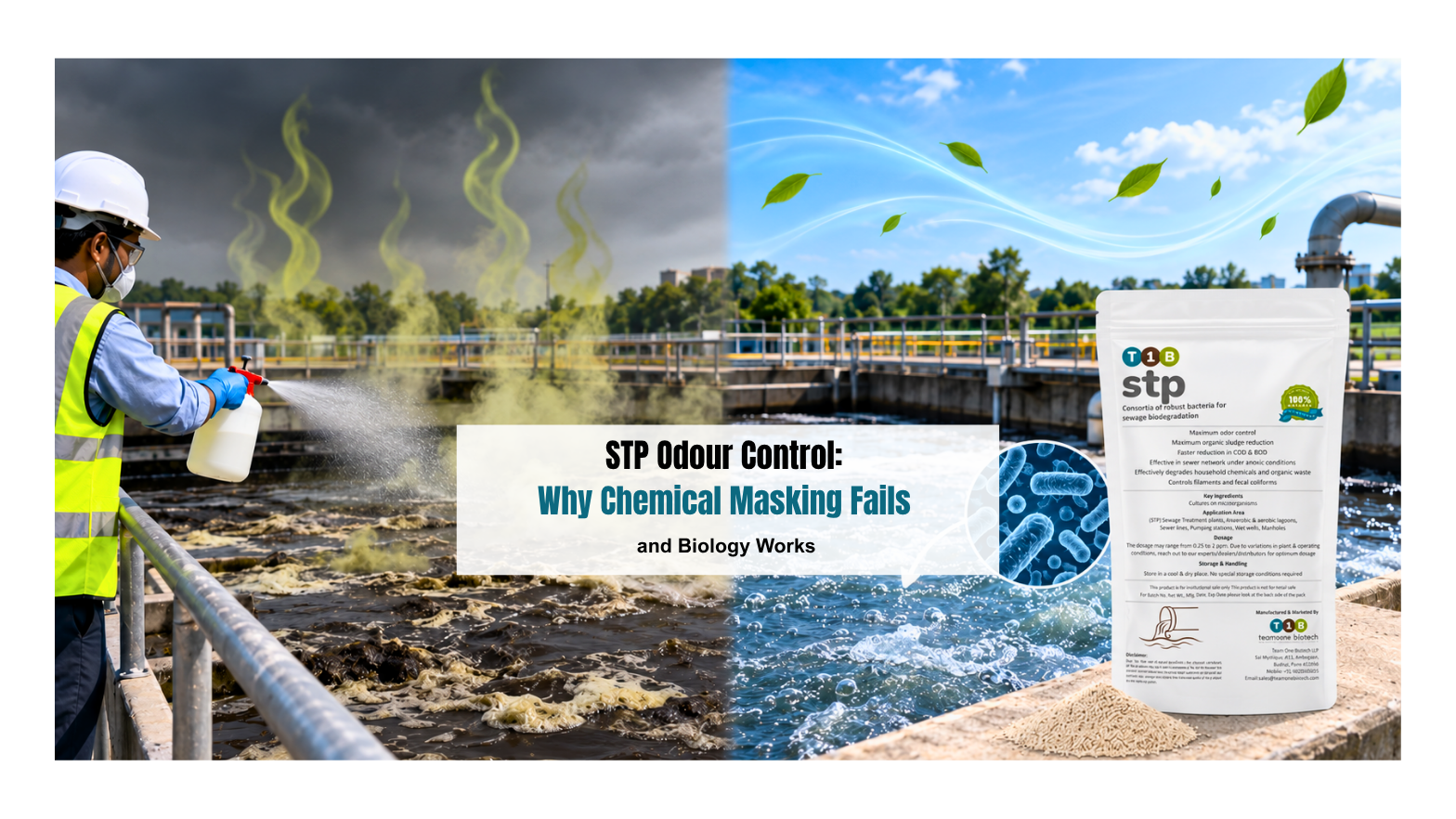

STP Odour Control: Why Chemical Masking Fails and Biology Works
It is a regular Tuesday morning, and before you have even finished your first cup of tea, there are three complaints in your inbox from residents living near the plant boundary. A worker has reported a headache for the second week running. And somewhere in the stack of papers on your desk, there is a regulatory notice that arrived last month, the one you have been meaning to respond to.
You have been buying chemical deodorants, neutralising sprays, and masking agents for months. The procurement team asks every quarter why the odour control budget keeps climbing, and the honest answer is uncomfortable: nothing is actually working.
This is not a story about negligence or indifference. Most STP operators dealing with persistent sewage smell are doing exactly what the market has told them to do, buy the spray, apply it regularly, and hope for improvement. The problem is not the operator. The problem is that the solution being sold is fundamentally the wrong category of intervention.
STP smell is not an air quality problem. It is a biological and chemical process happening deep inside your treatment system, in sludge beds, collection lines, and anaerobic zones. Spraying a fragrance or a neutraliser into the headspace above the water changes nothing about what is generating the odour below the surface. The smell comes back because the source never stopped.
This article explains why that cycle keeps repeating, what is actually causing the odour inside your system, and what a biological approach to STP odour control looks like when it is done properly, not as a product pitch, but as an honest explanation of the microbiology behind the problem and the solution.
What Is Actually Causing the Smell Inside Your STP?
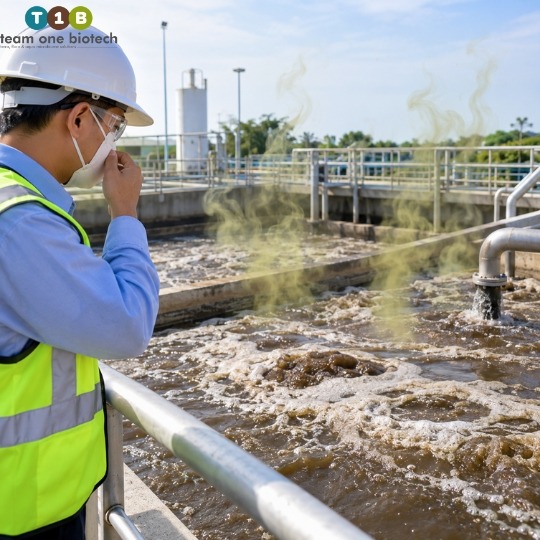
Understanding why STP odour control fails so consistently with chemical approaches requires understanding what is generating the smell in the first place. The short answer is anaerobic microbial activity, but the operational consequences of that activity are worth unpacking in detail.
Hydrogen Sulfide (H2S), The Most Dangerous Odour Compound
H2S is the compound most operators recognise immediately, the sharp, rotten-egg smell that hits you the moment you approach a pump station or open a manhole cover. But hydrogen sulfide in STP systems is far more than a nuisance odour.
H2S forms when sulfate-reducing bacteria (SRB) metabolise sulfate compounds under anaerobic, oxygen-starved, conditions. These conditions are common in collection lines with long retention times, in primary clarifiers, in sludge holding zones, and anywhere the dissolved oxygen level drops to near zero. The SRB thrive in these environments, and hydrogen sulfide is a byproduct of their metabolism.
The hazard profile of H2S is well established in occupational safety literature. At low concentrations, it is perceptible as that characteristic rotten-egg smell. At higher concentrations, which can occur in enclosed pump stations and confined treatment spaces, it becomes acutely toxic and can cause rapid incapacitation. Workers do not always receive adequate warning because H2S also causes olfactory fatigue at moderate concentrations, meaning the smell disappears even as exposure continues.
Beyond worker safety, hydrogen sulfide in STP infrastructure actively degrades the physical plant. H2S in the gas phase reacts with moisture to form sulfuric acid, which attacks concrete structures and metal fittings, accelerating infrastructure deterioration and adding significant long-term cost to a problem operators often frame as just an odour issue.
Disclaimer: Concentration thresholds vary by system design, flow rate, and ambient conditions. Values referenced in any site-specific context should always be assessed against applicable local and national occupational safety standards.
Volatile Fatty Acids (VFAs) and Other Odour Precursors
The other major contributor to sewage smell is a class of compounds called volatile fatty acids, acetic, butyric, propionic, and related acids that form when organic matter breaks down under anaerobic conditions. These are the compounds behind the smells communities describe as rancid, putrid, garbage-like, or simply “sewer.” They are chemically distinct from H2S but often co-exist with it, which is why STP odour tends to be complex and layered rather than a single identifiable smell.
VFAs are produced when the aerobic biological balance inside the STP is disrupted. A well-functioning aerobic zone keeps organic acids from accumulating. When hydraulic overload, inadequate aeration, or poorly managed sludge creates pockets of anaerobic activity, VFA production accelerates, and the odour follows.
Reduced Sulfur Compounds and Ammonia
Mercaptans, dimethyl sulfide, and dimethyl disulfide are reduced sulfur compounds that often accompany H2S and VFAs in STP off-gas. They have extremely low odour thresholds, detectable by the human nose at concentrations well below what poses a direct health risk, which makes them disproportionately responsible for boundary odour complaints even when H2S levels are technically within acceptable ranges.
Ammonia is another contributor, particularly from sludge digestion and nitrogen-rich influent streams. Its sharp, piercing character compounds the overall odour burden and can independently trigger community complaints.
What this picture tells you is that STP odour is not caused by a single compound that can be neutralised with a single chemical. It is a suite of compounds, generated continuously by ongoing anaerobic biological processes, from multiple points within the treatment system.
Why Chemical Masking Agents Are a Band-Aid on a Broken Pipe
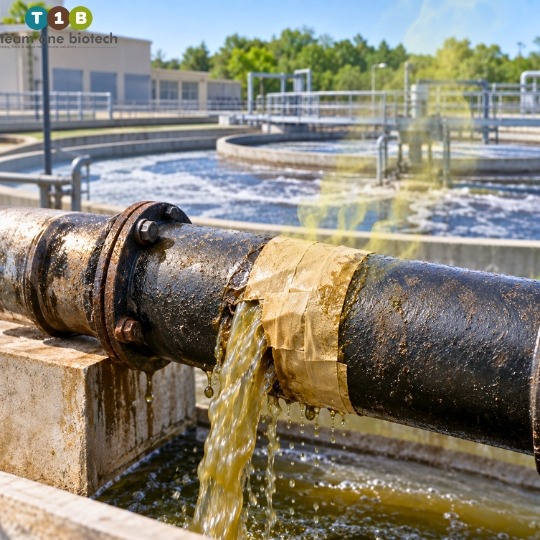
Chemical masking agents, fragrance-based deodorants, oxidising neutralisers, chlorine compounds, hydrogen peroxide dosing systems, represent the dominant market response to STP smell. They are widely available, easy to procure, and offer immediate sensory relief. They are also, in any durable operational sense, the wrong solution. Here is why.
They Address the Air, Not the Source
Every masking agent operates in the gas phase, in the air above the wastewater surface, in the headspace of a pump station, in the atmosphere around a clarifier. The H2S, the VFAs, and the mercaptans being generated inside the sludge and biofilm continue producing at full rate. Nothing has changed in the anaerobic zones where sulfate-reducing bacteria are metabolising sulfate compounds. Nothing has changed in the sludge bed where organic acids are accumulating.
When the masking agent dilutes, when the application interval lapses, or when influent loading increases, the odour returns, often with greater intensity, because the underlying anaerobic condition has frequently worsened in the interim. Operators find themselves increasing dosage and frequency just to maintain the same inadequate baseline. The budget climbs. The problem persists.
Chemical Oxidisers Can Disrupt Your Treatment Biology
This is the dimension of chemical masking that rarely appears in product literature. Oxidising agents, chlorine-based compounds, peroxides, strong neutralisers, do not discriminate between the odour-causing bacteria they are intended to suppress and the beneficial microbial populations that drive BOD and COD reduction in your biological treatment zones.
Introduce an oxidising agent in proximity to an activated sludge tank or a biological filter, and you risk damaging or disrupting the very microbial community your treatment process depends on. Operators who have experienced unexplained drops in effluent quality after aggressive odour treatment have sometimes discovered exactly this mechanism, the sewage smell solution created a different compliance failure downstream.
Regulatory Exposure Remains
Under CPCB and SPCB frameworks, and under most municipal odour abatement provisions, masking odour is not equivalent to abating it. Ambient air quality monitoring at the plant boundary measures actual compound concentrations, H2S, ammonia, and total reduced sulfur, not perceived smell. A site that is generating regulatory-level concentrations of these compounds but applying fragrance to the headspace is still in violation, regardless of what the plant perimeter smells like to a casual observer.
Regulatory inspectors and community monitoring organisations have become increasingly sophisticated. The distinction between genuine odour elimination and chemical masking is visible in the monitoring data, and relying on masking agents as a compliance strategy exposes operators to continued enforcement risk.
Worker safety is a parallel concern. CPCB/SPCB compliance frameworks and occupational health standards set permissible exposure limits for H2S in enclosed workspaces. Masking the perimeter smell does not reduce H2S concentrations inside pump stations, sludge handling areas, or covered treatment units. Workers remain exposed.
Disclaimer: Permissible exposure limits for H2S vary by jurisdiction and regulatory authority. Always refer to applicable local and national standards for your facility.
If your plant is still relying on chemical sprays to manage STP smell, it is time to evaluate what is happening at the microbial level. Connect with our technical team for a no-obligation site assessment.
How Biological Treatment Eliminates Odour at the Source
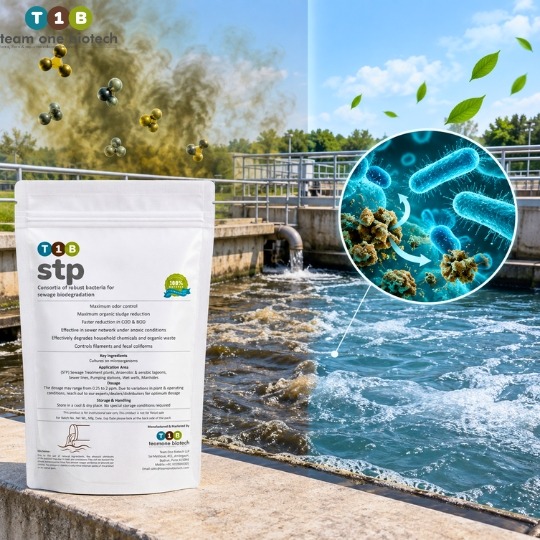
Biological odour treatment is not a new technology, and it is not a complicated concept. It is, at its core, working with the natural microbiology of a well-functioning STP rather than fighting the symptoms that arise when that microbiology goes wrong.
A healthy, well-oxygenated aerobic STP produces very little odour because the aerobic bacterial populations outcompete the sulfate-reducing bacteria responsible for H2S and rapidly metabolise organic acids before they accumulate. The odour problem begins when anaerobic conditions develop, and the biological solution involves restoring competitive balance in those zones.
Targeted Microbial Blends, Rebalancing the Biology
The core intervention in biological odour control is the introduction of specialised microbial consortia, carefully selected communities of bacteria that target the specific conditions producing H2S and VFAs in your system.
These microbial blends are dosed at the points where anaerobic conditions and odour generation are most acute: lift stations, equalisation tanks, primary clarifiers, sludge holding zones, and collection system entry points. The selected strains are chosen for their ability to outcompete sulfate-reducing bacteria under anaerobic conditions, to rapidly degrade volatile fatty acids, and to accelerate the oxidation of reduced sulfur compounds.
Unlike a chemical agent, a properly formulated microbial culture does not simply react with the target compound and disappear. The microbes reproduce. As long as substrate, the organic matter and sulfur compounds they metabolise, is available, the culture maintains itself and continues working. Dosing is ongoing but the mechanism is self-sustaining in a way that chemistry simply cannot replicate.
Measurable indicators of improvement include reduction in H2S readings at established monitoring points, reduction in boundary odour complaints, and, frequently, improvement in overall effluent quality parameters as the microbial community contributes to broader organic load reduction.
Working with a reputable STP bacteria manufacturer who provides verified colony-forming unit counts, strain-specific documentation, and site-specific dosing guidance is essential to achieving consistent results. This is where the quality and specificity of the microbial product makes a material difference, generic consortia without documented strain selection for H2S reduction and VFA degradation will not deliver the same outcomes as a purpose-formulated bioremediation solution.
Disclaimer: Results vary by system hydraulics, influent characteristics, temperature, and loading conditions. Improvement ranges are facility-specific, contact a technical specialist for site-specific expectations.
Bio-Filters, Treating Foul Air Before It Reaches the Boundary
Where enclosed treatment structures generate concentrated odorous off-gas, covered primary clarifiers, enclosed pump stations, sludge dewatering buildings, STP headworks, bio-filter units provide a complementary biological intervention for the gas phase itself.
A bio-filter passes the collected foul air through a biological media bed colonised by microbial populations capable of degrading H2S, mercaptans, VFAs, and ammonia in the gas phase. The compounds are biologically oxidised within the media, not masked, not chemically scrubbed into a liquid waste stream, but broken down into inert end products that can be discharged without regulatory concern.
The operational economics of bio-filtration compare favourably to chemical scrubbers over any meaningful time horizon. Chemical scrubbers require continuous reagent input, caustic soda, sodium hypochlorite, or similar, and generate a contaminated liquid waste stream that requires its own disposal management. A bio-filter requires periodic microbial replenishment and media maintenance, but carries no continuous chemical cost and produces no chemical waste. For enclosed wastewater treatment plant applications where foul air extraction is already in place or planned, bio-filtration as part of a biological odour treatment case study consistently demonstrates superior long-term cost and compliance performance.
The Compliance Advantage of Biological Odour Control
When odour-causing compounds are biologically degraded rather than masked, the results appear in your monitoring data. H2S concentrations at plant boundary monitoring points decrease. Ammonia and total reduced sulfur readings improve. The change is documentable, reportable, and defensible under CPCB/SPCB norms and applicable municipal odour abatement frameworks.
This distinction matters enormously in regulatory interactions. An operator who can present monitoring data showing genuine, sustained reduction in odour compound concentrations, rather than masking agent purchase records, is in a fundamentally stronger compliance position.
Worker safety improves in parallel for the same reason. When H2S concentrations in enclosed spaces decrease because the biological mechanism generating H2S has been suppressed, workers in pump stations and sludge handling areas are genuinely safer, not just exposed to less perceptible smell.
Team One Biotech provides site-specific microbial blends for wastewater treatment and technical support for STP operators across India. Reach out to understand the right biological intervention for your facility.
Choosing the Right Biological Solution, What STP Operators Need to Know
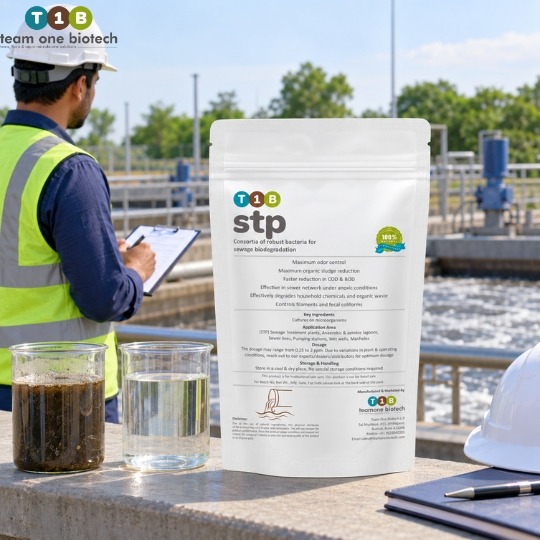
Biological odour control products vary widely in quality, specificity, and supporting technical infrastructure. When evaluating options, consider the following:
- Strain specificity: Is the microbial consortium specifically selected for H2S reduction and VFA degradation in anaerobic STP conditions, or is it a general-purpose culture with broad claims and limited documentation?
- Viability and CFU counts: Is the product manufactured under controlled fermentation conditions with independently verifiable colony-forming unit counts? A product with poor viability on arrival will not perform regardless of strain selection. Disclaimer: Dosing requirements differ based on system volume, loading, and temperature, always follow manufacturer guidance and site-specific recommendations.
- Compatibility with existing processes: Will the microbial culture work alongside existing aeration systems, chemical dosing programs, or nutrient addition without interference? A responsible manufacturer will provide compatibility assessment as part of technical support.
- Technical support depth: Does the manufacturer provide site assessment, hydraulic review, dosing protocol design, and performance monitoring, or do they supply the product and leave the operator to figure out application? The implementation support model is often as important as the product itself.
- Regulatory documentation: Does the manufacturer provide safety data sheets, environmental clearances, and documentation that supports compliance reporting? This matters when auditors and regulatory bodies request evidence of the odour abatement approach.
Team One Biotech’s approach integrates all of these elements, STP bacteria solutions designed for specific anaerobic conditions, manufacturing standards that ensure culture viability at the point of application, and a technical team that works with operators through assessment, implementation, and monitoring.
Frequently Asked Questions About STP Odour Control
Why does STP smell keep coming back even after chemical treatment?
Chemical masking agents address odour in the air but do not stop the biological processes generating H2S and volatile fatty acids inside the system. The sulfate-reducing bacteria producing H2S continue operating in anaerobic zones regardless of what is applied to the headspace above them. Without treating the source, odour will return as soon as application intervals lapse or loading conditions change.
Is biological odour control safe for use in operating STPs?
Yes. Properly formulated microbial blends used in bioremediation for STP applications are non-pathogenic, non-toxic, and compatible with standard STP operations. They do not interfere with BOD and COD reduction in aerobic zones when applied correctly, in fact, the overall biological health of the system frequently improves as organic acid accumulation decreases.
How long does it take for biological treatment to show results in an STP?
Most operators observe measurable improvement in H2S monitoring readings and a reduction in community complaints within a few weeks of consistent application, with continued improvement as the microbial population establishes. Improvement timelines depend on system size, influent loading, existing microbial conditions, and temperature. Disclaimer: Actual timelines differ by facility, contact a technical specialist for site-specific expectations.
Does biological odour control meet CPCB and SPCB compliance requirements?
Biological treatment that genuinely reduces odour-causing compounds produces documentable improvement in ambient air quality parameters, which is the basis of regulatory compliance under CPCB and SPCB frameworks. Monitoring records that demonstrate sustained reduction in H2S and other odour compounds provide far stronger regulatory standing than records of masking agent procurement. Always maintain systematic monitoring documentation.
What is the difference between a bio-filter and a chemical scrubber for STP air treatment?
A chemical scrubber uses reagent chemicals, typically caustic soda or sodium hypochlorite, to neutralise odorous gases, requiring continuous chemical input and generating a contaminated liquid waste stream requiring disposal. A bio-filter uses living microbial media to biologically degrade the same compounds, with minimal ongoing operational cost, no chemical waste stream, and sustained efficacy as the microbial community maintains itself on incoming substrate.
Stop Masking the Problem. Start Eliminating It.
STP odour is a biological problem. H2S forms because sulfate-reducing bacteria are operating in anaerobic conditions inside your system. Volatile fatty acids accumulate because organic matter is decomposing without adequate aerobic activity. Mercaptans and reduced sulfur compounds co-exist with these primary offenders, compounding the odour burden at the plant boundary.
No fragrance, no oxidising spray, no chemical neutraliser changes any of those underlying processes. They change the smell in the air for a period of time, and nothing more.
Operators dealing with community complaints, worker safety concerns, regulatory notices, and escalating chemical budgets are not facing a procurement problem, they are facing a diagnosis problem. The intervention category being applied does not match the nature of the problem. That is a systemic failure of the market, not of the people managing these plants under genuine operational pressure.
Microbial odour control, through targeted bacterial consortia applied at anaerobic source points and bio-filtration for enclosed off-gas, treats STP odour where it is generated, not where it is perceived. The results are measurable in monitoring data, documentable for regulatory purposes, and sustainable because the biological mechanism that drives them is self-reinforcing rather than consumable.
The operational case is not complicated: biological treatment costs less over time, produces defensible compliance evidence, improves worker safety in a way that masking cannot, and does not risk degrading effluent quality through interference with treatment biology.
Team One Biotech has been supporting STP operators across India in making this transition, from temporary chemical fixes to permanent biological solutions grounded in microbiology and backed by site-specific technical expertise. If your plant is dealing with persistent sewage smell, H2S hazards, escalating odour complaints, or compliance pressure that chemical masking has failed to resolve, our technical team is ready to help.
Looking to improve your ETP/STP efficiency with the right bioculture?
Talk to our experts at Team One Biotech for customised microbial solutions.
Contact: +91 8855050575
Email: sales@teamonebiotech.com
Visit: www.teamonebiotech.com
Discover More on YouTube – Watch our latest insights & innovations!-
Connect with Us on LinkedIn – Stay updated with expert content & trends!