
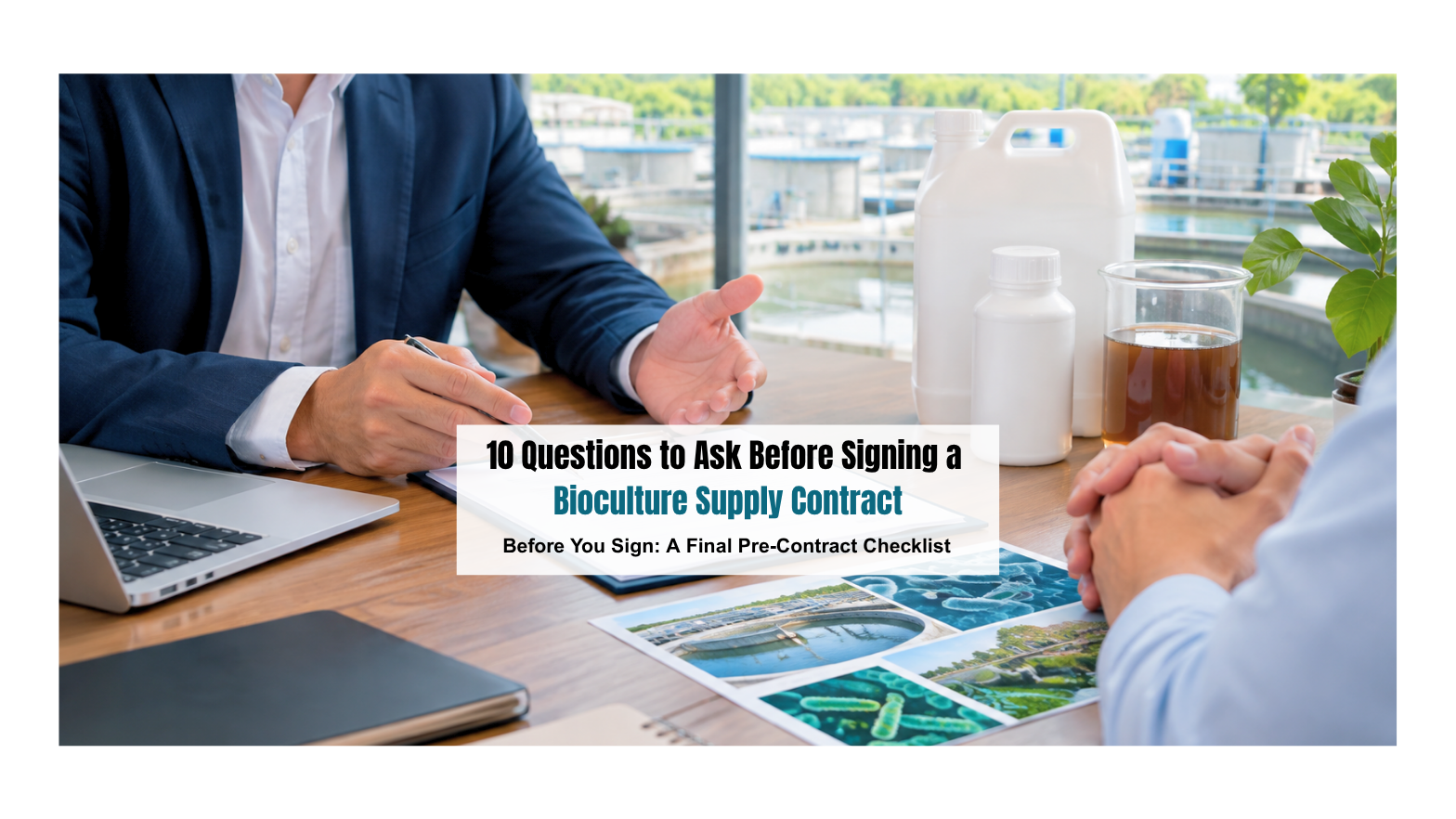

10 Questions to Ask Before Signing a Bioculture Supply Contract
A facility manager at a mid-sized industrial ETP trusted a supplier’s sales pitch. The presentation was polished, the price was competitive, and the contract was signed within a fortnight. Three months later, a batch arrived underpotent. The microbial population in the aeration tank thinned out, BOD and COD readings climbed, and the effluent failed discharge norms. When the State Pollution Control Board (SPCB) asked for explanations, the manager went back to the contract, only to find there was no enforceable CFU guarantee anywhere in it.
This is not a hypothetical. As a manufacturer supplying bioculture to industrial and municipal plants across India, Team One Biotech has seen versions of this story more than once. The pattern is always the same: a purchasing decision made on price and promises, and a compliance problem that follows.
Choosing a bioculture supplier is not a price negotiation exercise. It is a risk management decision. Your biological treatment supply chain sits directly underneath your regulatory standing, and a weak link in it becomes your problem, not the supplier’s.
The bioculture supplier questions below are not just due diligence. They are your last line of defense before a long-term commitment that directly affects your compliance record. Whether you manage a single ETP, oversee a network of STPs, or lead corporate procurement for wastewater bioculture procurement across multiple sites, these questions apply to you.
Why Bioculture Supplier Evaluation Is a High-Stakes Decision

Biological performance is not like buying chemicals or mechanical parts. A pump either works or it does not, and a chemical either meets specification or it does not. A bioculture product is a living system, and a bad batch does not simply underperform. It can destabilize the entire microbial ecosystem in your treatment plant, undoing weeks of acclimatization in days.
There is also the matter of dependency. Once a microbial community is seeded and adapted to your influent, switching products or suppliers mid-cycle is operationally costly. You are not just changing a vendor; you are disturbing a working biological balance.
Finally, there is regulatory exposure. CPCB and SPCB discharge norms are non-negotiable. When a supplier fails, it quickly becomes your compliance failure, with audits, notices, and possible penalties landing on your desk, not theirs.
The 10 Questions You Must Ask Before You Sign

Question 1: What Is Your Guaranteed CFU Count Per Batch, and How Is It Verified?
Why it matters: CFU (Colony Forming Units) per gram or milliliter is the only objective measure of product potency. A supplier who cannot guarantee CFU count is selling you a biological unknown. Any serious CFU consistency supplier should treat this question as the baseline, not a favor.
What a good answer looks like: A documented Certificate of Analysis (CoA) for every batch, issued by an accredited laboratory, showing CFU count within a defined, contracted range. The range should be written into the agreement itself, not left in a brochure.
Red flag: Vague language like “millions of CFUs” with no quantifiable floor value and no third-party verification. If the number cannot be measured and enforced, it is marketing, not a specification.
Disclaimer: CFU requirements vary significantly based on plant type, influent load, and treatment objectives. The values acceptable for your facility should be determined in consultation with a qualified environmental engineer.
Question 2: Is There Batch-to-Batch Consistency, and What Is Your Deviation Tolerance?
Why it matters: Biological treatment systems thrive on stability. Inconsistent microbial populations between batches cause unpredictable treatment efficiency, which can be worse than no dosing at all. Your operators tune dosing around expected performance, and a batch that behaves differently from the last one throws that tuning off.
What a good answer looks like: The supplier has documented Standard Operating Procedures (SOPs) for production, with defined acceptable deviation ranges and a replacement or credit policy when deviations occur. Ask to see how consistency is monitored across production runs, not just at final dispatch.
Red flag: No SOP documentation, or claims of “natural variation” used to justify inconsistency. Biology is variable, but a competent manufacturer controls that variability. It does not excuse it.
Question 3: Are Your Microbial Strains Patented or Proprietary? Can You Provide Documentation?
Why it matters: Proprietary, well-characterized strains backed by patent or trade secret documentation indicate genuine R&D investment. They also reduce the risk of contaminated, substituted, or diluted cultures, a risk that rises when a supplier is simply repackaging someone else’s product.
What a good answer looks like: Documented strain identity (genus, species, and function), the rationale behind the proprietary blend, and ideally, performance data for those strains under varying conditions such as temperature swings, salinity, or shock loads.
Red flag: A refusal to share any strain documentation, or generic descriptions like “naturally occurring bacteria” with no further characterization. If the supplier cannot tell you what is in the product, you cannot predict what it will do in your tank.
Question 4: What Is the Shelf Life of Your Product, and Under What Storage Conditions?
Why it matters: A bioculture product that degrades before application is money spent on dead biology. Shelf life directly determines your procurement planning windows and inventory risk, particularly for plants with seasonal load variation or irregular dosing schedules.
What a good answer looks like: A clearly stated shelf life on the label and in the contract, with storage temperature requirements, humidity guidelines, and a performance guarantee tied to proper storage. The supplier should also specify how potency is expected to change over the shelf-life window, not just the expiry date.
Red flag: Shelf life stated verbally but not written into the contract, or no guarantee clause if the product fails before expiry under correct storage. A verbal promise has no value in a dispute.
Disclaimer: Shelf life performance may vary based on local storage infrastructure and ambient conditions at individual facilities.
Question 5: What Technical Support Do You Provide Post-Supply, and What Is Your SLA?
Why it matters: Bioculture is not a set-and-forget input. Dosing, acclimatization protocols, and troubleshooting all require ongoing technical engagement, especially during plant startup or upset conditions. When your MLSS drops or foaming appears at 2 a.m., you need a technical team that responds, not a sales representative who has moved on to the next account.
What a good answer looks like: A documented Service Level Agreement (SLA) for on-site or remote technical support, with defined response time windows and escalation protocols. It should specify who you call, how quickly they respond, and what happens if they do not.
Red flag: Technical support offered enthusiastically during the sales pitch but not written into the contract. If support is not in the document, it is not part of the deal.
Team One Biotech includes post-supply technical support as a standard commitment, not an afterthought. Talk to our team to understand what that looks like for your plant.
Question 6: How Do You Handle Supply Disruptions or Force Majeure Events?
Why it matters: A wastewater treatment plant cannot pause operations. Supply disruptions, whether from manufacturing issues, logistics failures, or seasonal raw material constraints, must carry contractual remedies. Without them, you absorb the entire operational consequence of a supplier’s problem.
What a good answer looks like: A written contingency plan in the contract, including alternate sourcing provisions, priority supply clauses, advance notice requirements, and compensation terms for delays. Ask where the supplier manufactures and whether production depends on a single facility.
Red flag: Contract language that completely indemnifies the supplier for all disruptions without any obligation to mitigate. Force majeure should cover genuine, unforeseeable events, not ordinary supply chain failures dressed up in legal language.
Question 7: What Are the Liability Clauses If the Product Fails to Perform?
Why it matters: If a bioculture product fails, resulting in an effluent discharge violation, regulatory action, or treatment upset, who bears the cost? This must be answered before signing, not after. In an ETP bioculture contract, the liability section is often the most heavily one-sided clause, and it is frequently the least scrutinized.
What a good answer looks like: Performance-linked liability clauses, clear definitions of what constitutes “failure,” exclusions that are reasonable and narrow, and a dispute resolution mechanism that does not require years of litigation. The contract should link supplier accountability to measurable outcomes such as CoA compliance.
Red flag: Blanket “no liability” clauses or vague “best effort” language with no performance benchmark attached. A supplier confident in their product has no reason to avoid accountability for it.
Question 8: Does Your Product Comply With CPCB and SPCB Guidelines for Biological Additives?
Why it matters: Regulatory compliance is non-negotiable. Using a bioculture product that does not align with national or state pollution control board guidelines can expose your facility to audit risk and questions during inspections. CPCB compliance bioculture documentation should be available on request, not hunted down after a notice arrives.
What a good answer looks like: The supplier is familiar with CPCB and SPCB frameworks and can provide documentation of product composition confirming it does not include restricted organisms or prohibited components. They should also understand that requirements can differ between states and be able to speak to your SPCB’s specific expectations.
Red flag: The supplier is unfamiliar with Indian environmental regulations, or dismisses compliance questions as irrelevant to their product category. A supplier that does not understand your regulatory environment cannot protect you within it.
Question 9: Can You Provide References From Similar Industrial or Municipal Plants?
Why it matters: A supplier with a proven track record in plants similar to yours, in terms of influent type, capacity range, and discharge norms, carries meaningfully lower risk than one operating on theoretical claims. Results in a textile ETP say little about performance in a pharmaceutical effluent stream or a municipal STP.
What a good answer looks like: At least two or three verifiable references from ETP or STP operations of comparable complexity, with contact details and a willingness to facilitate a direct conversation. Ask the reference what went wrong at any point and how the supplier responded. That answer is often more revealing than the success story.
Red flag: References that are unavailable, unverifiable, or drawn from completely dissimilar applications. Reluctance to connect you with existing clients is itself information.
Question 10: What Are the Payment, Pricing Escalation, and Renewal Terms?
Why it matters: Long-term contracts with no price escalation caps or unclear renewal terms can expose procurement budgets to unpredictable cost increases, especially in a market where fermentation input costs are volatile. A competitive first-year price means little if year-two pricing is open-ended.
What a good answer looks like: A defined pricing structure, a transparent escalation mechanism linked to a published index or capped at a stated ceiling, and renewal terms that require mutual consent rather than automatic renewal. Payment terms should be clear on timelines, advance requirements, and any penalties.
Red flag: Open-ended escalation language or auto-renewal clauses buried in the contract’s fine print. If you need a magnifying glass to find the renewal terms, assume they do not favor you.
Before You Sign: A Final Pre-Contract Checklist

Before any signature goes on a bioculture contract, your procurement team should have the following in hand. Use this as your bioculture procurement checklist, and share it with legal and technical colleagues alike:
- Verified CoA with an agreed CFU range
- Signed SLA with response time commitments
- Liability and performance clause review completed
- CPCB/SPCB documentation confirmed
- Minimum two references validated directly
- Shelf life guarantee in writing
- Price escalation cap confirmed
- Contingency supply clause included
- Strain documentation reviewed
- Legal review of force majeure terms
This is not bureaucratic box-ticking. It is operational self-defense. Every item on this list corresponds to a failure that has cost a real plant real money, time, or regulatory goodwill. A procurement process that skips these steps is not faster. It simply moves the cost to a later date, usually a worse one.
If your team is also running a broader bioculture vendor evaluation across multiple suppliers, apply the same checklist to each one. The comparison will tell you more than any price sheet.
The Right Supplier Is a Long-Term Partner, Not Just a Vendor

The best bioculture supplier relationships are partnerships, not transactional exchanges. The questions in this article are not adversarial. They are the foundation of a relationship built on accountability and trust. A supplier who welcomes these questions, answers them directly, and puts the answers in writing is a supplier who expects to be around for the long term.
Team One Biotech approaches supply from a specific position: as a manufacturer, not a distributor. That means we control every variable in the chain, from strain development to batch testing to delivery. There is no intermediary to blame and no gap in accountability. When you ask us about CFU verification, batch consistency, or liability, you are asking the people who actually make the product.
If a supplier cannot answer these questions confidently and in writing, that is your answer. Contact Team One Biotech to understand how we approach every supply contract: with transparency, documented performance guarantees, and a technical team that stays with you after the ink dries. Request a consultation today.
Looking to improve your ETP/STP efficiency with the right bioculture?
Talk to our experts at Team One Biotech for customised microbial solutions.
Contact: +91 8855050575
Email: sales@teamonebiotech.com
Visit: www.teamonebiotech.com
Discover More on YouTube – Watch our latest insights & innovations!-
Connect with Us on LinkedIn – Stay updated with expert content & trends!