
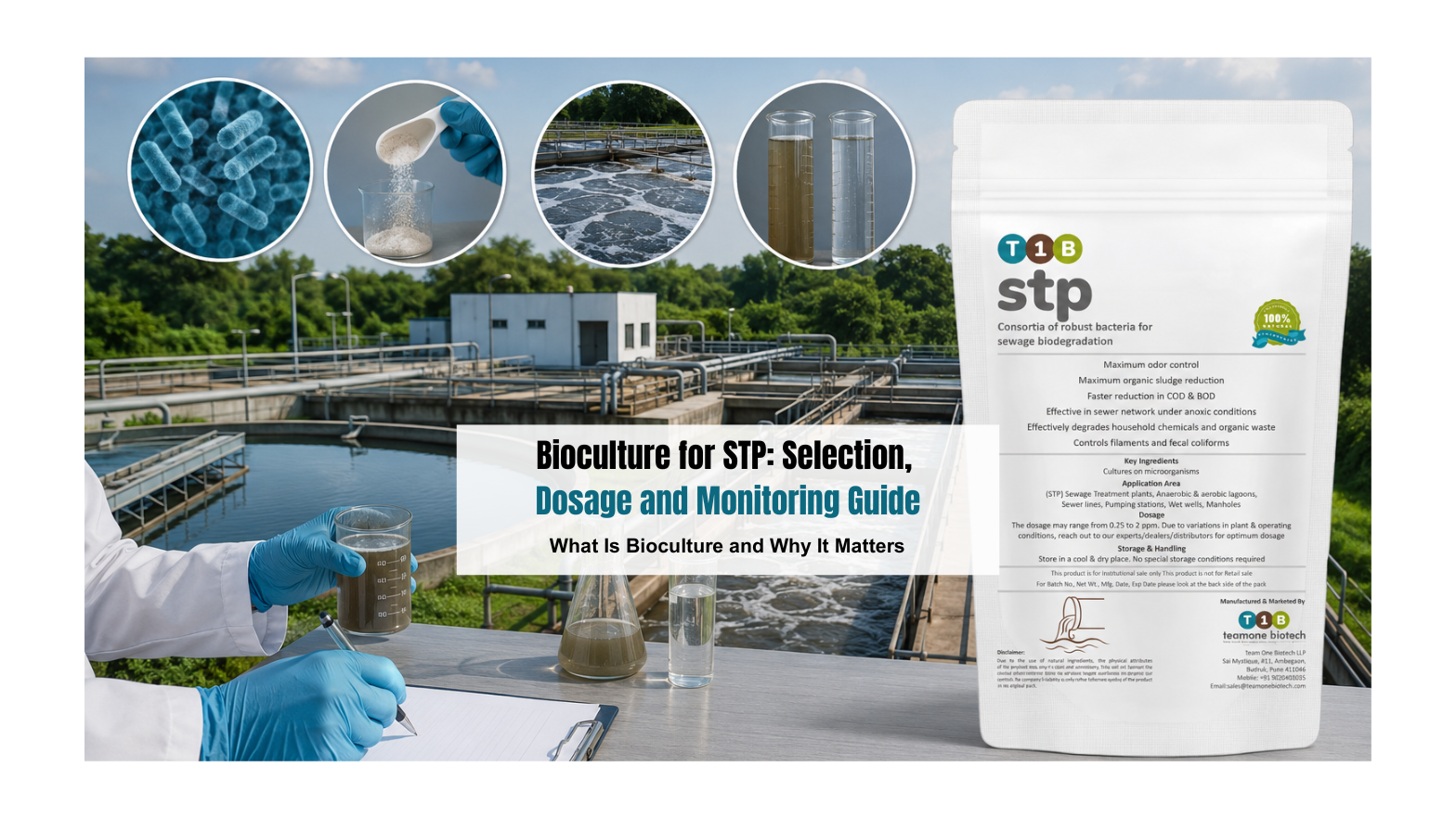

Bioculture for STP: Selection, Dosage, and Monitoring Guide
You’ve checked the aeration tank twice this morning. The MLSS looks fine. The DO meter reads where it should. And yet the lab report that comes back later in the day sits right on the edge of your discharge limit, not a violation, but close enough to keep you up at night.
If you run or manage a sewage treatment plant, you know this feeling. It’s not one big crisis. It’s the slow accumulation of small uncertainties, a load that swings more than it should, a sludge that settles a little slower this week, an SPCB inspection that could land any day without warning. You’ve done nothing wrong, and yet the plant’s biology doesn’t always cooperate with your compliance calendar.
This is where bioculture comes in. In plain terms, bioculture, sometimes called bacteria powder, is a concentrated blend of beneficial microorganisms added to a treatment system to strengthen its natural biological process. It doesn’t replace good plant design or operational discipline. It supports the living part of your system, the part that actually breaks down organic waste, so that BOD, COD, and TSS come down consistently instead of drifting with every change in influent.
This guide walks through three practical questions every operator eventually asks: which bioculture to choose, how much to dose, and how to monitor whether it’s actually working. Team One Biotech has spent years formulating Biocultures for STP, and this guide draws on that ground-level experience rather than textbook theory.
What Is Bioculture and Why It Matters for Sewage Treatment
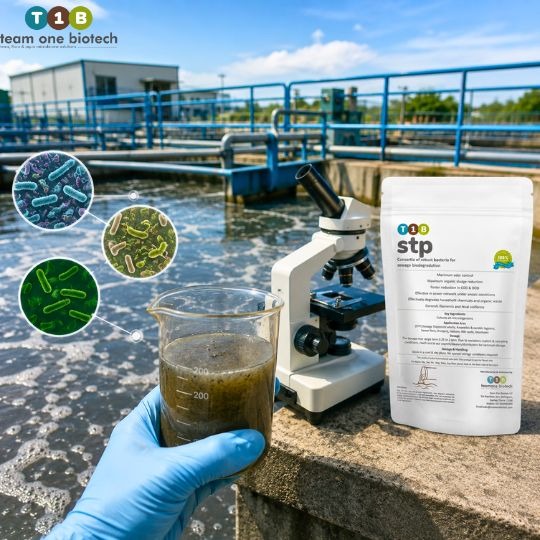
Every STP already relies on microorganisms to do the heavy lifting, that’s the whole idea behind activated sludge and similar biological processes. Bioaugmentation simply means introducing an additional, concentrated population of beneficial microbes in sewage treatment systems to reinforce that natural process, especially when the existing microbial community is stressed, slow to establish, or struggling with a difficult influent.
If you’re wondering about the specific microorganism used for sewage treatment, most commercial bioculture products rely on a mix of facultative and aerobic bacterial strains, along with nitrifying bacteria that support ammonia removal. Good formulations are typically multi-strain rather than single-species, because a broader microbial toolkit adapts better to the variability every real plant sees, different loads, different temperatures, different industrial inputs.
None of this matters, though, unless it translates into a result you can point to on a compliance report. The goal of bioaugmentation for a sewage treatment plant was never “add more bacteria” for its own sake. It’s consistent, defensible BOD, COD, and TSS reduction, the numbers that actually keep an SPCB inspector satisfied and keep your plant off a show-cause notice list.
How to Select the Right Bio Culture for Your STP
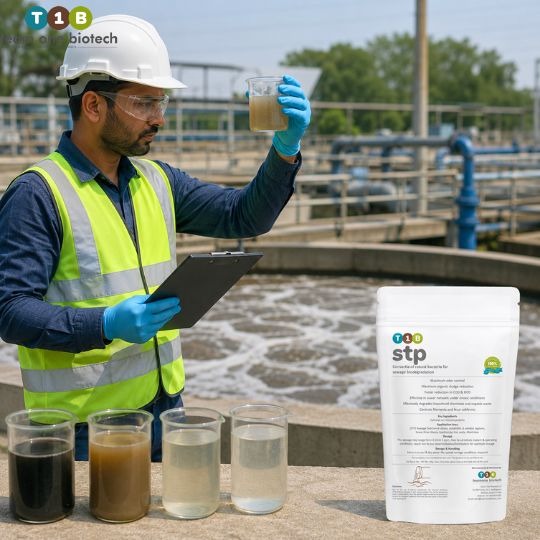
Not every bacteria powder on the market is built for your plant. Selection should start with your influent and your process, not with whatever product a supplier happens to be pushing that month.
Understand Your Influent Characteristics
Before choosing a bio culture for wastewater treatment, take an honest look at what’s actually coming into your system:
- Organic load variability, does your influent load swing sharply between shifts or seasons?
- Presence of oil and grease, which can smother biological activity if untreated
- Industrial trade effluent mixing in with domestic sewage, which changes the chemistry considerably
- pH swings that stress or kill sensitive microbial populations
- Temperature fluctuations, particularly in plants exposed to strong seasonal variation
A culture that performs beautifully on a steady domestic-only influent may struggle the moment industrial effluent enters the mix. Knowing your influent profile isn’t a formality, it’s the foundation everything else is built on.
Match the Culture to Your Treatment Process
Your treatment configuration also shapes which formulation will work best:
- Activated sludge systems generally need cultures that integrate well with existing floc structure
- SBR (Sequencing Batch Reactor) setups benefit from cultures that establish quickly within batch cycles
- MBBR systems need strains that colonize biofilm carriers effectively
- Extended aeration plants often do well with hardier, slower-growing strains suited to longer retention times
There’s no universal “best” bioculture, there’s a best fit for your specific process, and that fit is worth taking seriously before you commit to a product.
Look for Quality Indicators in a Bacteria Powder
Not all bacteria powders are created equal, even when the labels sound similar. A few things worth checking:
- Viable colony count at the time of use, not just at manufacture
- Shelf stability under your storage conditions, especially in humid or high-heat environments
- Multi-strain formulation rather than a narrow, single-species blend
- Ease of activation and dosing, so your operators aren’t fighting the product just to use it
A quick technical conversation can save months of trial and error here. If you’re not sure which bioculture formulation actually fits your plant’s design and influent profile, Team One Biotech’s technical team can walk through a quick assessment with you before you commit to anything.
Dosage Guidelines, Getting the Balance Right
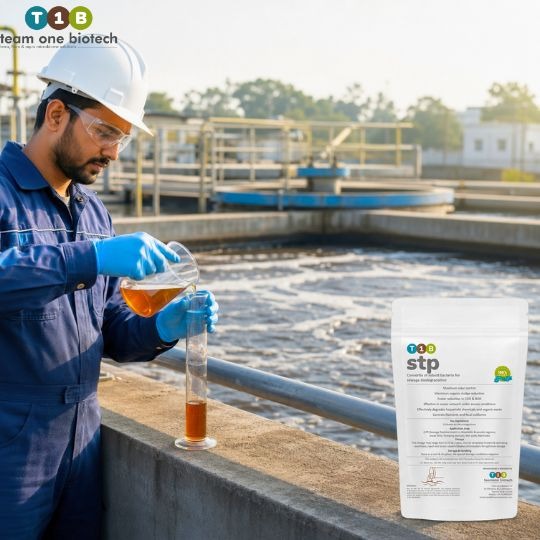
Here’s something worth saying plainly: stp bioculture dosage is never one-size-fits-all, no matter how confidently a product label states otherwise. The right dose depends on your plant’s organic load, retention time, current biological health, and whether you’re starting up a new system or maintaining an established one.
Broadly speaking, dosing tends to fall into three general phases:
- Initial seeding or startup dosing, typically a higher range, since you’re establishing a microbial population from a low baseline
- Maintenance dosing, usually a comparatively lower, steady range once the biological process has stabilized
- Recovery dosing after a shock load, often elevated again, temporarily, to help the system recover from an upset like a toxic spike or sudden overload
A quick but important disclaimer: any dosage ranges discussed here, or anywhere else in this guide, are general and indicative in nature. Actual dosage should be determined based on your plant’s specific BOD/COD load, hydraulic and solids retention time, and ideally, lab trial results. Figures genuinely differ from ETP to ETP, and what works for a neighboring plant may not translate directly to yours.
Rather than guessing at a starting dose, it’s usually far more efficient to get a tailored recommendation. If it would help, you can request a dosage guidance sheet or a short consultation with Team One Biotech’s application team based on your plant’s actual parameters.
Monitoring Biological Health and Effluent Stability
Selecting the right culture and dosing it correctly only gets you halfway. The other half is knowing whether it’s actually working, and catching problems before they show up in a lab report you can’t explain away.
Key Parameters to Track
A solid monitoring routine keeps an eye on:
- BOD and COD trends over time, not just single readings
- MLSS and MLVSS to gauge biomass concentration and health
- Dissolved oxygen (DO) levels, since aerobic microbes need adequate oxygen to function
- Sludge Volume Index (SVI) as an indicator of settling quality
- pH, which affects nearly every biological process in the system
- Odor, which is often the first sign something’s off, long before lab numbers confirm it
Early Warning Signs of Biological Stress
Certain symptoms tend to show up before a full compliance failure does:
- Foaming on aeration tanks or clarifiers
- Bulking sludge that won’t settle properly
- A sudden BOD or COD spike with no obvious external cause
- Odor complaints from nearby residents or staff
- Reduced settling, leading to solids carryover in the effluent
Catching these early gives you room to act, adjusting dosing, checking for a shock load source, or bringing in technical support, well before an inspection forces the issue.
Building a Simple Monitoring Routine
You don’t need a laboratory-grade monitoring program to stay ahead of problems. A practical routine generally combines frequent visual checks, daily or near-daily observation of foam, color, odor, and settling, with periodic lab testing at a cadence appropriate to your plant’s capacity and risk profile.
As with dosage, monitoring frequency and acceptable thresholds vary meaningfully depending on plant capacity, your regulatory zone, and how sensitive your discharge point is. What’s adequate for a small housing society STP may fall short for a plant discharging near an ecologically sensitive water body.
Staying Ahead of CPCB/SPCB Compliance
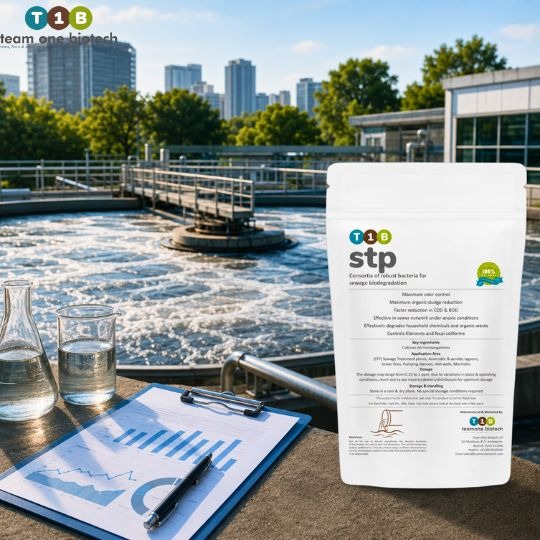
Everything above, selection, dosing, monitoring, ultimately serves one purpose: keeping your BOD, COD, and TSS consistently within limits, so a CPCB or SPCB inspection is a formality rather than a source of dread.
Most operators aren’t afraid of the standard itself. They’re afraid of the unpredictability, the possibility that a plant that’s been performing fine for months suddenly throws a bad reading on the one day someone’s checking. That fear is legitimate, and it’s exactly what a well-managed bioaugmentation program is designed to reduce.
Proactive bioculture management is, in almost every case, cheaper and considerably less stressful than reactive firefighting after a non-compliance notice lands on your desk. Penalty risk, forced downtime, and the reputational cost of a shutdown notice all cost more, in money and in peace of mind, than a properly planned bioaugmentation program ever will.
If you’d rather address this proactively than wait for a problem to force your hand, Team One Biotech offers plant assessments, sample trials, and technical consultations built around your actual operating conditions, not a generic playbook.
Frequently Asked Questions
What is bioculture used for in sewage treatment plants?
Bioculture is used to strengthen the biological treatment process in an STP, helping the system break down organic waste more consistently. It’s particularly useful when a plant’s natural microbial population is under stress, slow to establish, or struggling with a difficult or variable influent.
How do I know if my STP needs bioaugmentation?
Signs typically include inconsistent BOD/COD reduction, recurring odor complaints, poor sludge settling, or difficulty meeting discharge norms despite otherwise normal operation. If these issues recur rather than appearing as one-off events, bioaugmentation is worth evaluating.
Can bioculture dosage be adjusted seasonally?
Yes, and in many plants it should be. Seasonal shifts in temperature and load can affect microbial activity, so dosing is often adjusted, generally within a moderate range, to account for these changes. As always, the right adjustment depends on your specific plant conditions rather than a fixed seasonal formula.
Is bacteria powder safe to handle and store on-site?
Quality bacteria powders are generally formulated to be safe for routine handling by trained plant staff, with standard precautions similar to other treatment chemicals. Storage conditions matter for shelf stability, so it’s worth confirming specific handling and storage guidance from your supplier.
How soon will I see results after starting bioculture dosing?
Results vary depending on your plant’s starting condition, load, and dosing approach, but noticeable improvement in parameters like settling and odor often begins within a period ranging from a few days to a couple of weeks. As with dosage and monitoring thresholds, actual timelines differ from plant to plant and shouldn’t be treated as a fixed guarantee.
Conclusion, Building a More Resilient, Compliant STP
Getting bioculture right isn’t about finding a single magic product. It’s about matching the right culture to your influent and process, dosing it based on your plant’s actual conditions rather than a generic label, and monitoring consistently enough to catch problems while they’re still small. Put those three together, and you get something every operator actually wants: stable effluent, fewer surprises, and a lot less anxiety around inspection day.
If you’re ready to move from guesswork to a plan built around your plant’s real numbers, Team One Biotech is glad to be that partner, whether that starts with a plant assessment, a sample trial, or simply a conversation with our technical team.
As a final note: all dosage figures, timeframes, and parameter ranges discussed throughout this guide are general, indicative values meant to illustrate typical patterns. Every ETP and STP is different, and actual figures should always be evaluated based on your plant’s specific influent, load, design, and lab trial results.
Looking to improve your ETP/STP efficiency with the right bioculture?
Talk to our experts at Team One Biotech for customised microbial solutions.
Contact: +91 8855050575
Email: sales@teamonebiotech.com
Visit: www.teamonebiotech.com
Discover More on YouTube – Watch our latest insights & innovations!-
Connect with Us on LinkedIn – Stay updated with expert content & trends!