
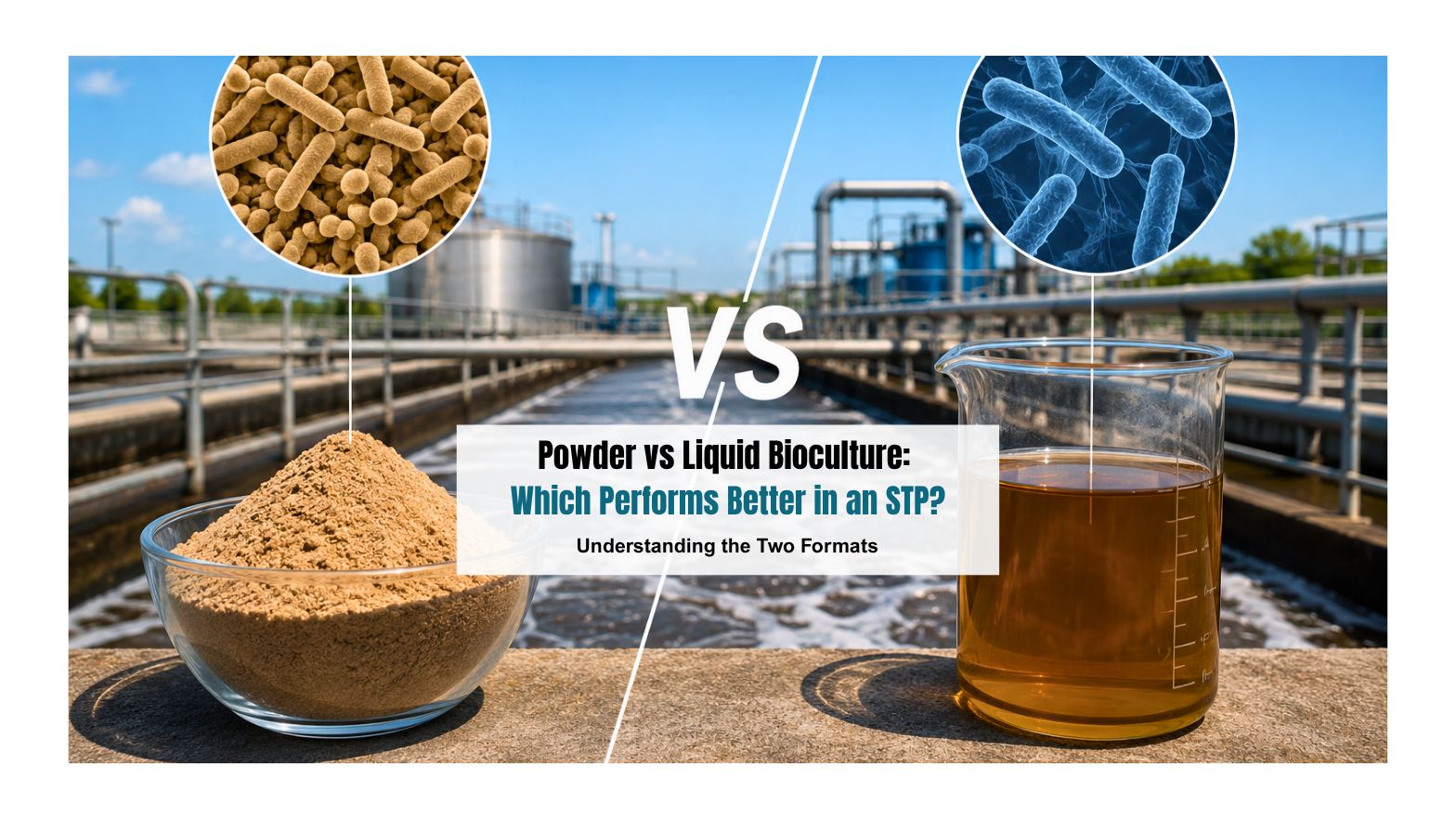
Powder vs Liquid Bioculture: Which Performs Better in an STP?
There is a particular kind of dread that settles in when a discharge report comes back non-compliant. The calls start, the paperwork stacks up, and somewhere in the middle of it all, someone asks the question that should have been asked earlier: did biology fail us, or did we fail biology?
For STP operators, plant superintendents, and biological process engineers working under the constant watch of CPCB and SPCB discharge standards, biological performance is not an abstract concern. It is a daily operational reality. BOD, COD, and suspended solids limits do not wait for your biomass to recover from a rough week. And when something goes wrong with the microbial community in your aeration tank, every hour of delay carries a compliance cost.
One of the decisions that sits quietly beneath this pressure, often made once and rarely revisited, is the choice of bioculture format. Specifically, the powder vs liquid bioculture question. Both are used in biological sewage treatment, but across the diverse operational landscape of Indian STPs, powder bioculture has emerged as the format that works reliably across a broader range of real-world conditions. This article explains why, while giving liquid bioculture its fair assessment where it genuinely earns it.
Understanding the Two Formats: What You Are Actually Buying
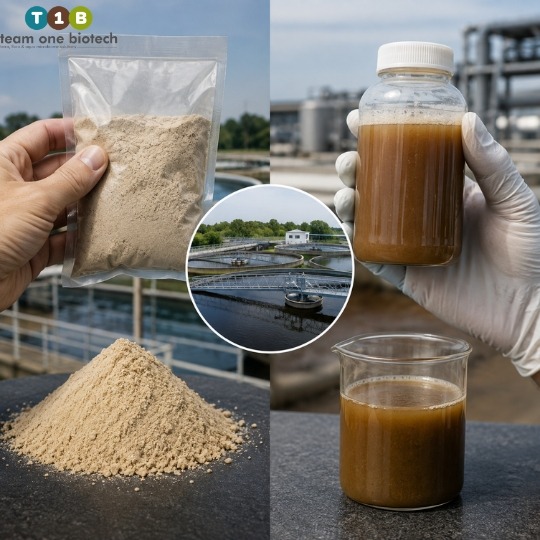
Before comparing, it helps to understand what each format fundamentally is and how it behaves from the moment it leaves the manufacturer’s facility to the moment it enters your aeration tank.
What Is Powder Bioculture?
Powder bioculture is a dry, shelf-stable microbial formulation. The organisms within it have been processed, typically through spray-drying or lyophilisation, into a dormant or spore-based state. This processing is not just a preservation technique. It is an engineering decision that gives powder bioculture a resilience that liquid formats cannot match across varied storage environments, transport conditions, and procurement timelines.
When you open a bag of powder bioculture, you are handling dormant organisms that need to be rehydrated and activated before they begin working in your system. That activation step, done correctly in clean, dechlorinated water at the right temperature, is straightforward and well within the capability of any competent STP operator. The lag between dosing and observable biological activity is a known, manageable variable, not a hidden risk.
What makes powder bioculture particularly well-suited to Indian STP conditions is its stability. From a municipal plant in the hills of Uttarakhand to a housing society STP on the outskirts of Chennai, powder bioculture can be transported without refrigeration, stored without cold infrastructure, and drawn from inventory months after procurement without meaningful loss of viability. That kind of operational flexibility is not a minor benefit. For the majority of STP facilities operating across this country, it is the difference between a dependable biological tool and one that requires constant management.
What Is Liquid Bioculture?
Liquid bioculture is a suspension of live or semi-active microorganisms in a liquid medium. The organisms have not been placed into dormancy, which means they are already metabolically active or close to it at the time of dosing. This gives liquid bioculture a faster integration time into your biological system, and in time-critical scenarios like post-upset recovery, that speed can matter.
The trade-off is significant, however. Live organisms are sensitive organisms. Liquid biocultures require refrigerated storage throughout their usable life, from the manufacturer’s facility through transit and right to your dosing point. Any gap in that cold chain, a delay at a transshipment point, a power cut in your storage room, an unusually warm transit vehicle, can degrade viability in ways that are not always visible on inspection. By the time a liquid product is introduced into your aeration tank, you may be working with a meaningfully reduced effective microbial count without knowing it.
For plants with reliable cold infrastructure and frequent, predictable procurement, liquid bioculture is a workable option. For the broader population of Indian STPs, particularly those in Tier 2 and Tier 3 cities or peri-urban locations where cold-chain reliability cannot be assumed, the format carries a structural vulnerability that operators should weigh carefully.
Head-to-Head Comparison: The Four Parameters That Matter Most
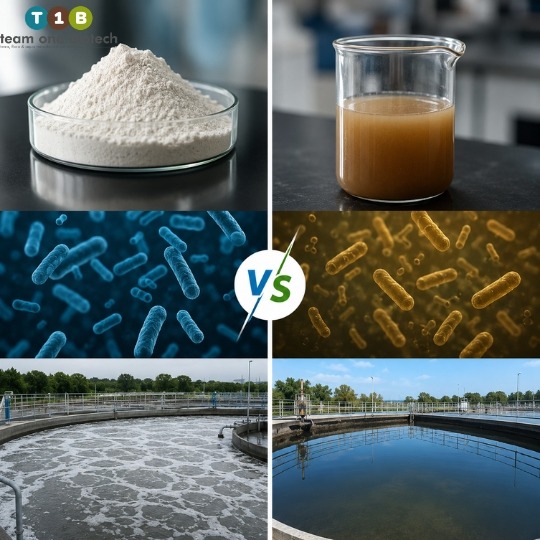
1. Shelf Life and Storage Stability
This is where powder bioculture’s advantage is most clear-cut and most practically significant.
Powder bioculture, depending on the formulation, can remain viable at ambient temperatures for several months to well over a year. It does not require refrigeration. It tolerates the temperature variation that is an everyday reality of Indian logistics and storage environments. Bulk procurement is straightforward: you procure, you store, you dose on schedule without worrying about what happened to the product between the manufacturer’s warehouse and your dosing point.
Liquid bioculture’s usable shelf life is measured in weeks to a few months, and that shelf life is conditional on maintained refrigeration at every stage. Procurement must be more frequent, cold storage must be reliable, and the margin for error in handling is narrower. Every procurement cycle is an opportunity for a cold-chain failure to compromise the product before it reaches your system.
For most STP operators managing real-world logistics, this distinction alone is a strong argument for powder bioculture as the default format.
2. Activation Time and Lag Before Performance
Powder bioculture requires a pre-activation step. The organisms need to be rehydrated and given time to transition from dormancy to metabolic activity before they are introduced into your aeration tank. Depending on the strains, the system temperature, and the organic loading at the time of dosing, this lag can range from several hours to a couple of days.
This is the parameter where liquid bioculture holds a genuine, legitimate advantage. Because the organisms are already active, liquid bioculture integrates into the biological system faster, and in acute emergency scenarios, that speed can translate to a measurably faster recovery curve.
However, it is worth putting this in operational context. The majority of bioculture dosing in a well-run STP is not emergency dosing. It is routine biological supplementation, scheduled seeding, planned system maintenance, and proactive biomass support. In all of these scenarios, the activation lag of powder bioculture is a predictable, manageable variable that experienced operators factor into their dosing schedule without difficulty. The lag only becomes a liability when a plant is in crisis mode, and the response to a biological crisis should not rest primarily on bioculture format. It should rest on early warning indicators, robust monitoring, and proactive biomass management that prevents the crisis from developing in the first place.
Powder bioculture’s slightly longer path to activation is a fair trade for its substantially superior storage reliability, procurement flexibility, and resistance to handling variability.
3. Bacterial Concentration and Effective Dosing
This is the area where the most misleading comparisons tend to circulate, and it deserves a careful look.
Powder biocultures are presented with CFU-per-gram figures that can look impressive on a datasheet. The organism that matters to your STP, however, is not the one on the label. It is the viable, metabolically active organism that successfully arrives in your aeration tank after activation, at a concentration sufficient to compete, establish, and perform in your mixed liquor. Recovery rate from dormancy is the variable that closes the gap between the label claim and the operational reality, and it is influenced by activation conditions, water quality, temperature, and how the product was handled prior to use.
Liquid bioculture delivers organisms that are already active, and the label concentration more directly represents what reaches your system, assuming the cold chain held and the product is well within its shelf life.
The practical implication is this: for powder bioculture, reliable performance is achieved when the activation protocol is followed correctly and consistently. For liquid bioculture, reliable performance is achieved when the cold chain is maintained correctly and consistently. The difference is that getting an activation protocol right is operationally simpler and more controllable for most STP teams than guaranteeing cold-chain integrity across an entire procurement and delivery cycle in Indian conditions.
When powder bioculture is handled correctly, the effective delivery to your system is predictable and reliable. That predictability is operationally valuable.
4. Cost-Efficiency Over the Long Term
The honest cost picture strongly favours powder bioculture for the majority of STP operations.
Powder bioculture generally carries a lower per-unit cost. Its extended shelf life means that bulk procurement is commercially advantageous and logistically practical, and the risk of product wastage due to expiry or mishandling is lower. There is no cold storage infrastructure to invest in or maintain, no running refrigeration cost, and no cold-chain management burden on your procurement team.
Liquid bioculture may offer a faster biological response in specific scenarios, and proponents argue that this can reduce total dosing volume in those scenarios, partially offsetting a higher per-dose cost. That argument has some merit in the right conditions. But when you account for the full cost picture, including refrigeration infrastructure, more frequent procurement cycles, greater wastage risk from cold-chain failures, and the higher per-unit price, liquid bioculture’s total cost of ownership is meaningfully higher for most plants.
The compliance cost perspective reinforces this. A non-compliance event carries costs that dwarf the price difference between formats. A powder bioculture that is correctly stored, correctly activated, and correctly dosed provides consistent, reliable biological support at a lower total cost, and consistent biological support is precisely what prevents compliance events.
What Does Compliance Demand of Your Bioculture?
CPCB and SPCB discharge standards require consistent, reliable reduction of BOD, COD, and suspended solids to within prescribed limits, not occasionally, not only when conditions are ideal, but discharge after discharge, across seasonal variation and influent fluctuation.
What this means in practice is that your bioculture choice must deliver biological stability across your plant’s actual operating conditions, not just its ideal ones. Powder bioculture’s resilience to storage variability, its procurement flexibility, and its lower sensitivity to handling conditions make it the more reliable foundation for that kind of consistent biological performance across a wide range of Indian STP environments.
Biological consistency is the compliance requirement. Powder bioculture, for most plants, is the more reliable path to achieving it.
So, Which Format Actually Performs Better?

For the majority of STPs operating in India, powder bioculture is the more practical, more reliable, and more cost-effective choice. Its shelf life advantage, storage flexibility, procurement simplicity, and lower total cost of ownership align well with the operational realities that most plant operators actually face.
Liquid bioculture has a real and legitimate place in specific scenarios: acute biological recovery situations where time is critical, plants with fully reliable cold-chain infrastructure and frequent procurement capability, and high-load systems where the speed-to-performance advantage justifies the additional handling requirements. In those conditions, it is a credible and effective tool.
But for routine biological supplementation, scheduled seeding, planned system maintenance, and general biomass support across a broad range of operating environments, powder bioculture is the format that delivers reliable performance without the logistical complexity.
Consider powder bioculture your primary format if:
Your plant is in a location where cold storage reliability cannot be fully guaranteed. You procure in advance and need inventory to remain viable over weeks or months. Your dosing schedule is planned and regular rather than crisis-driven. Cost efficiency across the full procurement and storage cycle is a meaningful factor in your decisions. You want a format that your operations team can handle correctly without specialised cold-chain management.
Consider liquid bioculture if:
You are responding to an acute biological upset where time-to-performance is critical and cold-chain capability at your facility is fully reliable. Your plant operates under consistently high organic loading and your procurement cycle is frequent and dependable. You have the infrastructure and operational discipline to maintain cold-chain integrity from procurement through dosing without exception.
The right bioculture is the one correctly matched to your plant’s actual conditions. For most plants, that match points clearly to powder.
Frequently Asked Questions
Can I switch between powder and liquid bioculture mid-operation in my STP?
Switching formats mid-operation is possible but should be managed carefully with guidance from your supplier. A controlled transition with appropriate biological parameter monitoring is recommended to avoid disrupting your established microbial community.
Does powder bioculture need to be pre-mixed before dosing into the STP?
Yes. Rehydration and pre-activation in clean, dechlorinated water for the period specified by your supplier is a required step, not an optional one. Skipping or shortening it will reduce the effective viable count reaching your aeration tank.
How do I know if my bioculture is still viable before dosing?
Check manufacturing and expiry dates. Confirm that storage conditions have been correctly maintained. When in doubt, conduct a jar test using your plant’s mixed liquor and influent, and consult your supplier before committing a full dose.
Which format is better for a newly commissioned STP during initial seeding?
Both are used effectively for initial seeding. Powder bioculture with a well-structured pre-activation and ramp-up protocol is a reliable, cost-effective approach for most new plant commissionings. Liquid bioculture may offer a marginally faster startup trajectory where timeline pressure is acute and cold-chain management is fully in place.
Does the choice of bioculture format affect CPCB compliance outcomes?
Indirectly, yes. A format that does not perform consistently under your specific storage and operational conditions creates biological instability risk, which in turn creates compliance risk. Powder bioculture’s greater resilience to storage and handling variability makes it the lower-risk format for most Indian STP operations.
Make the Decision That Serves Your Biology and Your Operations
Powder bioculture is not the right answer for every plant in every scenario. But it is the right answer for most plants across most scenarios that Indian STP operators actually face. Its shelf life, storage flexibility, cost efficiency, and resistance to handling variability give it a structural advantage that is difficult to match in the real-world operating environment of most facilities.
Team One Biotech manufactures both powder and liquid bioremediation solutions engineered specifically for Indian STP conditions and influent characteristics. Reach out to our technical team today to evaluate the right format for your plant, before your next compliance audit does it for you.