
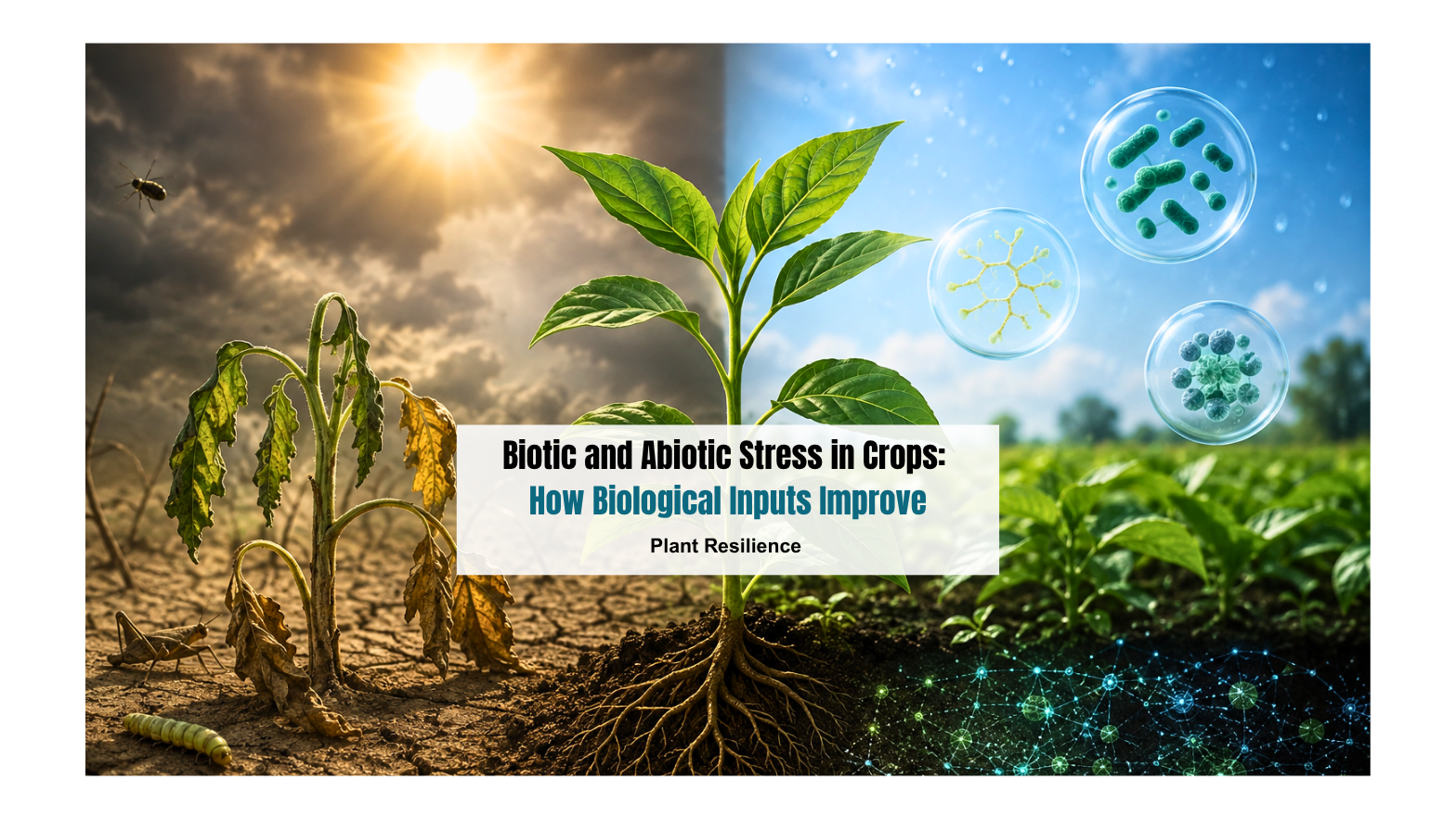

Biotic and Abiotic Stress in Crops: How Biological Inputs Improve Plant Resilience
You did everything right this season. The seed variety was carefully selected, irrigation was timed well, fertilizers went in on schedule, and crop protection applications were made as recommended. And yet, when harvest came around, the yields told a different story. Patchy performance. Stunted growth in some sections. Disease pressure that seemed to arrive from nowhere. A result that simply did not match the effort invested.
If this sounds familiar, you are not alone, and more importantly, you are not at fault. What many commercial farmers and agronomists are encountering, often without naming it clearly, is the compounding effect of plant stress. Not one problem, but a category of problems that silently erode yield potential across every growth stage.
Plant stress broadly refers to any condition that forces a plant to divert energy away from growth, reproduction, and yield formation toward self-protection and survival. That diversion is costly. It shows up as reduced grain fill, poor fruit set, heightened susceptibility to disease, and stubborn underperformance despite good inputs.
There are two distinct categories of stress that every crop faces: biotic stress, which originates from living organisms, and abiotic stress, which comes from the physical and chemical environment. Understanding both, and crucially, understanding how they interact, is the foundation of any serious crop resilience strategy. This is where biological inputs enter the picture, not as a trend, but as a scientifically validated tool for building plant immunity from the ground up.
Biotic Stress, The Living Threats to Your Crops
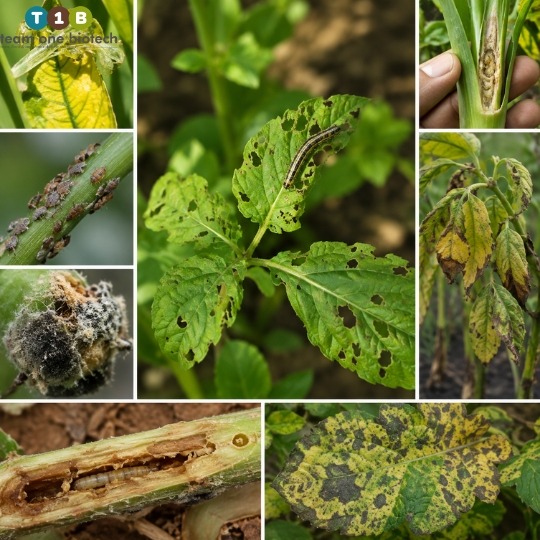
Biotic stress is caused by living organisms that attack, compete with, or parasitize the crop. These include fungal pathogens, bacterial infections, viral diseases, insect pests, root-knot nematodes, and competitive weeds. The living nature of these threats makes them dynamic, they adapt, evolve, and respond to the defenses both the plant and the farmer deploy.
When a plant detects a biotic threat, it mounts an immune response. Molecular signals travel through the plant’s vascular system, triggering the production of defensive compounds, structural reinforcements in cell walls, and in some cases, programmed cell death to contain the spread of infection. These responses are metabolically expensive. Every calorie spent on defense is a calorie not directed toward seed fill or canopy development.
Common biotic stressors by crop category include:
- Cereals and pulses: Fungal blights (Fusarium, Alternaria), aphids, stem borers, root-knot nematodes
- Vegetables: Bacterial wilt, downy mildew, whitefly-transmitted viral diseases, spider mites
- Oilseeds: Sclerotinia stem rot, mustard aphid, pod borers
- Plantation crops: Phytophthora root rot, thrips, mealybugs, bacterial leaf spot
Biotic stress management in crops has historically leaned heavily on chemical pesticides, fungicides, insecticides, and bactericides applied on calendar schedules or at the first sign of infestation. This model is under serious pressure. Pesticide resistance has emerged as a structural challenge across virtually every major crop-pest combination in India. Changing pest population dynamics, linked to both climate shifts and intensive monoculture systems, mean that biotic threats are becoming less predictable and harder to manage with single-mode-of-action chemistry alone.
Biotic and abiotic resistance in plants, the plant’s own capacity to withstand and recover from these attacks, is therefore not a passive trait. It is something that can be deliberately built, supported, and sustained through the right inputs.
Abiotic Stress, When the Environment Works Against the Plant

Abiotic stress refers to non-living environmental factors that push a plant beyond its physiological comfort zone. Drought, heat, cold, salinity, waterlogging, excessive UV radiation, nutrient imbalance, and heavy metal toxicity are the primary categories. Unlike biotic stressors, abiotic stressors cannot be treated or eliminated, they can only be managed through better crop physiology and input strategy.
Climate change has made abiotic stress in plants a significantly more urgent concern across Indian agricultural zones. Irregular rainfall patterns, extended dry spells interspersed with intense precipitation events, and rising ambient temperatures are not future scenarios, they are current-season realities that agronomists and farmers are navigating every crop cycle.
Physiologically, when a plant encounters abiotic stress, the consequences are cascading. Under drought, stomata close to prevent water loss, but this simultaneously shuts down gas exchange and photosynthesis. Photosynthetic output falls, carbon assimilation drops, and growth stalls. Under heat stress, enzymatic processes that govern everything from nutrient absorption to pollen viability are disrupted. Under salinity stress, osmotic imbalance makes it progressively harder for the plant to draw water and nutrients from the soil, even when both are technically present. Oxidative stress, the accumulation of reactive oxygen species, accompanies virtually every major abiotic stress event, causing cellular damage that accelerates aging and tissue death.
Key abiotic stress indicators that farmers and agronomists should monitor include:
- Leaf rolling or wilting during cooler parts of the day (early drought signal)
- Marginal leaf scorch or tip burn (salinity or heat)
- Stunted root systems with poor nodulation in legumes (waterlogging or compaction)
- Pale or chlorotic young leaves (nutrient uptake disruption under salinity or pH stress)
- Premature flower drop or poor fruit set (heat or osmotic stress during the reproductive stage)
Abiotic stress in plants rarely presents as a single, isolated event. More often, it creates a physiological environment in which the crop becomes increasingly vulnerable to everything that comes next, including the living threats described in the previous section. This is the stress interaction that changes everything.
Foliar spray for plant stress has emerged as a particularly important tool in managing abiotic stress events, and this is explored in detail in the biological inputs section below.
The Hidden Link, How Biotic and Abiotic Stress Compound Each Other
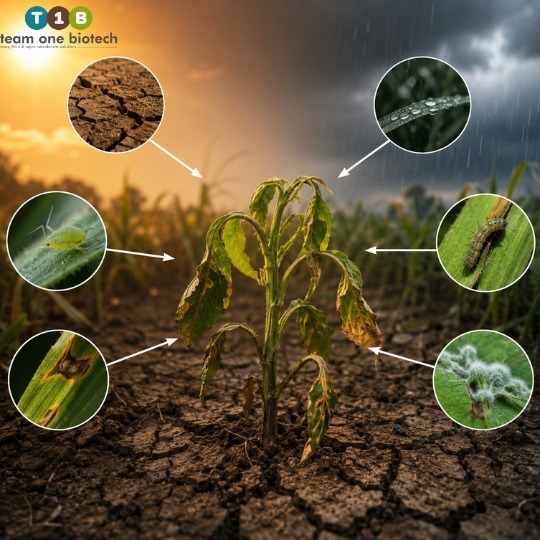
Most crop protection conversations treat biotic and abiotic stress as separate problems with separate solutions. This is one of the most significant gaps in conventional farm advisory practice.
The reality is that biotic and abiotic stress are deeply interconnected in a feedback loop that accelerates crop damage far beyond what either stressor would cause alone. The mechanism is straightforward, but its implications are significant.
When a crop is exposed to abiotic stress, a drought period, an unexpected heat spike, a salinity event, its immune system is the first casualty. The systemic acquired resistance pathways that would normally allow the plant to detect and respond to pathogen attack are energy-intensive. A plant under osmotic stress, with compromised photosynthesis and disrupted cellular metabolism, cannot maintain those defenses at full capacity. It is, in the most direct sense, immunocompromised.
This is precisely the window in which biotic threats, fungal spores, bacterial infections, pest populations, nematode pressure, find their easiest entry points. The logic chain runs: abiotic stress suppresses plant immunity → plant immunity biological inputs are depleted → biotic threats exploit the gap → yield loss accelerates → the farmer responds with emergency pesticide applications that address the symptom but not the underlying vulnerability.
Farmers who have experienced back-to-back seasons of this pattern often describe it as a treadmill. More inputs, more applications, more cost, and still, the crops do not perform the way the investment should allow.
Breaking this cycle requires an approach that addresses both stress types simultaneously, and that specifically supports the plant’s own immune and recovery systems from the soil level upward. This is exactly the role that biological inputs are designed to play.
How Biological Inputs Strengthen Plant Resilience Against Both Stress Types

Biological inputs are not a single product category, they are a spectrum of living organisms and bioactive compounds that work with the plant’s physiology rather than around it. Three categories are most directly relevant to biotic and abiotic stress management.
Microbial Inoculants, Arming the Root Zone
Microbial inoculants introduce beneficial microorganisms, bacteria, fungi, and consortia of both, directly into the crop’s root environment. These organisms compete with soil-borne pathogens for space and resources, produce antifungal and antibacterial metabolites, and help structure the rhizosphere in ways that favor the crop rather than its enemies.
Mycorrhizal fungi are among the most well-documented microbial inoculants for abiotic stress tolerance. By extending the plant’s effective root network many times beyond its physical roots, mycorrhizal associations improve water and phosphorus uptake under drought conditions, directly addressing one of the key physiological vulnerabilities that abiotic stress creates.
What this means for your crop:
- Improved access to water and nutrients during dry periods
- Reduced establishment pressure from soil-borne pathogens at the seedling stage
- Enhanced root architecture that supports better nutrient efficiency throughout the crop cycle
- Stronger canopy development and recovery post-stress events
Plant Growth Promoting Bacteria (PGPR) for Stress Tolerance
Plant growth promoting bacteria for stress tolerance represent one of the most researched and practically applicable categories of biological inputs available to commercial agriculture today. PGPR are bacteria that colonize the plant root system and produce a range of compounds that directly influence plant growth, immunity, and stress response.
The mechanisms through which PGPR support plant resilience are multiple and well-documented. Induced Systemic Resistance (ISR) is one of the most commercially significant: PGPR trigger a primed immune state in the plant that allows faster and stronger responses to pathogen attack without the metabolic cost of maintaining a fully active defense at all times. This is the biological equivalent of keeping the immune system trained and ready rather than continually reactive.
Under abiotic stress, PGPR contribute through osmotic adjustment, the production of compatible solutes that help plant cells maintain water balance under drought and salinity. Ethylene regulation is another key mechanism: stress conditions cause ethylene levels to spike, which accelerates senescence and tissue death; certain PGPR strains produce an enzyme that degrades the ethylene precursor, effectively slowing the plant’s stress-response clock and extending recovery windows.
Biotic and abiotic resistance in the plant is, in this sense, not simply a genetic trait, it is a dynamic capacity that can be meaningfully enhanced through the right microbial support.
PGPR registered under FCO and CIBRC guidelines are available as compliant formulations that can be integrated into standard seed treatment and soil application programs. Compliance registration matters here: it ensures strain identity, viability at point of application, and dosage accuracy, all of which directly affect efficacy in the field.
What this means for your crop:
- Primed immune response against fungal and bacterial pathogens
- Improved root function under drought and salinity conditions
- Reduced ethylene-driven senescence during stress events
- Consistent performance when sourced from CIBRC-registered, FCO-compliant products
Biostimulants and Foliar Sprays, Rapid Stress Response Support
Biostimulants occupy a distinct regulatory and functional category from both fertilizers and pesticides. They do not supply nutrients in the conventional sense, nor do they kill pests or pathogens directly. Instead, they activate the plant’s own metabolic pathways, triggering antioxidant production, improving water use efficiency, enhancing nutrient assimilation, and accelerating recovery from stress-induced damage.
Foliar spray for plant stress is particularly valuable in this context because it bypasses the root uptake system entirely. During acute abiotic stress events, drought spells, heat waves, post-flood recovery periods, the root system is often the most compromised organ in the plant. Stomata are closed, root function is disrupted, and the plant’s ability to draw materials from the soil is severely limited. Foliar delivery of amino acids, seaweed-derived compounds, humic substances, and targeted micronutrients reaches the leaf tissue directly, providing the metabolic inputs the plant needs precisely when its normal uptake routes are blocked.
This makes foliar applications not a supplement to the biological input program, but a critical rapid-response component of it, particularly during the stress windows that create maximum yield risk.
All biostimulant formulations used in commercial agriculture in India must carry appropriate CIBRC registration and comply with FCO standards for labeling, dosage, and storage. Label compliance is not bureaucratic box-ticking, it is the farmer’s assurance that the strain, concentration, and formulation in the product are what the science supports.
What this means for your crop:
- Fast-acting metabolic support during and immediately after acute stress events
- Antioxidant activation that limits cellular damage from oxidative stress
- Improved recovery speed following drought, heat, or pest damage
- Compliant, documented product performance when sourced from registered manufacturers
Looking for FCO and CIBRC compliant biological input solutions designed for Indian field conditions? Connect with Team One Biotech’s agri-science team to explore the right formulation for your crop and stress profile.
What Compliant Biological Input Programs Look Like in Practice
Understanding the science of biological inputs is important. Knowing how to integrate them into an actual crop program is what makes the difference in the field.
A well-designed biological input program is built around timing and layering. At the pre-sowing stage, seed treatment with PGPR and microbial inoculant formulations establishes the beneficial microbial population at the root zone before crop establishment, giving beneficial organisms a competitive head start over soil-borne pathogens. At transplanting or early vegetative stages, soil applications of microbial consortia reinforce rhizosphere populations as root systems expand into new soil volume.
During the crop cycle, foliar spray applications of biostimulants should be timed to anticipated stress windows, pre-flowering under heat stress forecasts, immediately following pest pressure, or during extended dry periods. Post-stress recovery applications, particularly after hailstorm, flood, or intense pest infestation, can significantly reduce the crop’s recovery time and protect yield formation in subsequent growth stages.
Integration with existing Integrated Pest Management programs is both feasible and advisable. Biological inputs do not compete with IPM, they enhance it by building the plant immunity layer that makes IPM interventions more effective and reduces the threshold at which chemical interventions become necessary.
Compliance is not optional. All biological inputs applied in commercial agriculture must carry valid CIBRC registration, carry FCO-compliant labeling with clear dosage and storage instructions, and be applied as directed on the registered label. Products from registered manufacturers provide not just efficacy data, but the regulatory documentation that protects the farmer and the agronomist.
Disclaimer: Application rates, timelines, and outcomes described here represent general guidance based on typical field conditions. Actual performance may vary significantly depending on soil type, crop variety, local climate, pest pressure, and specific product formulations. Always consult a registered agronomist and refer to product-specific FCO/CIBRC-compliant labels before application.
Frequently Asked Questions
Q1: What is the difference between biotic and abiotic stress in crops?
Biotic stress is caused by living organisms, fungal pathogens, bacteria, viruses, insect pests, nematodes, and competitive weeds. Abiotic stress is caused by non-living environmental factors, drought, heat, cold, salinity, waterlogging, and nutrient imbalance. Both categories directly reduce yield potential, and they frequently co-occur: crops weakened by abiotic stress become significantly more susceptible to biotic threats. Managing biotic and abiotic stress together, rather than in isolation, is the foundation of effective crop resilience planning.
Q2: How do plant growth promoting bacteria help with stress tolerance?
PGPR support stress tolerance through several mechanisms. Induced Systemic Resistance (ISR) primes the plant’s immune system against pathogen attack. Under drought or salinity, PGPR produce compounds that help plant cells maintain water balance through osmotic adjustment. Certain strains also regulate ethylene, the stress hormone that accelerates leaf drop and senescence, giving the plant more time to recover. PGPR registered under CIBRC guidelines are available as compliant seed treatment and soil application formulations suited to Indian field conditions.
Q3: Are foliar sprays effective for managing abiotic stress in plants?
Yes, foliar sprays are among the most practical tools available for managing acute abiotic stress in plants. During drought, heat, or post-flood recovery, the root system is often compromised and cannot efficiently absorb soil-applied inputs. Foliar delivery of amino acids, seaweed extracts, and targeted micronutrients reaches leaf tissue directly, providing metabolic support precisely when it is most needed. Foliar spray for plant stress is most effective when timed to stress events and applied as per CIBRC-registered label instructions.
Q4: What makes biological inputs different from chemical pesticides for biotic stress management?
Chemical pesticides typically work by directly killing or suppressing the pest or pathogen. Biological inputs for biotic stress management work by activating and strengthening the plant’s own defense systems, a mode of action that reduces selection pressure for resistance and leaves no chemical residue on the crop. Biological inputs and chemical pesticides are best understood as complementary tools rather than competing ones. Under high biotic pressure, a robust biological input program reduces the frequency and intensity of chemical interventions needed, improving both economics and sustainability outcomes.
Q5: How do I know if a biological input product is compliant with Indian agricultural regulations?
Look for a CIBRC registration number on the product label, this confirms that the specific strain, formulation, and dosage have been evaluated and cleared for commercial use. FCO-compliant labeling will include clear information on crop recommendation, dosage, method of application, and storage conditions. Manufacturer documentation, including batch testing records and strain identity certificates, provides additional verification. When in doubt, consult a certified agronomist and cross-reference with the CIBRC registered products list before purchase and application.
Build Crop Resilience That Lasts, The Biological Way
The evidence is clear and the field experience is consistent: biotic and abiotic stress are not isolated seasonal inconveniences. They are interconnected, compounding pressures that intensify with every season of climate variability and every crop cycle in which the plant’s underlying resilience is not actively supported.
Chemical inputs alone are no longer sufficient to carry the full burden of crop protection. Resistance development, regulatory evolution, market demands for residue reduction, and the sheer unpredictability of modern stress patterns have created a gap that chemistry cannot close by itself. The biological inputs category, microbial inoculants, PGPR, biostimulants, and compliant foliar spray formulations, fills that gap with tools that work with plant physiology rather than around it.
This is not a compromise between performance and sustainability. It is how plant immunity biological inputs deliver resilience that is genuinely durable, season after season, crop after crop, in conditions that are becoming harder to predict and increasingly costly to manage reactively.
The shift toward biological inputs is a commercial decision as much as it is an agronomic one. Farmers and agribusinesses that integrate these tools into structured, compliant programs are building something more valuable than a single good season. They are building a cropping system that is inherently better prepared for what comes next.
The time to start is not after the next stress event damages the crop. It is now, before the season begins, when the decisions about soil health, microbial populations, and plant immunity can be made deliberately rather than reactively.