
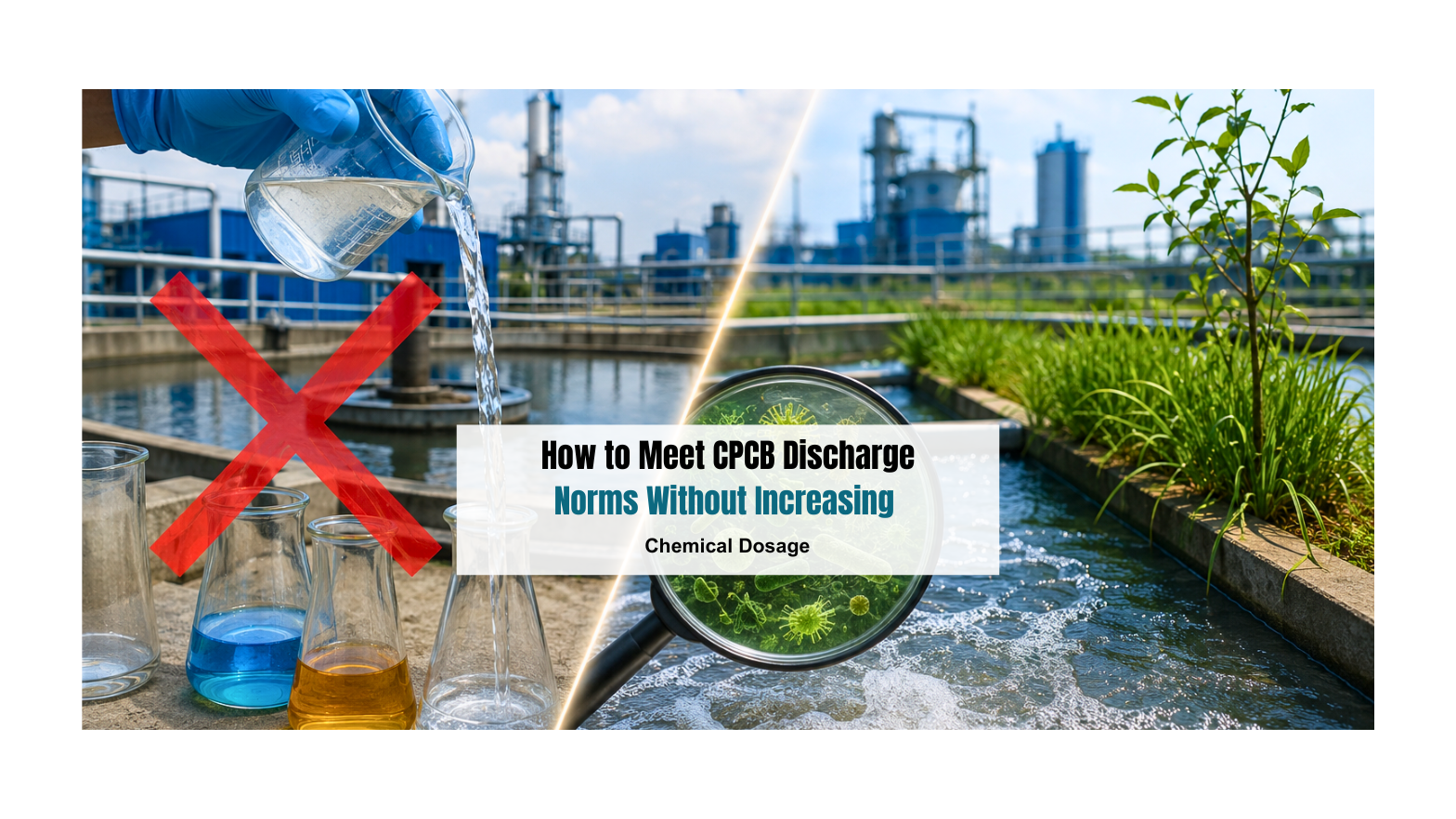
How to Meet CPCB Discharge Norms Without Increasing Chemical Dosage
It’s 7 AM, and before your coffee’s even gone cold, you’re staring at last night’s lab report. COD spiked again. You don’t know why yet, but you already know how this goes, someone from the SPCB office calls, or worse, shows up. You explain, you scramble, and somewhere in the back of your mind is the thought you’ve had a dozen times this year: “What if this is the time we actually get a closure notice?”
If that scenario feels a little too familiar, you’re not alone. Every ETP manager, every HSE officer, every factory head who’s ever had to sign a compliance report knows this exact flavor of dread. And the usual response, dose more coagulant, add more flocculant, push the oxidizer levels up, works today. Maybe tomorrow too. But it’s a patch, not a fix, and patches have a way of costing more every time you apply them.
There’s a better path. Instead of chasing compliance numbers with chemistry, you can build a treatment system that actually performs, biologically, mechanically, and operationally, so the numbers take care of themselves. This is what we do every day at Team One Biotech, and this article walks through exactly how it works.
Why Chemical Overdosing Isn’t a Sustainable Compliance Strategy
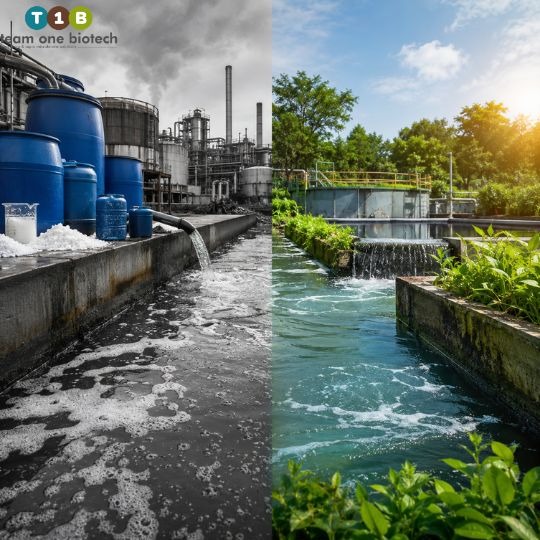
Chemical dosing has its place. Coagulants, flocculants, and oxidizers are legitimate tools in wastewater treatment. The problem isn’t that they exist, it’s when they become the default answer to every compliance scare instead of a targeted, occasional intervention.
Here’s what overdosing actually does to your operation over time:
- It masks the real problem. A COD or BOD spike is usually a symptom, of poor aeration, a dying microbial population, or hydraulic overload. Chemicals can suppress the number on the report without touching the underlying cause, which means the same spike will return, often worse.
- It inflates operating costs quietly. Chemical dosing costs don’t announce themselves as a single alarming line item. They creep, a little more coagulant this month, a little more oxidizer next month, until someone finally asks why the treatment budget has crept up so much year over year.
- It generates more sludge, not less. Chemical precipitation tends to produce higher sludge volumes than biological treatment, which means higher disposal costs and more frequent desludging cycles.
- It can destabilize your biology. Overdosing, especially with oxidizers, can kill off the very microbial populations your ETP depends on for baseline treatment, making your system more fragile, not more resilient.
- It doesn’t scale with growing production. As output increases, chemical-dependent systems usually need proportionally more chemical input, while a well-tuned biological system tends to scale more efficiently with better retention and process design.
None of this means abandon chemical dosing altogether. It means treating it as a supporting tool, not a crutch you lean on every time a report comes back looking rough.
A quick gut-check: if your chemical dosing has been trending upward over the last several months without a corresponding increase in production volume, that’s usually a sign the root cause hasn’t been addressed, only masked.
Understanding What CPCB/SPCB Actually Expects

Let’s step back and get plain about what regulators are actually measuring and why, without getting lost in numbers that vary by state and industry category anyway.
BOD (Biochemical Oxygen Demand) measures how much oxygen microorganisms need to break down organic matter in your effluent. Put simply, it’s a proxy for how much biodegradable pollution load you’re releasing. Higher BOD means more organic load, which can deplete oxygen in receiving water bodies and harm aquatic life.
COD (Chemical Oxygen Demand) measures the total amount of oxygen needed to chemically oxidize both biodegradable and non-biodegradable material in your effluent. COD is often higher than BOD in industrial effluent because industrial waste streams tend to include more complex, harder-to-break-down compounds.
TSS (Total Suspended Solids) measures the particulate matter floating or suspended in your discharge, the physical “stuff” that doesn’t dissolve. High TSS can clog waterways, smother aquatic habitats, and interfere with disinfection processes downstream.
Regulators expect all three parameters to sit within a permissible range that’s considered safe for the receiving environment, whether that’s a river, a municipal sewer, or land for irrigation. What counts as acceptable varies considerably depending on your industry category, the sensitivity of the receiving water body, and your state’s specific notification.
A note on numbers: You’ll notice we’re not quoting specific mg/L thresholds anywhere in this article, and that’s intentional. Actual CPCB and SPCB limits vary by state, by industry classification, and by the receiving water body your effluent discharges into. Some parameters that fall within a “moderate” range for one facility might be considered significantly higher than permissible for another operating under a stricter category. Always verify your applicable limits directly against your current SPCB/CPCB notification, or consult with an environmental compliance specialist who has visibility into your specific classification.
Where Most ETPs Lose Compliance Without Realizing It
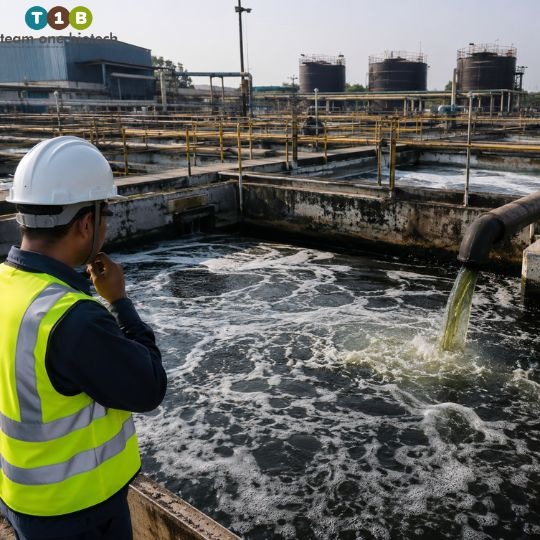
Here’s something we see constantly when we walk into a facility for the first time: the treatment system isn’t fundamentally broken. It’s just quietly underperforming in ways that don’t show up until a spike hits and everyone’s scrambling to explain it.
Common culprits include:
- Inadequate aeration. If dissolved oxygen levels in your aeration tank aren’t sufficient, your aerobic microbial population can’t do its job efficiently, and BOD/COD removal suffers.
- Insufficient hydraulic retention time. If effluent is moving through your system faster than your biology can process it, often because production volumes have grown without a matching upgrade to tank capacity, you’re essentially asking your ETP to do more work in less time.
- Poor sludge health. An aging or imbalanced microbial community (measured loosely through sludge volume index and MLSS trends) is less effective at breaking down organic load, and this decline often happens gradually enough that nobody notices until performance craters.
- Hydraulic and organic shock loading. Sudden spikes in flow or concentrated waste batches (common in facilities with irregular production schedules) can overwhelm a system that’s only calibrated for steady-state conditions.
- Nutrient imbalance. Microorganisms need more than just organic matter to thrive, they need a balanced nutrient profile (commonly framed around nitrogen and phosphorus ratios). Without it, biological treatment efficiency drops even if everything else looks fine on paper.
- Neglected mechanical maintenance. Clogged diffusers, worn-out blowers, or poorly calibrated dosing pumps quietly erode performance over months, long before anyone connects the dots to a compliance failure.
Here’s a useful exercise: take five minutes this week and map your last three “unexplained” compliance scares against this list. More often than not, at least one of these factors was already trending in the wrong direction before the spike showed up on a report.
Optimizing Biological Treatment Before Reaching for Chemicals
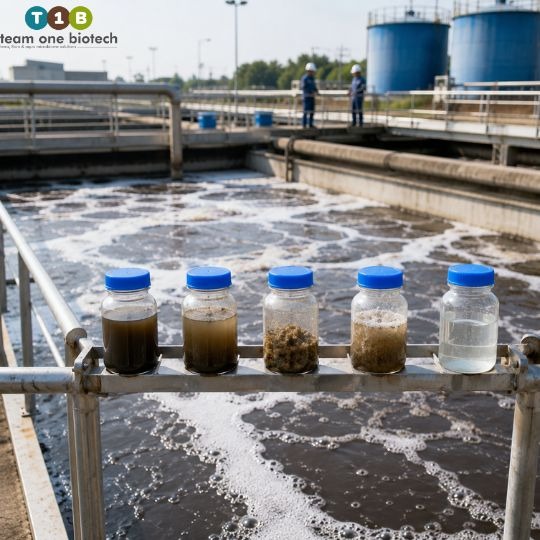
This is where the real, durable fix lives, and it’s the part of the process we spend the most time on with our clients.
Biological treatment, done well, is remarkably efficient at reducing BOD and COD without the recurring cost and instability of heavy chemical dosing. The goal is to give your microbial community everything it needs to do the job it’s biologically built to do.
Bioremediation and microbial augmentation. Introducing targeted microbial cultures, engineered or selected specifically to break down the organic and industry-specific pollutants present in your effluent, can dramatically improve treatment efficiency, especially in systems where the native microbial population has been struggling or where waste composition is complex.
Rebuilding microbial balance. A healthy microbial ecosystem in your aeration tank isn’t just “more bacteria.” It’s the right mix of organisms suited to your specific waste stream, operating at population levels your tank can actually support. Overloading or underfeeding this population in either direction reduces effectiveness.
Nutrient dosing, done correctly. Rather than chemical coagulants, targeted nutrient supplementation (calibrated to your specific effluent characteristics) supports microbial health and activity, improving natural breakdown rates.
Aeration efficiency improvements. This doesn’t always mean bigger blowers, sometimes it means better diffuser placement, optimized run cycles, or simply cleaning and recalibrating existing equipment to actually deliver the oxygen levels your system was designed around.
Retention time tuning. Adjusting flow patterns or tank configuration to give your biology adequate contact time with the waste stream, rather than pushing effluent through faster than it can be processed.
The core idea here is simple: your biology is a living system, and living systems perform best when supported, not overridden. Chemical dosing overrides the system temporarily. Biological optimization strengthens it permanently.
Mechanical and Process Fixes That Reduce Chemical Dependency
Biology does the heavy lifting, but it needs the right mechanical environment to actually perform. A few process-level fixes we consistently see move the needle:
- Diffuser and blower maintenance schedules. Fouled or damaged diffusers reduce oxygen transfer efficiency, forcing systems to compensate with more chemical intervention. A regular maintenance cadence prevents this silent decline.
- Flow equalization. Installing or better utilizing equalization tanks smooths out the shock loading that comes from irregular production, giving your biological system consistent conditions to work with instead of unpredictable surges.
- Sludge management optimization. Regular, appropriately timed desludging keeps your microbial population healthy and prevents the kind of sludge bulking that tanks treatment efficiency.
- Instrumentation and monitoring upgrades. Real-time dissolved oxygen, pH, and flow monitoring lets you catch a developing problem days before it becomes a reportable spike, giving you time to make a process adjustment instead of an emergency chemical dose.
- Process sequencing review. Sometimes the fix isn’t new equipment at all, it’s re-sequencing existing treatment stages (primary, biological, tertiary) to reduce the load hitting any single stage.
These fixes tend to have something in common: they’re investments that pay down over time, rather than recurring costs that climb every quarter.
Building a Sustainable, Cost-Effective Compliance Strategy
For the factory heads and executives reading this, here’s the budget-level version of everything above: chemical overdosing is an operating expense that grows with your compliance anxiety. Biological and process optimization is closer to a capital investment that reduces both your operating costs and your regulatory risk over time.
A sustainable compliance strategy typically includes:
- A baseline audit of your current ETP performance, biological health, mechanical condition, and chemical dosing patterns, so you know exactly where the gaps are instead of guessing.
- A phased optimization plan that addresses the highest-impact gaps first (often aeration and microbial health), rather than attempting a full overhaul at once.
- A reduced, targeted chemical dosing protocol used for genuine edge cases, not as a daily crutch.
- Ongoing monitoring and adjustment, since effluent characteristics shift as production changes, and a system tuned once needs periodic recalibration.
- Documentation and reporting practices that give you confidence walking into an inspection, rather than dread.
This is a strategy that protects your margins and your compliance standing at the same time, which is exactly the pitch that tends to land well with a board asking why the treatment budget keeps rising.
Frequently Asked Questions
Can biological treatment alone meet CPCB discharge norms, or do I still need chemicals?
For many industrial waste streams, a well-optimized biological system can meet discharge norms with minimal chemical support, used only for specific edge cases rather than routine dosing. The right balance depends on your waste characteristics and current system design, an assessment is the fastest way to know for certain.
How long does it take to see results after switching from chemical-heavy dosing to biological optimization?
Timelines vary by facility, but many operations see measurable improvement within a few weeks of microbial and process optimization, with full stabilization typically following over a couple of months as the biological population adjusts and matures.
Will reducing chemical dosage put my compliance at risk during the transition?
A properly managed transition is phased, not abrupt, chemical dosing is reduced gradually as biological performance improves, with monitoring at every step to ensure discharge parameters remain within acceptable range throughout.
How do I know if my ETP’s biological system is underperforming?
Common indicators include recurring unexplained BOD/COD spikes, rising sludge volumes without a production increase, and a growing reliance on chemical dosing just to maintain the same compliance outcomes you used to hit with less. A professional assessment can confirm what’s actually happening beneath the surface.
The ranges and descriptions used throughout this article are general and indicative only. Actual CPCB and SPCB discharge limits vary significantly by state, industry category, and the specific receiving water body your facility discharges into. Please verify your current applicable limits against your relevant SPCB/CPCB notification, or consult with a qualified environmental compliance professional before making operational decisions.
Stop Managing Around Compliance Anxiety, Start Solving It
If you’re tired of watching your chemical costs rise while the same compliance scares keep coming back, it might be time to look at what’s actually happening inside your ETP, not just what the lab report says on the surface.
Team One Biotech works with industrial facilities every day to build biological treatment systems that meet discharge norms reliably, without the recurring cost and fragility of chemical overdosing. If you’d like a clear-eyed assessment of where your system stands and what it would take to get it performing the way it should, get in touch with our team. Contact Us, We’ll walk your process with you, not just your paperwork.
Looking to improve your ETP/STP efficiency with the right bioculture?
Talk to our experts at Team One Biotech for customised microbial solutions.
Contact: +91 8855050575
Email: sales@teamonebiotech.com
Visit: www.teamonebiotech.com
Discover More on YouTube – Watch our latest insights & innovations!-
Connect with Us on LinkedIn – Stay updated with expert content & trends!