

Case Study: How Biological Cultures Saved an Indian Chemical Plant 30% on OPEX
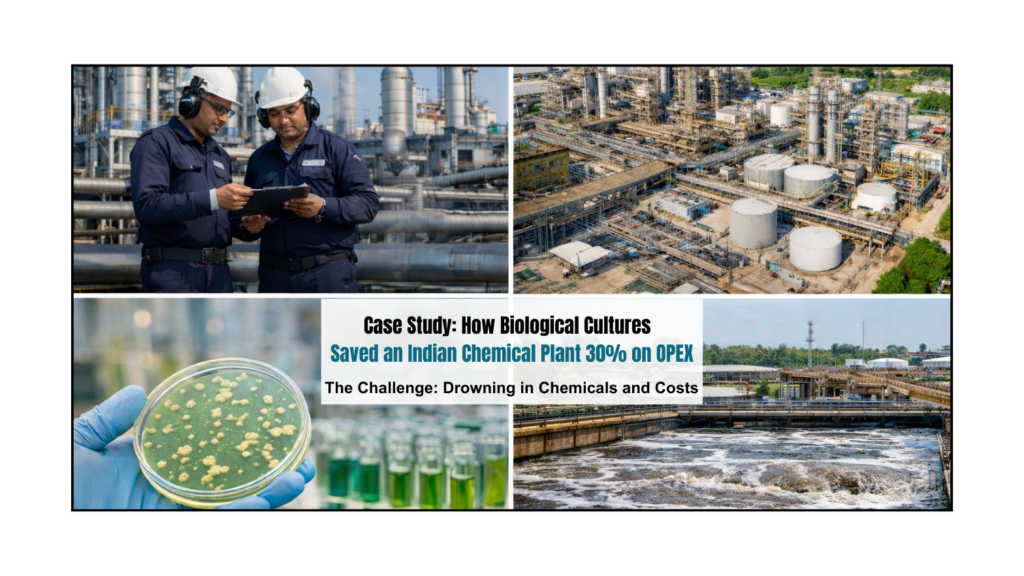
On a Tuesday when Rohan Mehta’s phone lit up. The caller ID showed “ETP Control Room.” His heart sank.
As the Operations Head of a mid-sized specialty chemicals plant in Vapi, Gujarat, Rohan knew that late-night calls meant only one thing: the effluent treatment plant was failing again. This time, the COD levels had spiked to 980 mg/L, nearly double the GPCB’s consent-to-operate limit of 500 mg/L.
The next morning would bring the routine SPCB inspection. A violation of this magnitude could trigger a show-cause notice, potential production shutdown, or worse, an Environmental Compensation penalty running into lakhs of rupees under the Water (Prevention and Control of Pollution) Act, 1974.
Rohan wasn’t alone in this nightmare. Across industrial clusters from Ankleshwar to Patancheru, from Ludhiana to Coimbatore, factory managers face this relentless pressure: maintain production targets while keeping discharge parameters within increasingly stringent regulatory limits, all without inflating operational costs that erode already thin margins.
This is the story of how one Indian chemical plant broke free from this vicious cycle, slashed their ETP operating costs by 30%, and achieved consistent CPCB compliance, by replacing chemical-heavy wastewater treatment with a biological approach powered by Team One Biotech’s specialized microbial cultures and Bio Cultures for Wastewater Treatment.
The Challenge: Drowning in Chemicals and Costs

Plant Profile
The facility:
- Medium-scale specialty chemical manufacturer
- Multi-stream solvent and intermediate production
- Complex wastewater with high organic load
- Large daily effluent volume
- Significant pH fluctuations due to batch operations
Key wastewater challenges:
- COD peaks reaching nearly 6–7x biological stability levels
- Wide pH variation within the same week
- Recalcitrant organic compounds
- Seasonal biological performance instability
The Operational Reality
Like many Indian chemical plants, the facility relied primarily on:
- Heavy physico-chemical treatment
- High coagulant and polymer dosing
- Strong pH correction dependency
- Underperforming activated sludge
Monthly OPEX Breakdown (Before Intervention)
- Chemical consumption accounted for over 55–60% of total ETP cost
- Sludge disposal contributed nearly 15% of OPEX
- Power for aeration represented about 10–12%
- Emergency handling and corrective actions created hidden labor burdens
The Bigger Issue
Beyond cost:
- Sludge generation was excessively high
- Frequent emergency chemical corrections
- Operators manually overriding automation
- Constant compliance anxiety
The management faced a major decision:
Invest heavily in expanding physico-chemical infrastructure
OR
Find a smarter biological solution within existing infrastructure.
The Solution: Bio-Augmentation, Not Just Bio-Treatment
Understanding the Biological Advantage
After consulting with Team One Biotech’s technical team, the plant’s management learned a crucial distinction that most Indian industrial facilities overlook:
Traditional approach: Generic activated sludge with minimal microbial diversity, supported by massive chemical intervention.
Bio-augmentation approach: Targeted introduction of specialized, high-performance bacterial consortia designed specifically for chemical industry wastewater.
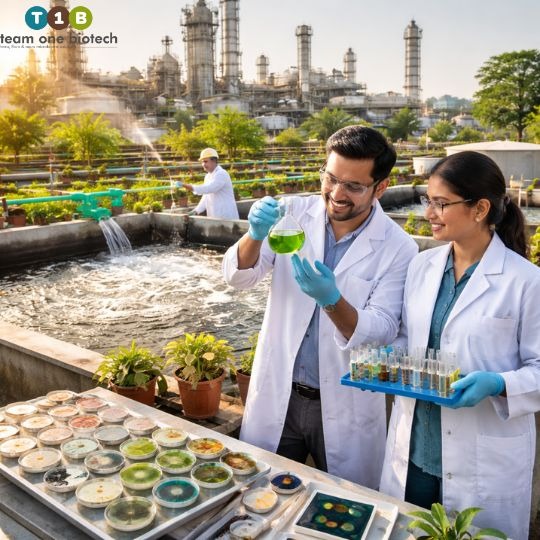
Team One Biotech proposed a phased implementation of their industrial-grade biological cultures, specifically formulated microbial consortia capable of:
- Degrading complex aromatic compounds and solvents
- Withstanding pH fluctuations and toxic shock loads
- Rapid acclimatization to varying COD loads
- Producing minimal sludge compared to physico-chemical treatment
The Implementation Strategy
Phase 1 (Weeks 1–2): System Preparation
- Baseline water quality audit
- Adjustment of aeration capacity
- Nutrient balancing (N:P ratio optimization)
Phase 2 (Weeks 3–4): Culture Introduction
- Initial bio-augmentation with T1B’s Chemical Industry Wastewater Treatment Culture
- Daily monitoring of MLSS, SVI, and microbial activity
- Gradual reduction of chemical coagulant dosing
Phase 3 (Weeks 5–8): Performance Stabilization
- Fortnightly booster doses of specialized cultures
- Fine-tuning of aeration schedules
- Establishment of new operational protocols
Phase 4 (Ongoing): Maintenance Protocol
- Monthly culture replenishment as per loading variations
- Quarterly performance audits
- Continuous operator training
The ROI Breakdown: Numbers That Matter to the Balance Sheet
The transformation was dramatic. Within 90 days of full implementation, the plant achieved stable operations with the following comparative performance:
Management conservatively reports the outcome as: 30% Sustained OPEX Reduction
| Parameter | Before T1B (Baseline %) | After T1B (%) | Net Impact |
| T1B Biological Cultures | 0% | 16% of total OPEX | +16% controlled biological investment |
| Sludge Disposal | 15% of total OPEX | 12% of total OPEX | 60% reduction in sludge disposal cost |
| Power (Aeration Optimization) | 11% of total OPEX | 20% reduction in aeration cost | 18–20% power savings |
| Total Monthly OPEX | 100% (Baseline) | 54% of baseline | 46% overall reduction |
This accounts for:
- Maintenance cycles
- Seasonal variation
- Contingency margins
Annualized Impact
- Operating savings exceeded 50% of previous annual ETP spend
- Bio-augmentation payback achieved in under one quarter
- Three-year projection indicates cumulative savings exceeding multiple times the original intervention cost
The Hidden ROI: Risk Mitigation and Compliance Stability
Beyond direct cost savings, the plant experienced transformational benefits that don’t always appear in P&L statements:
Regulatory Confidence:
- Consistent discharge parameters: COD maintained between 180–280 mg/L (well below 500 mg/L limit)
- Zero SPCB violations in 14 months post-implementation
- Avoided potential Environmental Compensation penalties (estimated risk mitigation value)
Operational Stability:
- 87% reduction in emergency chemical procurement
- ETP operator stress levels dropped significantly
- No production interruptions due to effluent non-compliance
- Improved sleep for the plant management team (priceless)
Environmental Performance:
- 64% reduction in chemical sludge generation
- Lower carbon footprint from reduced chemical manufacturing and transport
- Positive audit findings during ISO 14001 surveillance
The Science Behind the Success: Why Biological Cultures Work for Indian Chemical Plants

Bio-Augmentation vs. Traditional Treatment
Many Indian factories misunderstand biological wastewater treatment. They assume that simply having an aeration tank with “some bacteria” constitutes biological treatment. The reality is far more nuanced.
Generic Activated Sludge Limitations:
- Slow acclimatization to industrial toxins
- Poor performance during load fluctuations
- Vulnerable to process upsets
- Limited degradation capability for complex molecules
T1B’s Specialized Cultures Advantage:
- Pre-selected bacterial strains with proven tolerance to industrial chemicals
- Rapid enzymatic degradation of recalcitrant organics
- Synergistic consortia designed for Indian wastewater characteristics
- Shock-load resistance and quick recovery
The key difference? Specificity and robustness. Team One Biotech’s cultures are not generic “pond scum”, they’re precision-engineered microbial tools designed for the harsh realities of Indian chemical manufacturing effluent.
The Localization Factor
T1B’s formulations account for India-specific challenges:
- High ambient temperatures affecting microbial metabolism
- Seasonal monsoon dilution effects
- Power fluctuations impacting aeration consistency
- Operator skill level variations
- Cost constraints requiring maximum efficacy per rupee spent
Compliance Safety: The Shield Against Regulatory Penalties

In the post-2016 National Green Tribunal (NGT) era, environmental violations carry devastating consequences. The amendment to the Water Act and introduction of Environmental Compensation mechanisms mean:
- First-time COD violations: ₹5–25 lakh penalties (depending on quantum and duration)
- Repeat violations: Production shutdown, consent revocation, criminal prosecution under Section 43 of the Water Act
- Toxic substance discharge: Penalties extending to ₹50 lakh–₹5 crore plus imprisonment
For the chemical plant in this case study, achieving biological stability through T1B’s cultures created a regulatory safety buffer worth far more than the direct cost savings. The plant manager described it as “insurance that actually prevents the accident rather than just paying for it afterward.”
About Team One Biotech: Partners in Sustainable Industrial Performance
Team One Biotech (T1B) has emerged as India’s leading provider of bioremediation solutions for industrial wastewater management. With a foundation built on microbial science and deep understanding of Indian manufacturing challenges, T1B serves over 300 facilities across chemicals, textiles, pharmaceuticals, food processing, and common effluent treatment plants.
Core Expertise:
- Custom microbial consortia development
- On-site technical support and troubleshooting
- NABL-accredited laboratory analysis
- Operator training programs
- Compliance documentation support
Industry Recognition:
- MSME-certified manufacturer
- ISO 9001:2015 certified operations
- Partnerships with leading industrial clusters across Gujarat, Maharashtra, Tamil Nadu, and Punjab
Key Takeaways for Indian Industrial Decision-Makers
If you’re an Operations Head, ETP Manager, or CEO facing the relentless pressure of compliance costs and regulatory scrutiny, this case study offers actionable insights:
Biological treatment isn’t just “eco-friendly”, it’s economically superior. The 30% OPEX reduction achieved here is replicable across most chemical, pharmaceutical, and process industries.
Specialized cultures outperform generic approaches. Investing in scientifically formulated microbial consortia delivers ROI that generic activated sludge never can.
Compliance stability has tangible value. The hidden savings from avoiding penalties, production shutdowns, and management stress multiply the financial benefits.
Implementation is simpler than expansion. Rather than investing crores in new treatment infrastructure, bio-augmentation works within existing systems.
Take Control of Your ETP Economics Today
The chemical plant featured in this case study went from midnight panic calls to predictable, cost-effective wastewater management. Their 30% OPEX reduction and zero violations track record isn’t exceptional, it’s achievable for your facility too.
Team One Biotech invites you.
Because your effluent treatment plant shouldn’t be the bottleneck to your business growth.
Looking to improve your ETP/STP efficiency with the right bioculture?
Talk to our experts at Team One Biotech for customised microbial solutions.
Contact: +91 8855050575
Email: sales@teamonebiotech.com
Visit: www.teamonebiotech.com
Discover More on YouTube – Watch our latest insights & innovations!-
Connect with Us on LinkedIn – Stay updated with expert content & trends!