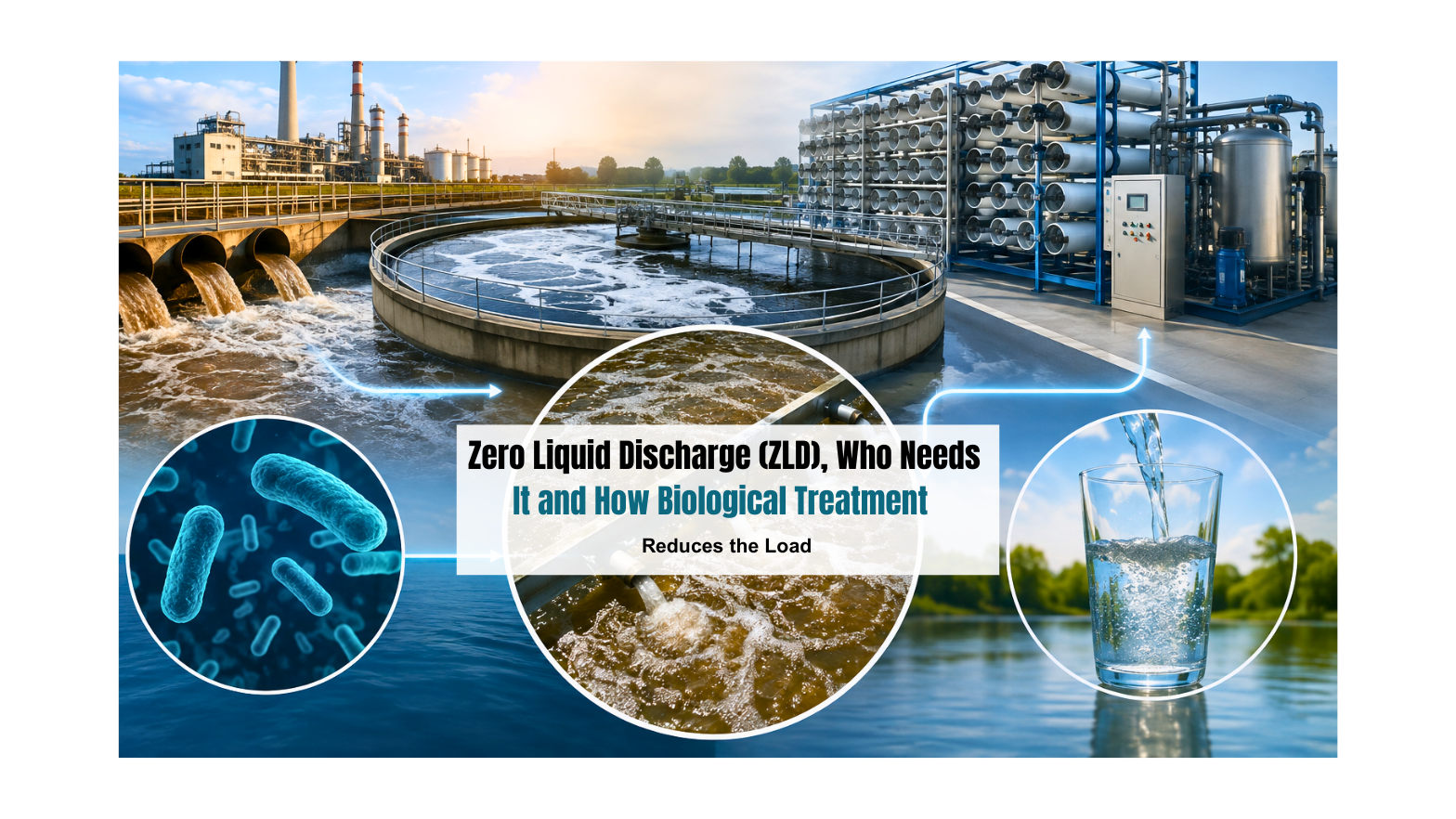
Zero Liquid Discharge (ZLD), Who Needs It and How Biological Treatment Reduces the Load
It is a Tuesday morning, and your compliance manager walks into your office with a printed directive. The letterhead reads CPCB. Somewhere in the second paragraph, the words “Zero Liquid Discharge” are underlined in red ink. The room goes quiet.
For a large number of plant directors and environmental heads across India, this is not a hypothetical. It is a moment that has already happened, or one they are quietly dreading. ZLD feels, at first glance, like an enormous, expensive, technically complex mandate handed down without a practical roadmap. The instinct is to panic, call three vendors, and receive three wildly different cost estimates that make things worse.
Before your team reaches that point, let us slow down. What ZLD actually means, which industries genuinely need it, what the compliance landscape looks like, and, most importantly, why the right biological treatment strategy can make the entire system far more manageable than the initial sticker shock suggests. That is what this guide is here to walk you through.
ZLD Full Form and What It Actually Means in Practice
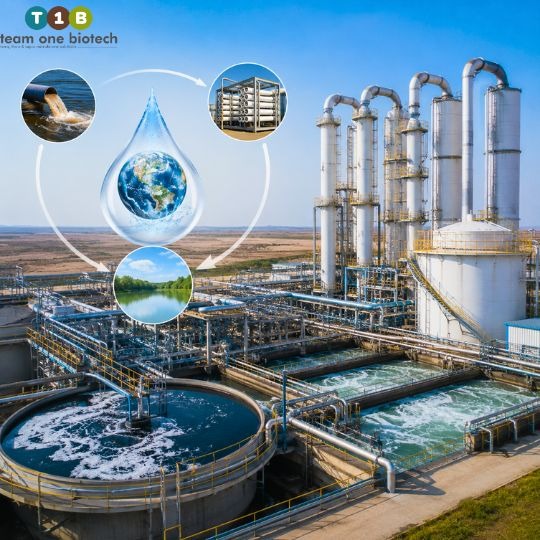
ZLD full form is Zero Liquid Discharge.
The definition, stripped of jargon, is this: a water management approach where no effluent leaves the plant boundary in liquid form. Every drop of wastewater generated within your facility is treated, recovered, and recycled back into your process. Nothing is discharged into a drain, a river, a municipal sewer, or any external body of water.
It is important to clarify what “zero” actually means here, because it trips people up. Zero Liquid Discharge does not mean zero water consumption. Your plant still uses water. It means zero untreated or partially treated liquid discharge leaving your premises. The water that enters must eventually either leave as solid waste, crystallised salts, sludge for disposal, or return to your process as recovered water.
In practice, a ZLD system moves through several stages. Incoming wastewater first goes through primary treatment, where solids and debris are removed. It then passes through secondary treatment, which is the biological stage, where microbial activity breaks down organic matter, reducing biochemical oxygen demand (BOD) and chemical oxygen demand (COD). After that comes tertiary treatment, including membrane filtration systems like reverse osmosis, which push water purity higher. Finally, the remaining concentrated reject stream goes through evaporation and crystallisation, where water is extracted as vapour and the dissolved solids are left behind as dry cake for disposal.
Each stage builds on the one before it. The quality of work done in your biological treatment stage directly determines how hard every stage after it has to work, and how much that costs you.
Zero Liquid Discharge India mandates are growing more stringent each year, and understanding the system architecture is the first step to approaching it rationally.
CETP Full Form and How It Fits Into the ZLD Conversation
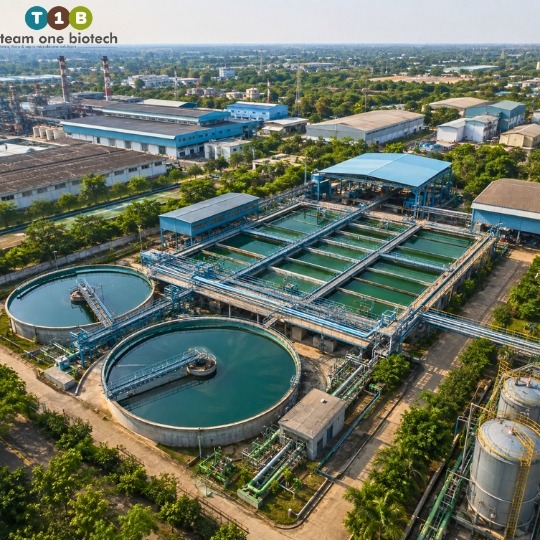
CETP full form is Common Effluent Treatment Plant.
A common effluent treatment plant is exactly what the name suggests: a shared treatment facility, typically set up by a cluster of small and medium-scale industries operating in proximity, to collectively treat their wastewater. Instead of each unit building and operating its own treatment infrastructure, which many small dyeing units, tanneries, or pharmaceutical manufacturers cannot afford, they pipe their effluent into a centralised CETP plant that handles treatment on their behalf.
In the context of industrial biochemistry, a CETP handles mixed-stream effluent. These streams tend to be complex: they carry high biological oxygen demand from organic matter, elevated chemical oxygen demand from synthetic compounds, variable pH, colour load, and in some cases heavy metals or residual solvents. The cetp full form in biochemistry context therefore implies not just shared infrastructure but shared biological and chemical treatment challenges, often in effluent streams that no single standard treatment protocol can address cleanly.
Here is where many industries make a dangerous assumption: they believe that discharging into a CETP exempts them from ZLD obligations. It does not. If your industry falls under a sector regulated for Zero Liquid Discharge, your wastewater does not get a free pass simply because it is pooled with others. The CETP itself may be required to meet ZLD norms, and the member industries may still carry regulatory responsibility. This is a compliance grey area that has caught several cluster units off guard during inspections.
Which Industries in India Are Legally Required to Implement ZLD
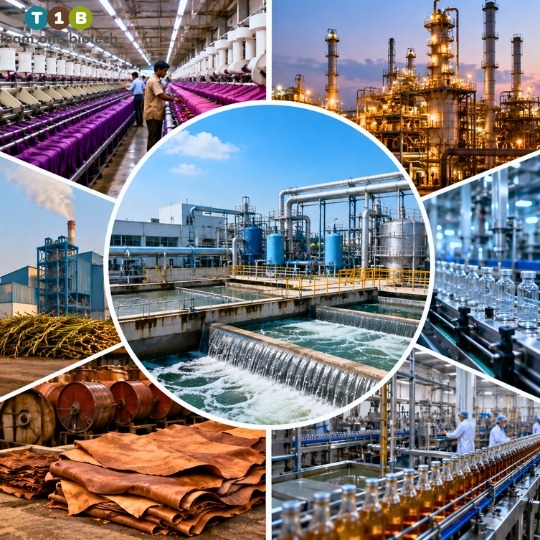
The regulatory foundation here is significant. The Central Pollution Control Board (CPCB) and State Pollution Control Boards (SPCBs) across India have issued mandates requiring ZLD compliance for a defined set of industries, those characterised by high water consumption, complex effluent chemistry, and historically significant environmental impact. Non-compliance is not a matter of receiving a warning letter and carrying on. It can mean plant shutdown, cancellation of operating permits, and in serious cases, legal proceedings under the Environment Protection Act.
The following sectors are subject to ZLD mandates or intensive enforcement in India:
Textile and dyeing units sit at the top of this list. ZLD norms for textile industry India are among the most rigorously enforced in the country. Dyeing and bleaching operations generate effluent that is heavily coloured, high in TDS, and laden with reactive dyes that resist conventional treatment. Several SPCBs, particularly in Gujarat, Tamil Nadu, and Maharashtra, have issued sector-specific compliance timelines, and enforcement has become increasingly active. If your unit is in the textile or dyeing segment, ZLD is not a future consideration. It is a present obligation.
Distilleries and breweries generate some of the highest COD effluent loads of any industrial sector. Spent wash from distilleries is notoriously difficult to treat and has been the subject of specific SPCB directions in states including Uttar Pradesh, Maharashtra, and Punjab.
The sugar industry, while seasonal in its discharge cycle, produces large volumes of high-strength effluent during crushing season. The episodic nature of the discharge makes management harder, and ZLD requirements have been applied to sugar mills in several states.
Pulp and paper manufacturers have been on the CPCB’s regulated polluter list for decades. Effluent from paper mills contains chlorinated compounds, lignin, and high suspended solids loads that make discharge into natural water bodies unacceptable.
Pharmaceutical and bulk drug manufacturers are under increasing enforcement pressure, particularly in industrial clusters in Hyderabad (Patancheru, Bollaram) and Gujarat (Ankleshwar, Panoli). The effluent from bulk drug synthesis contains complex organic molecules, residual solvents, and active pharmaceutical ingredients that conventional treatment does not fully eliminate.
Tanneries produce effluent containing chromium compounds, sulfides, and high biological load, a combination that has resulted in severe enforcement action in clusters such as Vellore in Tamil Nadu and Kanpur in Uttar Pradesh.
Thermal power plants, particularly those managing ash pond discharge and cooling tower blowdown, face ZLD-adjacent requirements around water use efficiency and zero discharge from specific streams.
One important caveat: compliance requirements are not uniform across states. The CPCB sets the national framework, but SPCBs have discretion over timelines, specific norms, and enforcement intensity. Always verify your current obligations directly with your relevant state board or through a qualified compliance advisor.
ZLD vs ETP, Understanding the Difference Before You Invest
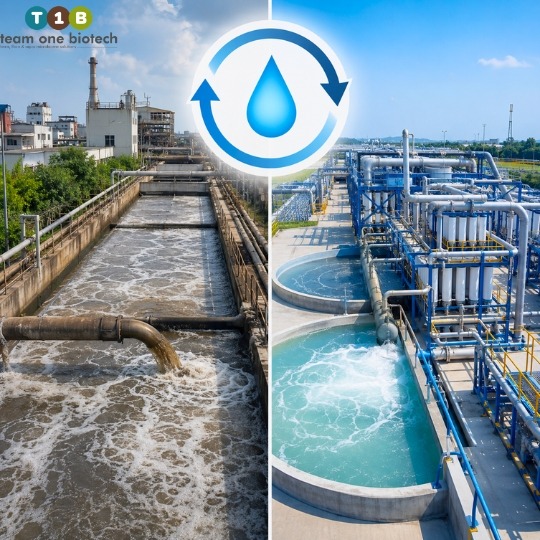
When plant engineers and utility heads search for information on ZLD vs ETP, they are usually at a decision point: they have an existing system, they know something needs to change, and they are trying to understand how large that change needs to be.
An Effluent Treatment Plant, or ETP, treats your wastewater to permissible discharge limits and then releases the treated water, into a drainage channel, a river, or a municipal network, depending on your permit conditions. An ETP does its job and lets go of the water. It does not recover it.
A ZLD system does not let go. It goes several stages beyond an ETP, recovering water through membrane systems and thermal evaporation until nothing liquid remains to discharge. The recovered water goes back into your process. The residual becomes solid waste.
What is critical to understand is that ZLD is not a replacement for an ETP. It is an extension of one. A well-designed ETP with robust biological treatment is the foundation that a ZLD system is built on top of. You cannot skip the biological stage and bolt on an evaporator and expect things to work efficiently. That is not a technical opinion, it is a practical reality that plants across India have discovered the hard way.
Here is a general comparison of the two approaches:
| Parameter | ETP | ZLD System |
| Liquid discharge allowed | Yes, within regulatory limits | No liquid discharge permitted |
| Water recovery | Partial | Near-complete |
| Primary cost driver | Chemical and biological treatment | Evaporation energy |
| Regulatory status | Standard compliance requirement | Mandatory for regulated sectors |
| Downstream destination of treated water | External drain, river, or sewer | Recycled back into plant process |
Disclaimer: The above is a general comparison. Actual performance parameters vary based on influent quality, plant design, technology selection, and operational conditions specific to each facility.
The underlying message: if you are in a regulated sector, ZLD is not an upgrade you choose. It is the standard you are required to meet. The question is not whether to build it but how to build it in a way that does not drain your operating budget every month.
Why Biological Treatment Is the Most Underrated Step in Any ZLD System
Here is where a great deal of industrial investment goes wrong, and where it can be corrected.
When the ZLD conversation starts inside a plant, the instinct is to focus on the visible, capital-intensive end of the system: the evaporators, the crystallisers, the multiple-effect evaporation units. These are the big-ticket line items. They look like the solution. And they are part of the solution, but they are the last part, not the whole.
The single most expensive mistake in ZLD system planning is rushing toward thermal evaporation without adequately addressing organic load upstream. The reason is straightforward: evaporation systems are energy-intensive by design. Every litre of water that enters an evaporator must be heated to the point of vaporisation. The higher the BOD and COD load in that water, the more the system fouls, scales, and struggles. The more it struggles, the more energy it consumes. The more energy it consumes, the higher your operating cost climbs, month after month, year after year.
Biological treatment, particularly advanced solutions using microbial consortia developed for specific effluent compositions, can reduce BOD and COD by a substantial margin before water reaches the thermal stage. This is not a marginal improvement. In well-designed systems, significant organic load reduction at the biological stage translates directly into reduced volume and strength of water entering evaporation, which translates into measurably lower energy consumption and operating expenditure.
What effective biological pre-treatment achieves within a ZLD system:
- Significant reduction in BOD and COD before water reaches secondary and tertiary processing stages
- Reduced fouling and scaling in membrane systems such as ultrafiltration and reverse osmosis, extending membrane life and cutting replacement frequency
- Extended operational life of evaporation equipment by reducing the chemical aggressiveness of the concentrated stream
- Lower consumption of chemicals in downstream polishing and pH correction stages
- A materially reduced energy footprint for the ZLD system as a whole
The logic is simple: every unit of organic load you remove biologically is a unit of load your evaporator does not have to deal with. Biological treatment is cheaper per unit of load removed than thermal evaporation. Therefore, investing adequately in biological treatment before your evaporator is not a compromise, it is the economically rational decision.
Disclaimer: Reduction efficiencies vary depending on influent composition, hydraulic retention time, microbial culture selection, temperature, and plant-specific operating conditions. The benefits described above are indicative and reflect observations across typical industrial applications. Plant-specific assessment by a qualified engineer is recommended before system design decisions are made.
What Does a ZLD System Cost in India, And How Biological Treatment Affects That Number
One of the most common questions plant directors ask is straightforward: what will this cost?
The honest answer is that ZLD system cost in India varies considerably, and anyone who gives you a firm number without understanding your influent quality, discharge volume, recovery targets, and technology selection is guessing. Mid-sized industrial plants implementing ZLD in India have seen costs range from a few crores on the lower end, for plants with simpler effluent chemistry, existing pre-treatment infrastructure, and modest recovery requirements, to significantly higher for plants handling complex, high-volume, high-TDS effluent streams.
What matters more than the headline number is understanding where the costs come from and where they can be managed intelligently.
Capital cost in a ZLD system is dominated by evaporation and crystallisation equipment. These are expensive to procure, install, and maintain. Operating cost is dominated by energy, specifically the thermal energy required to run evaporators.
The single most effective lever available to reduce both capital and operating cost is upstream biological treatment. A plant that invests in a well-designed biological pre-treatment system can reduce the organic and dissolved load entering its evaporator. A reduced load means a smaller evaporator can do the job, lower capital cost. A reduced load also means less energy per litre of water processed, lower operating cost. Over a ten or twenty-year system life, the savings from right-sizing your evaporator based on biologically pre-treated water can be substantial.
Framed differently: the question is not whether biological treatment costs money. It does. The question is whether that investment reduces a larger cost elsewhere in the system. In well-designed ZLD systems, the answer is consistently yes.
Frequently Asked Questions
What is the ZLD full form?
ZLD full form is Zero Liquid Discharge, a wastewater management approach in which no liquid effluent is released outside the plant premises. All wastewater is treated, recovered, and recycled internally.
What is CETP full form in biochemistry?
CETP full form is Common Effluent Treatment Plant. In the context of industrial biochemistry, a CETP handles mixed effluent streams from multiple industries, typically streams with high biological oxygen demand and chemical oxygen demand, within a shared treatment facility serving an industrial cluster.
Is ZLD mandatory for textile industries in India?
Yes. ZLD norms for textile industry India have been mandated by CPCB and multiple State Pollution Control Boards, with particular enforcement focus on dyeing and bleaching units. Compliance timelines and specific norms differ by state, and units should verify their current obligations with their relevant SPCB.
How does biological treatment reduce ZLD operating costs?
By reducing BOD and COD before water reaches evaporation stages, biological treatment lowers the organic and dissolved load on energy-intensive thermal equipment. This reduces energy consumption, slows fouling of membranes and evaporators, and in many cases allows right-sizing of downstream equipment, cutting both capital expenditure and ongoing operating costs.
ZLD Is Not Optional, But It Does Not Have to Break Your Budget
Three things are worth carrying away from everything covered here.
First, Zero Liquid Discharge India compliance is a regulatory reality for most high-polluting industrial sectors, not a future consideration and not something that can be deferred indefinitely. The enforcement environment is tightening, and the cost of non-compliance, in legal exposure, reputational damage, and potential plant shutdown, is considerably higher than the cost of building the right system.
Second, biological treatment is the most underutilised cost-reduction lever in ZLD system design. Plants that invest in robust upstream biological pre-treatment consistently find that their downstream evaporation systems are smaller, cheaper to run, and longer-lasting than those of plants that skipped or underinvested in this stage.
Third, the intelligence in ZLD design is upstream. Over-sizing your evaporator because your biological treatment is inadequate is not a safety margin, it is an avoidable expense that compounds every time your energy bill arrives.
ZLD is not optional. But with the right treatment architecture, it does not have to define your plant’s economics in the way that first CPCB directive made it feel.
Team One Biotech works with industrial plants across India to design and deploy bioremediation solutions that make ZLD systems leaner, more efficient, and more cost-effective. Whether you are planning a new ZLD system or optimising an existing one, our technical team is ready to support you. Contact us today for a no-obligation consultation.
Disclaimer: Cost ranges mentioned above are general industry indicators and may vary significantly based on influent characteristics, plant scale, technology selection, and site-specific conditions. These figures should not be treated as project estimates. Detailed techno-commercial proposals from qualified vendors are essential for accurate cost assessment.
Looking to improve your ETP/STP efficiency with the right bioculture?
Talk to our experts at Team One Biotech for customised microbial solutions.
Contact: +91 8855050575
Email: sales@teamonebiotech.com
Visit: www.teamonebiotech.com
Discover More on YouTube – Watch our latest insights & innovations!-
Connect with Us on LinkedIn – Stay updated with expert content & trends!