
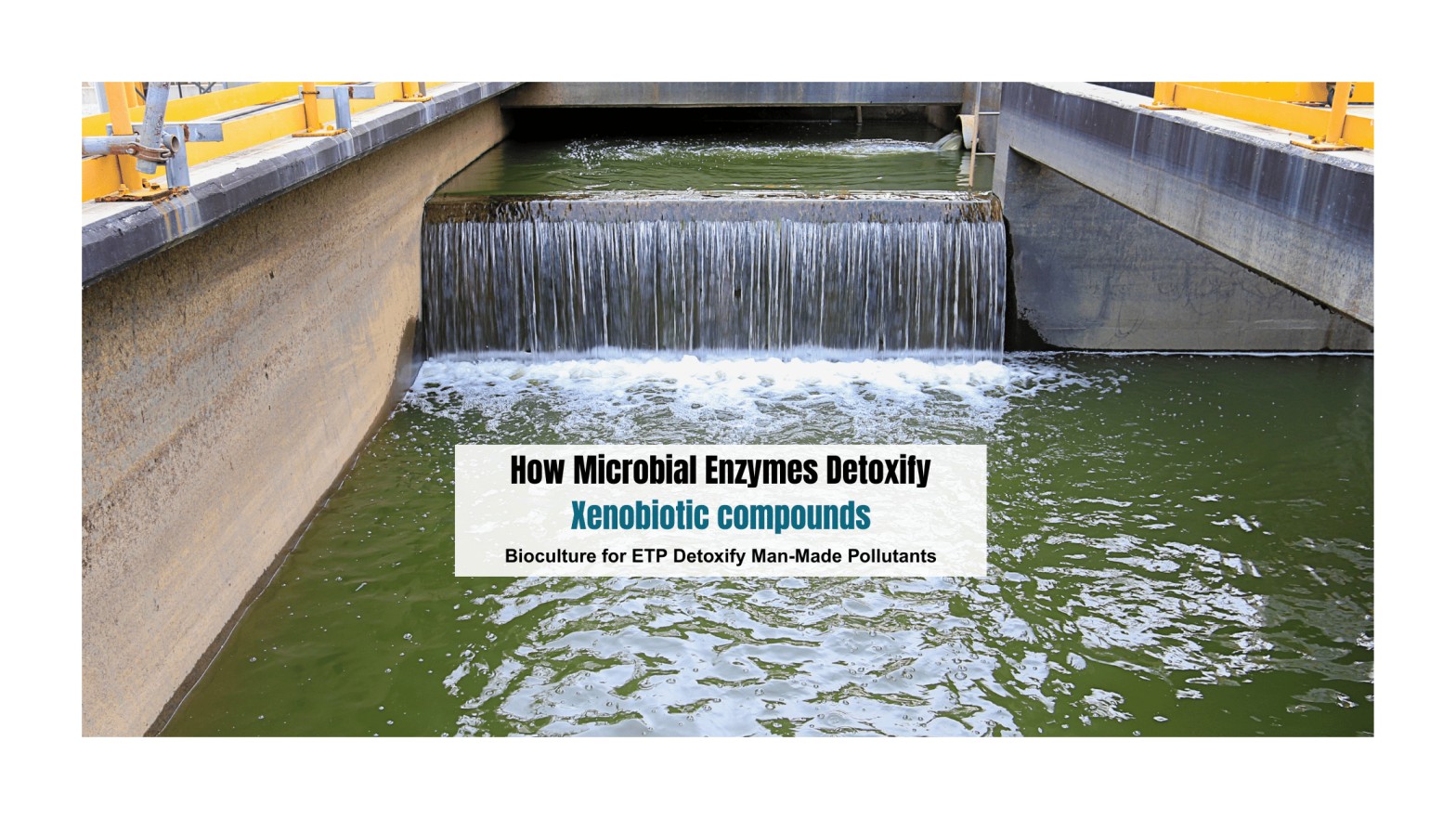
How Microbial Enzymes Detoxify Man-Made Pollutants
Biocultures for ETP- How Microbial Enzymes Detoxify Xenobiotic Compounds

Modern life depends on thousands of synthetic chemicals — plastics, pesticides, dyes, pharmaceuticals, fuels, and surfactants — that make living convenient but leave behind an uncomfortable legacy: xenobiotic compounds. These are man-made molecules that do not occur naturally and often resist degradation by normal biological pathways. They persist for decades, accumulate in ecosystems, and sometimes transform into even more toxic intermediates.

While conventional chemical and physical treatments can remove or immobilize some pollutants, they are energy-intensive and generate secondary waste. The sustainable alternative comes from nature itself — enzymes, the microscopic catalysts that drive every reaction inside living cells.

What Makes Xenobiotics So Stubborn

Xenobiotic molecules often contain:
• Halogenated groups (–Cl, –F, –Br) that make them chemically stable.
• Aromatic rings such as benzene that resist oxidation.
• Complex branching or polymeric chains that ordinary microbes can’t easily access.

Because of this structural complexity, the natural metabolic machinery of most microbes struggles to recognize these molecules as food.
Here’s where specialized microbial enzymes come into play — capable of attacking the unbreakable.

In industrial settings, especially in effluent treatment plants (ETPs), the accumulation of such persistent chemicals creates operational challenges. This is why many industries are now adopting biocultures for ETP systems to introduce pollutant-degrading microbes that can adapt to complex effluent loads.

How Enzymes Break the Unbreakable

Microbial enzymes act as molecular scalpels that cut and modify xenobiotic compounds into less toxic, more biodegradable forms. Key classes include:
Oxygenases and Monooxygenases – Insert oxygen into aromatic rings of hydrocarbons, initiating their breakdown (e.g., Pseudomonas oxygenases degrade benzene and toluene).
Peroxidases – Use hydrogen peroxide to oxidize phenols, dyes, and chlorinated pesticides.
Laccases – Multi-copper oxidases that transform phenolic and non-phenolic xenobiotics using atmospheric oxygen, with no harmful by-products.
Hydrolases and Esterases – Cleave ester and amide bonds in organophosphate pesticides, phthalates, and plastics.
Dehalogenases – Remove halogen atoms, converting recalcitrant chlorinated compounds like PCBs or trichloroethylene into simpler molecules.
Nitroreductases and Dehydrogenases – Detoxify nitroaromatics and explosives such as TNT by reduction and further mineralization.

These enzymatic steps either mineralize the contaminant completely into CO₂ and H₂O or transform it into intermediates that native microbes can assimilate.

When industries use biocultures for ETP, they are essentially introducing microbial communities capable of producing these enzymes naturally inside the aeration tank, equalization tank, or bioreactor. This ensures continuous in-situ enzyme production without requiring costly direct enzyme dosing.

Why Direct Enzyme Application Is Not Recommended

Although enzymes are highly efficient and environmentally friendly catalysts, they should not be administered directly into wastewater systems or soil environments. Free enzymes are unstable in real-world industrial conditions — they degrade quickly, get denatured by temperature, pH, or chemicals in the effluent, and lose activity within hours. They also lack the self-regenerating ability of microbes, meaning continuous dosing becomes impractical and extremely expensive. For sustainable bioremediation, enzymes must be produced in situ by living microbial communities that can multiply, adapt, and secrete fresh enzymes as required.

Why Enzyme-Based Bioremediation Matters
  1. Eco-friendly and specific – Enzymes target particular chemical bonds without producing toxic residues.
  2. Operate under mild conditions – They work at ambient temperature and pH, saving energy.
  3. Applicable to diverse pollutants – From pharmaceuticals and dyes to polyaromatic hydrocarbons and endocrine-disrupting compounds.
  4. Compatible with immobilization and reactors – Laccases, peroxidases, and hydrolases can be immobilized on carriers, enabling continuous treatment of wastewater streams.
  5. Synergy with microbes – Enzyme production in situ through microbial consortia sustains long-term remediation in soils, sediments, and bioreactors.

This is why biocultures for ETP are preferred — because living microbes multiply, adapt to effluent changes, and continuously secrete the required enzymes.

Biocultures for ETP: The Most Effective Way to Deliver Enzymes

In modern effluent treatment plants (ETPs), biocultures — specialized microbial consortia — are the safest and most effective way to introduce enzymes into the system. These microbes naturally produce a broad spectrum of enzymes such as oxygenases, hydrolases, laccases, and dehalogenases based on the pollutants present.

Biocultures:

• Maintain stable microbial populations
• Continuously regenerate and secrete fresh enzymes
• Break down complex industrial pollutants
• Reduce sludge generation
• Enhance COD/BOD removal
• Improve overall ETP stability and efficiency
• Reduce chemical dependency in biological treatment stages

For industries handling pharmaceuticals, chemicals, food processing waste, textiles, and dyes, biocultures for ETP have become an essential part of sustainable operations.

The Bigger Picture

Enzymes remind us that sustainability lies in mimicking nature’s chemistry rather than fighting it. They allow us to convert hazardous xenobiotics into harmless end-products without toxic by-products or energy-intensive treatment steps.

With the rising emphasis on zero-liquid-discharge (ZLD), operational efficiency, and cost control, adopting biocultures for ETP is no longer optional — it is a strategic environmental requirement for industries.

Looking for High-Performance Biocultures for Your ETP?

Team One Biotech provides premium microbial formulations designed for:

  • COD/BOD reduction

  • Sludge minimization

  • Colour & odour removal

  • Faster biological stabilisation

  • Enhanced ETP compliance

Our specialized enzyme-rich biocultures for ETP work across industries including pharmaceuticals, chemicals, textiles, food processing, dyes, FMCG, and more.

Industries today are also increasingly adopting biocultures for ETP not only for better pollutant degradation but also for their economic benefits. By improving microbial efficiency, reducing chemical usage, stabilizing biological reactions, and minimizing sludge handling expenses, biocultures significantly reduce overall treatment costs. To understand this in depth, you can explore how biocultures directly contribute to lowering operational and maintenance expenses in industrial wastewater systems here: How Biocultures Save Costs in Industrial Wastewater Treatment.

As one of the leading biotech companies in India and trusted bioremediation companies in India, Team One Biotech continues to deliver solutions that redefine sustainability across wastewater treatment, agriculture, aquaculture, and hygiene management.

Contact us at- +91 8855050575

Email: sales@teamonebiotech.com

Visit: www.teamonebiotech.com

Discover More on YouTube – Watch our latest insights & innovations!-

Connect with Us on LinkedIn – Stay updated with expert content & trends!

Bioculture in Wastewater Enhances Sewage Treatment
How Bioculture in Wastewater Enhances Sewage Treatment

In an age where sustainability and environmental responsibility are non-negotiable, effective wastewater treatment is a priority for industries and municipalities alike. One powerful yet often overlooked innovation is bioculture in wastewater treatment—a natural, eco-friendly solution that’s transforming how we manage sewage.

In this blog, we’ll break down what bioculture is, how it enhances sewage treatment, and why it’s becoming the go-to method for modern wastewater management. If you’re looking to reduce operational costs, improve efficiency, and stay compliant with environmental norms, keep reading.???? Contact Us Now to get our experts today for a free consultation or tailored solution.


What is Bioculture in Wastewater Treatment?


Bioculture refers to a specially formulated mixture of beneficial microorganisms—primarily bacteria and enzymes—used to accelerate the decomposition of organic matter in wastewater. These microbes are naturally occurring, but when cultivated and introduced in optimal quantities, they dramatically improve the biological treatment process of sewage.

Think of bioculture as giving your wastewater treatment system a performance boost—naturally.

Why Bioculture is a Game-Changer for Sewage Treatment


At Team One Biotech, the goal is simple: to harness nature’s own tools to make sewage treatment more effective, economical, and sustainable. Here’s how bioculture does just that:

1. Accelerates Decomposition of Organic Waste

Bioculture boosts the microbial population in sewage, which speeds up the breakdown of organic pollutants like fats, oils, grease, and human waste.

2. Reduces BOD and COD Levels

High levels of Biochemical Oxygen Demand (BOD) and Chemical Oxygen Demand (COD) are signs of pollution. Bioculture helps lower these levels, ensuring treated water is safer to discharge or reuse.

3. Controls Odor Naturally

Sewage smells? Not anymore. The right bioculture neutralizes foul odors by suppressing harmful anaerobic bacteria that produce hydrogen sulfide and ammonia.

4. Improves Sludge Settling

Bioculture enhances the flocculation and settling properties of sludge, making dewatering easier and reducing the volume of waste to dispose of.

5. Eco-Friendly and Non-Toxic

Unlike chemical treatments, bioculture is non-toxic and biodegradable—making it safe for both humans and aquatic ecosystems.

Applications of Bioculture in Wastewater Treatment


Bioculture is versatile and can be used in:

  • Municipal Sewage Treatment Plants (STPs)

  • Effluent Treatment Plants (ETPs) in industries like textiles, food processing, and pharmaceuticals

  • Septic Tanks in residential buildings and commercial complexes

  • Lakes and Ponds for bioremediation of stagnant water bodies

How Team One Biotech Helps You Use Bioculture the Right Way


At Team One Biotech, we don’t believe in one-size-fits-all solutions. Our customized bioculture formulations are tailored to your wastewater profile, plant size, and treatment goals. Plus, our technical team supports you from diagnosis to dosing and beyond.

Need expert guidance? We’re just a click away.

Frequently Asked Questions (FAQs)


✅ What is the function of bioculture in wastewater treatment?

Bioculture enhances the biological degradation of organic pollutants in sewage, helping reduce BOD/COD levels, eliminate foul odors, and improve overall treatment efficiency.

✅ Is bioculture safe for the environment?

Yes, bioculture is eco-friendly and biodegradable. It consists of naturally occurring microbes that are non-toxic to humans, animals, and aquatic life.

✅ How is bioculture applied in sewage treatment?

It is usually added directly into the aeration tank, equalization tank, or septic tank, depending on the treatment process. Dosage depends on the volume and load of wastewater.

✅ How fast does bioculture work?

Results can often be seen within a few days, especially in terms of odor control and reduction of sludge. Full performance is usually achieved within 2–4 weeks of consistent dosing.

✅ Can I use bioculture in an existing STP?

Absolutely. Bioculture is compatible with most existing sewage treatment systems and can often help revive underperforming STPs without major structural changes.

Final Thoughts


Bioculture in wastewater treatment isn’t just a trend—it’s the future. Whether you manage a large industrial effluent plant or a small residential STP, incorporating bioculture can lead to cost savings, regulatory compliance, and a cleaner environment.

Ready to make the switch to smarter sewage treatment?

???? Visit Team One Biotech and explore our bioculture solutions today!

???? Email: sales@teamonebiotech.com

???? Visit: www.teamonebiotech.com

???? Discover More on YouTube – Watch our latest insights & innovations!

???? Connect with Us on LinkedIn – Stay updated with expert content & trends!


Implementation of SBR system in a CETP
Implementation of SBR System in a CETP with T1B Aerobio Bioculture
Introduction: 

The SBR system in a CETP situated in Rajasthan handles effluents from over 40 industries in the RIICO sector the system faces difficulty in handling the load of COD above 2000 PPM, owing to discharges from textiles and  chemicals. The SBR system with 4 biological tanks and 4 cycles a day was struggling with its efficiency in terms  of COD reduction, due to which the outlet COD was very high and the load was carried on to the RO, leading to  damage of membranes and high OPEX. Contact us today to learn how we can help optimize your industrial effluent treatment plant (ETP) with customized bioaugmentation solutions.

ETP details: 

The industry had primary treatment, biological treatment, and then a tertiary treatment. 

Flow (current)  2 MLD
Type of process  SBR
No. of aeration tanks  4
Capacity of aeration tanks  3 MLD each
Total cycles in 24 hrs  4
Duration of fill and Aeration cycle  1.5 hrs and 2.5 hrs respectively
Challenges:
Parameters  Avg. Inlet parameters(PPM)  Avg. Outlet parameters(PPM)
COD  3000  800
BOD  1800  280-300
TDS  3000  1200
Operational Challenges: 
  • The primary treatment was working at 5 % efficiency in terms of COD reduction 
  • The whole SBR system was lagging in COD degradation efficiency and sustainability of MLVSS as well. 
  • The Carryover COD and unsettled biomass was traveling to RO, damaging membranes. 
The Approach: 

The agency operating the SBR system in a CETP approached us to solve their current issues.  

We adopted a 3D approach that included : 

  1. Research/Scrutiny :  
  • Our team visited their facility during the winter season as they encountered many issues at that  

         time. Team scrutinized every aspect of the plant to analyze the efficiency of each element. 

  • The visit gave us a complete idea of their processes, current efficiency, trends, and our scope of  

         work.  

  1. Analysis : 
  • We analyzed the previous 6-month cumulative data of their ETP to see trends in the inlet-outlet  

         parameters’ variations and the permutation combinations related to it. 

  1. Innovation :  
  • After the research and analysis our team curated customized products and their dosing schedules  with formulation keeping in mind the plan of action to get the desired results. This process is            called  bioaugmentation. 
Desired Outcomes : 
  1. Reduction of COD/BOD thereby improving the efficiency of biological tanks. 
  2. Degradation of tough-to-degrade effluents and develop robust biomass to withstand shock loads. 
  3. Ensuring proper settling of Biomass to stop carryover to RO, thereby preventing damage to RO membranes.
Execution: 

Our team selected two products : 

T1B aerobio product

T1B Aerobio Bioculture: This product consisted of a blend of microbes as bioculture  

selected as per our analysis to degrade the recalcitrant COD, and ensure sustainability in  

the SBR system.  

Plan of action: 
  1. We devised a 60 days dosing plan, which was further divided into two phases: 
  • Day 1 to day 30 : Loading dose, to develop the population of bacteria and generate biomass.
  • Day 31 to Day 60: Maintenance Dose, to maintain the population of biomass generated. 
  1. Dosing pattern: We advised dosing in all 4 SBR tanks cycle wise viz. during filling and Aeration, to give  the bioculture proper mixing and necessary DO. 
Results: 
Parameters  Inlet parameters  Tank 4 outlet parameters (ppm)
COD  3000 ppm  280-300 ppm
BOD  1800 ppm  60-82 ppm

Before and after adding bioculture

The implementation of the bioaugmentation program resulted in significant improvements in the performance  of biological units in their WWTP: 

  • We were able to achieve around 90 % reduction from their current inlet parameters in COD & BOD,  which was only 70% earlier. 
  • The overall ETP OPEX was reduced by 20%. 
  • The ETP achieved full capacity operations in terms of hydraulic load. 
  • The biological process became more stable and resilient to fluctuations in the influent characteristics. 
  • The RO membrane health was restored and and their damage reduced up to 80%.

Want similar results for your ETP or STP? Contact us for more Information.

Email: sales@teamonebiotech.com

Visit: www.teamonebiotech.com

Discover More on YouTube – Watch our latest insights & innovations!-

Connect with Us on LinkedIn – Stay updated with expert content & trends!

Scan the code