
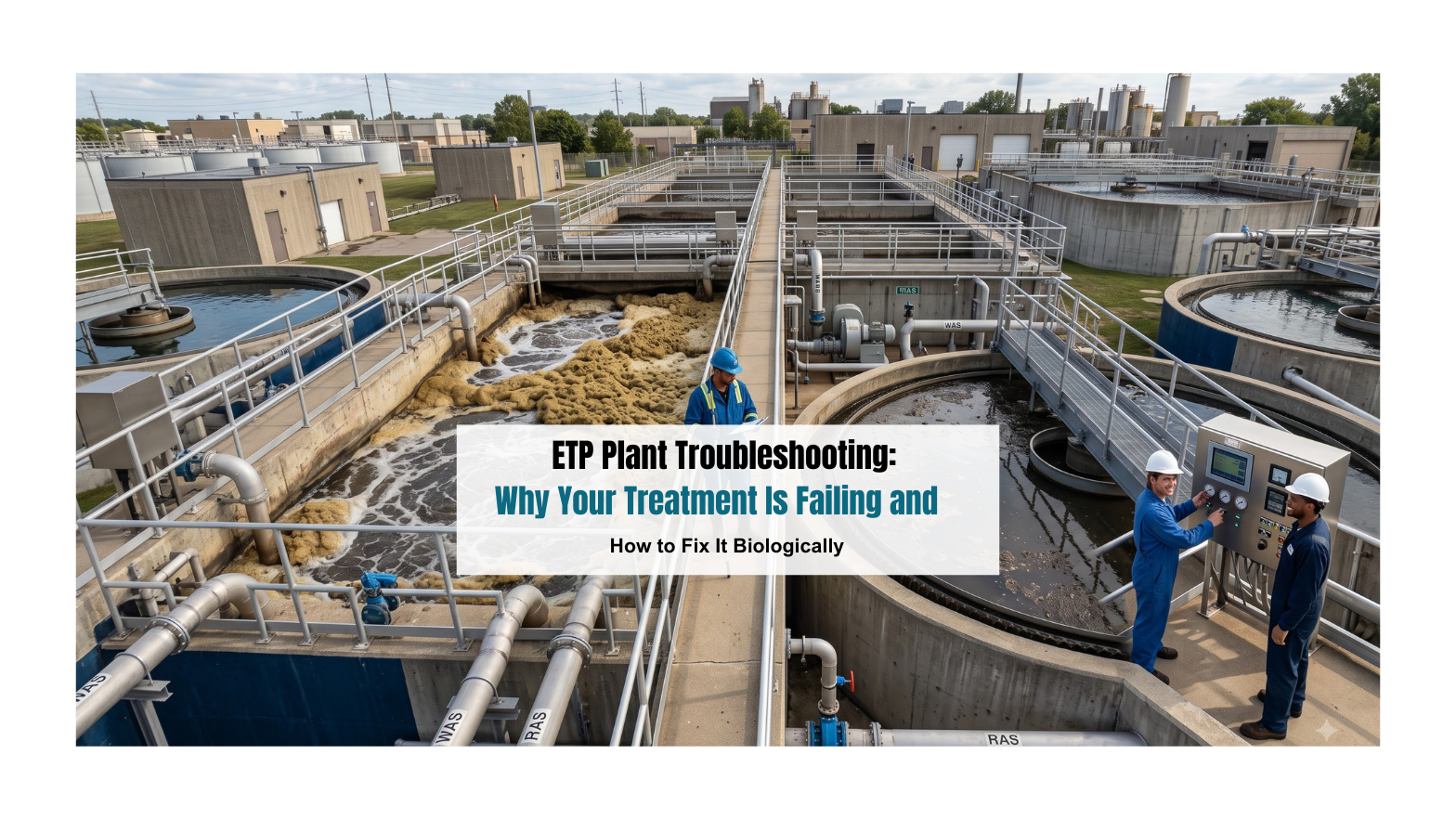
ETP Plant Troubleshooting: Why Your Treatment Is Failing and How to Fix It Biologically
There’s a particular kind of dread that sets in when the lab hands you an outlet report that doesn’t match what your gut was telling you all week. Maybe it’s a COD number that’s crept past your comfort zone for the third day running. Maybe it’s sludge that just won’t settle, no matter how much coagulant you throw at the clarifier. Or maybe it’s worse, an SPCB inspection is already on the calendar, and you’re standing next to an aeration tank at some odd hour trying to figure out what changed.
If any of that sounds familiar, you’re not alone, and you’re not doing anything obviously wrong. Most ETP failures aren’t mysterious once you know where to look. They’re also rarely permanent, provided you’re willing to treat the actual disease instead of dosing your way through the symptoms.
Quick definition for anyone who landed here searching “ETP full form” or “what is ETP”: an effluent treatment plant (ETP) is the system that treats industrial wastewater before it’s discharged or reused, typically combining physical, chemical, and biological stages to bring parameters like BOD, COD, and TSS within regulatory limits. If you’re already running one and it’s misbehaving, you probably don’t need that definition, you need answers. So let’s get into those.
Most ETP breakdowns trace back to a small handful of root causes, and the encouraging part is that most of them can be corrected biologically rather than papered over with another drum of chemical dosing. This piece walks through what failure actually looks like, the three root causes we see most often in the field, and a practical recovery sequence you can start applying this week.
Before we go further, one important note: every range, threshold, or figure mentioned anywhere in this article is a general industry indicator only. Actual acceptable values depend entirely on your plant’s design, influent characteristics, hydraulic load, and the specific CPCB and SPCB norms that apply to your state and industry category. Nothing here should replace your plant’s own baseline data or your consulting engineer’s site-specific recommendations.
What “ETP Failure” Actually Looks Like
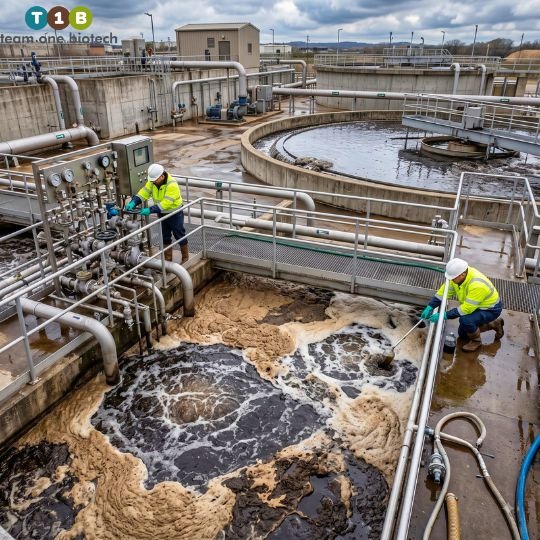
Before diagnosing anything, it helps to separate the symptoms from the disease. Operators often chase the symptom, dosing more coagulant, adjusting pH again, running the blower harder, without asking what’s actually breaking down underneath.
The usual suspects show up like this:
- Rising or erratic COD even though aeration looks completely normal on paper, DO is fine, blowers are running, nothing seems obviously wrong.
- BOD creeping upward over days or weeks, even while the plant “looks fine” on a walkthrough.
- Poor sludge settling, bulking sludge, foul odor near the aeration basin, or unexpected foaming on the surface.
- TSS spikes at the outlet that seem to appear out of nowhere, sometimes only during certain shifts or after certain production batches.
None of these are the actual problem. They’re symptoms of a biological system under stress. Your activated sludge process is, at its core, a living population of microorganisms doing a job, and like any living population, it responds to what you feed it, how much you feed it, and how badly you shock it. Once you start reading these symptoms as biology telling you something, the diagnostic path gets a lot clearer.
The Three Root Causes Behind Most ETP Breakdowns
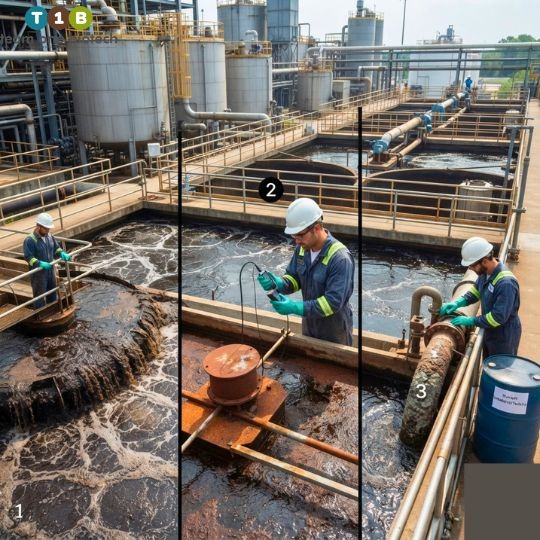
In our experience walking plants back from failure, across textile dyeing units, pharma and API manufacturing, food and beverage facilities, tanneries, and distilleries, nearly every ETP breakdown traces back to one of three root causes, sometimes two working together at once.
Toxic Shock Load
This is the one that scares people, and rightly so. A toxic shock happens when something enters the biological system that the microbial population simply can’t handle, a sudden discharge of disinfectants or cleaning agents, a solvent slug from a batch process, a spike in heavy metals, or an unplanned dump from production that bypasses equalization entirely.
Textile units dealing with dye-bath discharges know this pattern well, and so do pharma and API plants where a solvent recovery miss or an off-spec batch gets routed straight to the ETP instead of being held back.
How it presents is usually unmistakable once you know what you’re looking at: biomass die-off, sludge that goes from healthy brown floc to dark, dead, or sluggish material within hours, and a COD or BOD spike that seems to come from nowhere because the bugs that were supposed to be breaking it down simply aren’t functioning anymore.
The biological fix here isn’t a single dose, it’s a sequence. Reseeding the system with resilient, acclimatized bacterial consortia gives you a microbial population that’s better suited to handle the specific effluent characteristics of your stream. Pairing that with load buffering through equalization tanks means shock loads get diluted and evened out before they ever reach your biology unbuffered. And reintroducing flow in stages, rather than all at once, gives the recovering population room to stabilize instead of getting hit again mid-recovery.
Nutrient Deficiency
This one is quieter and easier to miss because nothing “dramatic” happens, there’s no obvious spill, no foaming crisis, just a slow decline in performance that operators often chalk up to “the plant just isn’t as efficient as it used to be.”
Biology needs a workable balance of organic carbon, nitrogen, and phosphorus to build healthy cell mass and floc structure. Without going into exact ratios, because the right balance genuinely does shift by effluent type and plant design, the short version is that carbon-rich, nutrient-poor streams (distillery effluent and some food and beverage waste streams are classic examples) can starve the microbial population of the nitrogen and phosphorus it needs to grow properly.
The tell-tale signs are weak floc formation that won’t bind together, poor settling in the clarifier even when everything upstream looks chemically normal, and filamentous bulking, those long, thread-like organisms that outcompete the floc-formers when nutrients are out of balance.
The biological fix is targeted nutrient dosing paired with bioaugmentation, so you’re not just adding nitrogen and phosphorus into a system with a depleted microbial population, you’re rebuilding the population itself alongside the nutrient correction. One without the other tends to produce short-lived improvement.
Hydraulic Overload
This is the root cause most likely to get blamed on “the chemistry” when it’s actually a physical problem wearing a chemistry costume. Flow exceeding your plant’s design capacity, whether from a production ramp-up, seasonal demand, or simply more effluent than the ETP was ever sized for, causes short-circuiting through your tanks and cuts your actual retention time well below what your biology needs to do its job.
It presents in a particularly frustrating way: incomplete treatment and TSS carryover at the outlet, even when upstream chemistry, pH, DO, general appearance, looks entirely normal. Operators often spend hours chasing a chemical explanation for a problem that’s fundamentally about time. The water simply isn’t staying in the system long enough for the biology to finish its work.
Fixing this biologically starts with flow equalization and staged loading, so peak flows get smoothed out before they hit your biological reactors. Alongside that, building a more robust and resilient biomass, one that can tolerate variable flow conditions without collapsing every time volumes spike, gives you a system that bends instead of breaking when the next high-flow day arrives.
Why Chemical Fixes Don’t Solve the Real Problem
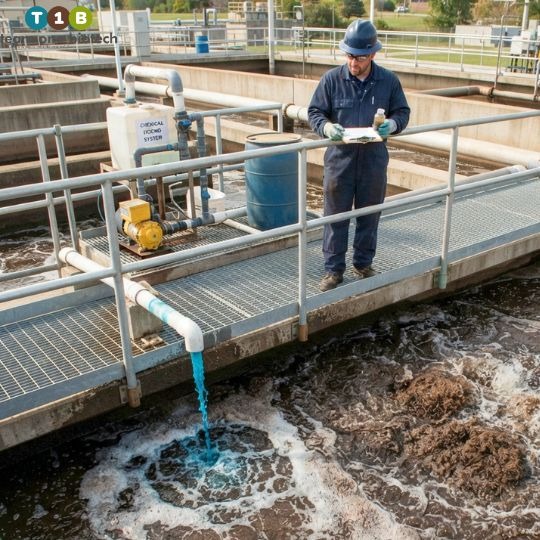
To be clear, chemical treatment has a place. Coagulants, oxidants, and pH correctors are sometimes genuinely necessary, during an active toxic shock, or when you need to hit an outlet number today because an inspection is tomorrow, chemical dosing buys you real, useful time.
But it’s a patch, not a repair. Chemical dosing treats the water sitting in front of you right now. It doesn’t restore the biological population that’s supposed to be breaking down organic load day after day, batch after batch. Once the chemical wears off, or once the next shock load hits, you’re back where you started, because the underlying system that does the actual pollutant breakdown never recovered.
There’s a cost angle here too. Repeated chemical dosing, batch after batch, month after month, tends to be more expensive over the long run than investing in biological recovery once. And critically, it doesn’t build any resilience. A plant running on chemical dosing alone is just as vulnerable to the next shock load as it was before the last one. A plant with a healthy, diverse, acclimatized biological population can absorb some punishment and keep functioning.
Think of it this way: chemistry treats today’s water. Biology treats the system, so tomorrow’s water doesn’t fail too.
A Practical Biological Recovery Plan
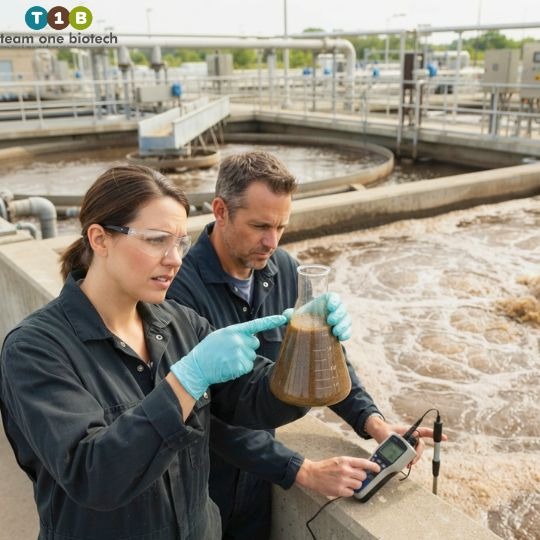
If you’re standing in front of a failing plant right now, here’s the sequence we’d walk through with a client, step by step.
Step 1: Isolate and confirm the root cause.
Sample upstream and downstream of key process points, and check your DO, pH, and sludge volume index against your plant’s historical baseline, remembering again that acceptable ranges here are general indicators and will differ based on your specific design and effluent type. Don’t skip this step to save time; treating the wrong root cause wastes far more time than diagnosing it properly upfront.
Step 2: Stabilize hydraulics before touching biology.
If flow equalization isn’t in place or isn’t working, fix that first. There’s little point reseeding a bacterial population into a tank that’s still short-circuiting flow, you’ll just shock it again.
Step 3: Reintroduce or boost the bacterial population with targeted bioaugmentation
Suited specifically to your effluent type, textile dye-bath residues need a different consortia profile than distillery spent wash or pharma solvent-laden streams. Generic, one-size-fits-all cultures tend to underperform against effluent-specific ones for exactly this reason.
Step 4: Monitor and adjust.
Biological recovery is not instant, and anyone who tells you otherwise is selling you something. Expect a gradual return to stable BOD, COD, and TSS over days to weeks, not hours. Track trends, not single readings, and be prepared to fine-tune nutrient dosing or bioaugmentation rates as the population re-establishes itself.
Preventing the Next Breakdown
Getting the plant stable again is only half the job. The other half is making sure you’re not back here in three months.
A few habits make the biggest difference:
- Build a routine monitoring cadence. Daily checks on the basics, DO, sludge appearance, settling behavior, and weekly deeper checks on sludge volume index and effluent trends, catch problems while they’re still small.
- Watch the early warning signs. Sludge color and texture changes, unusual odor near the aeration basin, and a settling time that’s slowly drifting in the wrong direction are all things biology tells you before the outlet report does.
- Build real buffer and equalization capacity, so shock loads and flow spikes get absorbed before they ever reach your biological reactors unbuffered.
- Maintain a resilient, diverse bacterial population rather than relying on a single-strain or minimally maintained system. Diversity in your microbial community is what lets the plant absorb the next unexpected load without collapsing.
None of this is complicated. It’s mostly discipline, the kind that’s easy to let slide when things are running fine and hard to rebuild once they’re not.
Frequently Asked Questions
What is ETP and what does ETP stand for?
ETP stands for effluent treatment plant, a system industrial facilities use to treat wastewater before discharge or reuse, typically combining physical, chemical, and biological treatment stages to meet CPCB and SPCB discharge norms.
What is ETP sludge and why does it stop settling?
ETP sludge is the biomass, the living microbial population, that develops in the biological treatment stage and does the actual work of breaking down organic pollutants. It stops settling well when that population is stressed, typically from toxic shock, nutrient imbalance, or filamentous bulking, and needs biological correction rather than just a coagulant dose to recover.
How can I reduce COD in an ETP plant without over-relying on chemicals?
Sustainable COD reduction generally comes from restoring the biological population’s health, through targeted bioaugmentation, nutrient balancing, and proper hydraulic retention time, rather than from oxidant dosing alone, which addresses the water in the tank today but not the underlying system.
Why does my ETP meet BOD limits but still fail on COD?
This pattern often points to non-biodegradable or slowly biodegradable organic load, common in pharma, textile dye, and certain industrial chemical streams, where standard biological treatment breaks down the readily biodegradable fraction (reflected in BOD) but struggles with the harder-to-degrade fraction that still shows up in COD. It can also point to an under-acclimatized microbial population that needs a more suited bacterial consortia.
How long does biological recovery take after a toxic shock load?
Recovery timelines vary considerably by plant and severity of the shock, but as a general indicator, expect a gradual improvement over days to a few weeks rather than an overnight fix, and remember that actual recovery time depends heavily on your specific plant design, effluent characteristics, and how quickly the root cause was addressed.
Stop Firefighting, Start Fixing the Biology
Most ETP breakdowns come down to one of three things: a toxic shock load hitting your biomass unbuffered, a nutrient imbalance quietly starving your microbial population, or a hydraulic overload cutting your retention time short. Once you know which one you’re dealing with, the fix isn’t mysterious, it’s methodical, and it’s biological.
Chemical dosing has its place, particularly when you need to hit a number before tomorrow’s inspection. But it’s a stopgap, not a solution. The plants that stop cycling through repeated failures are the ones that invest in restoring and protecting their biology, through targeted bioaugmentation, proper equalization, and routine monitoring, so the next shock load doesn’t send them right back to where they started.
The compliance stakes are real. CPCB and SPCB limits aren’t going to loosen, and neither is the pressure that comes with an outlet report that doesn’t pass. But a stable, resilient biological system is what actually keeps you within those limits, not a drum of coagulant you’re refilling every week.
If your ETP is fighting you right now, get a free effluent diagnostic from Team One Biotech’s bioremediation team before your next inspection. Better to know what’s actually broken today than to find out the hard way when the SPCB does.
Looking to improve your ETP/STP efficiency with the right bioculture?
Talk to our experts at Team One Biotech for customised microbial solutions.
Contact: +91 8855050575
Email: sales@teamonebiotech.com
Visit: www.teamonebiotech.com
Discover More on YouTube – Watch our latest insights & innovations!-
Connect with Us on LinkedIn – Stay updated with expert content & trends!