
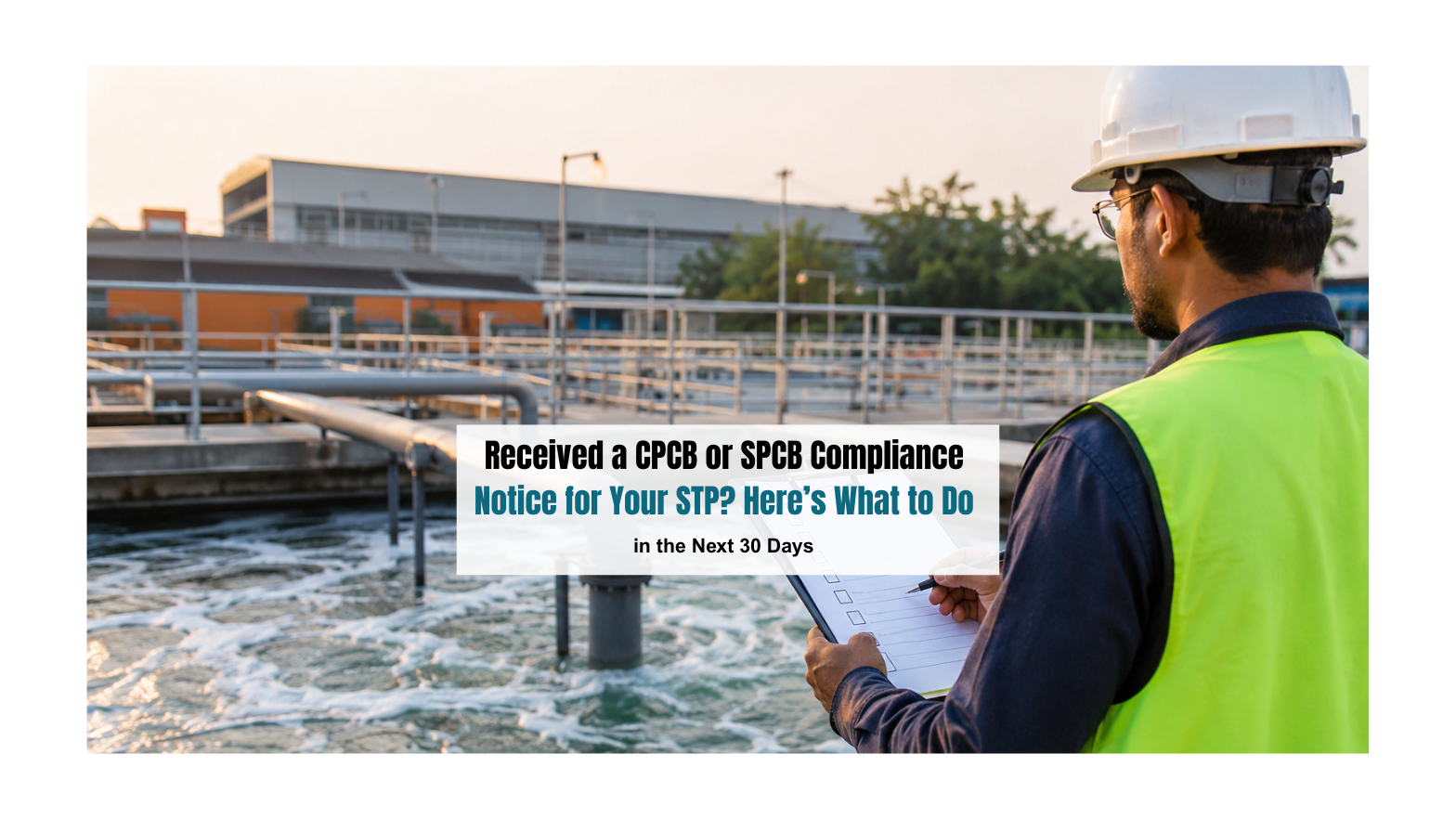
Received a CPCB or SPCB Compliance Notice for Your STP? Here’s What to Do in the Next 30 Days
The morning starts like any other. Then someone hands you an official envelope with a government seal, or your inbox flags an automated alert from your state pollution control board’s portal. Your stomach drops. The words “Show Cause Notice,” “Non-Compliance,” or worse, “Direction for Closure” stare back at you from the page.
If you manage a housing society, run an industrial facility, or oversee operations at a commercial hotel, this is one of the most disorienting documents you can receive. The legal language is dense. The timelines feel brutal. And the consequences, power disconnection, water supply cutoff, steep environmental compensation charges under the Water Act of 1974 and the Environment Protection Act of 1986, feel terrifyingly real.
Here is the truth: receiving a CPCB notice for your STP, or a similar directive from your SPCB, does not mean the situation is already lost. What it means is that the next 30 days are the most critical operational window your facility will face. Every hour you spend in paralysis is an hour you are not spending on recovery.
This guide is written for you, the person holding that notice right now, to move from panic to a clear, legally defensible, operationally sound response plan.
Step 1: Decoding the Allegations, Days 1 to 3

Before you respond to anything, you need to understand precisely what you have been accused of. Not all notices carry the same weight, and conflating them leads to either catastrophic under-reaction or costly over-response.
The Three Categories of Notices You May Have Received:
- Minor Non-Compliance Warning: This is typically an advisory or a preliminary notice flagging a specific parameter, elevated BOD or COD in your treated effluent, for instance, or a lapsed Consent to Operate (CTO). It is a warning shot, not a verdict. Most boards issue these before escalating.
- Show Cause Notice (SCN): This is a formal legal document requiring you to explain, within a specified window (typically a 7 to 15 day reply period), why regulatory action should not be taken against your establishment. This is serious, but it is also an opportunity, it means the board has not yet closed the matter.
- Closure or Stop-Work Direction: This is the highest-severity notice, issued under Section 33A of the Water Act, 1974, or under the powers vested in state boards by the Environment Protection Act, 1986. If you have received this, you need legal counsel immediately alongside your technical remediation plan.
What to Look for When You First Read the Notice:
Read the notice slowly, twice. Identify the following without editorial judgment:
- The specific section of law cited (Water Act, EP Act, or your state’s own environmental rules)
- The alleged violation, is it high BOD/COD in discharge, bypass of the treatment system, no functional STP, or expired CTO?
- The exact response deadline and the designated authority to whom the reply must be submitted
- Whether an inspection report or lab analysis is attached as an annexure
Do not, at this stage, make calls to the board or make any verbal admissions. Everything from this point forward must be documented.
Step 2: Fact-Finding and Data Collection, Days 4 to 10
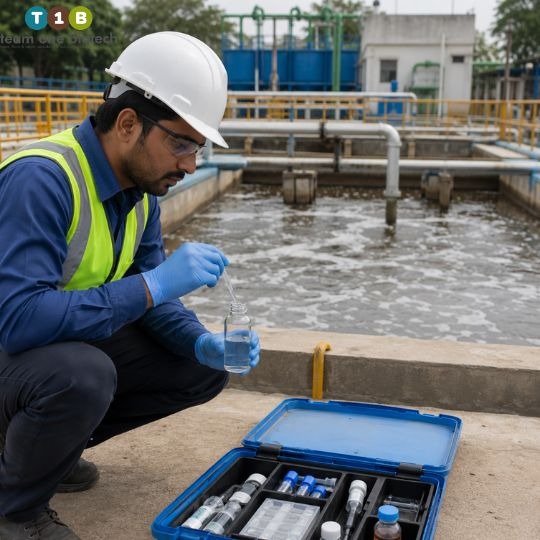
This phase is where your compliance case is either built or broken. You are gathering evidence “without prejudice”, meaning you are assembling a factual picture of your STP’s operational history before crafting your official position.
The Documents You Must Pull Together Immediately:
- Your current Consent to Operate (CTO) certificate and its expiry date. If it has lapsed, this is a primary allegation you must address directly.
- STP Logbooks covering at least the last 6 to 12 months, daily operational records, chemical dosing entries, sludge removal logs.
- Third-Party Lab Test Reports for your treated effluent. If you do not have recent ones, commission an accredited lab immediately. You will need these as baseline evidence.
- AMC (Annual Maintenance Contract) agreements with your STP vendor, proving ongoing maintenance commitment.
- Any prior correspondence with your state pollution control board.
Navigating Your State Board’s Online Portal:
Each state board has its own digital infrastructure, and knowing where to file, track, and respond is non-negotiable.
- KSPCB (Karnataka): The Karnataka State Pollution Control Board’s online portal allows CTO applications and compliance submissions. Responses to notices are typically routed through the regional officer’s desk.
- TSPCB (Telangana): Telangana’s board has a dedicated compliance management module where notice responses and supporting documents can be uploaded against your unit’s registration number.
- MPPCB (Madhya Pradesh): MPPCB processes consent renewals and show cause replies through its online consent management system. Physical submissions to the regional office are often required in parallel.
- GPCB (Gujarat): Gujarat Pollution Control Board has one of the more digitized portals in India. CTO renewals, reply submissions, and inspection scheduling can often be completed end-to-end online.
- UPPCB (Uttar Pradesh): UPPCB processes notices through its regional environmental offices. Many housing societies and industrial units in the NCR region interact with both CPCB and UPPCB simultaneously, requiring dual-track correspondence.
If your state board has an auto-generated portal reference number on your notice, and most now do, use it as your primary tracking ID in every subsequent communication.
Step 3: The Operational Fix, Days 11 to 20

This is the phase that most compliance guides skip entirely, and it is the most consequential. Legal replies and paperwork matter enormously, but if your STP is still discharging non-compliant effluent when the re-inspection happens, no amount of well-crafted documentation will save you.
You need to fix the biology of your plant before the inspector returns.
Why Biological Parameters Fail, and Why Mechanical Fixes Are Too Slow
Most SPCB STP non-compliance notices are triggered by elevated BOD (Biochemical Oxygen Demand), COD (Chemical Oxygen Demand), TSS (Total Suspended Solids), or FOG (Fats, Oils, and Grease) in treated effluent. These are biological process failures. The microbial community inside your STP’s aeration or sludge treatment zone has been disrupted, by chemical shock, overloading, inadequate aeration, or simple neglect.
Mechanical overhauls, replacing blowers, installing new filter media, rebuilding diffuser arrays, take weeks to months, cost significantly, and do not address the root biological cause. By the time a new mechanical system is commissioned, your compliance window has likely closed.
The Bioremediation Rapid-Response Approach
Modern industrial bioremediation deploys precisely selected, high-density live microbial cultures, bacteria and bioenzymes specifically active against BOD, COD, and sludge-forming organic compounds. When introduced into a failing STP at the correct dosage and stage, these cultures recolonize the biological treatment zone rapidly, outcompeting the non-functional microbial population and restoring the degradation efficiency of the system.
The operational outcomes, when the plant is functioning at a hydraulic load it was designed for, are meaningful. BOD and COD levels in the treated effluent can begin declining noticeably within approximately 7 to 14 days of microbial intervention. Accumulated organic sludge volume can reduce by around 50% to 70% over a treatment cycle.
Note: These are general values and operational outcomes will vary based on the specific design, hydraulic load, and unique operational parameters of individual Sewage and Effluent Treatment Plants (STPs/ETPs).
Critically, during this remediation window, your team should be collecting daily effluent samples and running in-house or third-party COD/BOD tests. This documentation becomes part of your compliance file, proof that active corrective action was underway from a specific date.
If you are unsure of your current effluent parameters, contact Team One Biotech for a rapid site-based water quality assessment before committing to any treatment protocol.
Step 4: Crafting a Bulletproof Reply, Days 21 to 25

Your pollution control board show cause notice reply is a legal document. It is also, in practical terms, a piece of institutional communication, and tone matters as much as substance.
The Framework of an Effective SCN Reply:
A strong reply to a CPCB or SPCB non-compliance notice follows this structure:
- Acknowledgment without admission: Formally acknowledge receipt of the notice, cite the reference number, and state your intent to cooperate fully with the board’s mandate.
- Factual rebuttal or contextual explanation: For each specific allegation, provide documented counterevidence or a factual explanation. If a parameter was high on the inspection date due to a verifiable operational event (a chemical discharge from a contractor, a 48-hour aeration failure that has since been repaired), say so, with supporting records.
- Corrective action already undertaken: Present the remediation actions you initiated, the bioremediation treatment program, the lab results showing improving parameters, the AMC renewal, the CTO renewal application if it was lapsed.
- Timeline of full compliance restoration: Commit to a specific, achievable window for full parameter compliance. Be conservative. Under-promise and over-deliver.
- Request for re-inspection: Formally request a board inspection at your stated compliance date. This demonstrates confidence and good faith.
What the reply must never be: defensive, dismissive of the board’s concerns, or vague about timelines. Boards across India, from KSPCB to GPCB, have seen thousands of generic, non-committal replies. A reply that demonstrates genuine operational intervention stands out.
State-by-State Portal Navigation Matrix
| State Board | Online Portal for Reply Submission | Typical Reply Window | CTO Renewal Online? | Key Contact Mechanism |
| KSPCB (Karnataka) | KSPCB Online Portal | Typically 15 to 30 days from notice date | Yes | Regional Environmental Officer |
| TSPCB (Telangana) | TSPCB Compliance Management System | Typically 15 to 21 days | Yes | Unit-linked portal tracking ID |
| MPPCB (Madhya Pradesh) | MPPCB Consent Management Portal | Typically 15 to 30 days | Partial, physical follow-up often required | Regional Office + Online |
| GPCB (Gujarat) | GPCB Online Services Portal | Typically 15 to 30 days | Yes, largely digitized | Online submission + hard copy |
| UPPCB (Uttar Pradesh) | UPPCB Regional Office Portal | Typically 15 to 21 days | Partial | Regional Officer + Portal |
Always verify current deadlines directly from the notice. Portal interfaces and processing timelines are subject to update by the respective boards.
From Reactive Panic to Proactive STP Health
The 30-day window after receiving a CPCB notice for your STP is high-pressure by design. Regulatory architecture is built to compel action, and that pressure, channeled correctly, can become the inflection point at which your facility genuinely upgrades its compliance posture rather than simply surviving this one inspection cycle.
The facilities that handle these situations best are not the ones with the most expensive STPs. They are the ones that respond fast, document everything, fix the biology of their plant using the most efficient tools available, and communicate with the board in a tone of calm, professional accountability.
Environmental compensation charges in India can extend into significant amounts for repeated violations. A pattern of non-compliance also directly affects Consent to Operate renewal timelines, sometimes triggering additional scrutiny that extends for years. The cost of doing nothing, or doing too little, too late, is always higher than the cost of the right intervention at the right time.
Act Now, Before Your Re-Inspection Window Closes
If you are reading this with an active CPCB notice, SPCB show cause notice, or closure direction in hand, the time for general research is over. You need specific answers for your specific plant.
Team One Biotech specializes in rapid STP compliance recovery for housing societies, industrial facilities, and commercial establishments across India. Our microbial rapid-response kits are engineered for fast biological stabilization of failing STPs, bringing BOD, COD, and TSS back within board-specified limits ahead of your re-inspection.
We offer immediate STP compliance audits, effluent parameter testing, and a structured 30-day remediation program designed to give your compliance reply the operational evidence it needs to be credible.
Note: Remediation outcomes will vary based on the specific design, hydraulic load, and unique operational parameters of individual Sewage and Effluent Treatment Plants (STPs/ETPs).
Ready to take the first step toward full STP compliance?
Visit our Contact Page to speak directly with a Team One Biotech compliance specialist — or to request an immediate site assessment, effluent testing, or a microbial rapid-response kit dispatch to your facility.
We respond to compliance emergencies within one business day.
Looking to improve your ETP/STP efficiency with the right bioculture?
Talk to our experts at Team One Biotech for customised microbial solutions.
Contact: +91 8855050575
Email: sales@teamonebiotech.com
Visit: www.teamonebiotech.com
Discover More on YouTube – Watch our latest insights & innovations!-
Connect with Us on LinkedIn – Stay updated with expert content & trends!