

Why Cheap Bioculture Costs More: A Cost-Per-Result Analysis
A purchase order lands on the plant manager’s desk. Three bioculture bids, one clearly the cheapest. The per-kilogram figure beats the incumbent supplier by a comfortable margin, the procurement head has a savings target to hit, and the approval goes through without much debate. Two weeks later, during an effluent inspection, the BOD reading comes back well above the permissible limit. Nobody connects it to the purchase order yet, but the connection is there.
This scenario plays out across Indian industrial plants more often than most people admit. Budget pressure is real. Procurement teams are measured on what they save, and a lower number on a quotation looks like a win. Nobody should be criticised for wanting to control costs in an operation that spends heavily on utilities, chemicals, power, and manpower.
The trouble is the metric itself. Price per kilogram is one of the most misleading numbers in wastewater treatment procurement. It tells you what you pay to receive a bag. It tells you nothing about what that bag does inside your biological reactor, how much of it you will need, or what happens to your plant when it fails to perform.
Cheap bioculture problems rarely show up on the invoice. They show up later, as higher dosing volumes, unstable biology, heavier sludge loads, emergency purchases, and regulatory exposure. This article walks through each of those hidden layers and offers a better framework for evaluation.
Saving on bioculture and saving money are not the same thing.
What Makes a Bioculture “Cheap” and Why It Matters
Low price in a biological product is almost never the result of a more efficient factory or a smaller margin. In most cases, it reflects what has been left out of the product. Understanding what is missing is the first step toward understanding why the cost-per-kilogram figure misleads.
The CFU Count Problem
Colony-Forming Units, or CFUs, are a measure of the live, active bacteria in a product. Put simply, they are the workers. When you dose bioculture into an ETP or STP, the CFUs are the organisms that actually consume organic pollutants, break down BOD and COD, and build the stable biological community your treatment depends on.
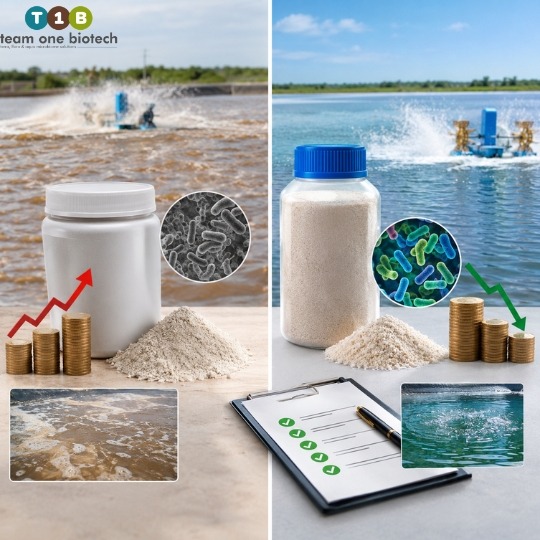
A product with a high viable CFU count delivers a dense population of working organisms per gram. A product with a low count delivers far fewer. This is where low cost bioculture usually reveals its true nature. Budget products often carry viable CFU counts well below what the label suggests, or well below what a premium product delivers in practice. Labels can describe the count at the time of manufacture, while the viable count at the time of use depends on formulation quality, storage, and shelf life.
The consequence is straightforward. If each kilogram carries fewer living organisms, you need more kilograms to reach the same microbial density in your system. A plant that would have dosed a certain quantity of a high-quality product may need to dose a considerably larger quantity of a budget product to reach comparable biological activity. The headline price advantage begins to disappear before the product even enters the tank.
Any serious evaluation therefore starts with CFU count bioculture data that has been independently verified, not simply stated on a datasheet.
Note: CFU counts and dosing volumes vary significantly depending on wastewater composition, ETP design, temperature, and organic load. The ranges referenced in this article are general indicators and may differ substantially at your facility.
Inert Filler Content and Dead Cell Matter
The second issue is what else is in the bag. Many low-cost biocultures are bulked up with inert carrier material, dead cell mass, or biologically inactive matter. This material has weight and volume. It does not have biological function.
Buyers who purchase by weight are, in effect, paying for material that contributes nothing to treatment. When a significant portion of a kilogram is filler or non-viable biomass, the effective price of the active component is much higher than the quoted figure suggests. A cheap per-kilogram rate on a product that is mostly carrier is not cheap at all once you calculate the price of the living fraction.
Buying cheap bioculture by weight without checking viable CFU is like buying fuel by volume without checking octane rating. Two tanks may look identical. What happens in the engine is entirely different.
Strain Selection and Resilience
The third difference is the least visible and the most consequential: which organisms are in the product, and how well they cope with real operating conditions.
Premium bioculture is built around strains selected for resilience. These organisms are chosen for their ability to tolerate pH fluctuations, temperature swings, toxic shock loads, and the high COD variability that characterises many industrial effluents. They have defined functional roles, whether degrading specific compounds, flocculating well, or competing against filamentous growth.
Budget products frequently use generic, uncharacterised microbial communities. They may perform acceptably when conditions are ideal and steady. But very few ETPs operate under ideal and steady conditions. A production change upstream, a cleaning chemical discharge, a cold week, a sudden spike in organic load: any of these can push a delicate culture past its tolerance.
When that happens, the biology collapses, and recovery is slow. It can take days to weeks to re-establish stable biological activity, and during that window the plant is operating on borrowed time. This is the point at which operators begin to say the bioculture is not working, and by then the damage is already accumulating on several fronts at once.
The Real Costs That Never Appear on the Purchase Order

If the purchase order shows only the price of the product, then the real cost of a bioculture decision is spread across the operating budget, the maintenance schedule, the sludge account, and the compliance file. This section follows those costs one by one.
Massive Dosing Volume Requirements
Low CFU counts and high filler content have a direct operational effect: operators must dose more product to achieve the microbial density the system needs. The extra volume is not a one-time adjustment. It repeats with every dosing cycle, every week, across the whole year.
Over a quarter, the surplus may seem modest. Over a year, the additional kilograms purchased, handled, stored, and dosed can erode the per-kilogram saving or eliminate it entirely. In some cases, the plant ends up spending more in total than it would have with a higher-priced, higher-potency product, while still receiving less consistent treatment performance.
There is also a hidden handling cost. More volume means more bags, more storage space, more labour, and more opportunities for dosing error. These are small items individually, but they accumulate.
Note: Dosing requirement differences between high-quality and budget bioculture products vary based on site-specific conditions. Consult your biological treatment specialist for a site-calibrated dosing analysis.
Biological System Crashes and Recovery Costs
A dosing premium is a predictable cost. A system crash is not, and it is far more expensive. ETP bioculture failure tends to arrive without warning and takes a long time to resolve. The costs of a crash event include several distinct items:
- Emergency procurement of replacement biology. When the system fails, plants cannot wait for the next scheduled order. They buy at spot-market rates, often at a premium, often from whichever supplier can deliver fastest.
- Extended aeration and higher power consumption. Operators run blowers and aerators for longer hours to keep what remains of the biology alive and to support re-establishment. Power is typically one of the largest operating costs in biological treatment, and crash recovery pushes it higher.
- Operator overtime. Stabilising a failed system demands extra monitoring, sampling, adjustment, and supervision, often outside regular shifts.
- Bypass risk. In the worst situations, plants face pressure to discharge partially treated or untreated effluent to avoid overflow or production stoppage. This carries serious regulatory and reputational consequences.
Taken together, these recovery costs often represent a multiple of whatever was saved by choosing the budget product in the first place. A saving measured in a purchase order can be cancelled out in a single bad week.
Increased Secondary Sludge Generation
Inefficient biological treatment does not make pollution disappear. It converts it into something else. When bioculture performs poorly, biodegradation is incomplete, and a greater share of the organic load ends up as secondary sludge rather than being mineralised.
More sludge means more volume to dewater, store, transport, and dispose of. Sludge disposal cost ETP operators face in India varies by region, treatment method, hazardous classification, and contractor, and plants should always obtain site-specific disposal quotes rather than relying on general figures. But the direction of the effect is consistent: more sludge means more disposal cycles, and each cycle adds to operating expenditure.
This cost recurs quarter after quarter. Unlike a one-off emergency purchase, it becomes a permanent feature of the budget, quietly absorbing the savings that justified the purchase decision.
Regulatory Penalties and Shutdown Risk
Beyond operational costs sits the largest exposure of all: regulatory consequences.
The Central Pollution Control Board (CPCB) and State Pollution Control Boards (SPCBs) mandate specific effluent quality standards before discharge. These cover BOD, COD, Total Suspended Solids (TSS), and other parameters depending on the industry. Plants must demonstrate compliance through monitoring, and regulators can inspect and sample at their discretion.
A biological crash, or chronic underperformance caused by inadequate bioculture, can push effluent parameters outside permissible limits. BOD COD treatment failure of this kind sets off a chain of escalating consequences: closer inspection, show-cause notices, financial penalties under environmental regulations, and, for repeat offences, directions that can include statutory shutdown orders.
This is not a hypothetical scenario. A CPCB compliance penalty is a documented reality across industrial sectors, from textiles and pharmaceuticals to food processing and chemicals. And a shutdown order does not just cost the fine. It costs lost production, delayed orders, strained customer relationships, and management time that no budget line captures.
When the price of a bag of bioculture is weighed against even one of these outcomes, the per-kilogram saving looks very small indeed. These are the cheap bioculture problems that procurement metrics never measure.
Cost-Per-Result: The Only Metric That Tells the Truth
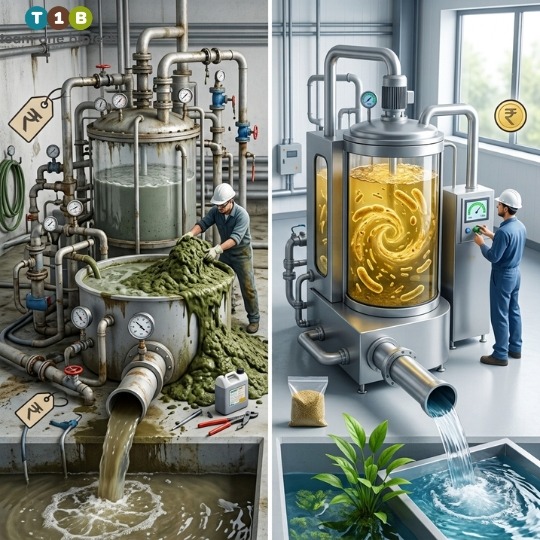
If cost-per-kilogram is misleading, what should replace it? The more reliable framework is cost-per-result. The question is not how much the product costs per kilogram, or even per dose. The question is how much it costs to remove a unit of pollutant, or to deliver one compliant discharge cycle.
Consider the logic. A bioculture that achieves consistent BOD and COD reduction at lower dosing volumes, with fewer crash events, lower sludge output, and reliable regulatory compliance, will deliver a lower cost-per-result even if its per-kilogram price is higher. Each of the costs described above shrinks: fewer kilograms dosed, less emergency spending, less sludge to dispose of, and no penalty exposure.
The inverse is equally true. A product that looks economical at procurement may deliver the highest total operating cost per compliant discharge once dosing surplus, instability, sludge, and risk are counted. The invoice looks good while the plant’s actual cost curve moves in the wrong direction.
This is the foundation of any honest bioremediation ROI calculation. Return is not measured by the price of inputs, but by the cost of outcomes: what the plant spends to treat a defined volume of wastewater to the required standard, consistently, across variable conditions.
To apply this framework, procurement teams and plant managers should request documented performance data before comparing price. That means CFU count certification, strain characterisation sheets, and independent application case studies from comparable industries. A supplier confident in the product will provide these readily. Reluctance to share data is itself informative.
Note: Values are general indicators and vary significantly based on ETP design, wastewater composition, and operational parameters.
Want a true cost-per-result evaluation for your ETP? Contact Team One Biotech’s technical team for a site-specific biological performance review, with no obligation.
What to Look for When Evaluating Bioculture Quality

Quality can be assessed before purchase, provided the right questions are asked. The following criteria give buyers a practical way to separate performance products from cheap ones.
- Verified CFU count. Ask for third-party validated CFU data, not just label claims. Independent testing is the only reliable check on viable organism density.
- Strain identification. The product should name its specific microbial strains and explain their functional roles, such as BOD degradation, nitrification, or sludge reduction. Unidentified “proprietary blends” deserve scrutiny.
- Shelf life and storage conditions. Live cultures degrade over time and with poor handling. Confirm cold-chain or controlled-storage requirements and request expiry data. A strong product that has sat in an unsuitable warehouse is no longer a strong product.
- Application track record. Request case studies or site references from similar industry verticals and ETP types. Results at a dairy plant do not automatically translate to a pharmaceutical effluent stream.
- Technical support availability. A quality supplier backs the product with application engineering support: dosing protocols, troubleshooting, and performance monitoring. A supplier that disappears after delivery is selling a commodity, not a solution.
- Regulatory alignment. Confirm the product is formulated for Indian wastewater conditions and supports compliance with CPCB and SPCB discharge norms.
The Questions Every Procurement Team Should Ask Before Signing a Purchase Order
The checklist below works for plant managers and CFOs alike. It moves the conversation from price to performance and gives both technical and financial stakeholders a shared basis for decision-making.
- What is the certified viable CFU count per gram or kilogram of this product?
- What dosing volume will be required to achieve our target BOD and COD reduction at our specific organic load?
- What is the documented crash recovery performance of this strain under our operating temperature range?
- What is the expected secondary sludge generation rate compared with a premium-tier bioculture alternative?
- What is the supplier’s liability or support protocol in the event of treatment failure?
- What is the total cost per compliant discharge cycle, rather than cost per kilogram?
If a supplier cannot answer these questions clearly, the price quoted is not the price you will pay. Asking them before the purchase order is signed costs nothing. Asking them after a failed inspection costs a great deal.
FAQ: Cheap Bioculture, Real Answers
Can a cheap bioculture still achieve acceptable BOD and COD removal?
In stable, low-variability wastewater streams with consistent loads, some budget products may perform adequately at higher dosing volumes. However, most industrial ETPs experience fluctuating loads, temperature variation, and periodic toxic shock, which are the conditions under which low-resilience strains are most likely to fail. When bioculture is not working in these circumstances, the failure is often sudden. Operational risk is always elevated with budget products, even where short-term results look acceptable.
How do I know if my current bioculture is underperforming?
Early indicators include creeping BOD and COD trends in your effluent monitoring data, rising secondary sludge volumes, increased aeration requirements, recurring odour issues, and difficulty maintaining a stable MLSS (Mixed Liquor Suspended Solids) reading. No single sign is conclusive, but several appearing together point strongly toward a biological problem. Reviewing trends over several months, rather than week to week, usually makes the pattern clearer.
Is switching bioculture suppliers disruptive to my ETP?
A properly managed biological transition, supported by technical guidance, can be completed with minimal disruption. The key is a planned changeover with monitoring, rather than an abrupt switch. The risk of staying with an underperforming product typically outweighs the effort of transition.
How does Team One Biotech’s bioculture differ?
Team One Biotech manufactures bioremediation solutions engineered for verified CFU activity, strain-specific performance, and resilience under Indian industrial wastewater conditions. Our technical team provides site-specific dosing protocols and ongoing application support, so performance is measured at your plant and not only in the laboratory.
The Most Expensive Bioculture Is the One That Does Not Work
The argument comes down to one idea. In biological wastewater treatment, the procurement metric that matters is not what you pay per kilogram. It is what you pay per compliant, verified treatment outcome.
Everything else follows from that. Low CFU counts drive up dosing. Filler dilutes the active fraction. Fragile strains crash under routine variation. Crashes trigger emergency spending, higher power use, and overtime. Incomplete treatment raises sludge volumes. Poor effluent quality invites inspection, penalties, and in serious cases, closure. Each link in the chain begins with a purchasing decision that looked sensible on paper.
Budget pressures are real, and they are valid. Nobody in procurement or finance is wrong to seek savings. But with the cost-per-result framework, certified performance data, and the right questions in hand, decision-makers can evaluate bioculture on what it delivers rather than what it costs to buy.
Your ETP has to meet its discharge norms every single day. The biology inside it has to match that standard. Choose accordingly.
Ready to find out what high-performance bioculture actually costs, and saves, at your facility? Get in touch with Team One Biotech. Our application engineers will walk you through a no-pressure, site-specific cost-per-result analysis.
Looking to improve your ETP/STP efficiency with the right bioculture?
Talk to our experts at Team One Biotech for customised microbial solutions.
Contact: +91 8855050575
Email: sales@teamonebiotech.com
Visit: www.teamonebiotech.com
Discover More on YouTube – Watch our latest insights & innovations!-
Connect with Us on LinkedIn – Stay updated with expert content & trends!