
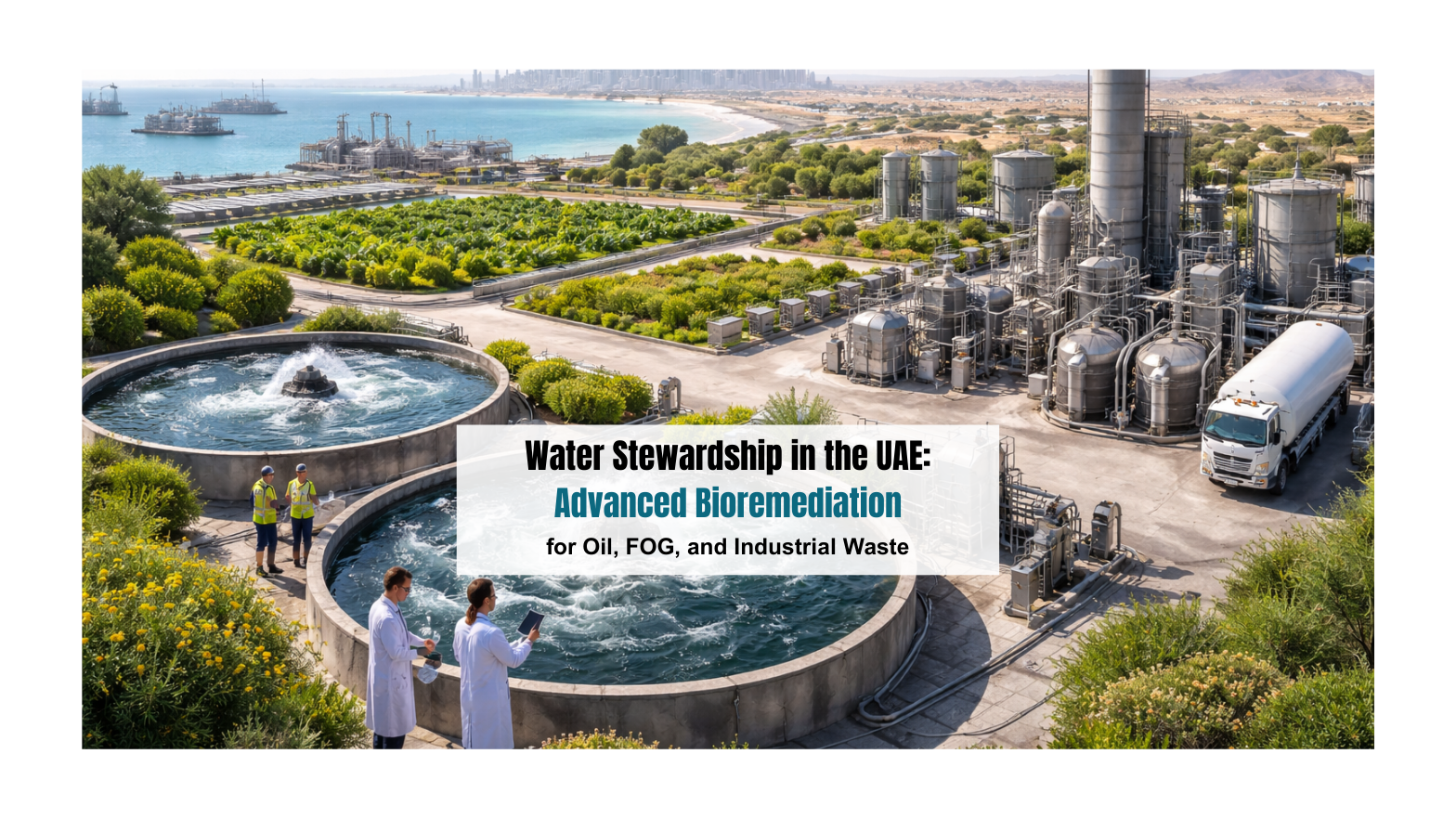

Water Stewardship in the UAE: Advanced Bioremediation for Oil, FOG, and Industrial Waste
The Cost of Inaction: Water Scarcity, Regulatory Pressure, and What It Means for Your Operations
The United Arab Emirates sits atop one of the most water-stressed regions on the planet. With annual renewable freshwater resources among the lowest per capita globally, and a rapidly expanding industrial base that demands more from every available liter, the pressure on water infrastructure is not theoretical, it is immediate, measurable, and accelerating. For operations directors, port authorities, and facility managers operating in this environment, the question is no longer whether tighter environmental regulation is coming. It is already here.
Dubai Municipality (DM) and the Abu Dhabi Sewerage Services Company, now operating under the Abu Dhabi Solutions and Services Company (ADSSC) framework, have both significantly strengthened their wastewater discharge standards in recent years. Non-compliance carries consequences that go beyond fines. Operational shutdowns, mandatory third-party audits, reputational damage with regional and international partners, and the potential loss of operating licenses are all real outcomes for facilities that cannot demonstrate adherence to discharge limits for parameters including Total Petroleum Hydrocarbons (TPH), biochemical oxygen demand (BOD), chemical oxygen demand (COD), and Fat, Oil, and Grease (FOG).
At the same time, the UAE’s Net Zero by 2050 Strategic Initiative has redefined the standard by which industrial operations are judged, not just by regulators, but by shareholders, financing institutions, and global partners. Corporate Social Responsibility directors are navigating a landscape where environmental performance is directly linked to market access and long-term business viability.
The good news is that advanced bioremediation technology has evolved to the point where achieving full regulatory compliance, and often exceeding it, is not only possible, but operationally practical across the UAE’s most demanding industrial environments.
Understanding the UAE’s Unique Environmental Variables
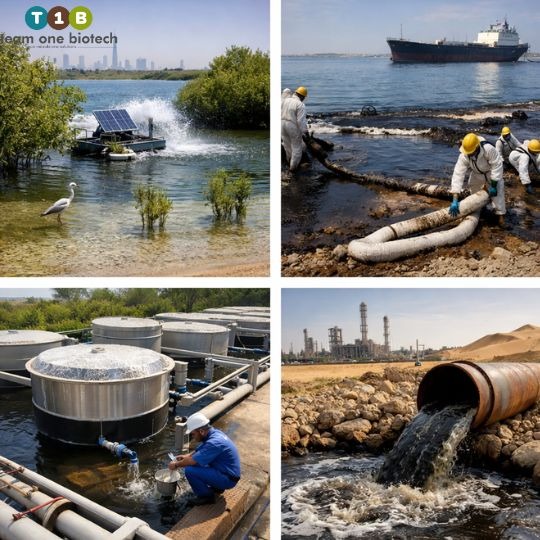
Bioremediation is not a one-size-fits-all technology. The microbial science that underpins effective industrial wastewater treatment must account for the specific environmental conditions of the deployment site. In the UAE, three variables create a treatment challenge that standard solutions, imported wholesale from temperate climates, consistently fail to address adequately.
High Salinity in Receiving Water Bodies
The Arabian Gulf is a semi-enclosed sea with naturally elevated salinity, a condition exacerbated by the UAE’s extensive desalination infrastructure and the discharge of industrial effluents. Microbial consortia that have not been specifically formulated or adapted for high-salinity environments will experience significant population decline when introduced to saline wastewater streams. This is not an edge case, it is the baseline operating condition for every marine terminal, offshore support facility, and coastal industrial operation in the country. Non-pathogenic microbial blends designed for bioremediation in the UAE context must demonstrate halotolerance as a core functional attribute.
Extreme Temperature Fluctuations
Microbial metabolic activity is temperature-sensitive. Enzymatic reaction rates within bacterial cells, the fundamental mechanism by which hydrocarbons are degraded, follow Arrhenius kinetics, meaning that activity roughly doubles with every 10-degree Celsius increase up to the organism’s optimum range, and then drops sharply beyond it. In the UAE, summer ambient temperatures regularly exceed 45°C, and wastewater streams held in open collection systems or surface pits can reach temperatures that are lethal to conventional microbial products. Winter operational conditions, while less extreme, introduce their own variability. Effective bioremediation UAE applications require strains selected for thermal resilience across this full range.
The Imperative of Arabian Gulf Marine Ecosystem Protection
The Arabian Gulf supports critical fisheries, coral systems, and marine biodiversity that are directly connected to the livelihoods and food security of millions of people across the GCC. Incidents of oil contamination, unchecked FOG discharge, or industrial effluent entering nearshore marine environments are not merely regulatory violations, they are events with long-duration ecological consequences. The UAE government has made the protection of this marine ecosystem a stated national priority, and regulatory enforcement in port and coastal zones reflects that commitment. For marine oil spill remediation specifically, the speed and biological efficacy of the response technology deployed in the immediate aftermath of a spill event is a determining factor in ecosystem recovery outcomes.
How Team One Biotech’s Bioremediation Technology Works
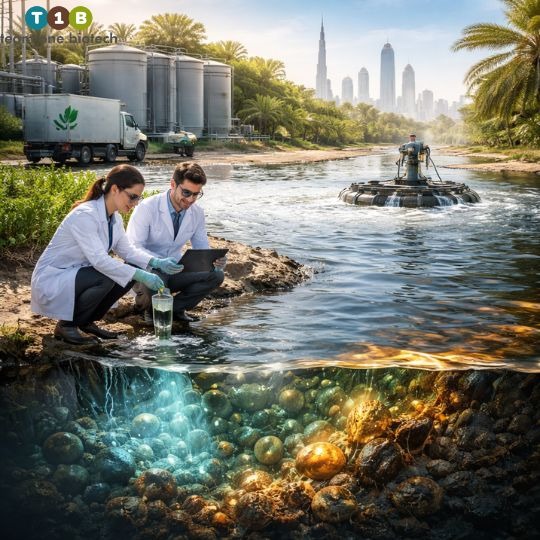
Team One Biotech (T1B) approaches industrial wastewater treatment and environmental remediation through a dual-strategy framework rooted in applied microbiology. Understanding the distinction between these two approaches, and why T1B employs both in an integrated system, is essential for any technical decision-maker evaluating solutions for their facility.
Bio-Augmentation: Introducing Purpose-Selected Microbial Populations
Bio-augmentation is the process of introducing concentrated populations of non-pathogenic, hydrocarbon-degrading microorganisms directly into a contaminated waste stream, soil matrix, or water body. These organisms are not genetically modified. They are naturally occurring bacterial and fungal strains, selected and concentrated for their demonstrated capacity to metabolize specific contaminant classes as their primary carbon and energy source.
In the context of industrial wastewater treatment UAE operations, T1B’s bio-augmentation products deliver microbial consortia that are:
- Hydrocarbon-specific: Capable of degrading a wide spectrum of petroleum-derived compounds including aliphatic hydrocarbons, aromatic hydrocarbons, and polycyclic aromatic hydrocarbons (PAHs) that constitute the primary contaminants in oil and gas wastewater streams.
- FOG-targeted: Producing lipase, protease, and amylase enzymes at scale to break down accumulations of Fat, Oil, and Grease in grease traps, collection systems, and treatment infrastructure, directly addressing one of the most persistent compliance challenges in food service, hospitality, and marine catering operations.
- Halotolerant and thermophilic variants available: Formulated specifically for deployment in the high-salinity, high-temperature conditions characteristic of UAE industrial environments.
- Non-pathogenic and safe for handlers: Full material safety data sheet (MSDS) compliance, posing no risk to operational personnel or the receiving environment beyond the targeted contaminant degradation function.
Biostimulation: Optimizing the Existing Microbial Environment
Where indigenous microbial populations already exist within a waste stream or contaminated site, a condition that is virtually universal in any organic-rich environment, biostimulation accelerates their natural degradation activity by supplying the limiting nutrients and environmental conditions they require to multiply and perform at maximum biological efficiency.
T1B’s biostimulation approach involves the precise application of nutrient packages, nitrogen, phosphorus, micronutrients, and specialized co-metabolites, calibrated to the specific contaminant load and indigenous microbial profile of each site. The result is a rapid increase in the population density and metabolic activity of naturally occurring hydrocarbon-degraders already present in the system.
The combination of bio-augmentation and biostimulation in T1B’s integrated treatment protocols produces outcomes that neither strategy achieves alone: faster contaminant reduction timelines, lower residual TPH concentrations, and sustained treatment efficacy that persists beyond the initial application window.
Ready to understand how T1B’s bioremediation technology applies to your specific operations? Contact our technical team for a no-obligation site assessment and contaminant profile review.
Core Application Areas: Where T1B Solutions Deliver Measurable Results
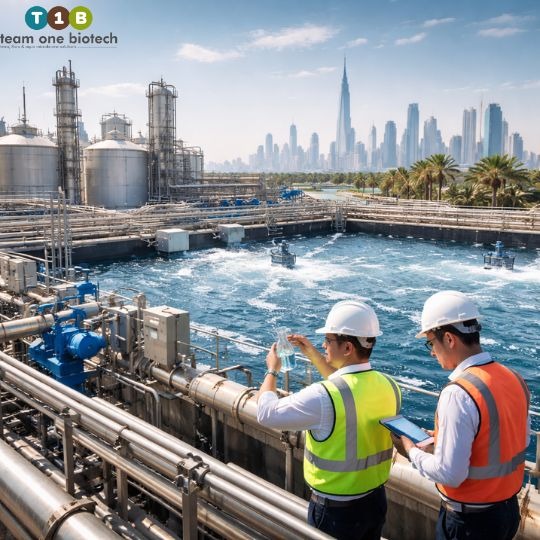
FOG Management in Dubai: Commercial, Marine, and Industrial Grease Trap Systems
FOG management Dubai is one of the highest-volume compliance categories that Dubai Municipality actively enforces. Food and beverage operations, marine catering suppliers, hotel complexes, and food processing facilities all generate Fat, Oil, and Grease loads that, without active biological management, rapidly overwhelm conventional grease trap infrastructure. The consequence is FOG migration into municipal sewer systems, a condition that triggers DM inspection, remediation orders, and potential facility closure.
T1B’s FOG management solutions employ high-concentration lipase-producing bacterial blends dosed directly into grease trap systems on scheduled application cycles. Documented outcomes in comparable operational environments include:
- Reduction in grease trap pump-out frequency by up to 60%, directly reducing operational costs
- Significant decrease in hydrogen sulfide (H2S) gas generation, improving safety conditions for maintenance personnel
- Consistent maintenance of effluent FOG concentrations below DM discharge thresholds
- Odor load reduction in collection systems, reducing community and regulatory complaint events
Industrial Wastewater Treatment: Oil and Gas, Petrochemical, and Manufacturing
For operations generating wastewater streams with elevated Total Petroleum Hydrocarbons (TPH) concentrations, including produced water from oil and gas extraction, wash water from equipment maintenance yards, and effluent from petrochemical processing, T1B’s bio-augmentation products are designed to integrate directly into existing treatment train infrastructure.
Rather than requiring wholesale replacement of physical treatment systems, T1B’s biological products function as a biological polishing layer that achieves TPH reduction targets that physical separation methods alone cannot reliably deliver. This integration approach means:
- Lower capital expenditure: No requirement for new physical infrastructure in most deployment scenarios
- Operational continuity: Treatment remains active during normal facility operations without process interruption
- Scalable dosing: Application rates calibrated to seasonal fluctuations in contaminant load and ambient temperature
- Documented discharge compliance: Supported by analytical testing and treatment records suitable for regulatory submission to Dubai Municipality and ADSSC
Marine Oil Spill Remediation: Rapid Response and Long-Term Recovery
Port authorities, offshore support vessel operators, and marine terminal managers carry direct liability for oil spill events within their operational zones. Marine oil spill remediation using T1B’s rapidly deployable bio-augmentation products offers a biological response capability that complements mechanical containment and recovery operations.
In marine environments, T1B’s specialized hydrocarbon-degrading consortia, formulated for the Arabian Gulf’s specific salinity and temperature profile, can be applied to:
- Contaminated water column and surface film hydrocarbon loads following spill events
- Shoreline and intertidal zone sediment contamination
- Bilge water and ballast water hydrocarbon contamination management in port facilities
- Oily sludge in collection pits and storage areas at marine terminals
The biological degradation pathway, converting petroleum hydrocarbons into carbon dioxide, water, and biomass, leaves no persistent chemical residue in the receiving marine environment, a critical advantage over chemical dispersant approaches that face increasing regulatory scrutiny globally and within UAE jurisdictional waters.
Navigating Dubai Municipality and ADSSC Compliance Standards
For any facility discharging industrial wastewater in Dubai or Abu Dhabi, the regulatory frameworks administered by Dubai Municipality and the Abu Dhabi Solutions and Services Company (ADSSC) define the operational boundaries within which you must perform, consistently, across every discharge event, regardless of seasonal operational peaks or process upsets.
What the Standards Require
Dubai Municipality’s technical guidelines for industrial effluent discharge establish maximum permissible limits across a comprehensive range of parameters. Key thresholds relevant to oil and gas and marine sector operations typically include limits on:
- Total Petroleum Hydrocarbons (TPH): Stringent maximum concentrations for direct discharge to sewer and, where applicable, marine outfall points
- Fat, Oil, and Grease (FOG): Limits that apply to any food service, catering, or food processing operation connected to the municipal sewer network
- Biochemical Oxygen Demand (BOD) and Chemical Oxygen Demand (COD): Indicators of overall organic loading that directly reflect biological treatment effectiveness
- Suspended Solids (SS) and pH: Physical-chemical parameters that define acceptable effluent quality across all discharge categories
ADSSC’s standards in Abu Dhabi operate under a similarly structured framework with equivalent technical rigor. Facilities operating across both emirates must ensure that their treatment systems and operational protocols are calibrated to the more stringent of the applicable standards at each discharge point, a complexity that makes a technically capable treatment partner, rather than a commodity chemical supplier, a strategic necessity.
How T1B Helps You Exceed, Not Just Meet, Compliance Thresholds
The distinction between meeting and exceeding discharge standards is not semantic. Facilities that consistently achieve effluent quality substantially below maximum permitted limits build a documented compliance record that provides operational headroom during process upsets, seasonal peaks, or system maintenance periods. T1B’s treatment protocols are designed to target effluent quality at margins that provide this headroom.
T1B supports client compliance in four specific ways:
- Pre-Treatment Assessment: Detailed characterization of incoming wastewater contaminant profiles, enabling precise product selection and dosing protocol development before treatment begins
- Treatment Protocol Documentation: Systematic application records, dosing logs, and effluent monitoring data formatted for regulatory submission to Dubai Municipality and ADSSC
- Adaptive Dosing Protocols: Treatment programs that adjust to seasonal temperature fluctuations and operational load variations, ensuring consistent compliance performance year-round, not just during favorable conditions
- Technical Support and Escalation: Access to T1B’s technical team for troubleshooting, treatment optimization, and rapid response to compliance events
Are you currently at risk of exceeding your DM or ADSSC discharge limits? T1B offers a rapid compliance gap assessment. Speak to a T1B technical consultant this week.
Aligning with UAE Net Zero by 2050: The Business Case for Advanced Bioremediation
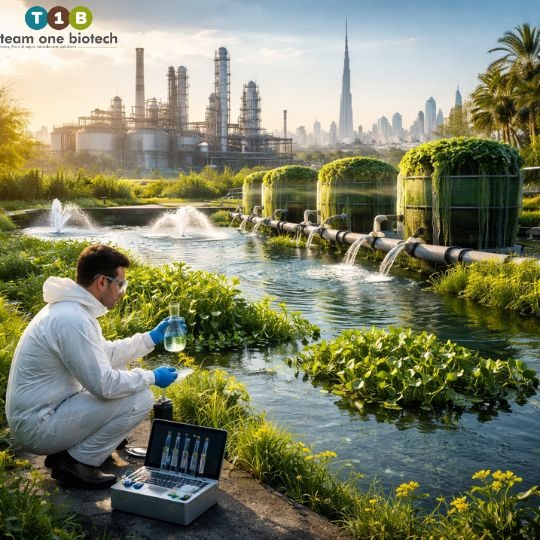
The UAE’s Net Zero by 2050 Strategic Initiative is not a distant policy aspiration, it is actively reshaping the regulatory and commercial environment in which industrial operations compete. Government entities, national oil companies, port authorities, and sovereign wealth funds are all incorporating sustainability performance metrics into procurement decisions, concession renewals, and operational licensing criteria.
For CSR Directors and Operations Heads, this creates a direct commercial imperative to demonstrate environmental performance that goes beyond minimum regulatory compliance. Advanced bioremediation offers a contribution to the Net Zero agenda that is both substantive and documentable:
- Carbon-neutral degradation pathway: The biological oxidation of petroleum hydrocarbons produces carbon dioxide and water as end products, the same outputs as natural aerobic decomposition, with no introduction of persistent synthetic chemicals
- Reduced energy intensity: Biological treatment systems typically operate at significantly lower energy consumption than physical-chemical treatment alternatives, contributing to facility-level carbon footprint reduction
- Waste minimization: Effective FOG and hydrocarbon management reduces sludge generation volumes, decreasing the waste disposal burden on municipal infrastructure
- Circular biology: Bioremediation products return organic contaminants to the natural carbon cycle, aligning with circular economy principles increasingly embedded in UAE sustainability frameworks
For operations reporting under frameworks such as the Global Reporting Initiative (GRI), the Task Force on Climate-related Financial Disclosures (TCFD), or the UAE Securities and Commodities Authority’s ESG disclosure requirements, documented bioremediation outcomes translate directly into measurable environmental performance data that strengthens sustainability reporting credibility.
Why Team One Biotech: The Technical and Commercial Differentiators
The UAE market for industrial wastewater treatment and environmental services includes a wide range of providers, from multinational chemical companies to local service contractors. The differentiating factors that position Team One Biotech as the preferred technical partner for compliance-critical applications are rooted in specific capabilities:
Formulations Developed for the Arabian Gulf Operational Environment
T1B’s microbial products are not European or North American formulations repackaged for the Middle East market. The temperature range, salinity gradient, and contaminant profiles of UAE industrial operations are embedded in the selection criteria applied to every microbial blend in T1B’s product portfolio. This is not a marginal advantage, it is the difference between treatment systems that perform consistently and those that fail precisely when environmental stress is highest.
Full Technical Data Sheet Transparency
T1B maintains comprehensive technical documentation for every product in its range: microbial enumeration data, contaminant degradation performance benchmarks, application protocols, safety data sheets, and regulatory compliance records.
Proven Deployment Across UAE Industrial Sectors
T1B’s solutions have been deployed across the oil and gas sector, marine port infrastructure, food and beverage manufacturing, hospitality facilities, and municipal wastewater support applications in the UAE and broader GCC region. This operational depth means that T1B’s technical team brings direct, relevant experience to every new client engagement, not theoretical product knowledge, but documented field performance.
Integrated Support from Assessment Through Compliance Reporting
T1B’s value proposition extends beyond product supply. From initial site assessment and contaminant characterization through treatment protocol development, application support, and compliance documentation, T1B functions as a technical partner, embedded in the operational challenge, not standing outside it as a commodity supplier.
Take the Next Step: Protect Your Operations, Meet Your Compliance Obligations, and Lead on Sustainability
The regulatory environment governing industrial wastewater discharge in the UAE is not static, and it is not forgiving of operators who treat environmental compliance as a secondary priority. Dubai Municipality and ADSSC enforcement activity has intensified, reporting requirements are more granular, and the consequences of non-compliance are more immediate than they have ever been.
Team One Biotech offers a direct path to compliance confidence, built on microbial science that works in UAE conditions, technical support that engages with your specific operational context, and documentation that stands up to regulatory scrutiny.
Global Reach, Local Expertise: Visit the T1B Official Alibaba Store
For procurement managers, operations directors, and technical teams evaluating bioremediation solutions for UAE operations, Team One Biotech’s official Alibaba store serves as the primary portal for international product access, technical specification review, and procurement inquiry.
The T1B Alibaba store provides direct access to:
- Full product catalogue: The complete range of T1B bioremediation products organized by application, hydrocarbon degradation, FOG management, marine environment remediation, and industrial wastewater treatment UAE applications
- Technical Data Sheets (TDS): Downloadable product specifications including microbial enumeration, application rates, performance data, operating temperature and salinity ranges, and compatibility information
- Material Safety Data Sheets (MSDS): Full safety documentation for all products, formatted for UAE regulatory authority review and workplace safety compliance
- Bulk and commercial pricing: Volume pricing structures appropriate for large-scale industrial deployment, port authority procurement, and ongoing operational treatment contracts
- Direct technical inquiry: Contact pathways to T1B’s technical team for product selection guidance, application consultation, and site-specific treatment protocol development
For international buyers, logistics partners, and organizations operating across multiple jurisdictions in the Middle East and North Africa region, the T1B Alibaba platform provides the procurement infrastructure of a globally recognized marketplace combined with the technical depth and regional expertise that UAE-specific industrial wastewater treatment demands. Whether your requirement is a single facility deployment or a multi-site programme aligned with your organization’s commitment to the UAE Net Zero by 2050 Strategic Initiative, the T1B Alibaba store is the starting point for an informed procurement decision.
Visit the T1B Official Alibaba Store to access technical data sheets, product specifications, and procurement support. Your compliance strategy starts with the right biological technology, and the right technology starts with a verified, transparent supplier.
About Team One Biotech
Team One Biotech is a specialized manufacturer and technical partner focused on advanced bioremediation solutions for the industrial, marine, and municipal wastewater sectors. With product formulations engineered for the specific environmental conditions of the Arabian Gulf region, T1B serves clients across the oil and gas, port authority, hospitality, food processing, and industrial manufacturing sectors throughout the UAE and the wider GCC. T1B’s commitment is straightforward: bioremediation technology that performs where it is deployed, documentation that withstands regulatory scrutiny, and technical support that remains engaged throughout the compliance challenge.
Looking to improve your ETP/STP efficiency with the right bioculture?
Talk to our experts at Team One Biotech for customised microbial solutions.
Contact: +91 8855050575
Email: sales@teamonebiotech.com
Visit: www.teamonebiotech.com
Discover More on YouTube – Watch our latest insights & innovations!-
Connect with Us on LinkedIn – Stay updated with expert content & trends!