
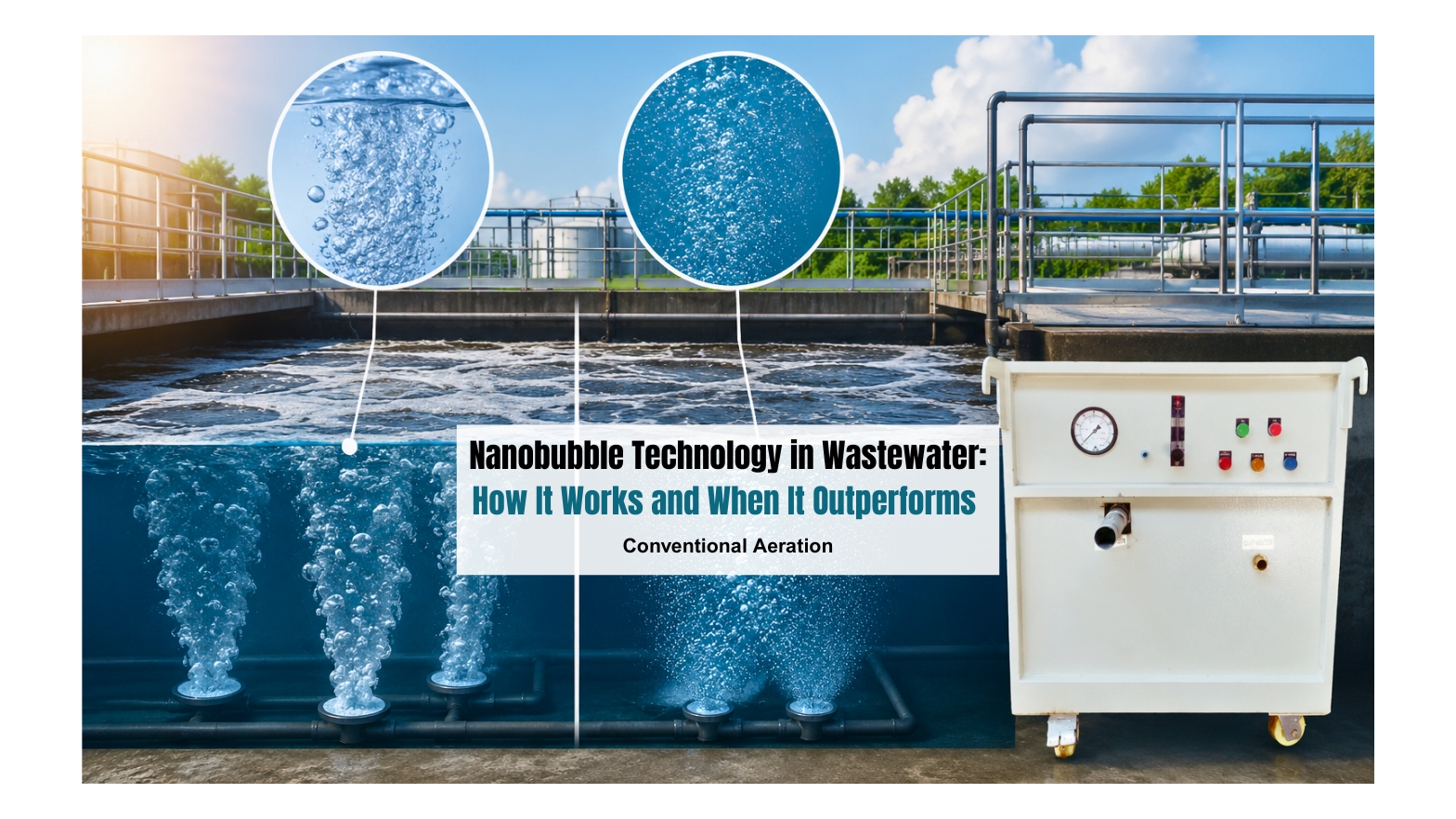

Nanobubble Technology in Wastewater: How It Works and When It Outperforms Conventional Aeration
Many plant managers running biological treatment systems have faced the same frustrating scenario. You follow the prescribed aeration schedule. You maintain the blower run-hours. You check the equipment, everything looks fine on paper. And yet BOD and COD in the effluent keeps creeping above discharge limits. The diffusers are working. The blowers are humming. But the biology is struggling, and your compliance reports are telling a different story than your operational logs.
The issue is not always the quantity of air being pushed into the tank. More often than engineers initially expect, the real problem is how efficiently that oxygen is actually transferring into the mixed liquor where microorganisms can use it. You can move enormous volumes of air through a system and still starve your biology of dissolved oxygen if the gas transfer mechanism is inefficient. This is exactly where nanobubble technology changes the conversation, not by blowing more air, but by making every unit of oxygen work dramatically harder.
If you have ever stood beside an aeration tank running at full blower capacity, watching the surface churn, and still pulled DO readings that made you wince, this article was written for you.
What Are Nanobubbles and Why Do They Behave Differently
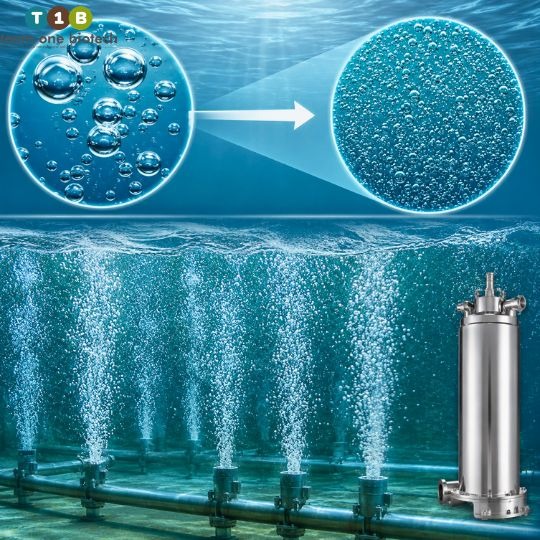
To understand why nanobubble technology performs the way it does, you need to first understand what makes nanobubbles physically distinct from the bubbles produced by conventional aeration systems, including fine bubble diffusers, which are themselves considered an improvement over coarse bubble systems.
Nanobubbles are gas-filled cavities in liquid that are orders of magnitude smaller than conventional fine bubbles. We are talking about bubble diameters in the sub-micron range, so small they are invisible to the naked eye and behave more like dissolved species in the liquid than like the bubbles most engineers are used to working with. That size difference is not a cosmetic distinction. It fundamentally changes the physics of how gas transfers into liquid, and that is where the performance gains come from.
High surface area-to-volume ratio
The relationship between bubble size and gas-liquid contact surface is not linear, it is exponential. As bubble diameter decreases, the total interfacial surface area available for oxygen transfer increases dramatically for the same volume of gas injected into the system. This is the foundational reason why nanobubble aeration can achieve substantially higher oxygen transfer efficiency than conventional systems operating with the same gas input.
Neutral buoyancy and extended residence time
This is one of the more counterintuitive properties of nanobubbles for engineers who are accustomed to thinking of bubbles as things that rise. Conventional fine bubbles, even the small ones produced by quality membrane diffusers, rise through the liquid column relatively quickly and escape at the surface before all their oxygen transfers into the mixed liquor. Nanobubbles, because of their extremely small size and correspondingly low buoyancy, remain suspended in the liquid column for extended periods. Some remain in suspension indefinitely until their gas content fully transfers into the surrounding water. This extended residence time means far more of the injected oxygen actually ends up dissolved in the wastewater rather than venting off at the surface.
Zeta potential and electrostatic stability
Nanobubbles carry a surface charge, specifically a negative zeta potential, that gives them electrostatic stability within the liquid. In practical terms, this means they resist coalescence. When conventional bubbles are in close proximity, they tend to merge into larger bubbles, which then rise faster and transfer oxygen less efficiently. Nanobubbles repel each other and maintain their size throughout the aeration tank, sustaining their transfer efficiency across the full volume of the basin rather than degrading as they move through the liquid.
Implosion and reactive oxygen species generation
Under certain conditions, nanobubbles collapse under the pressure of the surrounding liquid, and this collapse event generates reactive oxygen species, primarily hydroxyl radicals. These are powerful oxidising agents that can attack complex organic molecules, including recalcitrant COD compounds that standard biological processes struggle to break down. This mechanism adds a chemical oxidation pathway on top of the biological oxidation that aeration already supports, which is particularly relevant for industrial effluents with complex organic loads.
The combination of these properties, extended residence time, high interfacial surface area, electrostatic stability, and reactive oxygen species generation, explains why nanobubble technology is not simply a variation on conventional aeration. It is a fundamentally different mechanism of gas transfer.
How a Nano Bubble Generator Works in a Wastewater System
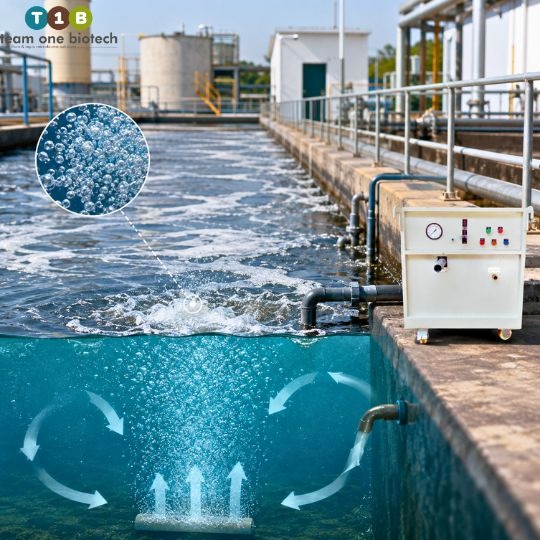
Understanding the physics of nanobubbles naturally leads to the question of how a nano bubble generator actually produces these structures at scale in a continuous-flow treatment environment.
Most nano bubble generator systems used in wastewater treatment operate on one of two primary principles: pressurised gas dissolution or hydrodynamic cavitation. In pressurised dissolution systems, gas, typically atmospheric air, or pure oxygen in applications where higher DO targets are needed, is dissolved into the process water under elevated pressure. When this pressurised, gas-saturated water is released back into the aeration tank at ambient pressure, the dissolved gas nucleates out of solution as nanobubbles distributed uniformly throughout the liquid volume. In hydrodynamic cavitation-based systems, high-velocity flow through specifically designed geometries creates localised low-pressure zones where nanobubbles are generated through a different but equally effective mechanism.
In both cases, the generator is integrated into the recirculation loop of the aeration tank, STP basin, or ETP equalization and treatment zone. A portion of the tank volume is continuously drawn through the generator and returned to the tank enriched with nanobubbles, maintaining steady-state dissolved oxygen levels across the basin.
A few operational characteristics of nano bubble generator systems are worth noting for plant evaluators. First, these systems are generally designed for retrofit integration into existing infrastructure, they do not require significant civil modification or tank redesign in most cases. The generator is installed in the recirculation pipeline, and the return flow is distributed back into the aeration basin through existing or modified return points. Second, unlike submerged membrane diffuser systems, most nano bubble generator configurations do not have submerged consumable components that require tank dewatering for inspection or replacement. This has meaningful implications for maintenance planning, as diffuser maintenance typically requires taking a tank out of service, a significant operational disruption in continuous-flow systems.
The ability to retrofit without full plant redesign is one of the more practically important features of nanobubble systems, particularly for facilities that are operating under compliance pressure and cannot afford extended downtime for infrastructure upgrades.
Fine Bubble Diffuser vs Nanobubble, A Direct Comparison
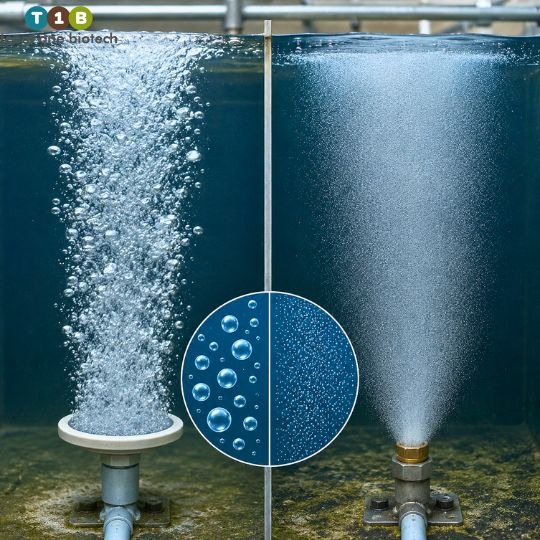
This comparison is worth approaching with some intellectual honesty. Fine bubble diffusers represent a mature, well-understood technology that has served the wastewater treatment industry reliably for decades. They are not a bad technology, they are simply not always the right technology, particularly for high-load industrial applications or aging systems that are struggling to maintain compliance.
Bubble size and oxygen transfer efficiency
Fine bubble diffusers produce bubbles in the range of a fraction of a millimetre in diameter, already a significant improvement over coarse bubble systems in terms of gas transfer. Nanobubbles are several orders of magnitude smaller, which translates to substantially higher oxygen transfer efficiency for equivalent gas input volumes. (Disclaimer: Actual OTE values vary significantly by wastewater type, tank geometry, organic loading, temperature, and operating parameters. Values cited in literature and from field installations are indicative and should not be taken as guaranteed performance for any specific installation.)
Energy Consumption
Fine bubble diffuser systems depend on continuous high-volume blower operation to maintain airflow through the diffuser grid. The blowers are typically the single largest energy consumer in an STP or ETP. Nanobubble systems can achieve comparable or, in many applications, superior dissolved oxygen levels at lower aeration energy inputs, because the oxygen they inject is transferred more efficiently, meaning less total gas needs to be processed. Actual energy outcomes are site-specific and depend on the baseline system being compared, but energy reduction is one of the consistently reported operational benefits across diverse installation types.
Dissolved oxygen consistency across the tank
One of the more significant operational differences between fine bubble diffuser systems and nanobubble aeration is DO distribution uniformity. Diffuser grids, even when well-designed, can leave zones of lower DO activity, particularly in corners, near tank walls, or in deeper sections with stratified flow. Nanobubbles, because they remain suspended throughout the liquid column and are distributed via recirculation flow, tend to produce more uniform DO profiles across the basin volume. This matters because DO-deficient zones are where biological performance degrades and where nitrification or COD removal can be inconsistent.
Maintenance and Biofouling
Diffuser membranes are subject to fouling from biological growth, scaling from mineral precipitation, and mechanical wear from continuous flexing. Membrane replacement or cleaning is a recurring maintenance cost in diffuser-based systems and typically requires tank dewatering. Nanobubble generators, with fewer or no submerged consumable components, generally require less frequent maintenance intervention, which reduces both direct maintenance cost and the operational disruption of planned downtime.
Capital cost and retrofit economics
Fine bubble diffuser systems have a lower upfront capital cost for new installations, and for a greenfield plant treating low-strength domestic wastewater with stable loading, they remain a cost-effective choice. Nanobubble systems involve a higher initial investment, but the total cost of ownership calculation changes significantly when you factor in energy savings, reduced maintenance frequency, and, critically, the cost of ongoing non-compliance for plants that are already struggling to meet discharge standards with their existing diffuser setup.
| Parameter | Fine Bubble Diffuser | Nanobubble System |
| Bubble size | Sub-millimetre range | Sub-micron range |
| Oxygen transfer efficiency | Moderate | Higher (site-specific) |
| Aeration energy demand | High (blower-dependent) | Generally lower |
| DO uniformity in tank | Variable, zone-dependent | More consistent |
| Submerged maintenance components | Yes, membrane fouling/wear | Minimal to none |
| Retrofit complexity | Requires tank dewatering | Typically pipeline-based |
| Upfront capital cost | Lower | Higher |
| Operational savings potential | Baseline | Significant in high-load applications |
(Disclaimer: The above comparison reflects general operational characteristics. Specific performance outcomes depend on wastewater characteristics, plant design, and operating conditions. A site-specific assessment is recommended before making technology selection decisions.)
Dissolved Oxygen Improvement in STP, What Changes Operationally
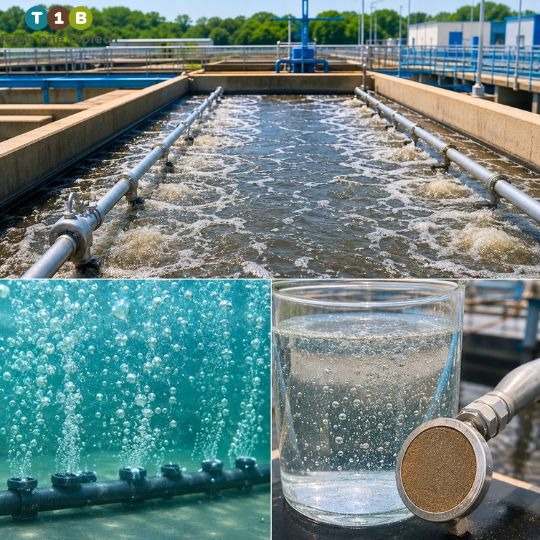
For the ETP or STP operator, understanding the physics of nanobubbles is useful, but what matters most is what actually changes at the plant level when nanobubble aeration is introduced into the treatment train.
The most immediate and consistent change reported by facilities that have adopted nanobubble technology is improved DO uniformity across the aeration basin. Rather than seeing high DO near the diffuser grid and progressively lower DO toward tank edges or at depth, operators typically observe a more stable DO profile throughout the basin volume. Dead zones, areas of chronically low oxygen activity, are significantly reduced or eliminated. This matters because biological treatment performance in an activated sludge system is directly tied to DO availability at the point where organisms and substrate interact, not just at the measurement probe.
With more consistent DO levels sustained across the tank, MLSS activity improves. Healthy, oxygen-sufficient biomass produces better settling characteristics, which flows through to clarifier performance and final effluent quality. This is a system-wide effect, better aeration in the biological reactor does not just improve BOD and COD removal, it also reduces sludge bulking risk and makes the downstream solids handling process more predictable.
Odour reduction is another operationally significant outcome that does not always feature prominently in technical literature but matters enormously to plant operators dealing with community relations or regulatory complaints. Anaerobic zones in aeration tanks are the primary source of hydrogen sulphide and other odorous compounds in biological treatment systems. When DO levels are consistently maintained throughout the basin, anaerobic microenvironments are suppressed, and odour generation drops considerably.
For plants that are running against CPCB and SPCB discharge norms, particularly during peak organic load events from seasonal production surges or industrial process changes, nanobubble aeration provides a meaningful buffer. Better oxygen transfer during peak loading means the biology can handle the surge more effectively, reducing the risk of compliance violations during the most operationally challenging periods.
If your STP or ETP is struggling with inconsistent DO levels, recurring compliance violations, or odour complaints that conventional aeration adjustments have not resolved, speak with our aeration specialists at Team One Biotech to evaluate whether nanobubble technology is the right fit for your system.
When Nanobubble Technology Outperforms Conventional Aeration, And When It Does Not
Technical credibility requires acknowledging that nanobubble technology is not the universal answer for every wastewater treatment application. Here is an honest evaluation of where it tends to outperform conventional systems, and where conventional approaches remain entirely adequate.
Nanobubble aeration tends to outperform conventional systems when:
- The wastewater has a high organic load and the aeration tank is frequently DO-deficient despite sustained high blower run-hours, this is the profile where nanobubbles deliver the clearest benefit
- The plant is treating industrial effluent with complex or recalcitrant COD compounds, pharmaceutical wastewater, food processing effluent, textile ETP streams, and similar high-strength applications where reactive oxygen species generation adds a meaningful oxidation pathway
- Space constraints prevent aeration tank expansion, and the facility needs to improve treatment performance within the existing footprint
- Energy cost reduction is a formal operational objective alongside compliance improvement, nanobubble systems offer a path to both simultaneously in many industrial applications
- The existing diffuser system is aging, approaching end-of-useful-life, and the facility is evaluating whether to replace it with the same technology or upgrade
Conventional fine bubble diffuser aeration may still be the more appropriate choice when:
- The plant is treating low-strength domestic wastewater with stable, predictable organic loading, in these conditions, a well-maintained diffuser system typically performs adequately without the additional capital investment that nanobubble systems require
- The existing diffuser system was recently installed, is performing within acceptable DO and effluent quality parameters, and there is no pressing compliance or energy cost driver
- Budget constraints make the higher initial capital investment in nanobubble generation infrastructure impractical at this stage of the facility’s lifecycle
The honest answer for most industrial ETP operators evaluating aeration upgrades is that nanobubble technology deserves serious, structured evaluation, not as a replacement for engineering judgment, but as an input to it. The technology has matured to the point where field performance data is available across a range of wastewater types and plant configurations, and that data supports a well-reasoned investment case for many high-load industrial applications.
Frequently Asked Questions
Q: Can a nano bubble generator be retrofitted into an existing ETP or STP?
In most cases, yes. Nano bubble generators are designed to integrate with existing aeration infrastructure through the tank recirculation loop, typically without significant civil modification or the need to take the tank out of service for extended periods. The specific retrofit approach depends on tank geometry, current flow rates, aeration configuration, and available pipe connections. A site assessment is recommended to confirm feasibility and define the integration scope before proceeding.
Q: How does nanobubble aeration help with CPCB compliance?
By improving dissolved oxygen consistency across the aeration basin and enhancing gas transfer efficiency, nanobubble systems support more complete biological oxidation of BOD and COD within the treatment tank. Better oxygen availability means better biological performance, and better biological performance translates to more consistent effluent quality within the limits prescribed by CPCB and SPCB discharge standards. In high-load industrial applications, the reactive oxygen species generated during nanobubble collapse can also contribute to COD reduction beyond standard biological pathways. Results are plant-specific and depend on wastewater characteristics and current treatment configuration.
Q: Is nanobubble technology suitable for all types of wastewater?
Nanobubble aeration has demonstrated strong results across a range of wastewater types, industrial effluent, pharmaceutical wastewater, food and beverage processing ETPs, textile effluent, and municipal STPs with elevated organic loads. Its effectiveness depends on the specific wastewater characteristics, current DO deficits, organic loading profile, and treatment objectives. Low-strength domestic wastewater with stable loading represents a category where the performance differential over conventional systems may not justify the capital investment without other driving factors.
Q: What is the typical energy saving compared to conventional aeration?
Energy outcomes vary significantly between installations and should not be generalised without a site-specific assessment. Facilities that have supplemented or replaced fine bubble diffuser systems with nanobubble aeration commonly report measurable reductions in aeration energy consumption, attributable to achieving equivalent or superior DO levels with lower total gas input volumes. The magnitude of savings depends on baseline blower energy consumption, wastewater characteristics, DO targets, and the specific nanobubble system configuration. A feasibility study based on your plant’s actual operational data will produce a more reliable energy savings estimate than any general range.
(Disclaimer: All performance values, efficiency ranges, and operational outcomes referenced in this article are general indicative estimates based on available literature and field data. Actual results vary depending on wastewater characteristics, plant configuration, organic loading rates, temperature, and site-specific operating conditions. We recommend a detailed site assessment before making any technology selection decisions.)
The Aeration Decision That Affects Everything Downstream
Aeration is not a background utility function in a wastewater treatment plant. It is the engine of biological treatment, the mechanism by which the microbial community that does the actual work of breaking down organic load receives the oxygen it needs to function. When aeration underperforms, the consequences are not confined to the aeration tank. They propagate downstream: into the secondary clarifier, into the sludge handling system, into the compliance report, and ultimately into the relationship between the facility and the regulatory authority.
Nanobubble technology offers a scientifically grounded, field-validated pathway to improve aeration efficiency without necessarily expanding tank volumes, adding blower capacity, or undertaking major civil works. For facilities that are operating hard to meet CPCB and SPCB norms and still falling short, particularly in high-load industrial applications where conventional aeration is running at its design limits, this technology deserves serious, structured evaluation.
The shift it represents is not from one brand of aeration equipment to another. It is a shift in the fundamental mechanism of oxygen delivery into the mixed liquor, and that is a meaningful distinction worth understanding before the next aeration infrastructure decision is made.
Team One Biotech works with environmental engineers and plant operators across India to evaluate, design, and implement nanobubble aeration solutions tailored to your ETP and STP requirements. Get in touch with our technical team to discuss your plant’s specific challenges and explore whether nanobubble technology is the right next step for your facility.
Looking to improve your ETP/STP efficiency with the right bioculture?
Talk to our experts at Team One Biotech for customised microbial solutions.
Contact: +91 8855050575
Email: sales@teamonebiotech.com
Visit: www.teamonebiotech.com
Discover More on YouTube – Watch our latest insights & innovations!-
Connect with Us on LinkedIn – Stay updated with expert content & trends!