
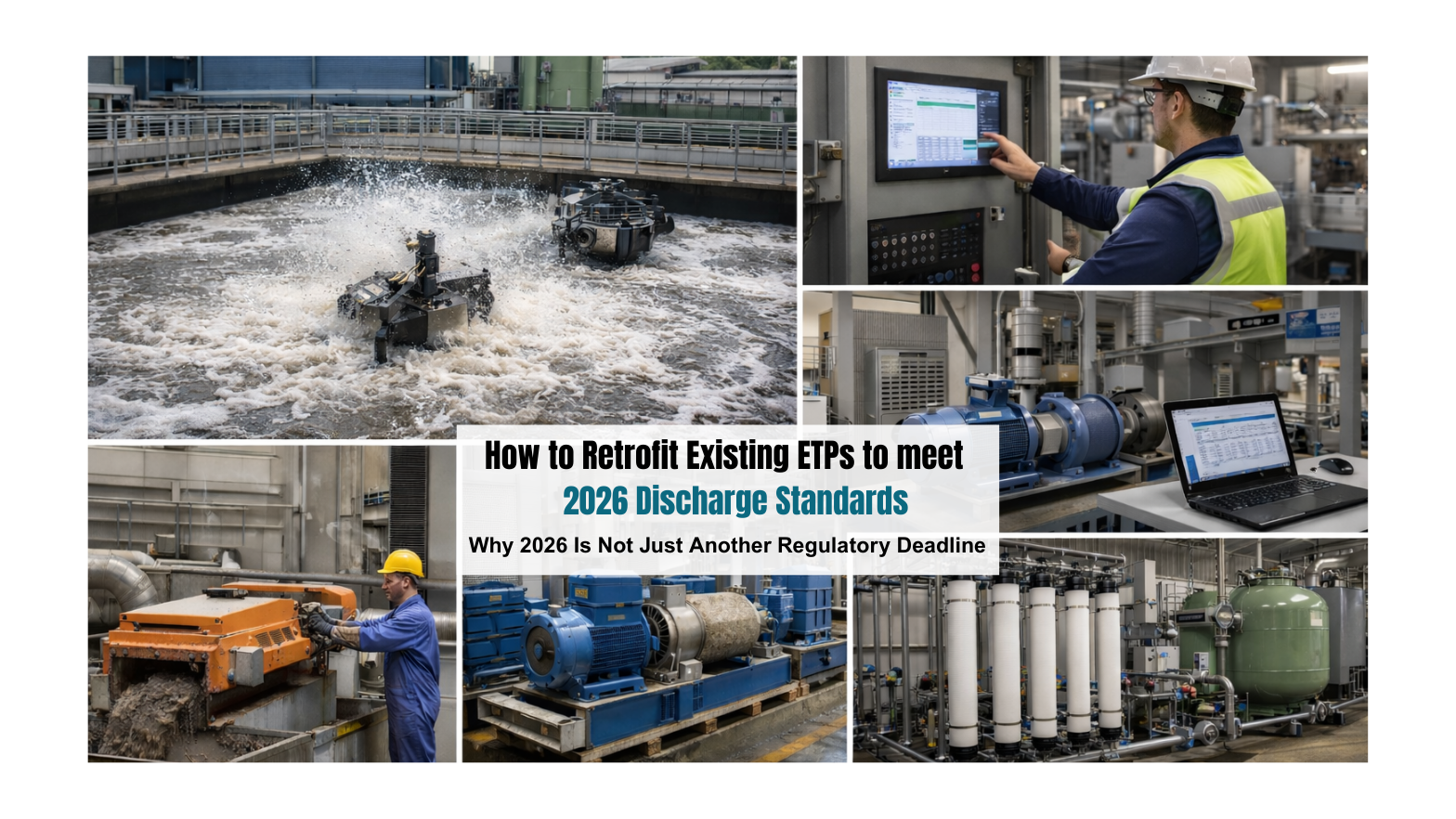

How to Retrofit Existing ETPs to meet 2026 Discharge Standards
The Compliance Clock Is Ticking, And Old Infrastructure Is Not Your Enemy
There is a particular kind of stress that settles over a plant manager around this time of year. It is not the stress of a broken pump or a production backlog. It is quieter than that, the kind that sits in the back of your mind during site reviews and board meetings alike. If you run an effluent treatment plant at an Indian industrial facility, you already know what we are talking about.
Walk into any industrial cluster in Surat, Vapi, Ludhiana, or Hyderabad right now and you will hear the same question in different rooms: “Are we going to make it to 2026 without a notice?” Plant managers who have been doing this work for fifteen or twenty years, people who know their systems inside out, are genuinely unsettled. Not because they are careless, but because the goalposts have moved in ways that the original designers of their ETPs could not have anticipated.
The Central Pollution Control Board and State Pollution Control Boards across India are no longer sending gentle reminders. Discharge norms are tightening with a specificity and enforcement muscle that earlier regulatory cycles simply did not have. For deeper insights into navigating these requirements, you can refer to The Comprehensive Guide to ETP & STP Design, Process, and Efficiency in India. And for facilities running effluent treatment plants commissioned in the early 2000s, or even the early 2010s, the uncomfortable truth is this: your plant was built for a different India.
But here is what we want you to hear before anything else. Your old infrastructure is not a liability to be demolished. It is a foundation to be built upon. Retrofitting an existing ETP is not an admission of failure. It is, in fact, one of the smartest operational decisions a factory manager can make right now. Team One Biotech has walked this road with dozens of industrial units across the country, and what we see on the other side consistently surprises even the most sceptical plant operators, lower costs than a greenfield build, faster timelines, and a system that actually fits into how your facility already runs.
Why 2026 Is Not Just Another Regulatory Deadline

Let us be direct about something. Indian industry has seen regulatory deadlines come and go. Extensions have been granted, timelines have shifted, and many plant operators have learned, sometimes correctly, that a degree of buffer exists between announcement and enforcement.
2026 is different, and here is why that matters.
The revised discharge standards being rolled out under the CPCB compliance framework are arriving alongside something that earlier cycles did not have: real-time accountability infrastructure. Online Continuous Effluent Monitoring Systems are no longer optional for designated large industries. When your effluent data is being transmitted live to a regulatory server, the quarterly inspection becomes almost secondary. Non-compliance is no longer a periodic audit risk, it is a daily operational exposure.
Beyond the monitoring shift, the standards themselves have genuinely tightened:
- COD and BOD discharge limits for inland surface water bodies have been revised downward, particularly for high-strength effluent sectors like pharmaceuticals, textiles, and food processing
- Total Nitrogen and Total Phosphorus are entering mandatory compliance cycles for larger facilities, parameters that most older ETPs were never designed to address
- SPCB norms in states like Gujarat, Maharashtra, and Tamil Nadu are, in several parameters, running ahead of national standards, creating a layered compliance reality that is genuinely complex to navigate
Facilities running conventional activated sludge process systems that have not seen meaningful upgrades since commissioning are facing the sharpest gap. BOD reduction demands in high-impact zones now frequently require performance in the range of 90% to 97%. Please note: These are general values provided for guidance; actual requirements differ for every ETP based on influent load and site conditions.
That is not a marginal adjustment. For many plants, it is a fundamental process rethink.
Honest Talk About the ETP-STP Plant Process, Where Things Are Actually Breaking Down

Most plant managers running older systems know, at some level, where their ETP struggles. They have seen it during the monsoon season when influent loads spike. They have seen it when production schedules change and the biological system gets hit with a load it was not expecting. The technical language around these failures can sound complicated, but the underlying story is usually straightforward.
The conventional etp-stp plant process built around the activated sludge process is not fundamentally flawed science. It has treated billions of litres of industrial wastewater across India and it remains the backbone of biological treatment worldwide. The problem is not the process, it is the gap between what these systems were designed for and what they are now being asked to do.
Here is where that gap tends to show up most painfully:
- Sludge bulking during variable organic loads, a chronic headache in Indian industrial clusters where production runs are seasonal and influent quality can shift dramatically week to week
- Hydraulic retention time deficits in ageing systems sized for lower concentrations than what is actually arriving at the inlet today
- Biomass washout during peak load events, the biological community collapses exactly when you need it most, and recovery takes days that compliance timelines do not always allow
- Recalcitrant compound accumulation, persistent chemicals from pharmaceutical synthesis, reactive dyes from textile processing, or complex organics from specialty chemical manufacturing that conventional biomass simply cannot degrade, no matter how well the rest of the system is running
This is the honest picture that a good process audit surfaces. And it is also the picture that tells us where the opportunity sits. Because each of these failure points has a solution, often one that does not require tearing down what already exists.
Team One Biotech’s bioremediation formulations have been developed specifically for these Indian industrial wastewater realities. Not adapted from European treatment profiles. Built from the ground up for the chemical fingerprints of Indian manufacturing, the dye loads from Tiruppur, the API residues from Hyderabad’s pharmaceutical belt, the high-COD effluents from distilleries across Maharashtra and Uttar Pradesh.
The Retrofitting Roadmap: What This Actually Looks Like in Practice
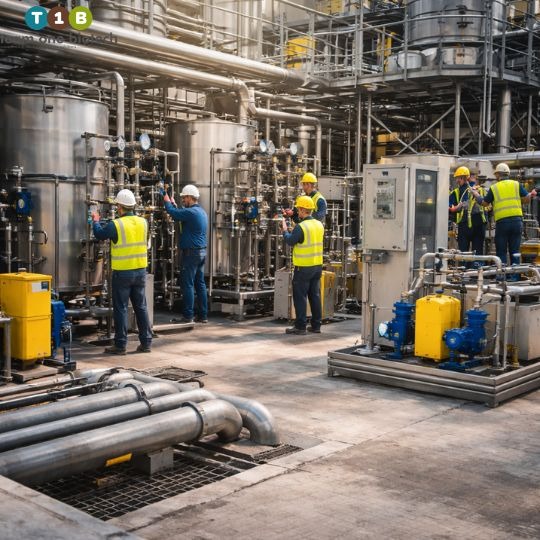
Step 1, Start With a Serious Process Audit
This is where most retrofitting efforts either gain traction or quietly fail. A proper audit is not a two-day walkthrough with a checklist. It is a forensic examination of what is actually happening inside your system versus what the design drawings say should be happening.
It means:
- Influent characterisation across all shifts, not just during standard working hours when the plant is running cleanly. Peak-load surges during night shifts and batch processing cycles are frequently where compliance failures originate, and they are frequently the data that gets missed
- Mass balance analysis across every unit operation to locate where efficiency is genuinely being lost versus where it only appears to be lost
- Civil and mechanical condition assessment, concrete integrity, diffuser fouling levels, clarifier mechanism wear, and whether existing electrical infrastructure can support upgraded aeration
- Regulatory gap mapping against your specific CPCB compliance category and applicable SPCB norms for your industry code
No two audits come back with the same picture. A textile ETP in Gujarat and a pharmaceutical facility in Himachal Pradesh may have similar BOD numbers on paper and completely different root causes behind those numbers. The audit is what tells you which problem you are actually solving.
Step 2, Address the Aeration System First
If the audit points anywhere in the first hour, it usually points here. Aeration is where the most significant performance losses occur in legacy Indian ETPs, and it is also where meaningful gains can be achieved relatively quickly.
Fine bubble diffuser systems, when properly installed and maintained, deliver oxygen transfer efficiency in the range of 20% to 35%, a substantial improvement over the coarse bubble systems that most older plants are still running. Please note: These are general values provided for guidance; actual requirements differ for every ETP based on influent load and site conditions.
The good news is that aeration upgrades rarely require new civil construction. Existing aeration tanks can typically be relined and re-diffused within four to eight weeks depending on dimensions. Pairing this with variable frequency drive-controlled blowers can reduce aeration energy costs somewhere in the range of 25% to 40%, which gives plant managers a genuinely compelling argument to make to their finance teams.
Please note: These are general values provided for guidance; actual requirements differ for every ETP based on influent load and site conditions.
Team One Biotech consistently recommends initiating bio-augmentation dosing immediately following aeration upgrades, the improved oxygen transfer creates exactly the right environment for specialised microbial consortia to establish quickly, cutting the biological recovery window significantly.
Step 3, Bring Bioremediation Into the Process
This is the part of modern wastewater management India that is still underutilised in many industrial facilities, and it is where some of the most dramatic performance improvements are being achieved.
Bio-augmentation means introducing specialised microbial consortia, organisms selected and cultivated for the specific compounds present in your effluent, directly into your biological treatment system. It is not a chemical fix. It is a biological one, and the distinction matters both for treatment performance and for the long-term health of your system’s microbial community.
For a textile dyeing unit, this means organisms adapted to azo dye intermediates and reactive dye breakdown products. For a bulk drug manufacturer, it means consortia capable of processing antibiotic residues and solvent compounds. For a distillery, it means high-efficiency degraders of complex sugars and fermentation byproducts.
Team One Biotech’s bioremediation programmes are not off-the-shelf products applied uniformly across sites. They are developed based on your specific influent characterisation data and adjusted as the biological community establishes and matures. This is the difference between a treatment solution and a treatment strategy.
Step 4, Explore Hybrid Biological Models Where the Situation Warrants
Not every facility needs a full transition to MBBR or SBR. But where influent variability is high, where land constraints make secondary clarifier expansion impossible, or where the existing system is consistently failing under peak loads, hybrid biological treatment deserves serious consideration.
Introducing MBBR media into an existing aeration tank creates a fixed-film biological component, a biofilm community on plastic media that continues functioning even during sludge washout events in the suspended growth system. The hybrid approach combines the strengths of both suspended growth and attached growth, building in the kind of process resilience that single-mode systems struggle to achieve.
SBR retrofits are particularly relevant in older Indian industrial estates where expansion land simply does not exist. By sequencing biological treatment and settling within a single tank, the need for a dedicated secondary clarifier is eliminated, which is a meaningful advantage when working within constrained footprints.
Step 5, Build Your Monitoring Infrastructure for the Long Term
Retrofitting the biological and mechanical systems without addressing monitoring is a half-finished job. OCEMS installation, beyond being a regulatory requirement for large industries under CPCB compliance norms, is genuinely useful operationally. Integrated with SCADA, it gives your team visibility into process parameters that allows biological failures to be caught and corrected hours before they reach the outlet.
This is the shift from reactive plant management to genuinely proactive wastewater management, and it changes the daily experience of running an ETP in ways that plant operators consistently report as significant.
What Indian Industrial Clusters Are Actually Dealing With
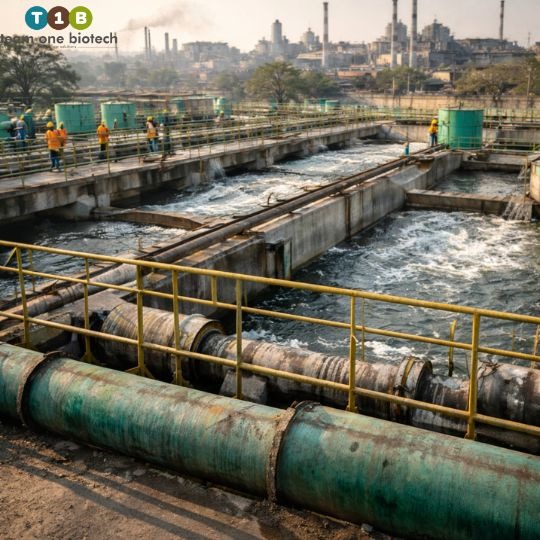
There is a tendency in technical literature to treat industrial wastewater as a generic category. Anyone who has worked across Indian industrial clusters knows that reality is considerably messier and more interesting than that.
The influent arriving at an ETP in Baddi’s pharmaceutical belt has almost nothing in common with what arrives at a tannery CETP in Kanpur. The microbial strategies, the chemical treatment protocols, the aeration requirements, and the monitoring parameters that matter most, all of these differ profoundly by sector and by location.
Some sector-specific realities worth naming directly:
- Textiles: High colour loads, elevated dissolved solids, and seasonal production variability that can swing influent characteristics dramatically between peak and off-peak periods. Biological systems need to be robust enough to handle these swings without crashing.
- Pharmaceuticals: API residues, solvent loads, and in some facilities, antibiotic compounds that actively suppress the biological community you are trying to cultivate. Bioremediation here requires consortia that are genuinely resilient to these compounds.
- Food and Beverage: High BOD but strong biodegradability, these facilities are often excellent candidates for integrating biogas recovery into the retrofit, turning a compliance cost into a partial energy offset.
- Common Effluent Treatment Plants: Mixed influent from multiple units creates dynamic, unpredictable loading conditions. Shock-load management and adaptive bio-augmentation protocols are not optional in CETP contexts, they are operational necessities.
Team One Biotech works directly with plant managers and CETP operators across all of these contexts. The solutions we develop are grounded in what is actually happening on your site, not in what a textbook says should be happening.
This Is About More Than Avoiding a Notice
Somewhere in this conversation, we want to say something that goes beyond the compliance mathematics.
The plant managers and operators who run India’s industrial ETPs are, in our experience, people who care about doing this work properly. The stress around 2026 is not coming from indifference, it is coming from the genuine difficulty of meeting evolving standards with infrastructure that was never designed for them, often with budgets that do not reflect the full scale of what is needed.
Retrofitting done well is not just about survival. It is about building a facility that your team can run with confidence, where the daily monitoring data is not a source of anxiety but a source of operational intelligence. Where the biological system is stable enough that a production surge does not send everyone into crisis mode. Where your facility’s environmental record is an asset rather than a liability.
That is what Team One Biotech is working toward with every site we engage. Not the minimum viable compliance outcome, but treatment systems that genuinely perform.
Let Us Have the Conversation Now, Not After the Notice Arrives
Your 2026 strategy should begin with a real conversation about where your plant actually stands. Team One Biotech’s senior environmental engineers are available for site-specific ETP audits, bioremediation programme design, and full retrofitting consultation across pharmaceutical, textile, food processing, distillery, chemical, and CETP operations throughout India.
We will tell you honestly what we find. Where your system is genuinely at risk, where it is stronger than you might think, and where targeted bioremediation and process upgrades can close the gap between current performance and 2026 requirements.
The time to start this conversation is not when a show-cause notice lands on your desk.
Reach out to Team One Biotech today for a confidential, no-obligation site consultation. Bring us your last three months of effluent monitoring data, your process flow diagrams, and your list of questions. We will bring the technical depth, the sector-specific bioremediation expertise, and the honest assessment your plant deserves.
Team One Biotech, Advanced Bioremediation Solutions for Indian Industry. CPCB-aligned. Sector-specific. Built for the realities of Indian industrial wastewater.
Looking to improve your ETP/STP efficiency with the right bioculture?
Talk to our experts at Team One Biotech for customised microbial solutions.
Contact: +91 8855050575
Email: sales@teamonebiotech.com
Visit: www.teamonebiotech.com
Discover More on YouTube – Watch our latest insights & innovations!-
Connect with Us on LinkedIn – Stay updated with expert content & trends!