
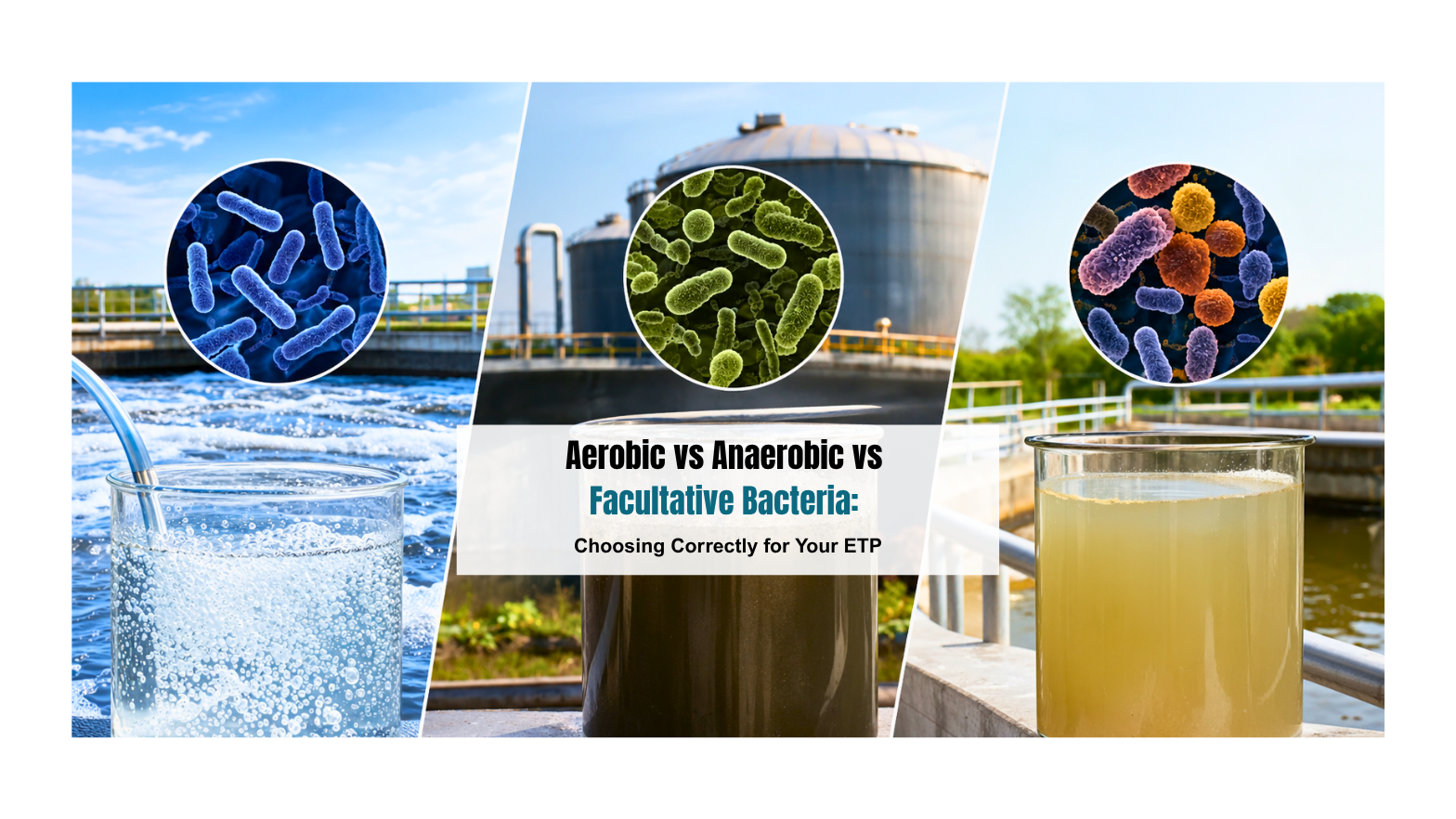

Aerobic vs Anaerobic vs Facultative Bacteria: Choosing Correctly for Your ETP
When a biological treatment system underperforms, effluent colour does not clear, COD remains stubbornly high, or the plant starts generating complaints from downstream users or regulators, the instinct is to add more bacteria. But adding the wrong type of bacteria to the wrong stage of treatment does not fix the problem. It often makes it worse.
This is not a hypothetical scenario. It plays out in ETPs and STPs across India every season, and the consequences are real: consent-to-operate violations, CPCB or SPCB show-cause notices, operational downtime, and the kind of reputational risk that takes years to recover from.
The type of bacteria deployed in a biological treatment system is the single most critical variable in determining process performance, not the tank size, not the hydraulic retention time, not the coagulants dosed upstream. Infrastructure sets the stage. Biology drives the outcome.
CPCB and SPCB discharge violations are frequently traced back not to equipment failure or capacity constraints, but to biological process failure, specifically, the deployment of the wrong microbial communities for the pollutant load and reactor conditions present in the system. This article addresses that problem directly.
By the time you reach the end of this guide, you will have a clear, practical framework for selecting between aerobic bacteria, anaerobic bacteria, and facultative bacteria for each stage of your ETP or STP, and you will understand why getting this wrong is one of the most common and most costly mistakes in biological wastewater treatment.
Aerobic Bacteria, The Workhorses of Organic Degradation
How They Function
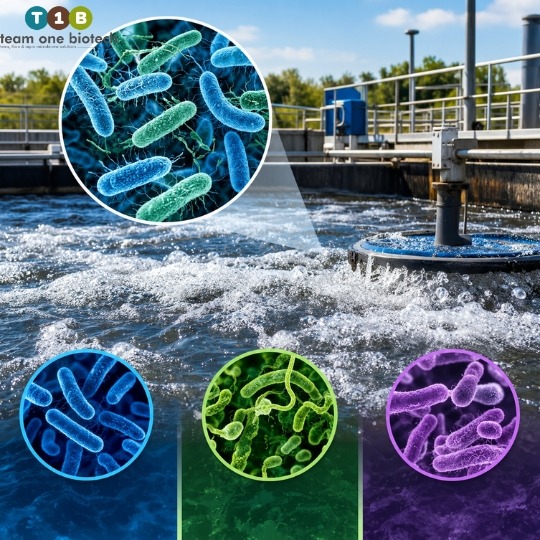
Aerobic bacteria require dissolved oxygen to survive, grow, and metabolise organic pollutants. In the presence of adequate oxygen, they break down BOD and COD rapidly and with high efficiency, converting organic carbon into biomass, carbon dioxide, and water.
The dissolved oxygen range typically cited for effective aerobic biological treatment falls between approximately 1.5 and 4 mg/L, though the optimal window can shift based on the nature of the wastewater and the organic loading rate applied to the system.
Note: These are indicative ranges based on general process knowledge. Actual operating parameters will vary depending on your specific wastewater composition, organic loading rate, and plant design. Always validate against your ETP’s baseline data.
Aerobic bacteria are also sensitive to temperature and pH shifts. Broadly, mesophilic aerobic cultures perform within temperature ranges commonly found in Indian industrial effluent conditions, but sudden shifts, particularly during monsoon season, can destabilise the biological community. Similarly, pH excursions outside the range tolerated by your specific culture can cause significant population loss.
Note: These are indicative ranges. Actual values will vary based on your specific ETP design, wastewater composition, and operating conditions.
Where Aerobic Bacteria Excel in an ETP
Aerobic bacterial cultures are the standard microbial choice for:
- Activated Sludge Process (ASP) systems, where continuous aeration and mixed liquor suspension support high microbial density
- Moving Bed Biofilm Reactors (MBBR), where biofilm carriers provide surface area for aerobic biofilm development
- Sequential Batch Reactors (SBR), where react, settle, and decant cycles rely on aerobic degradation during the reaction phase
- Secondary treatment stages following primary settling or upstream anaerobic pre-treatment
- Industries with moderate to high BOD loads: food and beverage processing, dairy, textiles, pharmaceuticals, and agro-processing facilities
These are environments where aerobic bacteria in wastewater treatment consistently demonstrate their value, fast reaction kinetics, high BOD/COD removal efficiency, and relatively predictable process behaviour under stable conditions.
Their Limitations
Aerobic systems are energy-intensive. Continuous aeration demands consistent power supply and mechanical reliability. In facilities where power availability is variable or aeration equipment is poorly maintained, aerobic bacterial populations suffer.
Aerobic bacteria are also vulnerable to shock loading events, sudden spikes in organic concentration, temperature, or the introduction of toxic influents like heavy metals or high-solvent effluents from batch discharge operations. When the biological community is overwhelmed, recovery is not instant. It can take days to weeks.
For very high-strength industrial effluents, where incoming COD concentrations are in the range of several thousand mg/L or higher, attempting aerobic treatment alone is neither efficient nor economical. The energy cost of aeration at that scale, combined with the elevated sludge generation typical of aerobic systems, makes upstream anaerobic pre-treatment the more rational engineering decision.
Aerobic bacteria are powerful, but they are not always the right first step, especially when the incoming effluent is heavily loaded.
Anaerobic Bacteria, Built for High-Strength Effluents
How They Function
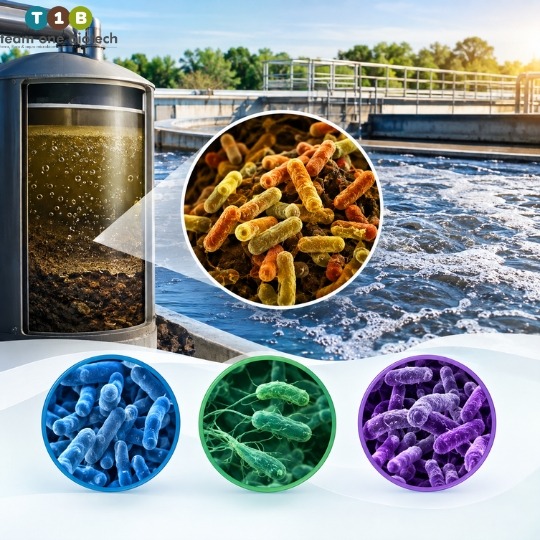
Anaerobic bacteria operate in the complete absence of dissolved oxygen. Rather than a single metabolic pathway, anaerobic digestion involves a consortium of microbial groups working in sequence: hydrolytic bacteria break down complex organic polymers; acidogenic bacteria convert the products into volatile fatty acids; acetogenic bacteria transform those into acetate and hydrogen; and finally, methanogenic archaea complete the process by converting acetate and hydrogen into biogas, primarily methane and carbon dioxide.
This multi-stage process is inherently slower than aerobic degradation. Reaction kinetics in anaerobic systems are measured in days and weeks, not hours. The upside is significant: very high COD reduction is achievable, and the biogas produced can be captured and used as an energy source, offsetting operational costs at scale.
Anaerobic bacteria ETP applications are critically dependent on maintaining stable environmental conditions. These organisms are far more sensitive to temperature fluctuations, pH shifts, and the presence of inhibitory compounds than aerobic cultures. Once disrupted, anaerobic communities are slow to recover.
Where Anaerobic Bacteria Are Indispensable
There are process scenarios where no other bacterial category is the right choice:
- UASB (Upflow Anaerobic Sludge Blanket) reactors, the most widely deployed anaerobic technology in Indian industrial wastewater treatment
- Anaerobic digesters and covered lagoons, for high-volume, high-strength applications
- Pre-treatment of industrial effluents before aerobic polishing, to reduce the COD load to a range that aerobic systems can handle efficiently
- Industries generating very high-strength wastewaters: distilleries, paper and pulp mills, slaughterhouses, sugar mills, and tanneries
- Situations where COD concentrations in the incoming effluent are typically above several thousand mg/L, requiring anaerobic-first process sequencing to achieve downstream compliance
Note: Specific COD thresholds at which anaerobic pre-treatment becomes necessary will vary based on wastewater characterisation, design criteria, and target discharge standards. These are indicative benchmarks, not design specifications.
When biogas recovery is a project objective, either for internal energy use or as part of a sustainability compliance mandate, anaerobic treatment is not just appropriate. It is the only viable option.
Their Limitations
Startup time is one of the most operationally significant constraints with anaerobic systems. Establishing a stable granular sludge bed in a UASB reactor, for example, can take several weeks under ideal conditions and longer if seed sludge quality is poor or the influent characteristics are inconsistent.
Anaerobic communities are particularly sensitive to inhibitory compounds. Heavy metals, sulphates above certain thresholds, certain organic solvents, and free ammonia at elevated concentrations can all suppress methanogenic activity, sometimes irreversibly if the exposure is prolonged.
Perhaps the most important limitation for Indian ETP operators to understand: effluent from anaerobic treatment alone will rarely, if ever, meet CPCB discharge norms for BOD, COD, or TSS. Anaerobic treatment is a pre-treatment and load-reduction step. Aerobic polishing downstream is almost always required to bring the treated effluent within regulatory limits.
Anaerobic treatment is powerful at scale but demands operational discipline. Between these two extremes, there is a third category of bacteria that offers remarkable flexibility.
Facultative Bacteria, The Adaptive Bridge
How They Function
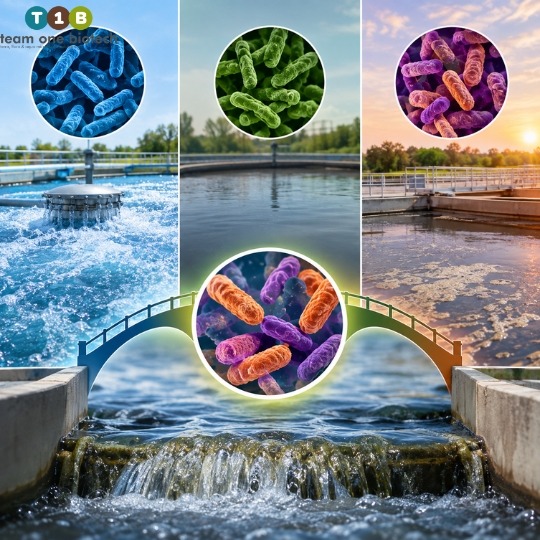
Facultative bacteria are metabolic generalists. Unlike aerobic or anaerobic specialists, facultative organisms can survive and function across a range of oxygen conditions, shifting their metabolic pathways in response to what the environment makes available.
In the presence of dissolved oxygen, they respire aerobically. When oxygen is depleted or absent, they switch to fermentation or anaerobic respiration pathways. This switching is not instantaneous, but it is reliable, and it makes facultative bacteria uniquely suited to environments where oxygen availability is variable or inconsistent.
This metabolic flexibility is not a compromise. In certain process environments and operational contexts, it is precisely the characteristic that a treatment system needs most.
Where Facultative Bacteria Are Most Valuable
Facultative bacteria STP and ETP applications include:
- Facultative stabilisation ponds and waste stabilisation lagoons, where oxygen levels vary by depth, time of day, and weather conditions
- Oxidation ditches, where zones of aeration and oxygen depletion coexist within a single basin
- Transition zones between aerobic and anaerobic compartments in multi-stage ETP configurations
- Systems where aeration is intermittent or variable due to power supply constraints, load fluctuations, or decentralised infrastructure
- Smaller municipal STPs and decentralised treatment systems where continuous process monitoring and control are not always feasible
- Facilities that deal with variable industrial effluent loads and cannot guarantee consistent reactor conditions
For many Indian municipal STPs operating in semi-urban and rural settings, where power availability is not guaranteed and staffing levels are limited, facultative systems and cultures offer a level of inherent resilience that neither purely aerobic nor purely anaerobic systems can match.
Their Limitations
Facultative bacteria, by nature, are not optimised for peak performance under any single set of conditions. Under well-aerated, controlled conditions, dedicated aerobic cultures will typically outperform facultative communities in terms of COD removal rate and efficiency.
For very high-strength industrial effluents requiring aggressive organic reduction in the primary treatment stage, facultative bacteria alone are not sufficient. They work best as a supporting element within a multi-stage process, not as the primary workhorse for heavy industrial loads.
Performance can also be inconsistent if process conditions shift too rapidly, denying the bacterial community time to adapt its metabolic pathway.
Side-by-Side Comparison, Aerobic vs Anaerobic vs Facultative
| Parameter | Aerobic Bacteria | Anaerobic Bacteria | Facultative Bacteria |
| Oxygen Requirement | Mandatory (DO 1.5–4 mg/L, indicative) | Must be absent | Flexible, aerobic or anaerobic |
| COD Reduction Efficiency | High under optimal conditions | Very high for high-strength loads | Moderate; depends on conditions |
| Energy Demand | High (continuous aeration required) | Low (no aeration) | Low to moderate |
| Sludge Generation | Comparatively higher | Low | Low to moderate |
| Startup Time | Relatively fast | Slow (weeks to months) | Moderate |
| Typical Reactor Types | ASP, MBBR, SBR | UASB, digesters, anaerobic lagoons | Stabilisation ponds, oxidation ditches |
| Best Industry Fit | Food/beverage, dairy, pharma, textiles | Distilleries, sugar mills, paper/pulp, tanneries | Municipal STPs, mixed-load industrial ETPs |
| Sensitivity to Shock Loads | Moderate to high | Very high | Lower, moderate resilience |
Disclaimer: All values and performance characteristics in this table represent general indicative benchmarks based on standard process knowledge. Actual performance will vary significantly based on wastewater composition, organic loading rate, temperature, reactor design, and microbial seed quality. These figures should not be used as design specifications without site-specific engineering assessment.
The Decision Framework, Choosing the Right Bacteria for Your ETP
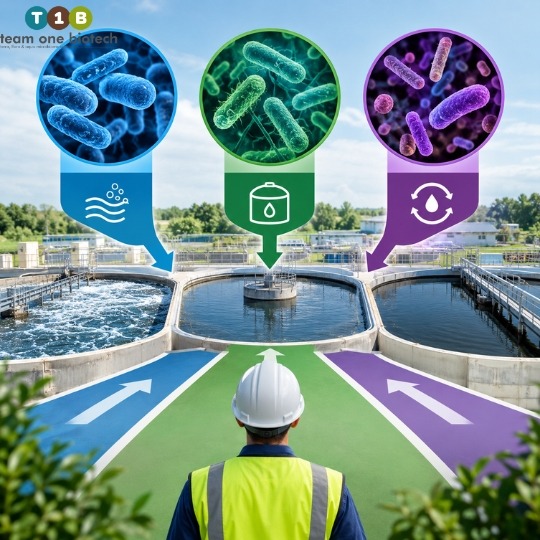
This is not about picking a favourite. It is about matching the biology to the process reality. Here are the questions every plant manager or environmental engineer should work through before selecting or deploying a microbial culture:
What is the incoming COD and BOD concentration?
- Very high-strength effluent (COD typically in the range of several thousand mg/L or above) → Begin with anaerobic pre-treatment to reduce organic load, followed by aerobic polishing
- Moderate-strength effluent → Aerobic systems may handle the load directly; facultative treatment can serve as a primary or buffer stage
- Variable or mixed loads → Facultative bacteria offer the resilience that variable loading demands
What reactor infrastructure do you currently operate?
- UASB reactor or anaerobic digester → Anaerobic microbial cultures, properly seeded
- ASP, MBBR, or SBR → Aerobic bacterial consortia matched to your industry’s effluent profile
- Stabilisation ponds or oxidation ditches → Facultative bacterial cultures suited to variable oxygen environments
What are your CPCB or SPCB discharge targets?
- CPCB discharge compliance requires specific BOD, COD, TSS, and pH values to be met consistently, not occasionally
- Single-stage biological treatment is rarely sufficient for high-strength industrial effluents
- A two-stage or three-stage configuration combining anaerobic pre-treatment with aerobic polishing, and optionally a facultative buffer stage, typically delivers the most consistent compliance outcomes across industries and seasons
What is your operational capacity and monitoring infrastructure?
- Skilled operators, continuous online monitoring, reliable power → Anaerobic systems are viable and economical at scale
- Limited monitoring capability, variable power supply, smaller teams → Facultative bacteria offer built-in resilience with lower monitoring burden
- High-performance secondary treatment target with consistent aeration → Aerobic cultures, properly managed
Is your system currently underperforming or experiencing a crash?
- Persistent high COD or BOD in treated effluent despite adequate HRT and aeration is a strong indicator of biological mismatch
- Poor sludge settleability, foam formation, or inconsistent effluent quality are common symptoms
- The fastest path to recovery in most cases is bioaugmentation ETP, introducing targeted, concentrated, pre-adapted microbial cultures to restore biological activity in the affected stage
Not sure which bacterial culture is right for your ETP stage? Our technical team at Team One Biotech has helped hundreds of plants across India recover from biological failures and achieve consistent CPCB compliance. Reach out for a free technical consultation.
Why Bioaugmentation Works, And When to Use It
Natural microbial communities in a new or recovering ETP are rarely optimised for the specific pollutant load, temperature profile, and industrial effluent composition they are expected to treat. Population density may be insufficient. Bacterial diversity may be limited. The organisms present may simply not be the right species for the job.
Bioaugmentation addresses this by introducing concentrated, pre-adapted microbial consortia, cultures that have been specifically developed and characterised to perform under the conditions found in Indian industrial effluent treatment environments. The benefits are well-established in practice:
- Significantly reduced startup time for new plants
- Accelerated recovery after biological system crashes or shock loading events
- Improved and more consistent BOD/COD reduction across treatment stages
- Support for scaling up operations without proportional increases in biological failure risk
- Targeted response to new or changing effluent streams resulting from process changes upstream
Bioaugmentation ETP applications work best when the correct bacterial type is matched to the correct treatment stage, aerobic cultures for aerated secondary stages, anaerobic cultures for UASB or digester pre-treatment, and facultative cultures for pond systems and variable-load environments.
Team One Biotech manufactures a range of aerobic, anaerobic, and facultative microbial consortia specifically formulated for Indian industrial effluent conditions and CPCB discharge compliance. Each culture is characterised for its target pollutant profile and process environment, not adapted from international formulations and applied generically.
Team One Biotech’s bioaugmentation cultures are built for Indian effluent conditions. Speak to our biological treatment specialists to identify the right culture for your specific ETP stage and industry.
Frequently Asked Questions
Can aerobic and anaerobic bacteria be used together in the same ETP?
Yes, and in fact, the most effective industrial ETPs typically use both in sequence. High-strength effluent enters anaerobic pre-treatment first, where COD is reduced significantly before the wastewater enters the aerobic polishing stage. This staged configuration is standard practice for distilleries, sugar mills, tanneries, and other high-load industries seeking consistent CPCB discharge compliance.
What happens if you add aerobic bacteria to an oxygen-depleted tank?
The bacteria will not function effectively. Without dissolved oxygen, aerobic metabolic pathways shut down, and the culture will die off over time. The system will not achieve meaningful BOD or COD reduction regardless of the microbial quantity added. This is one of the most common, and most avoidable, causes of biological system failure in ETPs where aeration is inconsistent or where cultures are added to the wrong treatment zone.
How long does it take for a new microbial culture to establish in an ETP?
This varies considerably depending on the bacterial type, reactor conditions, organic loading rate, and seed culture quality. Aerobic systems in stable conditions typically establish biological activity faster than anaerobic systems. Bioaugmentation with pre-adapted cultures significantly shortens the acclimation period compared to relying on natural seeding from incoming wastewater alone.
Note: Actual startup timelines depend on site-specific conditions, influent composition, and process management. These are general observations and should not be treated as design specifications.
What are the signs that the wrong bacterial culture has been deployed?
Common indicators include persistent high COD or BOD in the treated effluent despite adequate hydraulic retention time and aeration, poor sludge settleability, foam formation on the surface of aeration tanks, inconsistent effluent quality from day to day, and recurring failure to meet CPCB or SPCB discharge norms. If these symptoms are present, biological mismatch, rather than infrastructure failure, should be one of the first root causes investigated.
Get the Biology Right First
The distinctions between aerobic, anaerobic, and facultative bacteria are not academic. They are operationally decisive. Aerobic bacteria deliver high-efficiency organic degradation in oxygenated secondary treatment stages. Anaerobic bacteria are the right tool for high-strength pre-treatment and energy recovery. Facultative bacteria provide metabolic resilience in systems where oxygen availability is variable or operational control is limited.
Biological treatment failure, persistent COD non-compliance, system crashes, poor sludge management, is almost never purely a problem of tank capacity or hydraulic design. It is almost always a problem of mismatched microbial selection. The wrong organisms in the wrong environment will not perform, regardless of how much you dose.
CPCB and SPCB discharge compliance is not achievable without a stable, correctly-configured biological stage. And a correctly-configured biological stage requires the right microbial communities, deployed at the right concentrations, in the right reactor environment, matched to the specific organic loading and effluent characteristics of your plant.
This is exactly the problem that bioremediation bacteria India specialists like Team One Biotech exist to solve, with field-proven, purpose-formulated microbial solutions developed for the realities of Indian industrial wastewater treatment.
If your ETP is struggling to achieve consistent discharge compliance, or if you are configuring a new plant and want to get the biology right from day one, Team One Biotech’s technical team is ready to help. Reach out for a no-obligation consultation on microbial culture selection and bioaugmentation strategy.
Looking to improve your ETP/STP efficiency with the right bioculture?
Talk to our experts at Team One Biotech for customised microbial solutions.
Contact: +91 8855050575
Email: sales@teamonebiotech.com
Visit: www.teamonebiotech.com
Discover More on YouTube – Watch our latest insights & innovations!-
Connect with Us on LinkedIn – Stay updated with expert content & trends!