
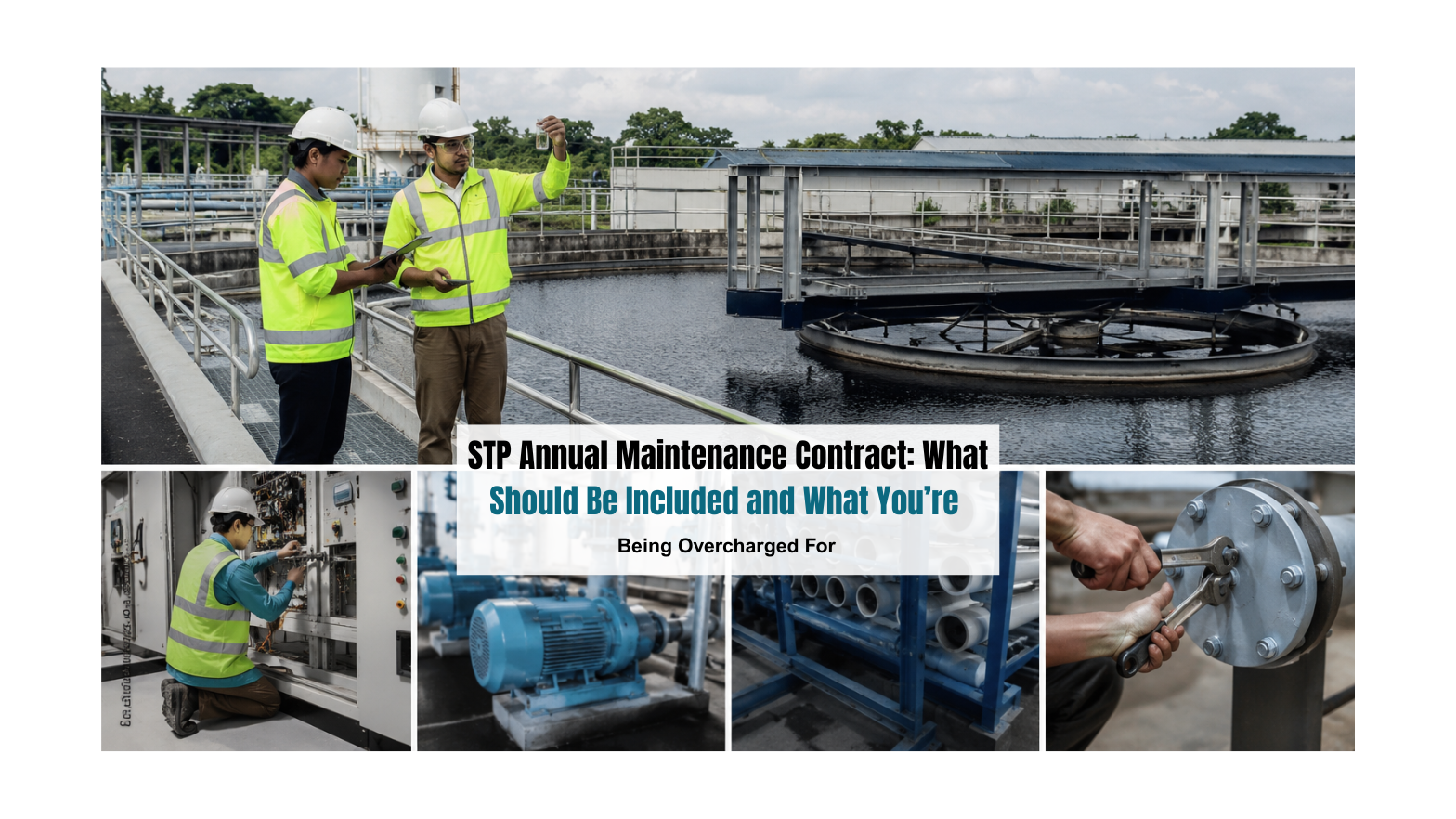

STP Annual Maintenance Contract: What Should Be Included and What You’re Being Overcharged For
There’s a particular kind of dread that hits an RWA treasurer or a factory procurement manager when an email lands from the State Pollution Control Board. It usually starts with words like show cause or violation, and within seconds, a routine Tuesday turns into weeks of paperwork, panic-driven vendor calls, and a budget conversation nobody wanted to have. Often, the root cause traces back to something as unglamorous as a sewage treatment plant that wasn’t maintained properly, despite an AMC supposedly being in place.
The second version of this dread is quieter but just as costly: discovering that this quarter’s emergency pump repair bill is the fourth one this year, each one billed separately, even though there’s an active annual maintenance contract sitting in a filing cabinet that was supposed to prevent exactly this. Somewhere between the contract’s fine print and the vendor’s invoice, money is leaking out, and most committees and procurement teams don’t realize it until the numbers are added up at year-end.
The STP AMC is, without exaggeration, one of the most misunderstood and most poorly negotiated line items in a housing society’s or factory’s annual budget. It’s treated as a checkbox, a mandatory expense to keep effluent flowing and inspectors satisfied, rather than what it actually is: a legally significant, technically complex service contract that directly determines whether a facility stays compliant or becomes the subject of a regulatory notice.
This guide walks through what a genuine, comprehensive STP AMC should include, where vendors typically pad costs or strip out coverage, and how a smarter biological approach to treatment can quietly reduce both compliance risk and the size of next year’s renewal quote.
The Legal Reality: Why Your Consent to Operate Depends on Daily STP Performance

Every facility discharging treated sewage, whether a residential township or an industrial unit, operates under a Consent to Operate (CTO) issued by the relevant State Pollution Control Board, working within the broader framework set by the Central Pollution Control Board. This isn’t a one-time approval. It’s a conditional, renewable license that assumes continuous compliance with CPCB discharge norms covering parameters like Biochemical Oxygen Demand (BOD), Chemical Oxygen Demand (COD), Total Suspended Solids (TSS), and pH.
The critical detail many committees miss is that CTO compliance isn’t measured by intentions or paperwork. It’s measured by what comes out of the outlet pipe on any given day, including the day an inspector decides to test it. An STP that runs adequately for eleven months and underperforms in the twelfth is still a compliance failure if that twelfth month happens to be when samples are drawn.
This is precisely why SPCB regulations increasingly expect facilities to demonstrate not just plant ownership but active, documented operation and maintenance. A functioning AMC isn’t a courtesy to your vendor relationship; it’s effectively part of your regulatory defense file. When a society or factory faces scrutiny, the maintenance logs, water testing records, and breakdown response documentation from the AMC vendor often become the primary evidence of due diligence.
Note: These figures, costs, and timelines are general guidelines and market ranges. Actual pricing and operational requirements will vary significantly based on plant capacity, design technology, current mechanical health, and the specific inlet-outlet parameters of individual Sewage and Effluent Treatment Plants (STPs/ETPs).
The Blueprint: What an Authentic STP AMC Must Include
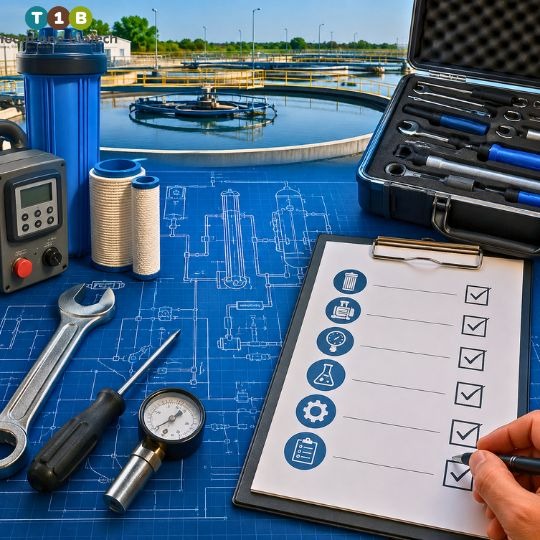
A genuine sewage treatment plant AMC isn’t a vague promise of maintenance support. It’s a structured service commitment with specific, auditable components. If your current contract, or the quotes you’re comparing, don’t clearly spell out the following, that’s a planning gap worth raising before signing.
Preventative Mechanical and Electrical Audits
This is the backbone of any STP operation maintenance contract in India. It should include scheduled inspection cycles for blowers, aerators, pumps, motors, control panels, and electrical wiring, typically occurring multiple times per month depending on plant capacity and load. The contract should specify:
- Routine visual and functional inspection of all rotating equipment
- Lubrication and wear-component checks on a defined cycle
- Electrical panel inspection, including checking for loose connections, overheating, and relay function
- Plumbing and pipeline checks for leaks, blockages, or scaling
- A documented maintenance log shared with the client after every visit, not just available on request
Water Quality Analytics and Compliance Reporting
An AMC without testing is essentially an AMC without proof. Your contract should mandate regular laboratory testing of treated effluent for BOD, COD, TSS, and pH, generally conducted somewhere between 2 to 4 times per month, though frequency can reasonably vary based on plant size and local SPCB requirements. These results should be shared as formal reports, not verbal assurances, and ideally retained in a format that can be produced instantly if a Consent to Operate compliance check arises.
Sludge Management Protocols
Sludge handling is frequently glossed over in vendor proposals, yet it’s central to both odor control and treatment efficiency. The contract should clearly define how often sludge wasting occurs, how it’s dewatered or stored, and how disposal is handled in line with local environmental guidelines. Ambiguity here often becomes a hidden cost center later.
Emergency Callout SLAs
Breakdowns happen, and how a vendor responds defines whether a minor fault becomes a major compliance event. A solid AMC should specify a guaranteed response window, commonly falling within 24 to 36 hours for non-critical issues, with shorter windows for critical failures affecting discharge quality. These SLAs should be written into the contract with measurable penalties for non-compliance, not just mentioned in a sales pitch.
Note: These figures, costs, and timelines are general guidelines and market ranges. Actual pricing and operational requirements will vary significantly based on plant capacity, design technology, current mechanical health, and the specific inlet-outlet parameters of individual Sewage and Effluent Treatment Plants (STPs/ETPs).
Want a structured way to check your current contract against this blueprint before your renewal date arrives? A simple side-by-side checklist can reveal gaps in minutes rather than after the next inspection.
Where the Money Bleeds: Common Overcharges and Contract Red Flags

This is where most procurement reviews and RWA budget discussions get uncomfortable, because the overcharges are rarely obvious. They’re built into structure, not single line items.
Biological dosing billed as an extra. Routine addition of bacterial cultures or enzymes to maintain biological treatment efficiency should typically be a built-in part of a comprehensive AMC, not an add-on invoiced separately each time the tank seems sluggish.
Visiting fees disguised as inspection charges. Some vendors quote a low base AMC cost, then attach a site visit fee for what should be a scheduled, contractually included monthly check. This single tactic is one of the most common ways sewage treatment plant AMC charges quietly balloon over a year.
Unbundled emergency repairs. Pump or blower repairs that should fall under preventative maintenance get rebranded as emergency callouts and billed at a premium, even when the failure was a predictable result of deferred servicing.
Vague consumable clauses. Contracts that don’t clearly state which consumables (chemicals, filters, minor spare parts) are included versus billed separately tend to generate disputes precisely when budgets are tightest.
No defined exit or escalation clause. If a vendor underperforms, is there a documented process to flag it, demand correction, or exit the contract without penalty? Many AMCs are silent here, leaving clients stuck.
When comparing STP AMC cost India quotes, the cheapest quarterly figure is often the one with the most exclusions. A genuinely comprehensive contract may carry a higher headline number but eliminates the unpredictable add-ons that erode any savings within two or three billing cycles.
Note: These figures, costs, and timelines are general guidelines and market ranges. Actual pricing and operational requirements will vary significantly based on plant capacity, design technology, current mechanical health, and the specific inlet-outlet parameters of individual Sewage and Effluent Treatment Plants (STPs/ETPs).
Comprehensive vs. Labor-Only Contracts: A Side-by-Side Comparison
| Aspect | Comprehensive AMC | Labor-Only Contract |
| Scope of coverage | Mechanical, electrical, plumbing, biological dosing, and consumables typically bundled | Covers technician visits and labor only; parts, chemicals, consumables billed separately |
| Cost predictability | Higher, more stable monthly or annual outlay; fewer surprise invoices | Lower headline cost, but frequent unpredictable add-on billing |
| Risk allocation | Vendor absorbs more operational risk; performance-linked SLAs common | Client absorbs most risk; vendor liability limited to labor presence |
| Compliance documentation | Usually includes structured water testing reports and maintenance logs | Documentation often inconsistent or client-managed |
| Best suited for | Societies and facilities prioritizing regulatory certainty and budget stability | Facilities with strong in-house technical oversight and spare parts inventory |
| Typical cost range | Generally varying from INR X to INR Y per month depending on plant capacity and inclusions | Often lower base rate, but cumulative annual cost can exceed comprehensive plans once add-ons are tallied |
Note: These figures, costs, and timelines are general guidelines and market ranges. Actual pricing and operational requirements will vary significantly based on plant capacity, design technology, current mechanical health, and the specific inlet-outlet parameters of individual Sewage and Effluent Treatment Plants (STPs/ETPs).
How Smart Biology Lowers Mechanical Costs
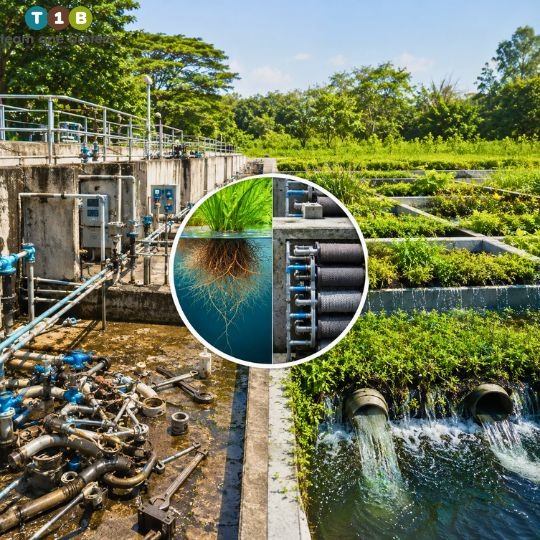
Here’s the part of the conversation that procurement teams and RWA committees rarely get from a purely mechanical vendor: the biological health of an STP directly determines how hard its mechanical components have to work.
A plant struggling with weak or imbalanced microbial activity tends to develop excess sludge, increased odor, and inconsistent BOD and COD reduction. That imbalance forces blowers and aerators to run longer and harder, accelerates wear on pumps, and increases the frequency of unexpected mechanical interventions that, as covered earlier, often get billed as emergencies.
This is where advanced bioremediation solutions and engineered microbial cultures, like those developed by Team One Biotech, change the equation. By introducing targeted bacterial strains and enzymatic formulations suited to a plant’s specific influent characteristics, biological treatment optimization becomes achievable in a way generic, one-size-fits-all dosing rarely allows. The practical results tend to include reduced sludge volumes, more stable effluent quality even under fluctuating load, and notably less strain on rotating equipment.
Over time, this biological stability gives facilities genuine leverage in AMC negotiations. A plant that consistently meets CPCB discharge norms with minimal mechanical drama is a far less risky, less labor-intensive account for any maintenance vendor to service, and that should be reflected in lower renewal quotes.
Note: These figures, costs, and timelines are general guidelines and market ranges. Actual pricing and operational requirements will vary significantly based on plant capacity, design technology, current mechanical health, and the specific inlet-outlet parameters of individual Sewage and Effluent Treatment Plants (STPs/ETPs).
From Passive Buyer to Informed Procurement Supervisor
The single biggest shift a treasurer or procurement manager can make isn’t switching vendors every renewal cycle. It’s reading the existing contract the way a compliance officer would: scope by scope, exclusion by exclusion, SLA by SLA. Most overcharges and most compliance risks live in the gaps between what was promised verbally and what was actually written down.
Before your next AMC renewal, request a structured breakdown from your current or prospective vendor that separates mechanical coverage, biological treatment support, water testing frequency, and emergency response commitments into distinct, itemized sections. If a vendor hesitates to put this in writing, that hesitation is itself useful information.
If your facility’s STP has been generating recurring mechanical complaints, inconsistent test results, or rising emergency invoices, the underlying issue may not be your equipment at all. It may be the biological foundation the equipment is being forced to compensate for. Team One Biotech works with housing societies and industrial facilities to assess and strengthen the microbial health of sewage and effluent treatment systems before committing to another expensive mechanical AMC cycle. A plant that’s biologically optimized is simply cheaper, safer, and easier to maintain, regardless of which vendor eventually signs the contract.
Every renewal cycle is a fresh opportunity to ask harder questions of your AMC vendor, and the answers often reveal more about your plant’s biological health than its mechanical condition. Rather than locking into another year of reactive repairs and unpredictable invoices, it’s worth starting with an honest assessment of what’s actually happening inside your tanks. Get in touch with Team One Biotech to evaluate your STP’s biological performance, identify the inefficiencies quietly inflating your maintenance costs, and build a treatment strategy that keeps your Consent to Operate secure without overpaying for it.
Looking to improve your ETP/STP efficiency with the right bioculture?
Talk to our experts at Team One Biotech for customised microbial solutions.
Contact: +91 8855050575
Email: sales@teamonebiotech.com
Visit: www.teamonebiotech.com
Discover More on YouTube – Watch our latest insights & innovations!-
Connect with Us on LinkedIn – Stay updated with expert content & trends!