
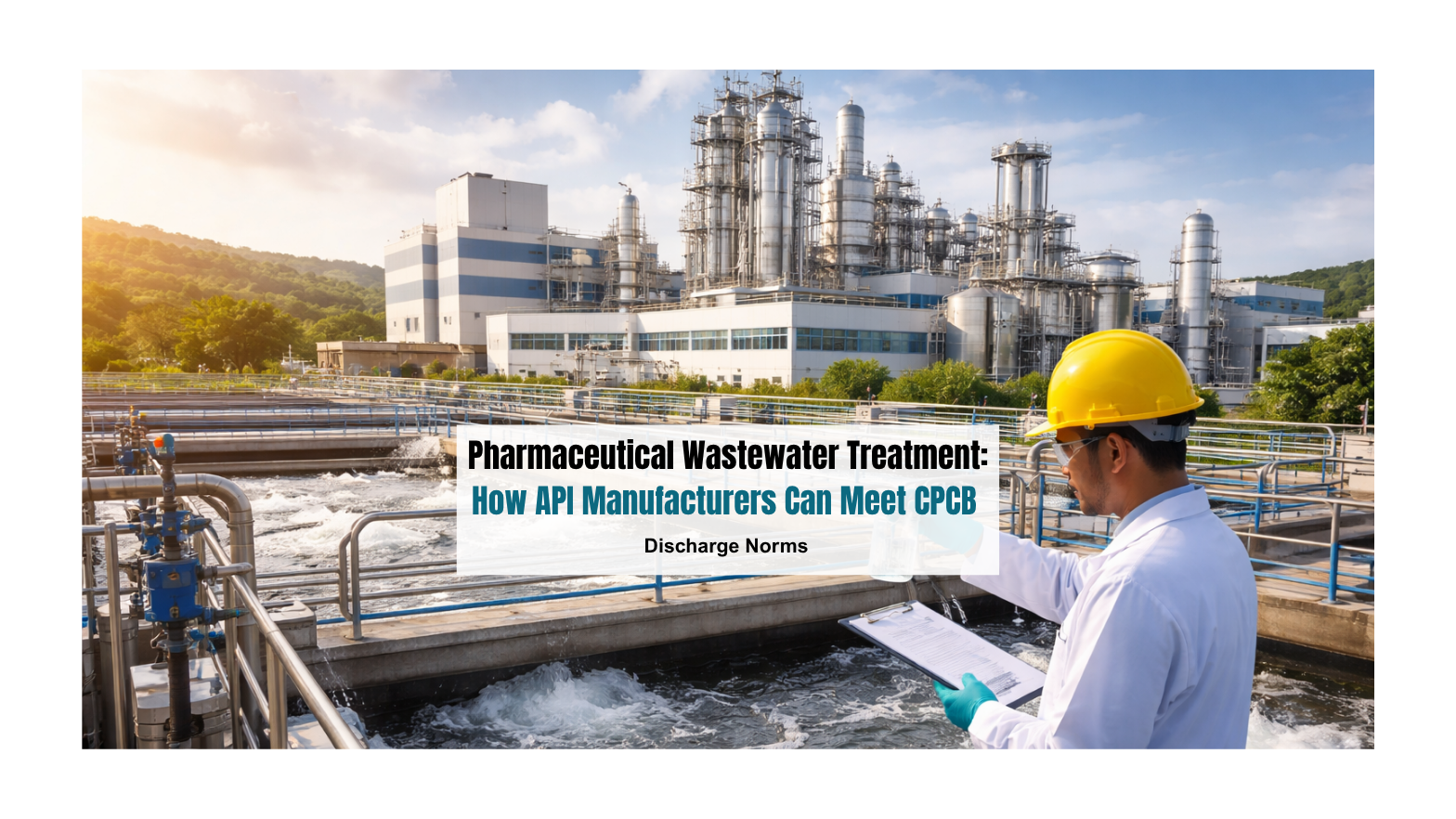

Pharmaceutical Wastewater Treatment: How API Manufacturers Can Meet CPCB Discharge Norms
If your Consent to Operate renewal is coming up in the next six months, this post is worth reading carefully. CPCB and SPCB inspection teams across Baddi, Vapi, Hyderabad, and Ankleshwar have sharpened their scrutiny of API manufacturing units over the past two years. Effluent quality records, real-time monitoring data from OCEMS, and third-party lab reports are being cross-verified with a level of technical rigor that most legacy ETPs were simply not designed to withstand.
The problem is not that plant managers are careless. The problem is that pharmaceutical effluent, particularly from API synthesis, is one of the most technically complex wastewater streams in Indian industry. High chemical oxygen demand (COD) in the range of 8,000 to 25,000 mg/L, sharp TDS spikes during solvent recovery operations, low biodegradability indices (BOD:COD ratios below 0.3 in many cases), and the persistent presence of refractory organics such as sulfonamides, beta-lactam intermediates, and heterocyclic compounds, none of this is manageable through conventional physicochemical treatment alone.
If your plant is still relying on a coagulation-flocculation-filtration sequence as the primary treatment mechanism, you are already operating at a structural compliance deficit. Effective biological wastewater treatment requires adaptive biological management.
What CPCB Discharge Norms Actually Require from API Units
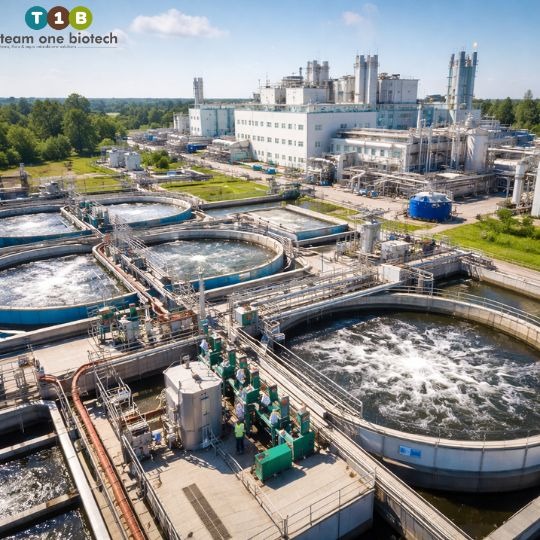
The Regulatory Baseline You Cannot Negotiate Around
Under the Environment Protection Act and the rules framed thereunder, API manufacturing units classified under the Red Category are subject to stringent effluent discharge standards. The current CPCB general standards for discharge into inland surface water include:
- COD: Not exceeding 250 mg/L
- BOD (5-day, 20°C): Not exceeding 30 mg/L
- Total Suspended Solids (TSS): Not exceeding 100 mg/L
- pH: 5.5 to 9.0
- Total Dissolved Solids (TDS): No Universal Fixed Limit
For units operating in ecologically sensitive zones or discharging into coastal waters, state-level norms enforced by SPCBs such as GPCB in Gujarat or TSPCB in Telangana are often more stringent than the national baseline. In Hyderabad’s Patancheru-Bollaram cluster, for example, combined effluent treatment plants have faced closure orders not because individual units violated any single parameter, but because cumulative biological oxygen demand loading breached the receiving water body’s assimilative capacity.
The Shift Toward Biological Stabilization
The regulatory shift over the last five years has been unmistakable. CPCB’s technical guidance documents and NGT-driven action plans have increasingly moved away from the notion that physicochemical treatment alone constitutes adequate ETP design for pharmaceutical and bulk drug units. The current compliance expectation, whether stated explicitly in your CTO conditions or implied through inspection scoring rubrics, is biological stabilization, the treatment of effluent to the point where residual organic load is not merely precipitated or filtered out, but metabolically degraded.
This is where the operational gap is widest for most API plants, and where bioremediation-led solutions have moved from being a niche option to a mainstream compliance necessity.
Why Standard Activated Sludge Processes Fail in API Effluent

The Refractory Organic Problem
Conventional activated sludge processes (ASP) depend on a mixed microbial community adapted to biodegrade organic matter using dissolved oxygen. These microbial communities perform adequately on domestic sewage, food processing wastewater, and moderate-strength industrial effluent. They are not equipped, by design or by acclimatization, to degrade the complex aromatic structures, halogenated compounds, and nitrogen-rich organics that characterize API manufacturing effluent.
When your aeration tank receives a batch discharge containing synthesis intermediates or solvent residues, two outcomes are typical. Either the MLSS concentration crashes due to biological toxicity, or the sludge becomes bulky with SVI values exceeding 200 mL/g, causing blanket carryover into the secondary clarifier and a direct spike in effluent TSS.
The Hydraulic and Seasonal Loading Variable
There is a complicating factor that rarely gets discussed in ETP audits but has a measurable impact on biological treatment performance: hydraulic loading variability driven by monsoon infiltration. In industrial clusters across Himachal Pradesh, Gujarat coastal belt, and Telangana, groundwater ingress into underground sewer networks during heavy rainfall months can dilute influent COD by 30 to 60%, disrupting the food-to-microorganism (F:M) ratio in aeration basins and destabilizing the biological equilibrium your system took weeks to establish.
Designing treatment responses around a static influent quality assumption is a common ETP design flaw.
Bioremediation in ETP: The Science Behind Specialized Microbial Cultures
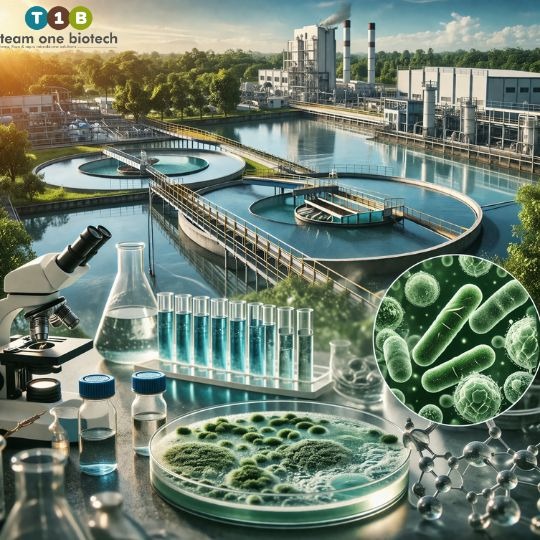
Bio-Augmentation vs. Bioaugmentation-Plus-Acclimatization
Team One Biotech’s approach to pharmaceutical effluent treatment is grounded in targeted bio-augmentation, the introduction of specialized, pre-screened microbial consortia capable of degrading specific classes of refractory organics that the indigenous mixed liquor cannot metabolize.
These are not generic bacterial cultures. The strains developed and deployed by Team One Biotech for API manufacturing effluent are selected for:
- Tolerance to high solvent concentrations and low BOD:COD ratios
- Capacity to degrade aromatic ring structures including benzimidazole, pyrimidine, and chlorinated phenol intermediates
- Stability under fluctuating pH (5.5 to 9.5) without requiring biological system restart
- Compatibility with existing SBR, MBR, and extended aeration configurations without requiring capital modifications
Operational Performance Metrics
In bio-augmented systems treating pharmaceutical and API effluent, the following operational improvements are typically observed:
- COD reduction efficiency: 75% to 92% across aeration and secondary treatment stages
- BOD:COD ratio improvement in treated effluent: from a pre-treatment range of 0.15–0.30 to post-treatment values of 0.05–0.10
- MLSS stabilization: 2,500 to 4,500 mg/L maintained without the sludge bulking events common in uninoculated systems
- SVI normalization: typically brought within 80 to 150 mL/g range within 3 to 6 weeks of consistent dosing
- Sludge volume reduction: 15% to 35% depending on influent organic load and existing digestion capacity
Note: These are general performance values. Specific results and operating parameters vary depending on the unique characteristics of each individual ETP and influent quality.
Cross-Sector Applicability, Dairy, Food Processing, Sugar, Tannery, and Paper Industries
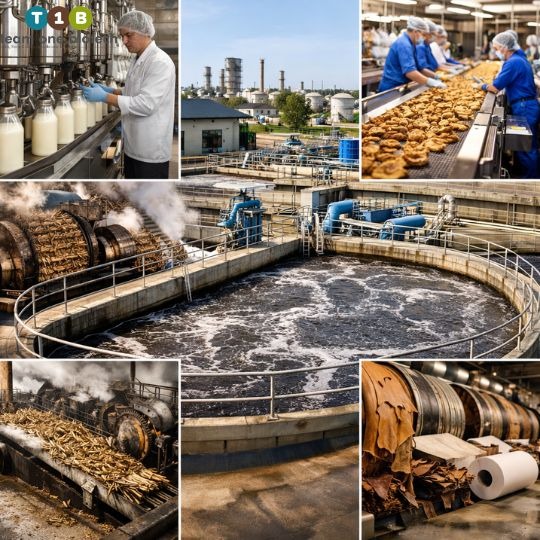
The biological treatment challenges described above are not exclusive to pharmaceutical units. Plant managers and EHS heads across several other high-load sectors face structurally similar compliance pressures.
Dairy and Food Processing
Dairy effluent carries high BOD loads (typically 1,500 to 4,500 mg/L) from fats, lactose, and cleaning chemical residues. The challenge here is less about refractory organics and more about rapid organic loading variability tied to production schedules. Bio-augmentation with lipase-producing and lactose-degrading microbial consortia accelerates treatment kinetics significantly in extended aeration systems.
Sugar and Distillery
Distillery spent wash remains one of the most challenging effluents in Indian industrial wastewater management, with COD values routinely between 80,000 and 120,000 mg/L. Melanoidin compounds, the dark-colored refractory polymers formed during fermentation, are highly resistant to conventional biological treatment. Specialized ligninolytic and melanoidin-degrading cultures can meaningfully reduce color and residual COD in the post-anaerobic treatment stage.
Tannery Sector
In tannery clusters across Kanpur and Tamil Nadu, effluent contains sulphide, chromium, and protein degradation products in combination. Bio-augmented systems using sulphide-oxidizing and chromium-tolerant microbial consortia have demonstrated effective secondary treatment performance where standard ASP systems have repeatedly failed SPCB inspections.
Paper and Pulp
Lignocellulosic effluent from paper mills, with COD loads of 5,000 to 15,000 mg/L and high color values driven by lignin derivatives, responds well to fungal-bacterial consortium-based bioaugmentation, particularly in CETP-linked secondary treatment stages.
Note: These are general performance values. Specific results and operating parameters vary depending on the unique characteristics of each individual ETP and influent quality.
Next Steps for EHS Managers and Plant Technical Heads
If your ETP is consistently producing treated effluent with COD above 350 mg/L, if your sludge is bulking intermittently, or if your next CTO renewal is within the next 12 months, the time for remediation is before the inspection, not after the notice.
Team One Biotech provides:
- On-site technical ETP audits covering biological process assessment, influent characterization, and CPCB compliance gap analysis
- Customized microbial dosing charts specific to your effluent composition, ETP configuration, and seasonal hydraulic loading profile
- Ongoing technical support through dosing adjustment, performance monitoring, and pre-inspection documentation review
To schedule a technical ETP audit or request a customized microbial dosing recommendation for your pharmaceutical, dairy, sugar, or tannery unit, contact Team One Biotech’s technical team directly. Bring your last three months of ETP monitoring data to the first consultation. The more specific the input, the more precise the solution.
Looking to improve your ETP/STP efficiency with the right bioculture?
Talk to our experts at Team One Biotech for customised microbial solutions.
Contact: +91 8855050575
Email: sales@teamonebiotech.com
Visit: www.teamonebiotech.com
Discover More on YouTube – Watch our latest insights & innovations!-
Connect with Us on LinkedIn – Stay updated with expert content & trends!