
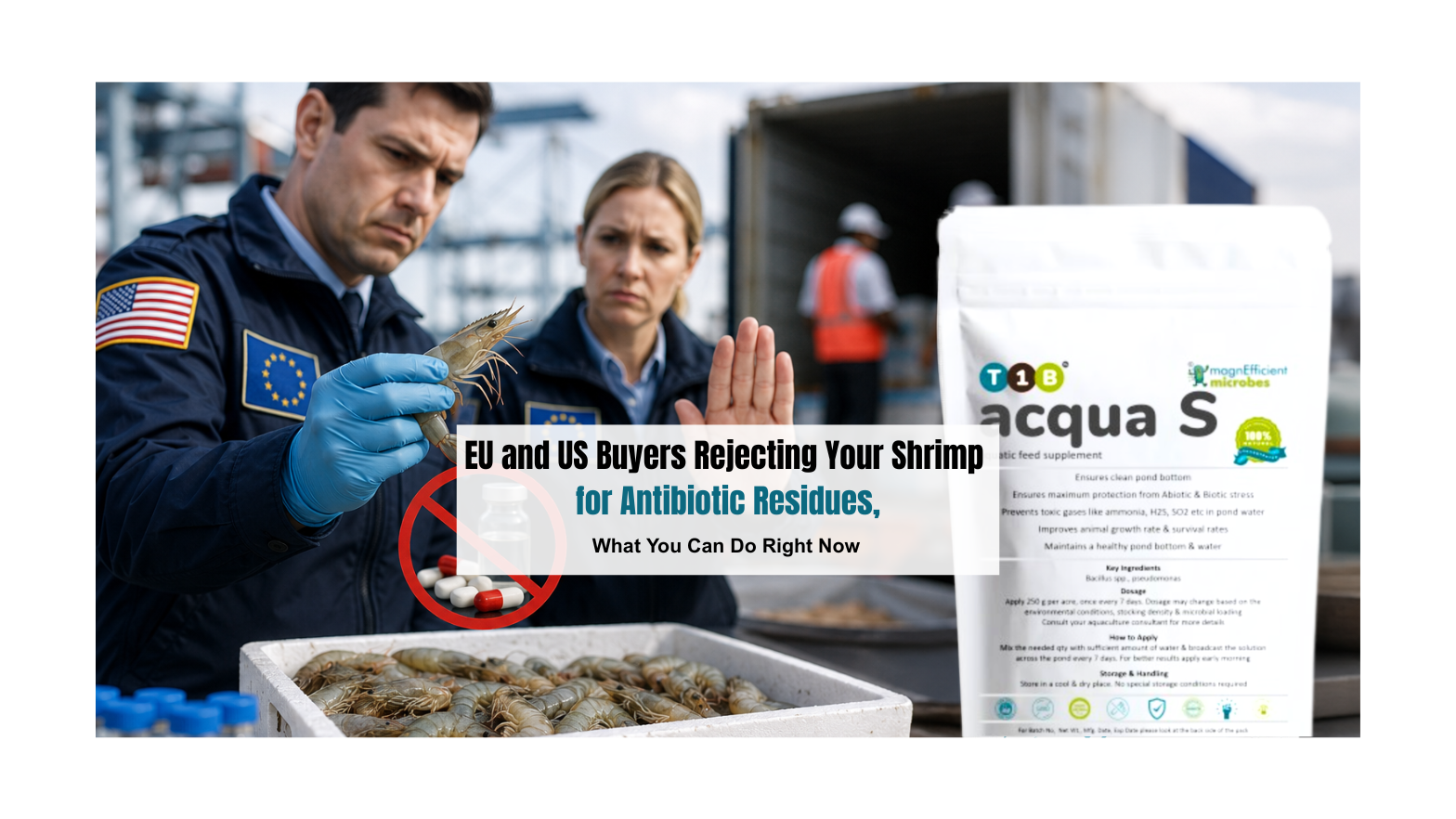
EU and US Buyers Rejecting Your Shrimp for Antibiotic Residues , What You Can Do Right Now
There is a particular kind of silence that falls over an export office when the email arrives. A consignment that left Kakinada or Nellore three weeks ago, fully paid for, fully documented, sailing toward what should have been a routine handover, has been flagged. Detained. Pending residue analysis.
What follows is not a single cost. It’s a cascading one. The container itself becomes a ticking demurrage clock, accumulating port storage fees by the day. The product inside, if confirmed positive, faces destruction or mandatory re-export at the exporter’s expense. The buyer, understandably, begins looking elsewhere for their next order. And the exporter’s name gets logged, quietly, permanently, into a heightened-surveillance category that means every future consignment from that facility gets pulled aside for extra scrutiny, whether or not anything is actually wrong with it.
This is the reality facing a growing number of Indian shrimp exporters right now. Search any industry forum, any trade bulletin, and the phrase shrimp export rejection antibiotic India shows up with uncomfortable regularity. The EU antibiotic residue shrimp India story isn’t a one-off scandal anymore, it’s becoming a structural risk baked into how international buyers evaluate Indian suppliers as a category.
The frustrating part is that this is almost entirely preventable. The regulatory bar hasn’t moved unpredictably; it has moved consistently, and in one direction, tighter. Detection technology has gotten more sensitive, traceability expectations have gotten stricter, and buyers in Brussels, Hamburg, and Seattle have gotten considerably less patient with “occasional” residue findings. Indian shrimp rejected EU market headlines aren’t going away until the industry’s underlying farm practices catch up to where detection science already is.
This guide is written for the people standing in that gap right now, farm managers, quality heads, and operators who need a clear-eyed look at what’s actually triggering rejections, and a realistic path toward antibiotic free shrimp export India status that doesn’t just chase compliance, but builds a genuinely more resilient operation underneath it.
The Compliance Landscape: What the EU and US FDA Are Actually Looking For
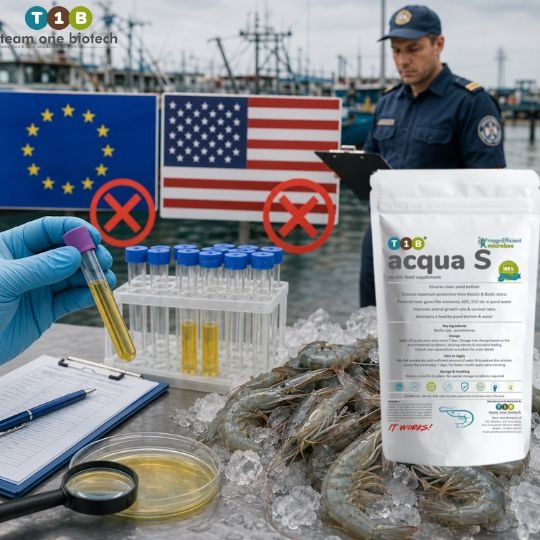
It helps to understand that EU and US inspection regimes aren’t designed around catching exporters out, they’re designed around statistical assurance. Under the framework that traces back to EU Regulation EC 854/2004, the European Union requires that imported aquaculture products originate from a country with an approved residue monitoring system, not just an approved individual farm. That’s a crucial distinction. The EU isn’t only checking your shipment; it’s checking whether India’s entire control architecture, including the Export Inspection Council (EIC) National Residues Control Programme (NRCP), is functioning credibly enough to justify routine market access.
The US FDA approaches it from a different angle but lands in a similar place. US FDA HACCP import requirements obligate exporters to demonstrate documented, verifiable control points across the supply chain, not just clean test results at the end. A processor can have a pristine final-product report and still face import alerts if their Hazard Analysis and Critical Control Points documentation can’t show where contamination risk was actually managed upstream, at the farm and hatchery level.
What this means practically: a single residue violation rarely stays a single-shipment problem. It becomes evidence in a larger pattern that regulators use to decide whether an entire exporting region needs intensified, mandatory pre-export testing, the kind that slows every shipment, not just the flagged one.
The Blacklisted Substances: Why Nitrofurans and Chloramphenicol Are the Immediate Tripwires
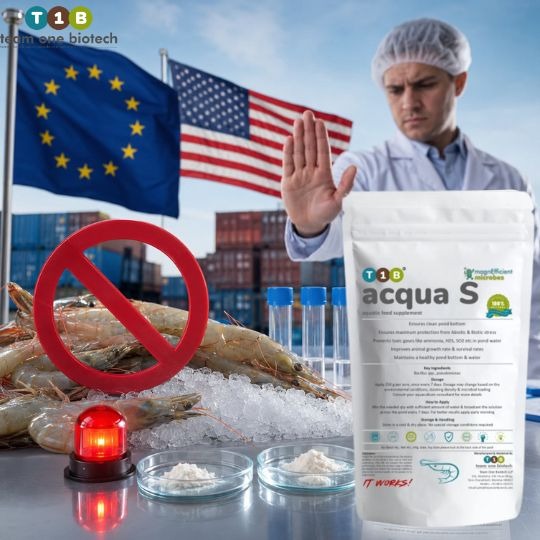
Two categories of compounds account for a disproportionate share of Indian shrimp export rejection antibiotic India cases, and it’s worth understanding exactly why.
Nitrofurans and Their Persistent Metabolites
Nitrofurans (furazolidone, furaltadone, and related compounds) were once common in shrimp farming for controlling bacterial infections. The problem is that nitrofurans themselves break down quickly in tissue, but they leave behind stable metabolites, AOZ (from furazolidone) and AMOZ (from furaltadone), that persist in shrimp muscle tissue long after the parent compound is undetectable. Modern liquid chromatography-mass spectrometry (LC-MS/MS) testing doesn’t look for the drug; it looks for these metabolite “fingerprints,” and it finds them at extraordinarily low concentrations, often in the range of 0.3 to 1.0 parts per billion. At that sensitivity, there is effectively no margin for “a little bit” of legacy use anywhere in the supply chain.
Chloramphenicol: Zero Tolerance in Practice
Chloramphenicol is treated with similar severity. It’s banned outright in food-producing animals across both EU and US jurisdictions because of its association with serious human health risks, including aplastic anemia, even at trace exposure. Detection thresholds sit in a comparably narrow band, often identifiable down to roughly 0.1 to 0.3 parts per billion depending on the testing lab’s calibration.
The unforgiving part of both cases is that contamination doesn’t require deliberate misuse on the exporting farm. Antibiotic drift through shared water channels, contaminated seed stock from an unverified hatchery, or even residue carried in feed ingredients sourced from a supplier further up the chain can all introduce these compounds without the processing plant ever directly applying them.
Why Traditional Farm Management Fails Under Modern Scrutiny
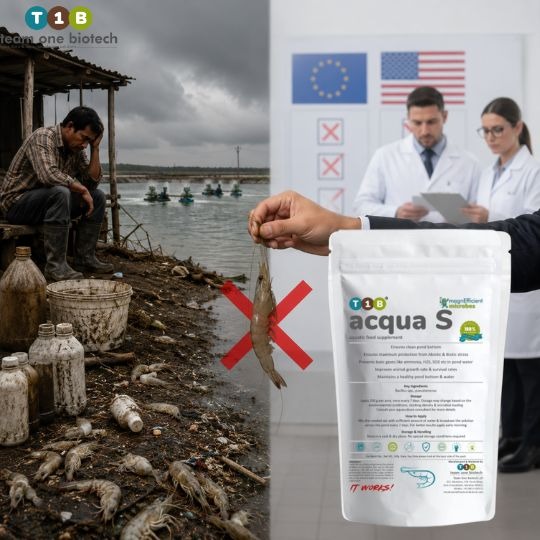
Indian aquaculture’s traditional operating model evolved around reactive disease management, watch for signs of stress or mortality, then treat. That model made sense when testing technology lagged behind farm practice. It does not survive contact with current detection capability.
In farming clusters across Andhra Pradesh, Odisha, West Bengal, and Gujarat, several structural vulnerabilities keep resurfacing:
- Fragmented seed sourcing, where post-larvae move through multiple unregulated hatcheries and aggregators before reaching a farm, making it nearly impossible to trace a single point of antibiotic exposure.
- Shared water inlets and canal systems across clustered ponds, which means a single upstream farm’s chemical use can drift into a dozen “clean” downstream operations.
- Informal feed and input suppliers, where formulations aren’t always fully disclosed, and antibiotic-laced growth promoters can enter a farm’s system without the farm manager’s direct knowledge.
- Treat-first instincts under disease pressure, where the financial panic of a Vibrio outbreak or early mortality event pushes operators toward whatever was used successfully “last time,” regardless of withdrawal periods or residue persistence.
None of this reflects bad faith. It reflects an industry built for a different regulatory era, now operating inside one that has fundamentally changed its tolerance for ambiguity.
The Bioremediation Blueprint: Actionable Steps to Go Antibiotic-Free
Moving away from prophylactic antibiotic use isn’t about removing a tool and hoping disease pressure stays manageable. It’s about replacing reactive chemical control with a proactive biological system that prevents the conditions pathogens need to take hold in the first place.
Phase 1: Soil and Source Water Remediation Before Stocking
The work begins before a single post-larva enters the pond. Pond bottoms accumulate organic sludge, ammonical nitrogen, and sulfide compounds across grow-out cycles, creating exactly the anaerobic micro-pockets where pathogenic bacteria thrive. Pre-stocking bioremediation using targeted microbial inoculants breaks down this organic load and resets the pond’s baseline microbial balance, typically over a 10 to 14 day conditioning window before stocking begins.
Note: These are general values and operational outcomes will vary based on the specific pond ecosystem, initial microbial load, stocking density, and the unique design parameters of localized Effluent Treatment Plants (ETPs) or waste management setups.
Phase 2: Competitive Exclusion of Pathogens in the Water Column
Once stocked, the strategy shifts to maintaining dominance of beneficial bacterial populations over pathogenic ones, primarily species of Vibrio that cause early mortality syndrome and related outbreaks. Beneficial strains compete directly for nutrients and attachment sites, effectively crowding out pathogens rather than chemically eliminating them. Operations that maintain consistent probiotic dosing schedules through the water column report improving survival rates by roughly 20% to 35% compared to reactive-treatment-only ponds.
Note: These are general values and operational outcomes will vary based on the specific pond ecosystem, initial microbial load, stocking density, and the unique design parameters of localized Effluent Treatment Plants (ETPs) or waste management setups.
Phase 3: Strengthening Immune Response Through Gut Microflora Optimization
The final layer addresses the shrimp itself. A healthy, diverse gut microbiome improves feed conversion and strengthens natural immune response, reducing the animal’s vulnerability to opportunistic infection even under stress conditions like temperature swings or density crowding. This is where the entire rationale for “just in case” antibiotic dosing starts to dissolve, a shrimp with strong baseline immunity simply doesn’t present the same disease pressure that drove prophylactic use in the first place.
Introducing T1B™ Acqua S: Engineering Residue-Free Harvests
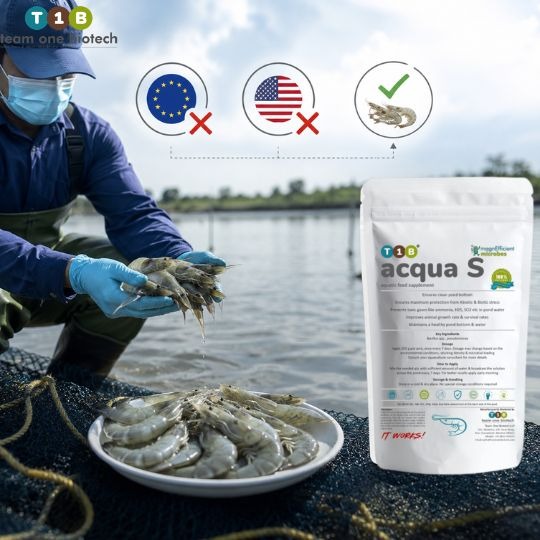
This is precisely the gap T1B™ Acqua S was engineered to close. Vannamei prawn farming thrives with T1B™ Acqua S, a high-performance probiotic formulation designed to enhance pond ecosystems naturally. This bio-accelerator, derived from natural vegetable sources through advanced fermentation technology, is rich in macro, micro, and secondary nutrients essential for aquatic life.
By promoting beneficial microbial growth, T1B™ Acqua S helps maintain water quality, reduces harmful compounds like ammonia and nitrites, and supports a balanced aquatic environment across all three phases above simultaneously. By maintaining a dominant, well-managed microbial population, it supports the natural competitive exclusion of pathogenic bacteria, including problem Vibrio strains, helping the pond ecosystem stay balanced from the floor up through the water column.
For an operator under pre-shipment testing pressure, this isn’t an incremental tweak. It’s a structural shift away from needing antibiotics in the rotation at all.
If your pond management is still reactive rather than preventive, the next disease cycle is not a matter of if, it’s when. The time to rebuild your biosecurity foundation is before your next stocking cycle begins, not after your next consignment gets flagged at a foreign port. Talk to Team One Biotech about a pond-specific Acqua S implementation plan before you stock again.
The Role of the EIC and MPEDA: Aligning Farm Audits With National Standards
India’s regulatory bodies aren’t adversaries in this process, they’re the structure that keeps Indian shrimp competitive in markets that could otherwise close entirely. The Export Inspection Council, through the National Residues Control Programme, sets the monitoring framework that EU authorities rely on to maintain India’s approved-exporter status at a country level. MPEDA guidelines complement this by setting farm-level traceability and registration standards intended to catch problems before they reach the processing plant, let alone the port.
Forward-looking operations are now treating these frameworks as a floor, not a ceiling, running internal audits that mirror NRCP sampling logic on their own ponds well ahead of any official testing cycle. This means:
- Maintaining verified hatchery sourcing records for every stocking batch
- Running internal residue screening at key growth intervals, not just pre-harvest
- Documenting every chemical and biological input applied to a pond, including from third-party suppliers
- Cross-training farm staff on withdrawal periods for any approved treatment that is used
Aligning internal practice with MPEDA and EIC expectations before an external audit ever happens is, in practical terms, the single highest-leverage compliance investment a mid-sized operation can make.
Antibiotic Reliance vs. Probiotic-Led Bioremediation: A Direct Comparison
| Factor | Antibiotic-Reliant Model | Probiotic-Led Bioremediation |
| Export compliance risk | High — vulnerable to residue detection at parts-per-billion levels | Low — eliminates the source compounds entirely |
| Cost trajectory | Lower upfront, but rises sharply with rejection/destruction risk | Moderate upfront investment, more predictable long-term |
| Pond ecosystem health | Degrades over repeated cycles; disrupts beneficial microbial balance | Improves cumulatively across cycles |
| Disease response style | Reactive — treat after outbreak begins | Preventive — maintains conditions hostile to pathogens |
| Buyer relationship stability | Vulnerable to sudden blacklisting after a single violation | Builds long-term trust through consistent clean test history |
| Regulatory audit readiness | Requires constant vigilance to avoid violation | Naturally aligned with NRCP/MPEDA documentation expectations |
| Long-term sustainability | Risk of resistant pathogen strains, declining pond productivity | Supports stable, reusable pond ecosystems season over season |
Turning Compliance Into Competitive Advantage
The exporters who treat residue compliance as a box-checking exercise will keep finding themselves on the wrong side of a rejection notice, because the global testing environment isn’t softening, it’s getting more precise, not less. But the exporters who treat it as an operational redesign opportunity are finding something unexpected: clean, traceable, antibiotic-free product is becoming a genuine market differentiator, not just a regulatory minimum. Buyers in the EU and US are increasingly willing to pay a premium for verified clean supply chains, precisely because so much of the market still can’t reliably offer one.
The choice facing every farm manager and processing quality head right now isn’t really about whether to comply. It’s about whether compliance becomes something done to your operation under pressure, or something built into it by design.
Secure Your Next Harvest Before You Need To
If your facility has faced a residue flag, an FDA import alert, or simply wants to get ahead of the next round of tightening EU inspection criteria, the conversation needs to start at the pond, not at the port. Team One Biotech works directly with export farm managers and processing plant quality heads across India’s coastal aquaculture clusters to run on-site biosecurity audits, map pond-specific bioremediation plans, and implement T1B™ Acqua S protocols built around your actual stocking density and water conditions, not generic recommendations.
Contact Team One Biotech today to schedule a biosecurity audit and build the kind of supply chain your next buyer won’t think twice about.
Looking to improve your ETP/STP efficiency with the right bioculture?
Talk to our experts at Team One Biotech for customised microbial solutions.
Contact: +91 8855050575
Email: sales@teamonebiotech.com
Visit: www.teamonebiotech.com
Discover More on YouTube – Watch our latest insights & innovations!-
Connect with Us on LinkedIn – Stay updated with expert content & trends!