
Why Your Restaurant’s Oil and Grease Trap Fails: A Biological Solution to FOG
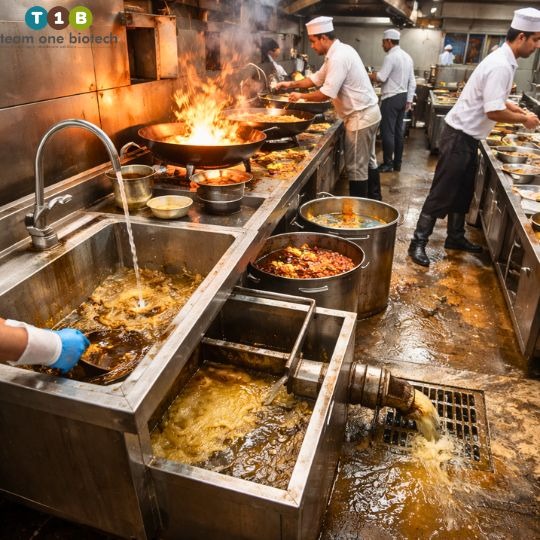
A Friday night, every table is full, the kitchen is in full swing, dal makhani bubbling on the burner, tawa rotis coming off hot, biryani portions flying out to service. Then someone shouts from the back. The floor drain by the dishwash station is gurgling. And before you can even react, greasy, foul-smelling water is spreading across your kitchen floor.
You’re standing there with exactly two options: call off service and eat the loss, or keep the kitchen running and hope a health inspector doesn’t walk through that door tonight. This isn’t a worst-case scenario cooked up to sell you something. It’s Tuesday for hundreds of hotel kitchens, restaurant chains, and canteen operations across India. It gets worse every monsoon. It peaks every Diwali banquet season. It follows the catering calendar like clockwork.
To prevent these costly disruptions, many operators rely on The Ultimate FOG Management & Septic Health Guide for Commercial Facilities to maintain their infrastructure. And almost every time, it traces back to the same two things, a grease trap that’s given up, and drain lines packed solid with FOG: Fats, Oils, and Grease.
What FOG Actually Does to Your Drainage Infrastructure

FOG doesn’t announce itself. It doesn’t cause a problem the first day, or the tenth. It accumulates quietly, service by service, shift by shift, until one day your drain simply stops draining.
Here’s what’s actually happening inside your pipes. Hot oil, ghee, coconut cream, meat fat, all of it flows down the drain as liquid. The moment it hits the cooler temperatures inside underground drain lines, it solidifies. It sticks to the pipe walls. The next batch sticks on top of that. Food particles, debris, and grime get trapped in the layers. Over weeks and months, the pipe’s internal diameter shrinks, and eventually water can’t move through at all.
Implementing a Microbial Solution for FOG Treatment can help break down these stubborn accumulations before they lead to total blockages.
Now factor in what Indian commercial kitchens are actually cooking. The FOG load here is considerably heavier than what most Western F&B operations deal with:
- Refined oils, mustard oil, and ghee used in large volumes across multiple cooking stations
- Coconut milk and cream gravies that are standard in South Indian and coastal menus
- Cream-heavy dishes like butter chicken and korma that generate emulsified fat in quantity
- Tandoor cleaning that pushes dripped fat directly into the drainage system
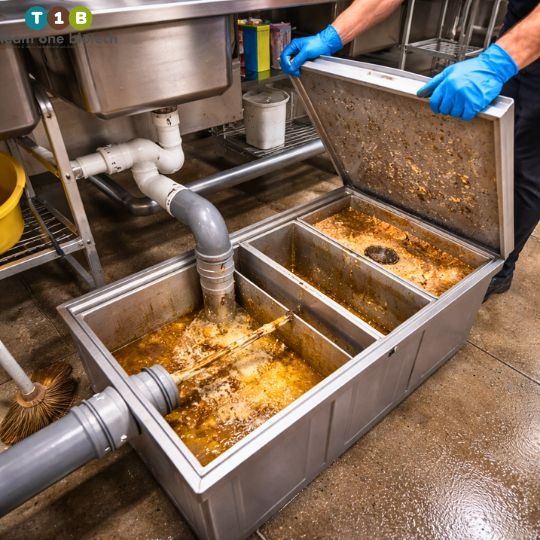
Your grease trap exists to catch this FOG before it reaches the main drain line. The problem isn’t that the trap can’t do the job, it’s that most operators are maintaining it in a way that makes failure almost inevitable.
Why Conventional Grease Trap Cleaning Falls Short
The Pump-and-Dump Problem
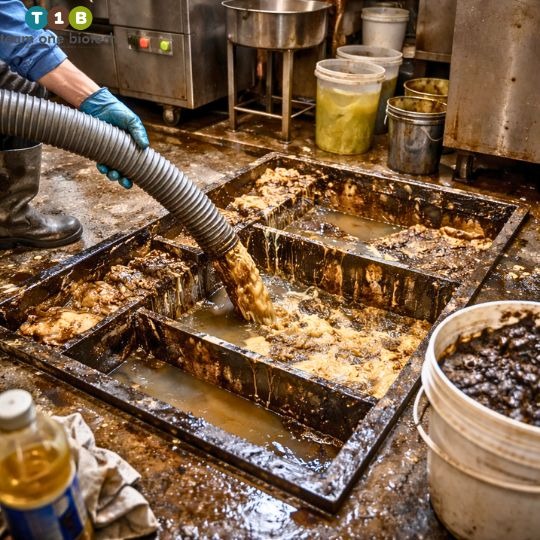
Ask most kitchen managers how they handle grease trap maintenance and you’ll get a version of the same answer: wait for a problem, call a tanker, pump it out, move on. It’s treated like a janitorial emergency rather than an engineered process that actually requires some thought.
The issue is what that tanker leaves behind.
Mechanical pumping removes the bulk of what’s sitting in the trap, but it doesn’t touch the thick biofilm of degraded FOG coating the internal walls, the inlet baffle, and the outlet pipe. That residual layer is what seeds the next buildup cycle. It’s also what produces hydrogen sulphide gas, the rotten egg smell that has a way of drifting out of the kitchen and into your dining room or hotel lobby at the worst possible moment.
Infrequent Servicing Schedules
Most operators time their grease trap cleanouts around budget cycles or visible failures, not around what the trap is actually accumulating. In a high-volume hotel kitchen or a restaurant running multiple stations, a trap that genuinely needs attention every two to three weeks is routinely left for six to eight. By that point, it’s not intercepting much of anything. FOG is passing straight through into the main drain line, and the problem you’re managing has quietly tripled in scale.
The Monsoon Amplifier
There’s a seasonal dimension to this that operators in cooler climates simply don’t have to think about. During the Indian monsoon, ground-level drains are absorbing heavy stormwater, which significantly raises the hydraulic pressure in underground drain lines. That pressure surge physically pushes accumulated FOG blockages further into the system. Hotels with large banquet kitchens and restaurants in low-lying areas can see simultaneous drain failures at multiple points across the property, all triggered by a single rain event on top of months of accumulated buildup.
The Biological Evolution: Biobloc and FOG Powder
Microbial degreasing introduces non-pathogenic bacteria and enzymes—specifically lipase—to eat the grease. Unlike caustic chemicals that provide a temporary (and corrosive) fix, biological solutions establish a living colony that works 24/7.
To manage a high-volume Indian kitchen effectively, a dual-pronged biological approach is required:
Biobloc: The Constant Guardian for Grease Traps
For grease traps, wet wells, and lift stations, the Biobloc is the primary line of defense.
- What it is: A slow-release block composed of highly concentrated bacteria and enzymes.
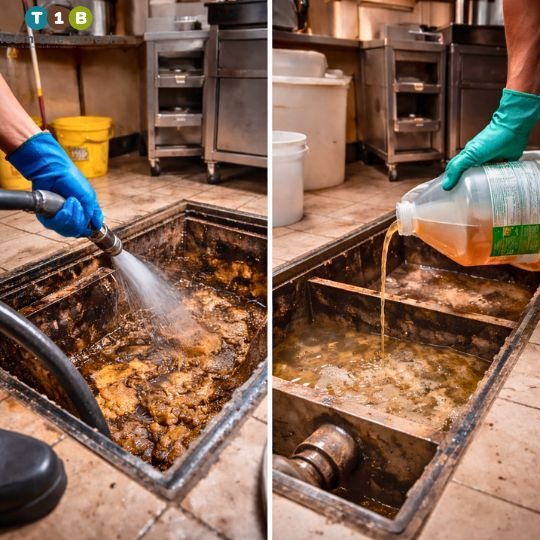
- How it works: Placed directly inside the grease trap, it dissolves slowly over time, releasing a steady stream of microorganisms into the wastewater.
- The Benefit: It ensures consistent treatment without manual dosing. It breaks down the heavy FOG “cap” in the trap, reducing the frequency of expensive tanker pump-outs and keeping odors under control.
FOG Powder: The Deep-Clean for Drain Lines
While the Biobloc guards the trap, FOG Powder is designed to keep the “arteries” of your kitchen clear.
- What it is: A concentrated powder formulation designed for manual dosing into floor drains and sinks.
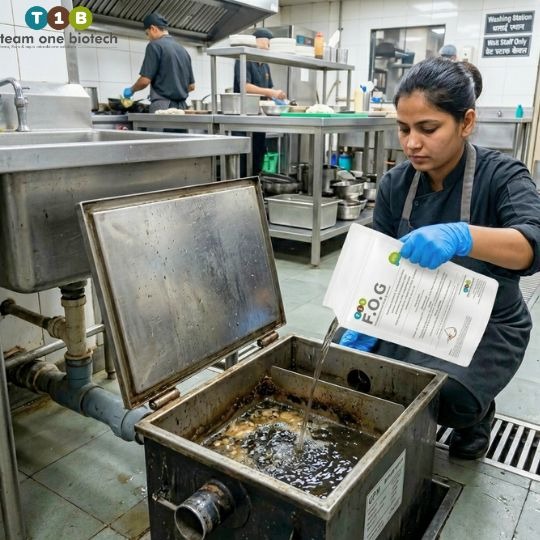
- How it works: When flushed into the drains at the end of a shift, the powder colonizes the pipe walls, eating away at the solidified grease and food particles that cause backups.
- The Benefit: It prevents the slow drains and unsanitary overflows that lead to kitchen shutdowns. Regular use of FOG powder ensures that the pipes leading to the trap remain as clear as the trap itself.
The Biological Alternative: Microbial Degreasing
How It Works
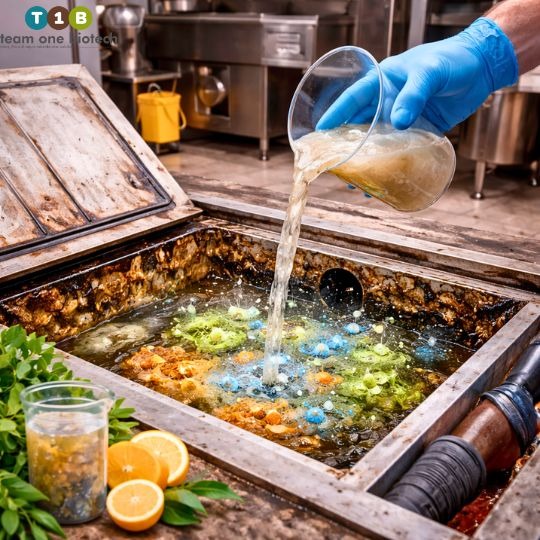
Microbial degreasing means introducing carefully selected, non-pathogenic bacteria and enzyme consortia directly into your drain lines, grease traps, and connected drainage infrastructure. These aren’t generic microbes, they’re specifically chosen for their ability to produce lipase enzymes in large quantities. Lipase is the same class of enzyme your own digestive system uses to break down fat. Applied industrially, it’s remarkably effective.
Once these bacterial cultures get into a FOG-heavy environment, here’s what they do:
- They secrete lipase enzymes that break the ester bonds in fat molecules, converting solid grease into water-soluble fatty acids and glycerol that can actually be flushed away
- They consume the resulting organic compounds as their carbon and energy source, the grease is literally their food
- They colonise the biofilm layer on pipe walls and progressively degrade accumulated FOG from the inside out
- They compete with and displace the anaerobic bacteria responsible for hydrogen sulphide production, which means the smell reduces as a natural consequence
The key difference from chemical degreasers is that biological treatment isn’t a one-time fix. A caustic chemical might dissolve a blockage on the day, but it also destroys the microbial environment in the drain and leaves the pipe wide open for rapid FOG re-accumulation. A biological treatment establishes a living, self-sustaining microbial population that keeps breaking down incoming FOG as part of its ongoing metabolic cycle. The protection is continuous, not episodic.
Application in the Indian Commercial Kitchen Context
Bioremediation products for drain line maintenance are delivered in two main ways, depending on your setup:
Dosing Units are automated dispensers fitted at the drain line or grease trap inlet. They release a measured volume of bacterial suspension during low-traffic hours, typically overnight, so biological activity happens consistently without needing anyone to do anything. For high-volume properties, this is the most reliable option.
Manual Dosing uses concentrated bacterial powder or liquid formulations that kitchen staff add to floor drains or directly into the grease trap at the end of each service. This is perfectly workable for smaller standalone restaurants where a daily end-of-shift routine is feasible and staff are properly trained.
For a mid-scale hotel kitchen running two or three meal services a day, consistent biological dosing typically shows measurable results, reduced grease trap solids accumulation, noticeably lower drain odour, within three to six weeks. Once the microbial population is properly established, the interval between mechanical pump-outs can extend considerably. That said, biological treatment doesn’t replace periodic physical inspection and servicing. It makes those intervals longer and those visits less dramatic.
FOG Management and Your Regulatory Exposure
FSSAI Compliance and Kitchen Sanitation
FSSAI is clear on this: food business operators are required to maintain drainage and sanitation infrastructure in a state that prevents waste accumulation, contamination risk, and pest attraction. A grease trap that’s chronically failing, or a drain line that backs up into food preparation areas, is a direct compliance violation. Depending on how an inspector finds it, you’re looking at licence suspension or cancellation.
It’s worth saying plainly: FSSAI compliance isn’t just about your cold storage temperatures or your prep surface hygiene. Waste management infrastructure, including your drainage, is squarely within scope. A kitchen that smells like a backed-up drain during an inspection is going to have a bad time regardless of how clean everything else looks.
State Pollution Control Board Norms and ETP Obligations
For hotels and larger restaurants that discharge to municipal sewers or operate their own Effluent Treatment Plants, there’s a second layer of regulatory exposure. State Pollution Control Boards, working under the Water (Prevention and Control of Pollution) Act, set discharge limits for BOD, COD, and total suspended solids in final treated effluent.
When a kitchen is pushing high-FOG wastewater downstream without proper pre-treatment, it dramatically elevates the organic load hitting your ETP. That makes the plant harder to run, drives up your chemical dosing costs, and puts your discharge compliance at risk.
Addressing FOG at the grease trap and drain line stage, before it reaches the ETP, directly reduces that organic load. It makes the plant more efficient and keeps your numbers in range without having to compensate downstream for what wasn’t handled upstream.
Building a FOG Management Protocol That Actually Works
The Three-Layer Approach
There’s no single fix for FOG management in a working Indian commercial kitchen. What works is a three-layer approach running concurrently.
Layer 1, Source Control is the simplest and most overlooked. Train your kitchen staff on not pouring oil down the drain. Build dry wiping of pans and cooking vessels into the standard wash-up process before anything goes near the sink. Set up a segregation system for used frying oil so it goes to authorised disposal or repurposing rather than disappearing down a drain.
Layer 2, Mechanical Interception means having a correctly sized grease trap installed in the right position in your drainage system, and then actually servicing it on a schedule tied to real FOG accumulation rates, not to whatever quarter the budget falls in. Every service visit should include inspection of inlet and outlet baffles, not just pumping and leaving.
Layer 3, Biological Maintenance is where consistent microbial dosing fits in. Use a product formulated for the FOG profile of Indian commercial kitchens specifically, the oil types and cooking volumes here differ enough from global averages that generic products often underperform. If you have an on-site septic tank treatment system, dose that too. Run a monthly review of odour levels, trap accumulation rate, and drain flow, these three indicators tell you whether the programme is working before something fails.
What to Look for in a Bioremediation Partner
Not all microbial products are equal, and not all suppliers know Indian kitchen conditions. When you’re evaluating options, look for:
- Documentation of bacterial strains and a viability guarantee, the product must contain live, active cultures at the point of use, not dead material that sat in a warehouse
- Confirmed compatibility with your existing ETP and STP chemistry, certain bacterial consortia underperform in high-chlorine or high-disinfectant drain environments
- Site-specific dosing recommendations rather than a generic dosing chart that assumes conditions nothing like yours
- A demonstrated track record with Indian F&B and hospitality clients, where the grease profile, cooking volumes, and infrastructure realities are genuinely different
The Long-Term Cost Case
A single emergency drain clearance in a mid-scale restaurant or hotel kitchen, tanker hire, plumber callout, and whatever service revenue you lost during the shutdown, routinely lands somewhere in the five figures. Run that scenario three or four times in a year and you’ve comfortably spent more than a structured biological maintenance programme would have cost over the same period.
The financial math is fairly straightforward. The reputational math is harder to quantify but more expensive to ignore. One social media post about a sewage smell in your dining room. One hygiene review mentioning a kitchen closure. One regulatory action that ends up in a public record. These don’t recover cleanly, and no maintenance budget can undo them after the fact.
Biological FOG management isn’t a premium service for large hotel chains with dedicated facilities teams. It’s a baseline operational control that any food service business running a serious kitchen in India should have built into its maintenance framework.
Final Assessment
Your oil and grease trap isn’t failing because you bought the wrong equipment. It’s failing because reactive, pump-only maintenance can’t keep up with what a working Indian commercial kitchen generates across every single service.
Switching from pump-and-dump to biological drain line maintenance isn’t a complicated transition. It takes consistency, the right dosing protocol, and a microbial product matched to your specific kitchen’s profile. What you get in return, fewer shutdowns, lower compliance risk, a more manageable ETP, and a kitchen that doesn’t carry the smell of last week’s service into this week, is concrete and measurable.
Team One Biotech provides scientifically validated bioremediation solutions designed specifically for the Indian hospitality and food service sector. Reach out to discuss a FOG management protocol built around your property.
Looking to improve your ETP/STP efficiency with the right bioculture?
Talk to our experts at Team One Biotech for customised microbial solutions.
Contact: +91 8855050575
Email: sales@teamonebiotech.com
Visit: www.teamonebiotech.com
Discover More on YouTube – Watch our latest insights & innovations!-
Connect with Us on LinkedIn – Stay updated with expert content & trends!