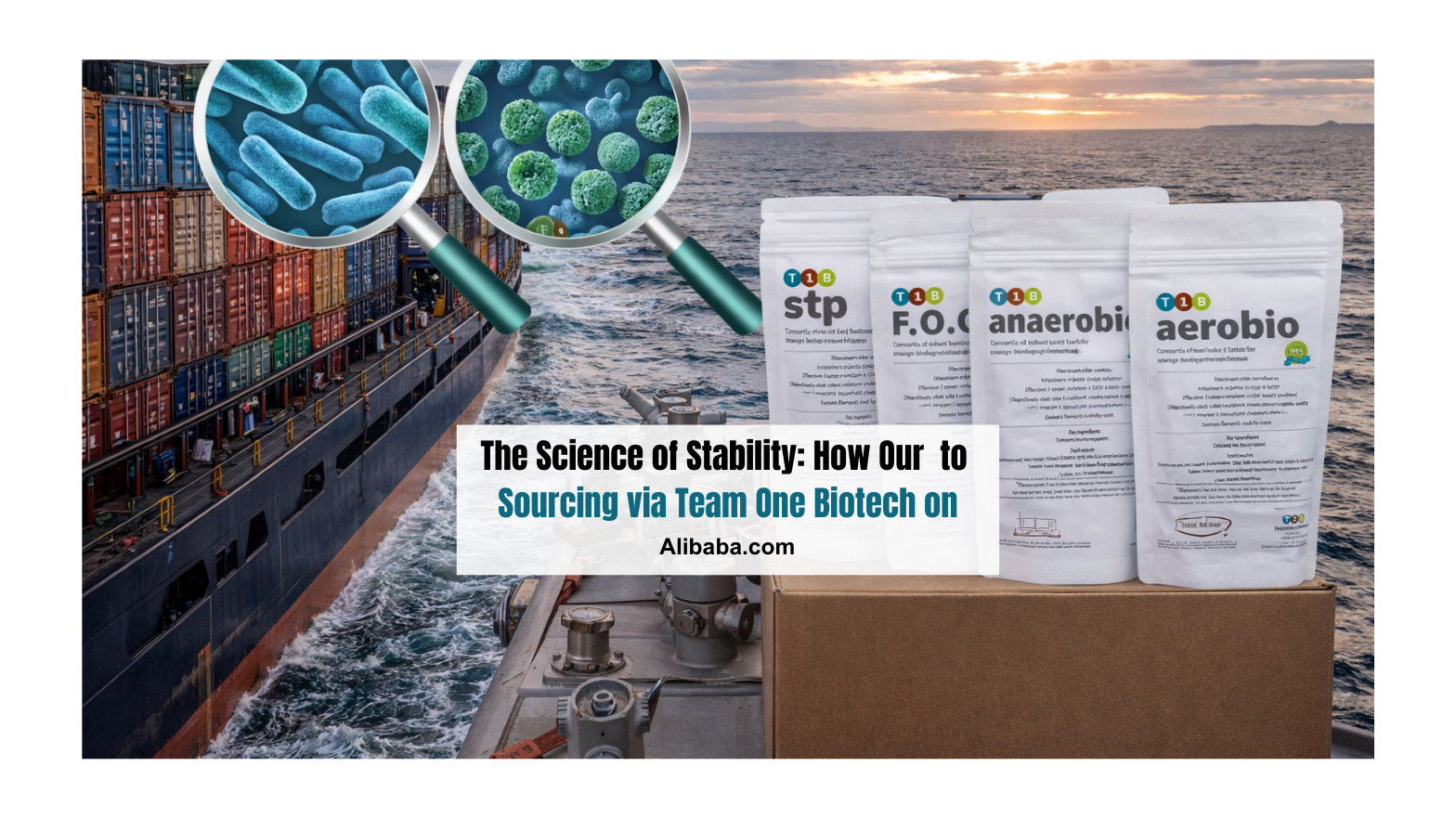
The Science of Stability: How Our Microbes Survive 60-Day Sea Transit to Global Ports
In the high-stakes world of international biotechnology, the journey from the laboratory to the field is often more perilous than the biological challenges the products are designed to solve. When a shipping container leaves a port, it isn’t just carrying cargo; it is carrying a promise of soil regeneration, water purification, or industrial remediation.
For distributors, NGOs, and mining firms, the difference between a viable microbial shipment and a “dead” one is measured in millions of dollars of lost opportunity and broken trust. At Team One Biotech (T1B), we have spent over 27 years perfecting the science of stability. We ensure that our microbial solutions, Terro, Flaro, and Aqua, arrive at global ports with 100% efficacy, even after enduring 60-day maritime transits through the planet’s harshest environments.
The High Stakes of Biological Logistics
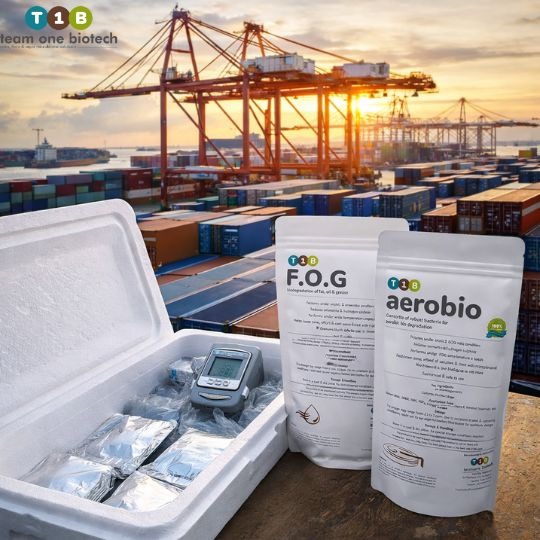
Biological logistics is a field where “good enough” is a recipe for catastrophe. Unlike inert chemicals or mechanical parts, microbes are living entities. In international trade, they are frequently subjected to “The Gauntlet”, a grueling logistics chain that tests the limits of biological endurance.
When a shipment is destined for an NGO in Sub-Saharan Africa or a mining operation in the high Andes of South America, it must first survive weeks in a steel container under a relentless equatorial sun. If those microbes lose viability en route, the consequences are cascading:
- Agricultural projects stall, leading to food insecurity.
- Wastewater treatment plants fail to meet compliance, resulting in heavy fines.
- Aquaculture harvests are wiped out by ammonia spikes that could have been prevented.
For Team One Biotech, microbial stability is not just a technical specification; it is the foundation of global trust. Backed by ISO, GMP, and SGS certifications, and proven across 55+ countries, we deliver more than just bacteria; we deliver reliability.
The Problem: Heat, Humidity, and the 60-Day Horizon
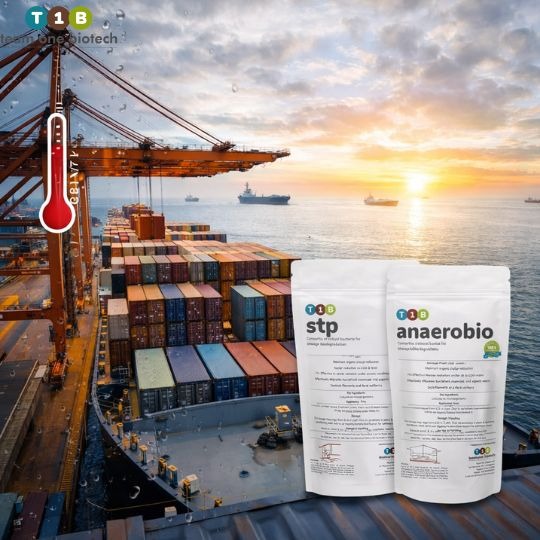
Shipping live microbial products across oceans presents three primary environmental antagonists:
1. Extreme Thermal Stress
Containers on the deck of a cargo ship can reach internal temperatures exceeding 60°C (140°F) when crossing equatorial waters. For standard vegetative bacteria, these temperatures cause rapid protein denaturation and cell death.
2. Humidity and Atmospheric Fluctuations
Microbial products are often hygroscopic. Moisture ingress during transit can trigger premature metabolic activation. If a microbe “wakes up” inside its packaging because of high humidity, it will quickly exhaust its nutrient reserves and die long before it reaches the customer.
3. The Time Factor
Global supply chains are currently stretched. A 30-day transit can easily turn into a 60-day ordeal due to port congestion and transshipment delays. A product must not only survive the journey but arrive with a “full tank” of biological energy ready for immediate deployment.
The Science: Dormant Spore Technology and Stabilization
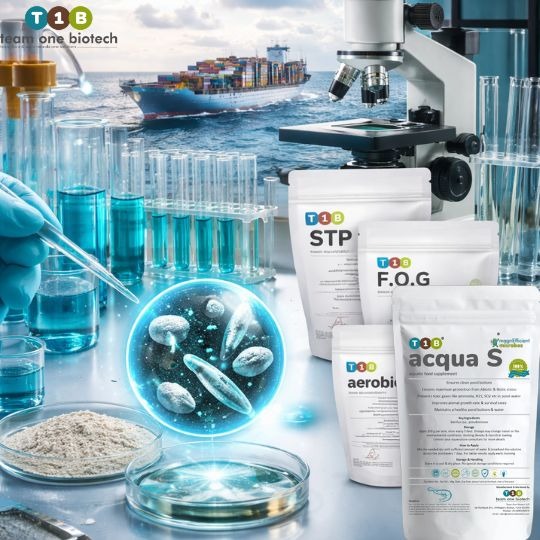
How does Team One Biotech ensure survival under such hostile conditions? We look to nature’s own survival vault: Dormant Spore Technology.
While many competitors use vegetative cells, which are active, fragile, and short-lived, our formulations center on specialized spore-forming strains. A spore is a highly resilient, non-reproductive structure. Think of it as a biological “escape pod.”
Our Proprietary Stabilization Pillars:
- Advanced Spore Selection: We select specific Bacillus and other robust strains characterized by thick peptidoglycan layers and specialized coat proteins that shield DNA from heat and UV radiation.
- Cryo-Stabilization Matrices: Our microbes are embedded in a proprietary matrix that acts as a physical buffer. This matrix locks the spores in a protective “glassy” state, preventing any mechanical damage during the vibrations of sea travel.
- Moisture-Controlled Encapsulation: We use advanced encapsulation techniques that prevent water molecules from reaching the spore. This ensures the microbes stay in deep dormancy until they are intentionally diluted in water by the end-user.
- Industrial-Grade Desiccation: By reducing water activity ($a_w$) to near-zero levels through controlled industrial drying, we bring metabolic activity to a complete standstill.
- Technical Insight: By keeping the microbes in a state of suspended animation, we ensure that the biological “shelf life” remains intact regardless of whether the ship is docked in Singapore or sailing past the Cape of Good Hope.
The Logistics: Precision Packaging and Quality Assurance
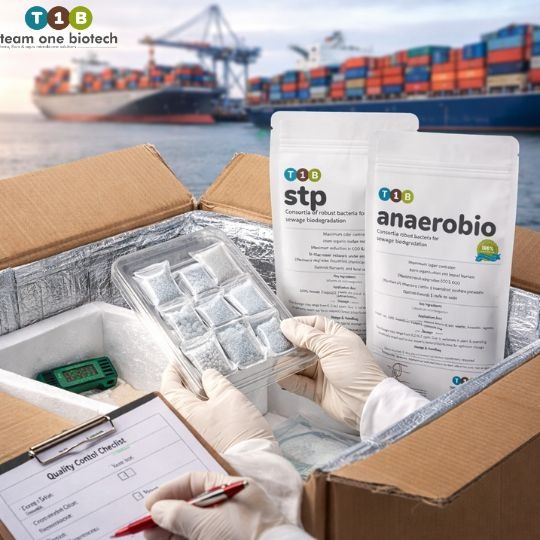
Science in the lab is only half the battle; the other half is fought in the warehouse and the loading dock. Team One Biotech integrates precision engineering into our secondary and tertiary packaging.
Transit Validation Protocols
We don’t guess if our products will survive; we know they will. Our in-house transit simulation chambers replicate the exact heat and humidity profiles of a 60-day maritime journey. Every batch must pass these “stress tests” before it is cleared for export.
- Triple-Layer Barrier Packaging: We utilize high-spec foil laminates with superior Oxygen Transmission Rates (OTR) and Water Vapor Transmission Rates (WVTR) to create a micro-environment that is immune to outside weather.
- Thermal-Resistant Boxing: Our bulk shipments are packed to minimize thermal conductivity, slowing the rate of internal temperature changes.
- ISO/GMP QC Checkpoints: Every single batch undergoes a final viability count (CFU/g) post-packaging to ensure the customer receives exactly what is promised on the COA (Certificate of Analysis).
Sector Deep-Dives: Stability in Action
The resilience of our microbes translates directly into economic value across three primary sectors:
1. Aquaculture: Aqua Microbiome Solutions
In the intensive shrimp and fish farms of South America and Southeast Asia, water chemistry can change in hours. Farmers cannot afford to wait for a “weak” microbial product to slowly replicate.
- The Benefit: Our Aqua microbes activate instantly. They immediately begin reducing ammonia ($NH_3$) and nitrites ($NO_2^-$), supporting disease resistance and improving Feed Conversion Ratios (FCR).
- The Result: Consistent water quality even when the product has been stored in tropical warehouses for months.
2. Wastewater Treatment: Flaro Microbiome Solutions
Mining firms and heavy industries operate in remote locations where logistics are a nightmare. They rely on Flaro for industrial wastewater probiotics.
- The Benefit: Flaro strains are engineered for rapid biofilm formation. Even after a long transit, they retain the enzymatic “machinery” needed to degrade complex hydrocarbons and sequester heavy metals.
- The Result: Total compliance with environmental discharge standards and avoided downtime for treatment plants.
3. Agriculture: Terro Microbiome Solutions
NGOs and agricultural distributors in Africa deal with some of the most challenging last-mile logistics on earth. Terro microbes are the backbone of sustainable soil health.
- The Benefit: Terro survives the “last mile” in non-refrigerated trucks. Once applied, they enhance nitrogen fixation and drought resilience.
- The Result: Increased crop yields and a reduced dependency on expensive, volatile chemical fertilizers.
The Partnership: In-House Expertise and Global Reach
Choosing a microbial partner is a long-term strategic decision. Team One Biotech distinguishes itself through a vertically integrated model that emphasizes Human-to-Human (H2H) trust.
- In-House Manufacturing: We do not outsource our fermentation. By owning the entire production process, we maintain 100% control over the quality and stability of the strains.
- Government-Level Experience: We have successfully executed national-scale bioremediation and agricultural programs, proving our ability to handle complex regulatory and logistical frameworks.
- Global Export Expertise: We navigate the labyrinth of international shipping regulations, ensuring that all phytosanitary and customs documentation is perfect, preventing delays that could further test product stability.
Why Buyers Choose T1B:
| Feature | Benefit |
| 27+ Years Experience | Deep institutional knowledge of microbial behavior. |
| SGS Certified | Independent verification of quality and potency. |
| Bulk White Labeling | High-margin opportunities for distributors and NGOs. |
| 55+ Countries | A proven track record on every inhabited continent. |
The Global Export Hub: T1B on Alibaba
To streamline the procurement process for international buyers, we have established the Team One Biotech Official Alibaba Store. This serves as our digital Global Export & Private Label Hub.
Through this platform, procurement officers can:
- Access Full Documentation: Download technical data sheets and certifications instantly.
- Request Custom Formulations: Discuss specific microbial concentrations for unique environmental challenges.
- Secure Transparent Pricing: Get direct-to-manufacturer rates for bulk orders and white-labeling.
- Coordinate Logistics: Leverage our experience in shipping to Africa, South America, and beyond.
Stability as the Foundation of Trust
In the biotech industry, the laboratory results are only as good as the product’s survival during transit. Team One Biotech has bridged the gap between advanced microbiology and global logistics. By mastering dormant spore technology and barrier packaging, we have turned the 60-day sea transit from a risk into a routine.
For the distributor in Lagos, the mine manager in Chile, and the shrimp farmer in Ecuador, T1B represents a guarantee: that the science we put into the container is the same science that comes out, active, potent, and ready to work.
Are you ready to secure your biological supply chain?
Visit the T1B Official Alibaba Store to explore our product lines or Request a Technical Stability Report to see our 60-day transit validation data firsthand.
Looking to improve your ETP/STP efficiency with the right bioculture?
Talk to our experts at Team One Biotech for customised microbial solutions.
Contact: +91 8855050575
Email: sales@teamonebiotech.com
Visit: www.teamonebiotech.com
Discover More on YouTube – Watch our latest insights & innovations!-
Connect with Us on LinkedIn – Stay updated with expert content & trends!