

Biofertilizers for Rice Cultivation: How Nitrogen-Fixing Bacteria Reduce Urea Costs
Ask any paddy farmer in Punjab or Andhra Pradesh what keeps them up at night, and the answer rarely changes: input costs that climb every season while farm-gate prices refuse to keep pace. The price of a 45 kg bag of urea has risen consistently over the past decade, and farmers, particularly those growing premium Basmati or high-value non-Basmati varieties, are quietly absorbing losses that never appear on any government report.
The cruel irony of urea dependency is this: the more you apply, the less it seems to work. Farmers who once got a visible response from a single top-dressing now find themselves applying two or three rounds just to maintain the same tiller count or canopy colour. Soils that were once dark, crumbly, and alive with microbial activity have gradually turned hard, pale, and exhausted.
Yet the compulsion to keep applying chemical nitrogen continues because the biological alternatives were never explained clearly enough, or trusted enough, to replace it.
This is precisely the gap that biofertilizer for rice is built to close, not as a replacement for all agronomic inputs overnight, but as an intelligent, science-backed system that allows progressive farmers to partially restore soil biology, reduce their chemical fertilizer burden, and protect their margins in a way that compounds over seasons.
The Hidden Damage of Urea Over-Application
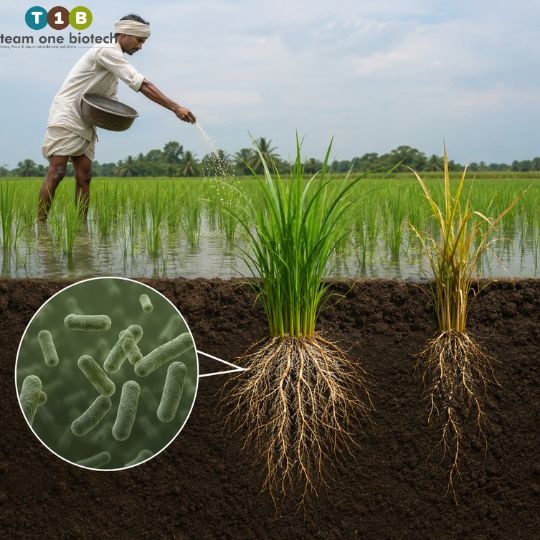
Urea is not inherently a villain. Applied correctly, in balanced ratios alongside phosphorus and potassium, it does what it is supposed to do. The problem lies in how it is actually used across major rice-growing belts in India.
Data from multiple state agricultural departments consistently shows that the NPK application ratio in high-intensity paddy states like Punjab, Haryana, and Uttar Pradesh is severely skewed in favour of nitrogen. Instead of the ideal 4:2:1 NPK ratio recommended for rice, many fields receive ratios closer to 10:2:1 or worse. This nitrogen overload creates a cascade of problems:
- Soil acidification that suppresses beneficial microbial populations
- Soil compaction from the breakdown of organic matter structure under chemical loading
- Phosphorus and zinc lockup, where these nutrients are chemically bound and unavailable to the plant even when present in the soil
- Nitrate leaching into groundwater, with environmental consequences that are increasingly difficult to ignore
- Yield plateau or stagnation, where incremental increases in urea application no longer produce incremental increases in yield
In West Bengal and Andhra Pradesh’s deltaic rice zones, the problem takes a different form, waterlogged soils with already-fragile microbial counts are further depleted by chemical overloading, making each successive crop more expensive to protect. Farmers are effectively running faster just to stay in place.
How Biofertilizers for Rice Work Under the Surface
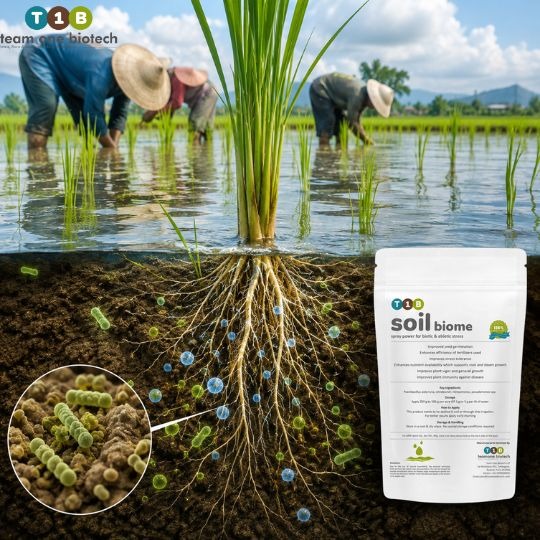
The concept behind a quality liquid biofertilizer for paddy is straightforward, even if the biology operating beneath the soil is quietly complex.
Certain strains of bacteria, particularly Azospirillum and phosphate-solubilizing organisms like Phosphobacter, have developed a remarkable ability to perform critical nutrient cycling functions that chemical fertilizers simply cannot replicate.
Nitrogen Fixation: The Underground Factory
Azospirillum for rice is perhaps the most practically important bacterial group in this conversation. These free-living, associative nitrogen-fixing bacteria colonize the root zone of the rice plant and fix atmospheric nitrogen, which is abundantly available in the air above every field, converting it into ammoniacal nitrogen that is directly absorbable by the plant root system.
The atmosphere above one acre of land contains millions of kilograms of nitrogen in its inert gaseous form. Azospirillum strains essentially unlock this resource, acting as a continuous, low-cost nitrogen delivery mechanism operating from within the soil itself.
Phosphate Solubilization: Unlocking Trapped Wealth
Most Indian soils, particularly those under long-term intensive cultivation, are not actually deficient in phosphorus. They are deficient in available phosphorus. Years of chemical application have left vast reserves of fixed, insoluble phosphorus compounds in the soil, nutrients that are chemically present but biologically locked away.
Phosphobacter strains produce organic acids that dissolve these fixed compounds, releasing phosphorus into plant-available forms. Farmers who begin using these bio-inputs often notice that their phosphatic fertilizer requirement decreases gradually over two to three seasons, even as plant phosphorus nutrition improves.
Together, these microbial groups function as a 24/7 underground nutrient management system, reducing the farmer’s dependence on purchased chemical inputs while actively improving soil health over time.
The Economics of Shifting to Bio-Inputs

This is where abstract biology becomes compelling financial reality for the paddy farmer.
A typical progressive farmer growing premium Basmati in Haryana or Pusa 44 in Uttar Pradesh currently spends a significant share of their input budget on chemical nitrogen fertilizers across the kharif cycle. Integrating a quality biofertilizer programme does not eliminate this expense overnight. What it does is allow a structured, partial replacement of chemical urea that becomes more effective as soil biology recovers over seasons.
In practical terms, farmers integrating biofertilizers alongside a reduced chemical fertilizer programme have reported:
- A reduction in urea consumption of roughly 20% to 35% per acre in the first full season of adoption
- Consequent input cost savings in the range of ₹1,500 to ₹3,500 per acre per crop cycle, depending on the baseline chemical programme and current urea pricing
- Improved soil moisture retention and root architecture, which supports yield stability especially during dry spells between irrigation cycles
- Gradual improvement in soil organic carbon, which begins to show yield dividends from the second or third season onward
Note: These are general values and actual field outcomes will vary based on specific soil profiles, regional climatic conditions, water management practices, and individual field parameters.
If you are a progressive paddy farmer and want to understand exactly how much your farm can save based on your specific input programme, Team One Biotech offers customized soil health consultations. Reach out to our agronomic support team to schedule an on-field assessment before your next kharif season begins.
A Clear Breakdown for Agri-Dealers and Distributors
The shift toward biologicals is not a passing trend in Indian agriculture, it is a structural, policy-driven, and agronomically validated transition that is already reshaping the input market across progressive farming districts.
For regional dealers and distributors, stocking a credible range of biofertilizers represents a significant revenue opportunity for several reasons:
- Growing farmer demand: Progressive farmers, particularly those selling into export or premium domestic markets, are actively seeking alternatives to reduce chemical dependency and improve produce quality metrics
- Government push: State and central schemes promoting bio-inputs, including subsidized distribution in several states, are creating policy tailwinds that support adoption
- Repeat purchase cycles: Unlike one-time machinery investments, biofertilizers generate season-on-season purchase behaviour, building a reliable recurring revenue stream
- Differentiation from commodity dealers: Dealers who can explain the agronomic rationale behind biologicals, and back it up with field data from their own geography, build the kind of farmer trust that is nearly impossible for online-only competitors to replicate
Agri-dealers and distributors: Team One Biotech is currently onboarding regional distribution partners ahead of the upcoming kharif season. Contact our commercial team to discuss bulk stocking arrangements, product demonstrations, and farmer training support for your territory.
Chemical vs. Bio-Input Management: A Practical Comparison
| Parameter | Chemical Urea (Conventional) | Biofertilizer Programme (Integrated) |
| Application Method | Top-dressing or basal broadcasting | Seed treatment, root dipping, or soil application |
| Nutrient Availability | Immediate but short-lived pulse | Gradual, sustained release over crop cycle |
| Soil Microbial Impact | Suppresses native microbial populations over time | Restores and amplifies soil microbial diversity |
| Environmental Runoff Risk | High, nitrate leaching into waterways | Low, fixes atmospheric nitrogen in situ |
| Cost Per Acre (Seasonal) | Higher baseline, increases with soil degradation | Lower over time as soil health improves |
| Long-Term Yield Trend | Plateau or decline without dose escalation | Stable to improving as soil biology recovers |
| Residual Soil Benefit | Minimal, next crop starts at same baseline | Positive carry-over into subsequent seasons |
Best Practices for Indian Paddy Fields
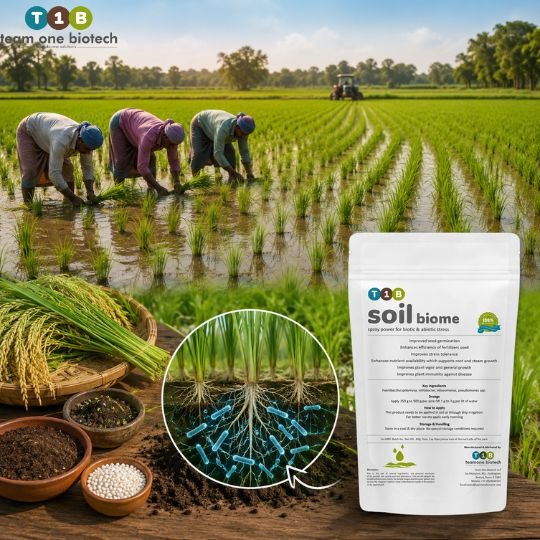
Integrating a biofertilizer programme into your paddy cultivation does not require complex changes to your existing field operations. The following practices are the most commonly adopted across Indian rice-growing conditions:
Seed Treatment (Pre-Sowing) Coat paddy seeds with a slurry of liquid biofertilizer containing Azospirillum strains before sowing. Allow the coating to dry in shade before sowing. This establishes the beneficial bacterial population at the earliest possible stage of plant development.
Seedling Root Dipping (For Transplanted Paddy) For farmers following the transplanting method, common across West Bengal, Andhra Pradesh, and parts of Uttar Pradesh, dipping seedling roots in a diluted biofertilizer solution for 20 to 30 minutes before transplanting ensures early root zone colonization. This is one of the most cost-effective application methods available.
Main Field Soil Application (For fields with severely depleted microbial counts), a direct soil drench application of liquid biofertilizer after primary tillage helps establish a viable microbial population in the rhizosphere before the crop establishes.
Integration with Reduced Chemical Programme Always integrate bio-inputs as part of a balanced reduction strategy, not a complete elimination of chemical fertilizers. The recommended approach is to reduce your chemical nitrogen application by roughly 20% to 25% in the first season while maintaining full phosphorus and potassium inputs. Monitor plant canopy colour and tiller development. Adjust in subsequent seasons based on observed crop response.
Note: These are general values and actual field outcomes will vary based on specific soil profiles, regional climatic conditions, water management practices, and individual field parameters.
Securing the Future of Indian Paddy Farming
The most resilient agricultural systems in the world are not built on any single input or technology. They are built on the intelligent integration of what science makes available with what farmers know from generations of cultivating the same land.
Indian paddy farming sits at an inflection point. The economics of urea-intensive cultivation are increasingly difficult to defend. The soil science behind nitrogen-fixing and phosphate-solubilizing bacteria is mature, well-documented, and practically deployable at the farm level today. The regulatory and market environment is actively supportive of the transition to sustainable paddy farming.
What remains is the bridge, between laboratory efficacy and field reality, between agronomic recommendation and farmer trust, between the promise of soil health improvement and the actual seasonal savings that show up in a farm’s input ledger.
Team One Biotech’s biofertilizer programme for rice is designed to be that bridge.
Take the Next Step With Team One Biotech
For progressive farmers: If you are cultivating premium Basmati, Pusa, or high-value non-Basmati varieties and want to reduce your urea dependency while protecting yield quality, connect with our agronomic team for a field-specific bio-input consultation. We will assess your soil baseline, current input programme, and recommend an integrated plan tailored to your land.
For agri-dealers and regional distributors: The kharif window for biologicals is short. Dealers who stock early, train their teams on the science, and support farmer adoption in their territory will lead this market in their district. Reach out to Team One Biotech’s commercial partnerships team today to discuss product range, pricing, margin structure, and farmer demonstration support.
Contact Team One Biotech to begin building a more profitable, more resilient paddy farming future, for your fields, for your customers, and for Indian agriculture.
Looking to improve your ETP/STP efficiency with the right bioculture?
Talk to our experts at Team One Biotech for customised microbial solutions.
Contact: +91 8855050575
Email: sales@teamonebiotech.com
Visit: www.teamonebiotech.com
Discover More on YouTube – Watch our latest insights & innovations!-
Connect with Us on LinkedIn – Stay updated with expert content & trends!