

Sulfide Removal in Petroleum Refinery Wastewater | Case Study
Introduction:
A reputed petroleum refinery approached us due to high concentration of sulfides in their effluents. They tried multiple solutions, including electroplating, RO, etc., but they were very cost-intensive. Also, they received multiple notices from the pollution control board and were paying heavy fines. In petroleum refineries, Effluent Treatment Plants (ETPs) are critical for managing complex wastewater containing sulfides, phenols, and hydrocarbons. Our advanced bioculture-based solutions ensure consistent COD and BOD reduction, even under fluctuating hydraulic and organic loads. Reach out to us today to experience how our bioculture-driven solutions can turn wastewater challenges into success stories.
ETP details:
The industry had primary treatment, biological treatment, and then a tertiary treatment.
Previous Capacity
| Flow (current) | 4500 KLD |
| Flow (design) | 4500 KLD |
| Type of process | Facultative |
| Capacity of UASB | 12500 KL |
| Capacity of AT | 7500 KL |
| Retention Time | 106.66 hours(combined) |
Challenges:
| Parameters (PPM) | Avg. Inlet parameters | Avg. Outlet parameters |
| COD | 5500-9010 | 2200-4600 |
| BOD | 2500-5800 | 1300-3000 |
| Ammoniacal Nitrogen | 200 | 120-150 |
| PAH | 1250 | 680 |
Operational Challenges :
- The primary treatment was working at 10 % efficiency in terms of COD reduction
- The biological treatment worked at an average of 50 % efficiency in terms of COD reduction.
They were struggling to control the higher AN levels, and it was inducing shock loads as explained earlier.
Issues with Process:
The main issue with the process was that there was no significant reduction in AN at the outlet despite having a UASB and an Aeration tank
The Approach:
The industry partnered with us to commission their UASB and Aeration tank with increased capacity and restart the plant at its full capacity in terms of hydraulic load.
We adopted a 3D approach that included :
- Research/Scrutiny :
- Our team visited their facility to go through the process of the new ETP and to scrutinize the value-addition factors.
- Analysis :
- We analyzed the 3-month cumulative data of their ETP to see trends in the inlet-outlet parameters’ variations and the permutation combinations related to it.
- Innovation :
- After the research and analysis our team curated customized products and their dosing schedules with formulation keeping in mind the plan of action to get the desired results.
This process is called bioaugmentation.
Desired Outcomes :
- Reduction in AN levels in the final outlet
- Development of strong biology to withstand shock loads and prevent upsets.
- Making ETP more efficient regarding COD/BOD and PAH degradation.
- Reduction in FOG.
Execution:
Our team selected the product :
For the Aeration Tank
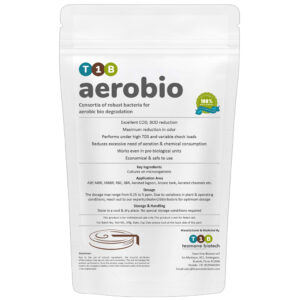
- T1B Aerobio: Our aerobic Bioculture blend consists of blends of several strains of Nitrifying and Denitrifying bacteria and facultative microorganisms, usually bacteria, along with key trace elements on a complex inert media.
For the UASB tank
- T1B Anaerobio: Our Anaerobic Bioculture blend consists anaerobic microbes that will effectively reduce AN as well as enhance COD/BOD control.

Our plan of action included:
- T1B Anaerobio was dosed in UASB for sulphate and COD reduction.
- The addition of T1B Aerobio was also done Aeration Tank after UASB every day
Results:
Parameters
| Parameters (PPM) | Avg. Inlet parameters | Avg. Outlet parameters (secondary clarifier outlet) |
| COD | 5500-9010 | 900-1300 |
| BOD | 2500-5800 | 350-750 |
| AN | 200 | 20-25 (After Aeration Tank) |
| PAH | 1250 | 220 |
The implementation of the bioaugmentation program resulted in significant improvements in the performance of biological units in their WWTP:

- The COD/BOD degrading efficiency increased from 50% to 83 % in the biological system.
- AN reduction was achieved up to 90 %
- PAH was also getting degraded up to 82.4 %.
- MLSS: MLVSS ratio was optimized.
- Biomass in the ASP system displayed great stability even during shock load situations.
- Methane gas production increased by 12%.
The application of Anaerobic Treatment through UASB reactors combined with Aeration tanks enabled effective Ammoniacal Nitrogen control and reduced PAH levels significantly. This approach minimized the risks of shock loads and enhanced the stability of biological systems.
With a focus on Industrial wastewater treatment, we targeted Sludge reduction and improved MLSS:MLVSS ratios to enhance operational efficiency. Our strategies also mitigated Odour issues and prevented the proliferation of filamentous bacteria, ensuring long-term system reliability.
By aligning with CPCB, PCB, and NGT compliance norms, the refinery avoided penalties while achieving sustainable wastewater management. The integration of bioaugmentation technology, nutrient balancing, and biogas recovery further optimized the performance of the effluent treatment process.
This case study demonstrates how refinery clients can achieve reliable wastewater treatment solutions while reducing OPEX, improving sulphide reduction, and ensuring a future-ready industrial effluent treatment system.
As one of the leading biotech companies in India, we provide a sustainable product range across multiple verticals, including probiotics for aquaculture, biofertilizers and plant growth promoters, eco-friendly cleaning solutions, animal probiotics, and on-site consultation for biocultures for ETP and STP.
Email: sales@teamonebiotech.com
Visit: www.teamonebiotech.com
Discover More on YouTube – Watch our latest insights & innovations!-
Connect with Us on LinkedIn – Stay updated with expert content & trends!
