

Aerobic vs. Anaerobic Treatment: Which Biological Process is Right for Your Industry?
The Sludge Crisis Nobody Wants to Talk About
There is a conversation happening in plant manager offices across Vapi, Ludhiana, and Ankleshwar. It does not happen in board meetings or annual reports. It happens quietly, between the ETP operator and the plant head, usually when another disposal invoice lands on the desk.
The ETP is running. The compliance reports are being submitted. And yet the sludge keeps building up, the costs keep climbing, and nobody quite knows how to make it stop.
If that sounds familiar, you are not alone. Across pharma, textile, food and beverage, and chemical manufacturing units in India, wastewater treatment has quietly become one of the most expensive operational headaches that nobody budgeted for properly. CPCB and SPCB regulations are not getting looser. Disposal fees are not coming down. And the biological systems that were installed years ago, often by contractors who designed for compliance on paper, were never really built to perform under the pressure your plant is under today.
Many facilities are now looking toward Advanced Bioremediation, Using Microbial Cultures to Solve Complex Industrial Waste as a way to bridge the gap between outdated infrastructure and modern discharge standards.
What most manufacturers are running right now is not a bad system. It is the wrong system, or more precisely, a system running the wrong biology. And that distinction is costing serious money every single month.
This blog post is an attempt to cut through the technical jargon and give you a clear, honest comparison of the two primary biological treatment approaches, aerobic and anaerobic, and help you figure out which one actually makes sense for your plant.
Understanding Biological Treatment in 2026
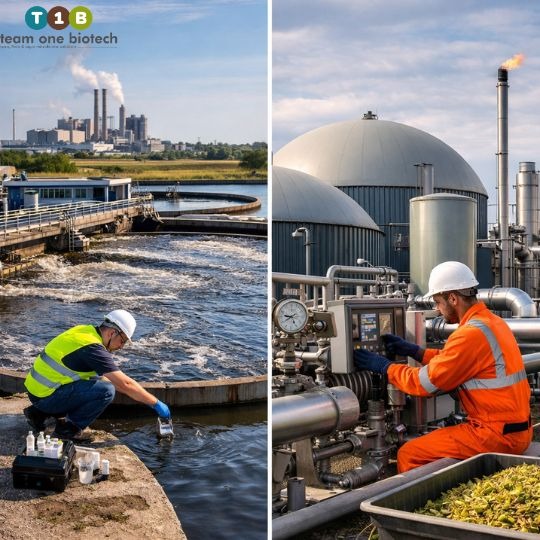
Here is something worth saying plainly: biological treatment is not a machine. It is a living process.
When wastewater enters your ETP, it does not encounter a chemical reactor or a filter press. It encounters billions of microorganisms, bacteria, archaea, and fungi, that have been conditioned over time to consume the organic matter in your effluent. They eat the BOD and COD. They break down complex molecules. And in doing so, they clean the water.
The reason this matters is that a machine can be tuned once and left alone. A living ecosystem cannot. It responds to temperature changes, seasonal fluctuations, toxic shocks, and shifts in your effluent composition. When your biology is healthy and well-matched to your specific wastewater, the system runs efficiently and costs stay manageable. When it is not, you generate excess sludge, miss discharge standards, and spend money trying to compensate for a problem you cannot quite identify.
There are two fundamentally different ways to run biological treatment:
- Aerobic treatment, where oxygen-dependent microorganisms break down organic matter quickly and reliably.
- The anaerobic process, where a more complex community of microorganisms works without oxygen, digesting waste slowly and producing biogas in the process.
Both approaches use microorganisms in bioremediation. Both can achieve meaningful COD and BOD reduction. But they are not interchangeable, and choosing the wrong one for your effluent type is one of the most expensive mistakes an industrial plant can make.
The Aerobic Engine, Microbes, Oxygen, and Speed
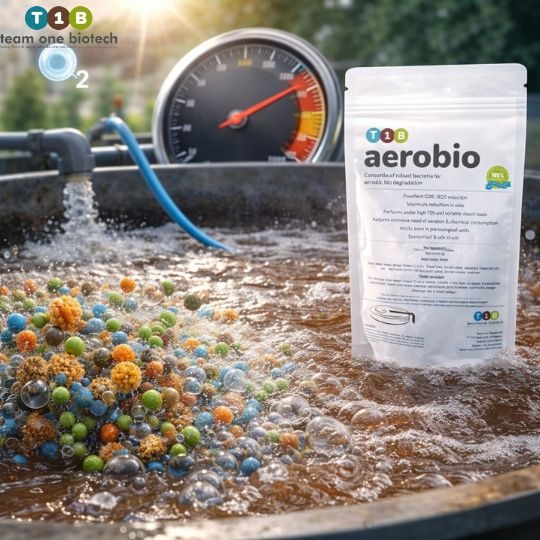
What Is Actually Happening in Your Aeration Tank
In a well-run aerobic system, the biology is surprisingly active. Species like Pseudomonas, Nitrosomonas, and various Bacillus strains form dense microbial communities in the mixed liquor. They consume dissolved organic carbon as a food source, using oxygen as the electron acceptor, and they multiply rapidly as they do so.
The result is fast, predictable BOD and COD removal. A healthy aerobic system can achieve BOD removal in the range of 85% to 95% under typical operating conditions. Please note that these are general values and performance metrics differ across every ETP based on influent characteristics and operational parameters.
For industries with moderate-strength wastewater and strict discharge deadlines, that speed and reliability is genuinely valuable.
But Here Is What the Sales Pitch Leaves Out
Running an aerobic system is expensive, and not in ways that always show up on a single line item.
The blowers and aerators that keep your mixed liquor oxygenated run around the clock. In peak summer months, when ambient temperatures rise and oxygen transfer efficiency drops, those systems work even harder. For many plants, aeration alone accounts for a significant share of total ETP electricity consumption. It is a cost that is easy to accept because it is built into the baseline, but it is worth questioning whether you are spending more than you need to.
The bigger issue, and the one that tends to create the most sustained financial pain, is sludge. Aerobic systems produce a lot of it. Because the microorganisms are growing rapidly and continuously, a large volume of excess biological sludge accumulates in the system and must be removed, thickened, dewatered, and disposed of. For pharma or chemical units whose sludge is classified as hazardous under the Hazardous Waste Management Rules, that disposal cost can be substantial and recurring.
It does not feel like a crisis on any given day. But over a year, it adds up in ways that deserve serious scrutiny.
When Aerobic Treatment Is the Right Call
- Your effluent COD is in the lower range, roughly below 2,000 to 3,000 mg/L.
- You need rapid startup capability and operational flexibility.
- Your discharge standards are stringent and you cannot afford variability in effluent quality.
- Your plant is located in a cooler climate where maintaining the temperatures needed for stable anaerobic performance would require additional energy input.
The Anaerobic Process, Energy Recovery and Low Footprint
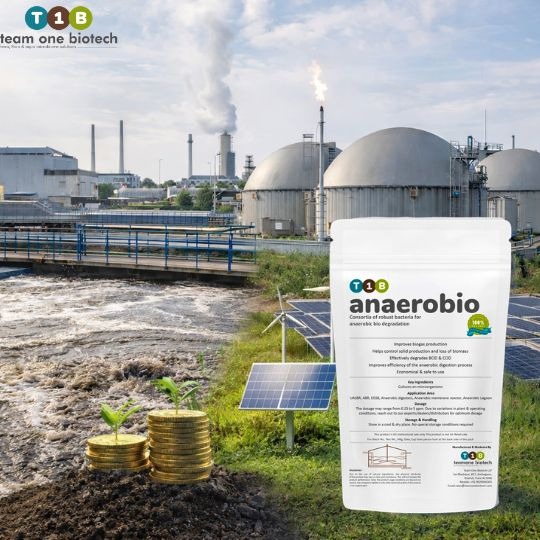
The Slower, Smarter Approach to Degradation
The anaerobic process tends to get underestimated because it is slower and less intuitive than aerobic treatment. But for the right effluent type, it is arguably the more intelligent system to run.
Here is what happens inside an anaerobic reactor. Complex organic molecules are broken down in stages by a remarkably coordinated chain of microbial communities. Hydrolytic bacteria go first, breaking apart large polymers. Acidogenic bacteria convert those fragments into volatile fatty acids. Acetogenic bacteria process those further. And finally, methanogens, a group of archaea that are among the oldest forms of life on earth, convert acetate and hydrogen into methane.
This is microorganisms in bioremediation operating at its most sophisticated. Every stage depends on the one before it. When the community is healthy and balanced, the system runs with a quiet efficiency that aerobic processes simply cannot match for high-strength wastewater.
And the methane that comes out at the end? That is not waste. That is fuel.
The Case for High-COD Industries
If your plant generates wastewater with COD loads in the range of 5,000 mg/L to 50,000 mg/L or higher, as is common in distilleries, food processing units, and many chemical manufacturers, the anaerobic process starts making a compelling economic argument.
Consider what you gain:
- Drastically lower sludge production. Anaerobic systems typically generate somewhere between 60% to 80% less excess biomass per unit of COD removed compared to aerobic treatment. Please note that these are general values and performance metrics differ across every ETP based on influent characteristics and operational parameters. Less sludge means lower disposal costs, fewer press hours, and less polymer consumption.
- Biogas that can be captured and used to offset heating or electricity costs elsewhere in your facility. For some high-COD industries, this is genuinely meaningful energy recovery.
- A smaller physical footprint per unit of COD treated. In industrial clusters where land is expensive, this matters more than many plant managers initially expect.
What You Cannot Ignore
Anaerobic systems ask more of their operators. Start-up is slow, often taking anywhere from 4 to 12 weeks to build a stable and effective microbial consortium. The biology is sensitive to toxic compounds, which is a real concern if your effluent contains antibiotic residues, heavy metals, or certain solvents. And methanogens, in particular, are temperature-sensitive. Below approximately 25 degrees Celsius, their activity drops noticeably.
In northern Indian industrial clusters, winters are not something you can engineer around with wishful thinking. Maintaining reactor temperature during the colder months requires deliberate design choices and sometimes additional operational input.
None of this makes anaerobic treatment a bad choice. It makes it a choice that requires more thought, more planning, and the right operational expertise behind it.
Wondering whether your current system is actually suited to your effluent? Team One Biotech’s engineers offer a complimentary waste audit that gives you a process-specific answer, not a generic recommendation. Book yours today.
The Sludge Factor, Comparing ETP Sludge Yields
The Number on Your Disposal Invoice That Should Bother You
Ask most plant managers where their biggest ETP cost sits, and they will point to power consumption or chemical dosing. Ask them about sludge treatment and disposal, and you often get a resigned shrug. It is expensive. It has always been expensive. What can you do?
Quite a lot, as it turns out.
ETP sludge in India is governed under the Hazardous Waste Management and Transboundary Movement Rules, and depending on your industry and sludge characterization, disposal can involve transportation logistics, manifest documentation, laboratory analysis, and per-tonne fees at Common Hazardous Waste Treatment Storage and Disposal Facilities. These costs have been moving in one direction for years.
For a mid-sized pharma or textile unit, the annual cumulative cost of sludge treatment and disposal is often higher than plant managers realize when they look at it as a single annual figure rather than a monthly line item.
Where the Two Systems Diverge Most
This is the comparison that matters most when you are trying to control costs.
Aerobic systems generate significant excess biomass. Because the microorganisms are actively growing, the system continuously produces new cells, a large portion of which must be wasted and handled as ETP sludge. Even with good sludge thickening and dewatering equipment, you are dealing with a high-volume output problem.
Anaerobic systems operate at much lower microbial growth rates. The microorganisms are not proliferating rapidly; they are conserving energy and metabolizing slowly. The sludge that is produced tends to be denser and better conditioned for dewatering, which means less time on the filter press and less polymer usage. The total volume differential between a well-operated anaerobic system and a comparable aerobic system can fall in the range of 50% to 75% reduction in sludge volume generated. Please note that these are general values and performance metrics differ across every ETP based on influent characteristics and operational parameters.
That is not a marginal improvement. For many plants, that kind of reduction represents a meaningful shift in annual operating costs.
The Microbial Augmentation Angle Most Plants Are Missing
There is a third lever that very few Indian industrial plants are pulling, and it may be the most cost-effective one available: deliberately enhancing your existing biological system with specialized microbial cultures.
Whether your ETP is aerobic or anaerobic, the biology driving it is a community of microorganisms. In most plants, that community is a generalist population, capable of handling broadly typical effluent but not specifically optimized for the molecular complexity of your wastewater. Reactive dye compounds in textile effluent, pharmaceutical intermediates, food-processing fats and greases, all of these place demands on microbial communities that standard activated sludge populations are not always equipped to meet efficiently.
Augmenting your system with industry-specific microbial cultures, the kind of cultures that have been selected and concentrated for your specific degradation challenges, can produce measurable results:
- Improved removal of recalcitrant COD compounds that standard biology struggles with.
- Reduced excess sludge generation through higher endogenous respiration rates within the microbial community.
- Greater system stability during shock loads, which are a daily reality in many Indian industrial ETPs.
- Faster recovery when the system is disturbed by a toxic event or an unexpected shift in influent quality.
At Team One Biotech, this is where a significant part of our work sits. Not just recommending a process, but putting the right biology into your system and supporting it through to stable, measurable performance.
Decision Matrix, Which Process Is Right for Your Industry?
There is no universal answer here, and anyone who gives you one without looking at your effluent data is guessing. But there are patterns worth knowing.
Pharma
Pharmaceutical wastewater is among the hardest to treat biologically. Antibiotic residues can suppress or destroy anaerobic microbial communities. Solvent carry-overs create toxicity spikes. High TDS loads interfere with biological activity across both systems.
For most pharma ETPs, the practical answer tends to be a robust aerobic system, often an MBBR or SBR configuration, paired with specialized microbial cultures that have been selected for tolerance to pharmaceutical compounds. Sludge treatment is a priority given the hazardous classification that typically applies, and every percentage point of sludge volume reduction matters.
Textile
Textile effluent is high in colour, salinity, and COD, and it punishes underpowered biological systems. The approach that is gaining traction in Indian textile clusters, particularly in Gujarat and Tamil Nadu, is anaerobic pre-treatment followed by aerobic polishing. The anaerobic stage takes on the bulk COD load while generating useful biogas. The aerobic stage then handles colour reduction and final BOD polishing to meet discharge norms. It is a logical split of labour between two biological processes.
Food and Beverage
High BOD, readily biodegradable organics, and significant fats, oils, and greases make food processing wastewater a strong candidate for anaerobic treatment. UASB reactors have a solid track record in this sector across India. The biogas generated can meaningfully offset boiler fuel costs, which in food processing facilities are often substantial. The economics here can be genuinely attractive.
Chemical Manufacturing
Chemical effluent resists generalization because the variability between facilities is so wide. What holds true across most chemical manufacturing ETPs is the need for biological resilience, communities of microorganisms that can handle COD spikes, handle some level of chemical toxicity, and recover quickly from upsets. This is precisely where augmented microbial bioremediation cultures add operational value that standard community biology cannot consistently provide.
If you are not sure where your plant falls in this picture, or if your ETP has evolved over the years into something of a hybrid that nobody quite designed deliberately, reach out to Team One Biotech. Our process review starts from your actual data, not from a template.
The Cost of Leaving Things As They Are
Indian industry is moving into a phase of environmental compliance that has less room for approximation than it once did. Real-time effluent monitoring mandates from the CPCB, increasing enforcement activity from SPCBs in major industrial clusters, and the rising cost of sludge disposal are combining to turn what was once a background operational concern into a front-line financial issue.
The decision between aerobic and anaerobic biological treatment is not a technical footnote. It is a choice with real consequences for your operating costs, your compliance posture, and your ability to scale your operations without your ETP becoming the bottleneck.
Getting that choice right, and then backing it up with the right microbial biology, is not complicated. But it does require an honest assessment of where your current system falls short, and a willingness to move past the thinking of “this is how we have always done it.”
That is the conversation Team One Biotech exists to have. Not to sell you something off a shelf, but to look at your actual effluent, your actual sludge numbers, and your actual operating constraints, and tell you what we honestly think will work.
The first step is a waste audit. It costs you nothing and gives you a clear picture of what your ETP is actually doing versus what it should be doing.
Book that conversation with our engineers today. Because every month you wait is another month of paying for a system that is not performing as well as it could be.
Looking to improve your ETP/STP efficiency with the right bioculture?
Talk to our experts at Team One Biotech for customised microbial solutions.
Contact: +91 8855050575
Email: sales@teamonebiotech.com
Visit: www.teamonebiotech.com
Discover More on YouTube – Watch our latest insights & innovations!-
Connect with Us on LinkedIn – Stay updated with expert content & trends!
