
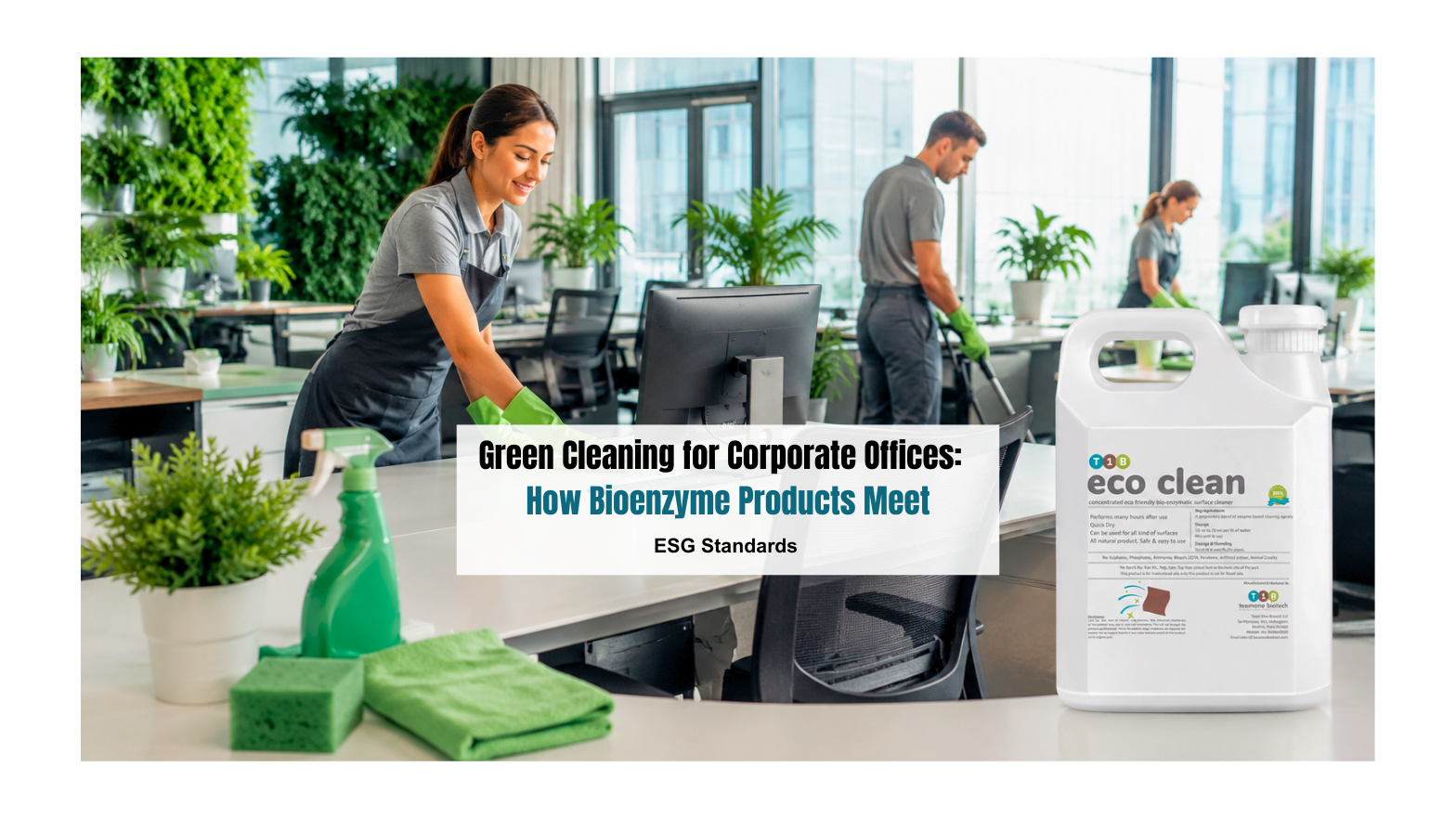

Green Cleaning for Corporate Offices: How Bioenzyme Products Meet ESG Standards
The Air You’re Not Talking About
Walk into any premium corporate campus in Bengaluru’s Whitefield corridor, a glass-and-steel IT park in Pune’s Hinjewadi, or a centrally air-conditioned headquarters in Mumbai’s BKC district. What you notice immediately is the gleam. Polished floors. Sanitized restrooms. Lobbies that smell aggressively clean.
What you don’t notice is the chemistry hanging in the air.
Conventional industrial cleaning products, quaternary ammonium compounds, chlorine-based disinfectants, synthetic surfactants, volatile fragrance compounds, don’t simply vanish after use. In a building where windows don’t open and HVAC systems recirculate the same air for eight to twelve hours a day, residual chemical vapors accumulate. According to indoor environmental quality research cited by global green building bodies, indoor air can contain two to five times more chemical pollutants than outdoor urban air. In a country where the majority of India’s top 500 companies operate out of sealed, centrally conditioned campuses, this is not a peripheral concern. It sits at the intersection of employee health, operational liability, and corporate reputation.
And increasingly, it sits squarely within the scope of ESG reporting.
This piece is for the facility managers, procurement heads, and operations directors who are being handed ESG targets by their leadership teams and asked to translate those targets into on-ground action. The argument here is straightforward: the single most consistent, cost-manageable, and measurable lever available to facilities teams is the shift from conventional chemical cleaning to bioenzyme-based cleaning solutions. It is not a trend. It is an operational upgrade with compounding returns.
Why Indian Corporate Facilities Are at an Inflection Point
India’s corporate real estate sector is in the midst of a green building revolution. The Indian Green Building Council (IGBC) has certified over 12 billion square feet of green building footprint, and LEED India certification has become a non-negotiable benchmark for Grade A commercial developments in NCR, Bengaluru, Mumbai, and Hyderabad. Many of India’s largest conglomerates, from Infosys and Wipro to Mahindra and Tata, have publicly committed to net-zero carbon goals within this decade.
What is often underestimated is how deeply housekeeping and sanitation practices feed into these targets. Green building rating systems evaluate indoor air quality, water usage, chemical toxicity, and waste generation, all of which are directly impacted by cleaning protocols. A facility that has invested crores of rupees in green HVAC systems and energy-efficient lighting can quietly undermine those credentials through the continued use of phosphate-heavy floor cleaners and chlorinated disinfectants that discharge into drainage and contaminate ETP influent.
Bioenzyme cleaners, products that deploy naturally occurring microbial cultures and enzyme complexes to break down organic matter at a molecular level, offer facilities teams a way to close that gap. They are not a compromise. In high-performance operational contexts, they consistently match or outperform conventional chemicals on key hygiene parameters, while delivering a fundamentally different chemical footprint.
Sector-by-Sector: Why the Vertical Matters
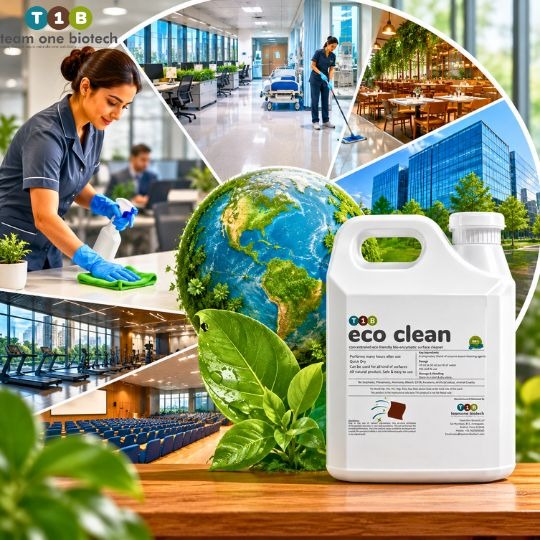
The transition to green cleaning is not one-size-fits-all. The specific drivers and operational requirements vary meaningfully depending on the facility type. Here is how the case for bioenzyme cleaners plays out across the verticals that matter most.
Corporate Office Complexes and Tech Parks
In a large IT campus housing 5,000 to 15,000 employees, housekeeping teams run cleaning cycles across multiple shifts. The cumulative chemical load deposited on surfaces, in the air, and into drainage systems across a single week is substantial. For facilities managers operating under LEED or IGBC certification requirements, every cleaning input counts toward the facility’s environmental performance score.
Bioenzyme floor cleaners, restroom care formulations, and drain maintenance products reduce Volatile Organic Compound (VOC) emissions from cleaning activities, a parameter that directly affects a building’s Indoor Air Quality score. They also break down organic residues in drainage lines, reducing drain blockage incidents and lowering the BOD (Biological Oxygen Demand) load entering ETPs, a meaningful benefit for large campuses managing their own wastewater infrastructure.
Hospitals and Healthcare Facilities
This is arguably where the stakes are highest. Healthcare-associated infections (HAIs) are a persistent challenge for Indian hospitals, and the instinctive response of many facility managers has been to increase the concentration and frequency of chemical disinfectants. The problem is that many of these compounds, particularly chlorine-based and phenolic disinfectants, leave toxic residues on surfaces, contribute to airborne chemical contamination in patient areas, and accelerate the corrosion of expensive medical equipment surfaces.
Bioenzyme-based sanitation products work differently. By targeting the organic biofilm matrix that pathogens use as a substrate, they disrupt the environment in which harmful microorganisms thrive, without depositing toxic chemical residues. For ICUs, operation theaters, and patient wards where surface and air purity are clinical requirements, this distinction is not academic. Cleaning staff, who are often the most chemically exposed workers in a healthcare facility, also benefit significantly from the shift to non-corrosive, non-allergenic formulations.
Educational Institutions and Schools
Children are not small adults when it comes to toxicological exposure. A child’s body surface area relative to body weight is higher, their respiratory rates are faster, and their detoxification systems are less developed. A school hallway cleaned with a harsh chemical disinfectant and then occupied by 400 children twenty minutes later is a scenario that few parents or school administrators have quantified, but many are beginning to question.
Bioenzyme cleaners address this directly. Their formulations are free of carcinogenic compounds, synthetic fragrances, and corrosive agents. For schools pursuing green certifications or positioning themselves as health-forward campuses, a growing differentiator in India’s premium private school segment, the shift to biological cleaning solutions is both a safety upgrade and a marketing asset.
Large Commercial Malls
The organic load in a large commercial mall is formidable. Food courts processing thousands of meals daily, restrooms servicing tens of thousands of footfalls, waste collection areas accumulating grease and organic decomposition, these create a maintenance challenge that brute-force chemical cleaning often fails to solve sustainably. Bioenzyme drain care products, for instance, don’t just mask odors. They colonize drain infrastructure with enzymatic microbial cultures that continuously break down grease and organic accumulation, reducing drain blockage frequency and associated maintenance costs. For mall facility teams working with third-party housekeeping contractors on tight SLA targets, this means fewer reactive interventions and more predictable operations.
The ESG Breakdown: How Bioenzymes Deliver Across All Three Pillars
Environmental
- Biodegradability: Bioenzyme formulations break down into water, carbon dioxide, and inert biomass. They do not persist in soil or water systems.
- Effluent Quality: Facilities using bioenzyme cleaners consistently report a measurable reduction in the chemical oxygen demand (COD) and BOD loads in their drainage outflows, typically in the range of 30% to 40%, though actual figures will vary based on facility design and load. This eases the operational burden on ETPs and reduces the risk of regulatory non-compliance.
- Water Efficiency: Bioenzyme products are generally formulated for use with reduced water volumes compared to conventional chemical protocols, contributing to a facility’s overall water conservation metrics.
Social
- Worker Safety: Housekeeping staff are disproportionately exposed to cleaning chemicals. Eliminating corrosive acids, synthetic biocides, and harsh surfactants from daily use reduces incidences of chemical burns, respiratory sensitization, and long-term dermal exposure effects.
- Indoor Air Quality: Reduced VOC emissions from cleaning operations contribute directly to a healthier work environment for office occupants, with potential downstream effects on productivity and absenteeism.
- Non-Allergenic Spaces: Bioenzyme formulations are free of synthetic fragrances and common allergens, making them appropriate for shared environments with diverse occupant health profiles.
Governance
- Regulatory Alignment: India’s Central Pollution Control Board (CPCB) and state-level pollution control boards are progressively tightening discharge standards for commercial and industrial facilities. Using products that reduce chemical load in effluent is a proactive compliance posture.
- ESG Reporting: Global reporting frameworks, GRI Standards, BRSR (Business Responsibility and Sustainability Reporting) mandated by SEBI for listed Indian companies, require disclosure of environmental impact metrics. Housekeeping chemical inputs that generate auditable data on biodegradability and reduced toxicity strengthen these disclosures.
- Third-Party Audits: Facilities pursuing IGBC or LEED recertification benefit from documentation showing a shift to low-impact cleaning chemistry. Bioenzyme products typically carry verifiable biodegradability certifications that can be submitted directly to auditors.
Disclaimer: The operational benchmarks and performance ranges referenced in this article, including effluent parameter improvements and water usage reductions, represent general industry benchmarks based on observed operational data across a range of facility types. Actual performance will vary based on the specific design, occupancy load, plumbing configuration, and Effluent Treatment Plant (ETP) setup of each individual facility. Team One Biotech recommends a site-specific audit prior to establishing performance baselines for any facility.
Making the Transition: What It Actually Looks Like
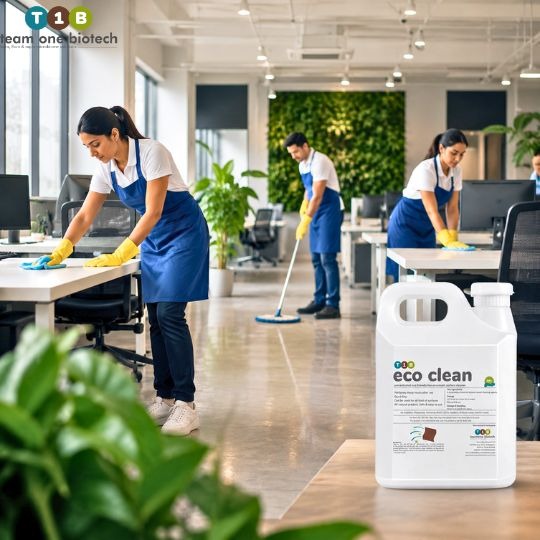
The practical barrier to switching is often not cost or conviction, it is inertia. Housekeeping teams are trained on specific products. Procurement teams have existing vendor relationships. Facility managers are managing too many variables to introduce new unknowns.
Here is what a structured transition looks like in practice:
- Phase 1, Audit: Identify current chemical inventory, application areas, and discharge points. Map ESG reporting requirements to cleaning inputs.
- Phase 2, Pilot: Replace conventional products in one high-impact zone, typically restrooms and drainage systems, and run a 30 to 60-day performance comparison.
- Phase 3, Scale: Extend bioenzyme protocols facility-wide, train housekeeping staff, and establish documentation trails for ESG and certification reporting.
- Phase 4, Report: Use product biodegradability data, VOC profiles, and operational logs as verifiable inputs for BRSR disclosure, IGBC/LEED audits, or internal ESG dashboards.
The Chemistry of Corporate Responsibility
The facilities that will define the next generation of corporate sustainability in India are not going to be defined solely by solar panels and green rooftops. They will be defined by the granular, operational decisions that stack up daily, what goes into the mop bucket, what flows into the drain, what lingers in the air after the cleaning crew has moved on.
The shift to bioenzyme cleaning is not a sacrifice. It is not a compromise between hygiene and responsibility. It is an upgrade, to cleaner air, safer staff, lower regulatory risk, and credible ESG reporting.
Team One Biotech works with facility managers across corporate, healthcare, educational, and commercial sectors to design customized bioenzyme cleaning protocols that align with your ESG targets, building certification requirements, and operational realities.
Ready to move from chemical dependency to biological efficiency?
- Request a free facility audit to identify your current chemical exposure and effluent impact.
- Sign up for a structured pilot program tailored to your facility type and ESG reporting cycle.
- Download our product documentation for IGBC/LEED certification submissions.
Contact Team One Biotech to schedule your consultation. The transition starts with one conversation.
Looking to improve your ETP/STP efficiency with the right bioculture?
Talk to our experts at Team One Biotech for customised microbial solutions.
Contact: +91 8855050575
Email: sales@teamonebiotech.com
Visit: www.teamonebiotech.com
Discover More on YouTube – Watch our latest insights & innovations!-
Connect with Us on LinkedIn – Stay updated with expert content & trends!