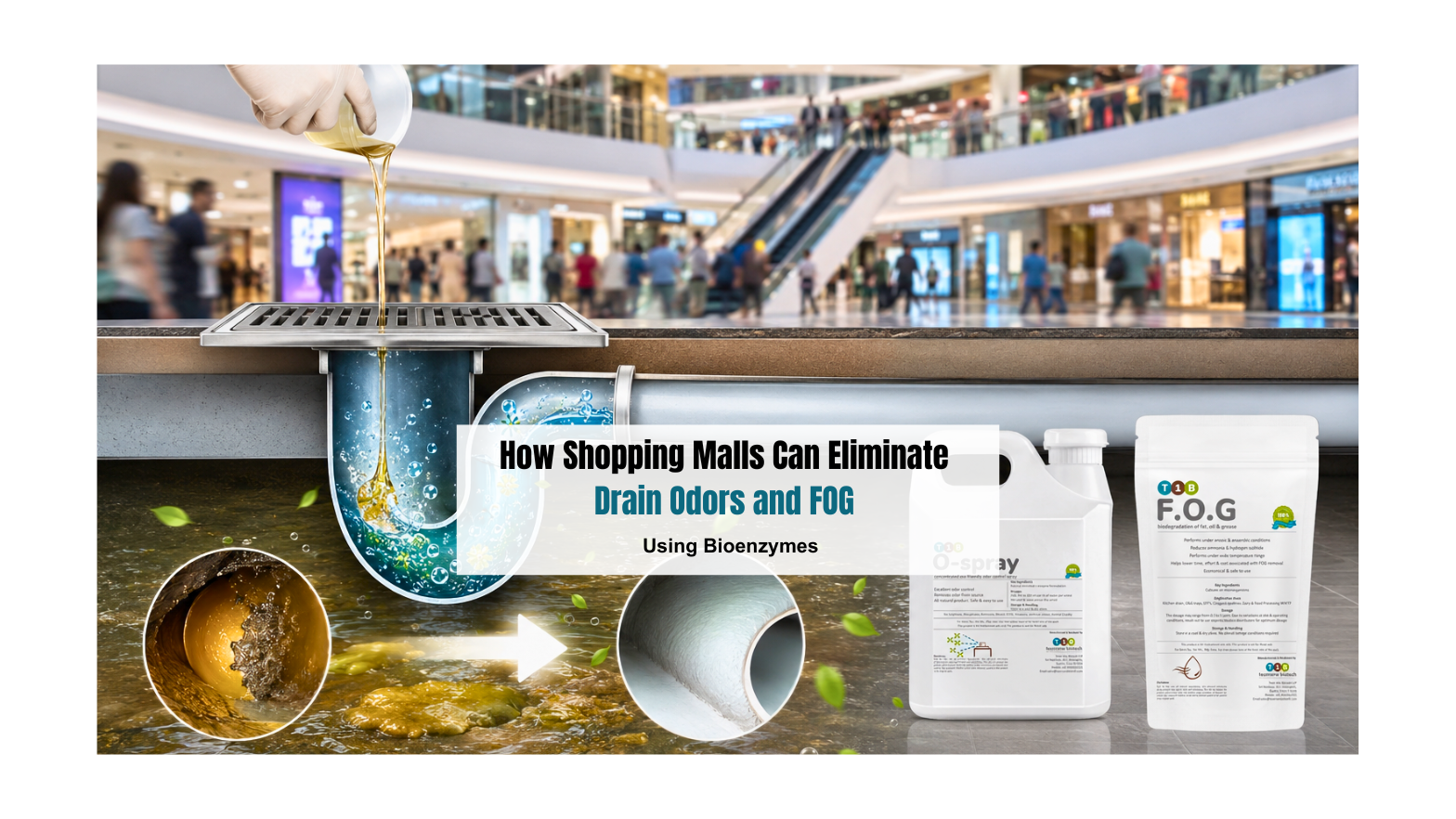
How Shopping Malls Can Eliminate Drain Odors and FOG Using Bioenzymes
There is a moment, usually within the first thirty seconds of walking into a commercial space, when a visitor decides how they feel about it. It is not the lighting, the store layout, or even the promotions on display that form that judgment. More often than not, it is the air. A faint, sour smell rising from a drain near the food court entrance. A subtle but unmistakable heaviness in the corridor near the restrooms. That single sensory signal communicates something that no marketing spend can easily undo: neglect.
For facility managers and operations heads overseeing shopping malls, this is not a hypothetical scenario. It is a daily operational reality, and it costs more than just visitor discomfort. It costs footfall retention, tenant satisfaction, regulatory compliance, and, in the long run, the structural integrity of your drainage infrastructure itself.
This guide from Team One Biotech is written specifically for the professionals who manage these environments: the facility managers handling multi-zone commercial complexes, the sustainability officers balancing environmental compliance with operational budgets, and the operations heads who understand that cleanliness is not a cosmetic concern but a strategic asset.
The Unique Plumbing Burden of a Modern Indian Shopping Mall
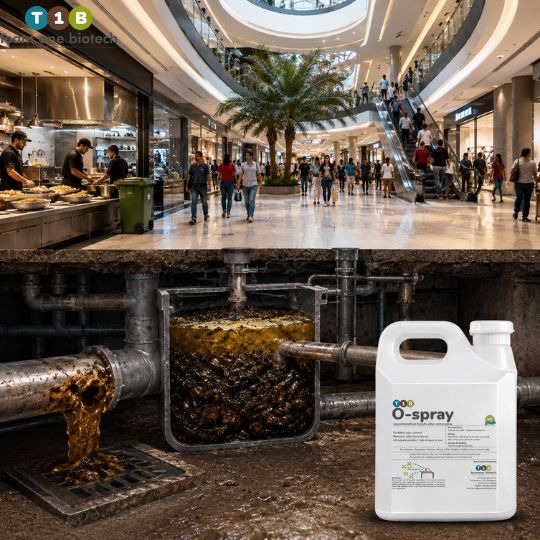
A large-format mall in an Indian metro city is not simply a retail destination. It is a microcity. On any given weekend, it may receive between 20,000 and 60,000 visitors. It houses a food court serving hundreds of meals per hour, multiple restaurants with full-scale commercial kitchens, public restrooms servicing thousands of users daily, and back-of-house operations running throughout the day and night.
Every one of these activities generates organic waste. And virtually all of that waste, food residue, cooking oils, fats from meat preparation, soap scum, and biological waste, eventually enters the same drainage system.
Understanding the FOG Crisis in Commercial Food Spaces
FOG stands for Fats, Oils, and Grease. In the context of a food court or commercial kitchen, FOG is produced constantly and in enormous volume. When hot cooking oil, rendered fat, or grease enters a drain, it does so in liquid form. The problem begins the moment it starts to cool.
As it travels through the drainage network, FOG solidifies and adheres to pipe walls. Over time, these layers accumulate, narrowing the effective diameter of the drain, slowing flow rates, and creating an anaerobic environment, one without oxygen, where bacteria begin breaking down trapped organic matter and producing sulfur-based gases. The result is hydrogen sulfide and mercaptans: compounds that produce the characteristic rotten-egg and sewer odor that no amount of air freshener can neutralize.
The Indian climate introduces an additional complication here. In cities where ambient temperatures regularly exceed 35 to 42 degrees Celsius for months at a stretch, FOG behaves inconsistently. In some seasons, high temperatures keep grease partially liquid, pushing it deeper into the drainage network before it solidifies, creating blockages that are harder to locate and costlier to remove. In cooler months or in air-conditioned back-of-house areas, grease solidifies rapidly near the drain trap, causing frequent localized blockages. There is no single predictable pattern, and that unpredictability is precisely what makes conventional, reactive cleaning strategies insufficient.
Why Traditional Drain Cleaning Methods Are Failing Your Facility
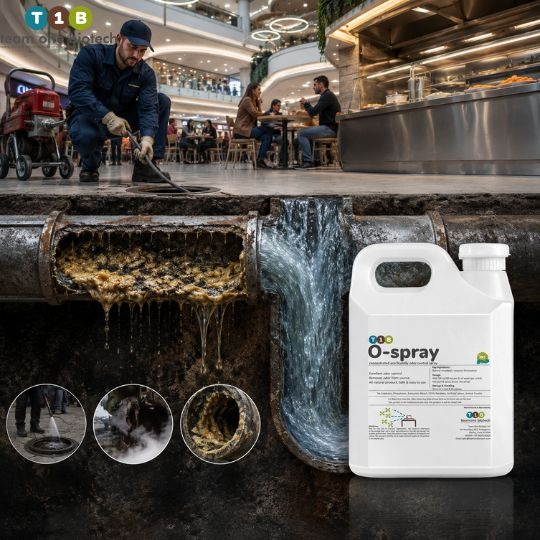
Most facility teams respond to drain issues reactively. A blockage occurs. A jet-cleaning crew is called. High-pressure water or chemical drain cleaners are used to clear the immediate obstruction. The problem appears resolved.
But this approach is fundamentally flawed, and here is why.
Chemical drain cleaners, particularly those using sodium hydroxide or sulfuric acid, do not eliminate FOG or organic waste. They push it further down the system, temporarily restoring flow without removing the material causing the problem. Repeated chemical use also degrades pipe infrastructure over time, particularly in older PVC or mild-steel plumbing systems common in Indian commercial buildings. Beyond the infrastructure damage, caustic chemicals kill the beneficial microbial populations in your facility’s Effluent Treatment Plant (ETP) or Sewage Treatment Plant (STP), directly compromising biological treatment performance and BOD removal efficiency.
Jet cleaning addresses physical blockages but offers no biological degradation of the underlying organic load. Within days or weeks, the same FOG accumulation resumes its buildup cycle.
Both approaches are reactive, not preventive. And in a facility operating 365 days a year, reactive maintenance is the most expensive kind.
The Bioremediation Approach: From Clearing to Digesting
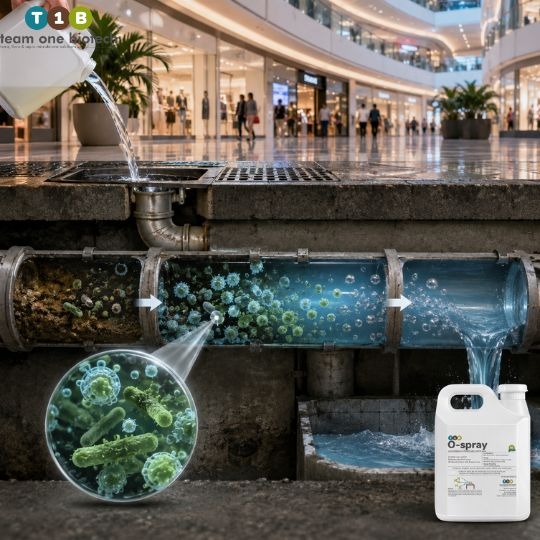
Bioremediation, in the context of commercial drainage management, is the use of naturally occurring or specially cultivated microbial cultures, and the enzymes they produce, to biologically degrade organic waste at the source.
A high-quality bioenzyme drain cleaner for malls does not simply mask odor or push blockages further down the pipe. It introduces concentrated populations of lipase-producing bacteria directly into the drainage environment. Lipase is the enzyme responsible for breaking down fats and oils at a molecular level, converting them into water, carbon dioxide, and simple organic acids that can be safely processed by your ETP or STP.
How the Mechanism Works
The process follows a three-stage degradation pathway:
- Colonization: Applied microbial cultures adhere to the biofilm layer inside drain pipes and grease traps, establishing a working bacterial population.
- Enzyme Production: As the bacteria multiply, they secrete lipase, protease, and amylase enzymes, targeting fats, proteins, and starches respectively. This is the active digestion phase.
- Continuous Degradation: Because the bacterial culture continues to reproduce and work between maintenance cycles, FOG does not get the opportunity to accumulate. The process is ongoing, not episodic.
The shift this represents is critical: from a reactive clearing model to a proactive digestion model. Rather than waiting for a blockage or odor complaint and then calling in a cleaning crew, bioenzyme dosing establishes continuous organic load management within the drain system itself.
Contact Team One Biotech today for a professional audit of your facility’s drainage and grease management system. Our bio-experts assess your specific load profile and design a dosing protocol matched to your operational schedule.
The Indian ETP/STP Compliance Dimension
Facility managers in India operating commercial complexes above a certain scale are required to maintain functional ETPs or STPs on-site. The Central Pollution Control Board (CPCB) and respective State Pollution Control Boards prescribe discharge standards for parameters including BOD (Biochemical Oxygen Demand), COD (Chemical Oxygen Demand), TSS (Total Suspended Solids), and oil and grease content.
Here is where the strategic value of bioenzyme-based drain treatment becomes especially significant.
When FOG and organic solids from food courts enter an ETP without any pre-treatment or upstream biological reduction, they arrive as a concentrated organic load. This places an extreme burden on the biological treatment stages of your ETP, reducing its efficiency and frequently leading to treated effluent that fails to meet prescribed standards.
Regular application of a bioenzyme drain cleaner for malls at critical upstream points, grease traps, food court drain lines, kitchen wastewater channels, achieves a measurable reduction in the organic load entering your ETP. Facilities using consistent bioenzyme dosing protocols typically observe BOD reductions in incoming effluent streams in the range of 80% to 90%, along with significant reductions in oil and grease content and TSS levels, before the effluent even reaches the biological treatment stage.
This translates directly into:
- Improved ETP performance consistency and higher confidence in discharge compliance
- Reduced chemical dosing requirements in the ETP, lowering operational costs
- Extended service intervals for ETP sludge removal and mechanical servicing
- Reduced risk of regulatory non-compliance and associated penalties or reputational damage
Disclaimer: All numerical values and performance ranges mentioned in this article are general estimates based on observed outcomes across varied commercial applications. Actual results depend on site-specific ETP/STP design parameters, influent load characteristics, temperature, dosing consistency, and facility management practices. Consult a qualified bio-expert for a site-specific assessment.
Beyond Malls: Why This Solution Scales Across Commercial Verticals
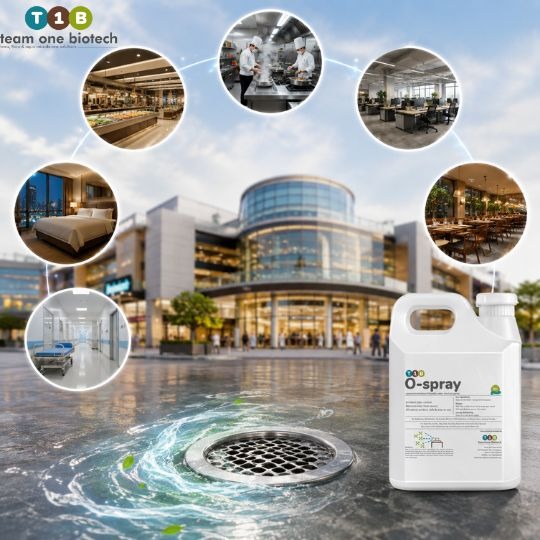
The bioenzyme approach is not exclusive to retail environments. The same core challenge, high organic load, complex drainage networks, compliance obligations, and reputational stakes, exists across multiple facility types.
Hospitals face a particularly acute version of this problem. Canteen and kitchen waste combines with biomedical waste streams, creating a drainage environment where odor control, pathogen management, and strict effluent compliance are simultaneously critical. Bioenzyme formulations designed for healthcare environments address FOG, protein-based waste, and biofilm formation while being safe for use in sensitive infrastructure.
Schools and university campuses with central mess facilities or large canteens generate consistent daily FOG loads. The long-term infrastructure damage from untreated FOG buildup is a significant hidden cost for educational institutions managing aging plumbing systems.
Corporate parks and IT campuses with multiple cafeteria outlets, often running breakfast, lunch, and dinner services, produce food court-level organic loads without always having food court-level maintenance protocols. Bioenzyme dosing provides an efficient, low-supervision solution that scales across distributed drain networks.
In each of these settings, the core value proposition remains consistent: continuous biological digestion of organic waste, reduced infrastructure maintenance costs, improved compliance outcomes, and elimination of malodor at the source.
Explore Team One Biotech’s sector-specific bioenzyme solutions for hospitals, educational campuses, and corporate facilities. Speak to our specialists to understand the right protocol for your environment.
Implementing a Bioenzyme Drain Management Programme: What to Expect
For a facility manager considering the transition from conventional chemical maintenance to a bioenzyme-based approach, the process with Team One Biotech follows a structured pathway.
Phase 1: Site Assessment and Load Profiling
Every facility is different. The organic load generated by a food court serving primarily North Indian cuisine, with high ghee and oil usage, differs from one serving international fast food. A bio-expert assessment maps your drain network, identifies high-load points, evaluates grease trap capacity and condition, and profiles the volume and nature of daily effluent generation.
Phase 2: Protocol Design and Dosing Schedule
Based on the site assessment, a customised dosing protocol is developed. This includes the specific bioenzyme formulation suited to your waste profile, the dosing points (typically grease trap inlets, main food court drain lines, restroom main drains), dosing frequency and volume, and integration with your existing ETP biological treatment cycle.
Phase 3: Monitoring and Optimisation
Bioenzyme programmes are not static. As seasonal temperatures change, as the facility’s food court tenancy mix evolves, or as operational patterns shift, the protocol is reviewed and adjusted. Regular monitoring of key parameters, odor levels, grease trap accumulation rates, ETP influent quality, provides the feedback loop necessary for continuous improvement.
The Team One Biotech Advantage: Science, Not Sales
What differentiates a professional bioenzyme programme from off-the-shelf enzyme cleaners available in the market is the depth of formulation science, the specificity of strain selection, and the rigour of application methodology behind it.
Team One Biotech works exclusively in the bioremediation space, with formulations developed specifically for Indian climate conditions, Indian food industry waste profiles, and Indian regulatory frameworks. Our bacterial cultures are selected for thermophilic stability, meaning they remain active and effective at the elevated ambient temperatures characteristic of Indian commercial environments, rather than declining in efficacy during summer months as many imported formulations do.
Our protocols are designed to complement, not conflict with, your existing ETP biological treatment processes. We work in close coordination with your facility’s ETP operators to ensure that upstream bioenzyme activity enhances downstream treatment performance.
The Cost of Inaction Is Not Zero
Every month a mall operates without a proactive drain management strategy, FOG accumulates in pipe walls, drain capacity diminishes incrementally, odor complaints from tenants and visitors continue, and the biological load entering the ETP remains unmanaged. The cost of inaction compounds quietly until it becomes an emergency: a major blockage during peak weekend trading hours, a regulatory notice following an effluent compliance failure, or the reputational damage of a negative visitor experience shared widely on social media.
The right time to implement a professional drain cleaner for malls programme is before the problem becomes visible. Request a facility audit from Team One Biotech and take the first step toward sustainable, odor-free, compliant drain management.
Facilities that invest in proactive bioremediation-based drain management are not simply solving a hygiene problem. They are protecting infrastructure, ensuring regulatory compliance, reducing long-term maintenance expenditure, and, critically, ensuring that the first impression every visitor forms of their space is the right one.
That is not a cleaning decision. That is a strategic one.
For inquiries, site assessments, or to consult with a Team One Biotech bio-expert, reach out to our commercial solutions team. We serve facility management professionals across India’s retail, healthcare, education, and corporate sectors.
Looking to improve your ETP/STP efficiency with the right bioculture?
Talk to our experts at Team One Biotech for customised microbial solutions.
Contact: +91 8855050575
Email: sales@teamonebiotech.com
Visit: www.teamonebiotech.com
Discover More on YouTube – Watch our latest insights & innovations!-
Connect with Us on LinkedIn – Stay updated with expert content & trends!