
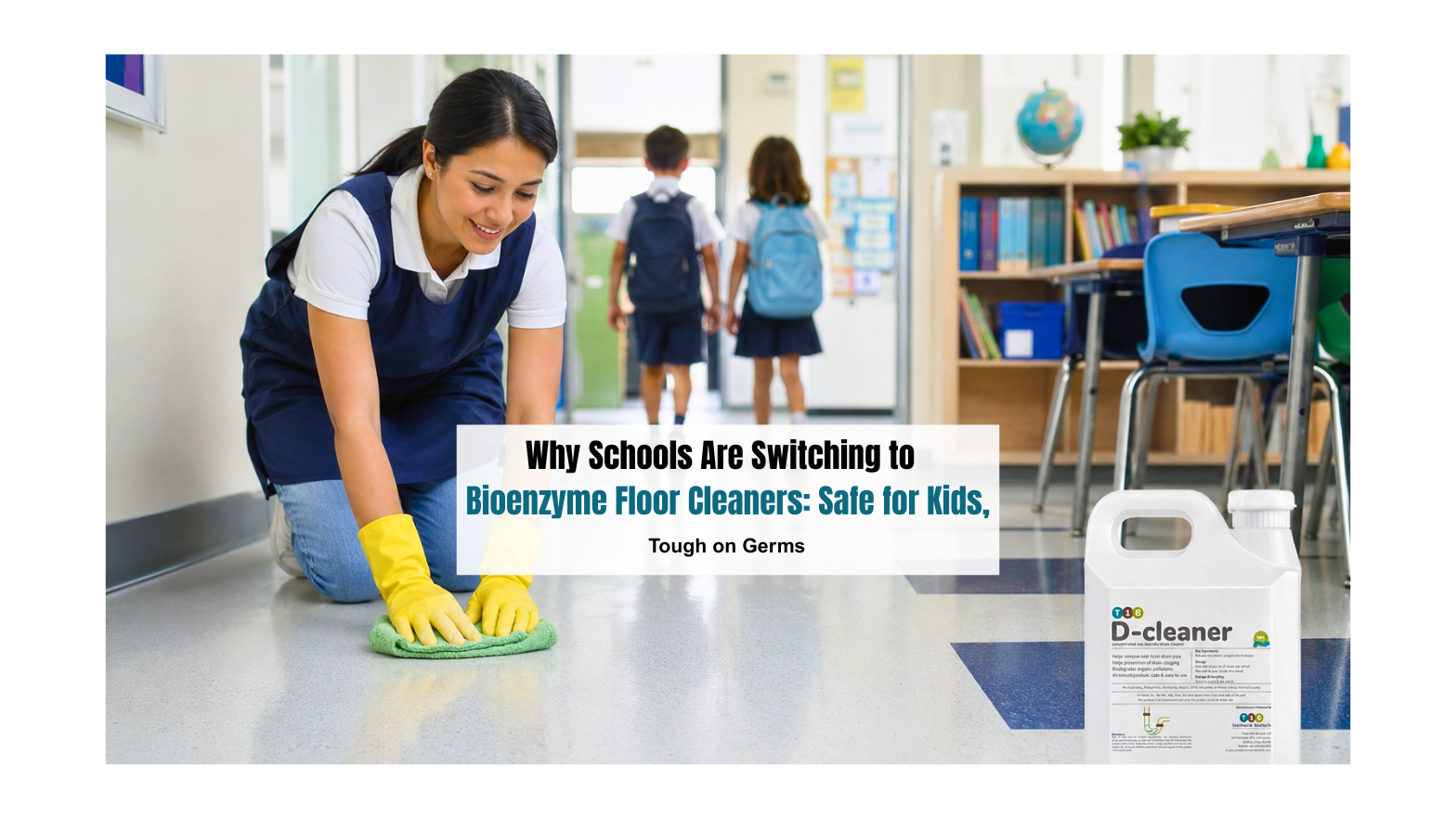

Why Schools Are Switching to Bioenzyme Floor Cleaners: Safe for Kids, Tough on Germs
Walk into almost any school in India on a Monday morning. The floors gleam. There is the sharp, familiar sting of phenyl in the air. Parents drop off their children, reassured by the smell of “clean.” But here is the uncomfortable truth that most facility managers and school administrators have not been asked to confront: that smell is not cleanliness. It is chemistry, and not the kind that belongs in a space where six-year-olds sit cross-legged on the floor for eight hours a day.
India’s school environments present a unique hygiene challenge that has no real parallel elsewhere. Classrooms are densely packed. Monsoon season brings with it a surge of fungal spores, moisture-borne pathogens, and mud tracked in by hundreds of pairs of feet. Hard water across cities like Lucknow, Kanpur, Bhopal, and Chennai means mineral deposits cling to floor surfaces and interact unpredictably with chemical cleaning agents. And unlike in a corporate lobby, the people crawling, sitting, eating, and breathing closest to those floors are children, whose immune systems, respiratory tracts, and developing neurologies are significantly more vulnerable to toxic chemical exposure than those of adults.
The conventional cleaning products that have dominated India’s institutional cleaning market for decades, phenyl-based disinfectants, quaternary ammonium compounds, bleach solutions, and synthetic surfactant mixes, do one thing very well: they look effective. The floor shines. The smell signals sanitation. But beneath that performance lies a more complicated, more troubling story about what these chemicals actually leave behind, and what they fail to actually eliminate.
This is the problem that natural cleaners for schools are now being designed to solve, and why forward-thinking institutions across India are making a deliberate, principled shift toward bioenzyme-based cleaning solutions.
What Traditional Cleaners Are Actually Doing to Your Building, and the People In It
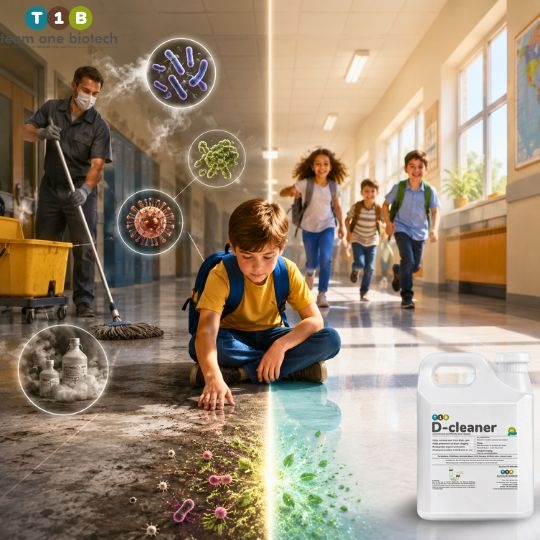
To understand why the shift to bioenzyme cleaners matters, you first need to understand what chemical cleaners are genuinely doing when applied to a floor surface.
Most conventional disinfectants operate through a process of surface-level chemical disruption. They kill or suppress microbial life on contact but do so by depositing residue, sometimes toxic, often persistent, on the very surfaces they are meant to clean. Quaternary ammonium compounds, commonly found in institutional floor cleaners, have been flagged in multiple studies for contributing to antimicrobial resistance. Phenol derivatives are classified as potential endocrine disruptors. Bleach-based cleaners, when mixed with hard water mineral content or organic matter (both of which are guaranteed in any Indian school corridor), can generate volatile chlorine compounds.
None of this is visible. None of it smells alarming after the initial cleaning has been done. But children sitting near freshly mopped floors are breathing these residuals. Children with asthma, eczema, or respiratory sensitivities are particularly exposed. And over the course of an academic year, which runs to roughly 200 school days, that cumulative exposure is not negligible.
There is also the problem of what chemical cleaners miss entirely. Biofilm. Organic residue embedded in grout, tile joints, and textured floor surfaces. These reservoirs of bacteria and mold are not addressed by surface-level chemical treatment, they are temporarily suppressed and then, in the humid conditions typical of India between June and September, allowed to re-establish even more aggressively.
The Science, Made Simple: How Bioenzymes Actually Clean
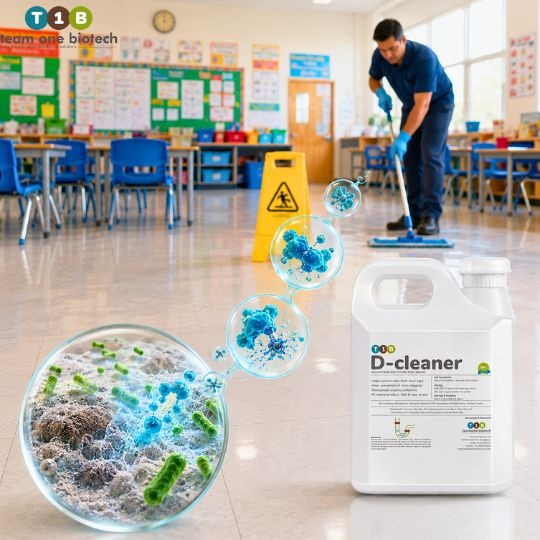
This is where bioenzyme cleaners represent a genuinely different category of solution, not merely a greener version of the same thing, but a fundamentally different mechanism of action.
Bioenzymes are formulations of naturally occurring microbial cultures and the enzymes they produce. When applied to a surface, these microorganisms and their enzymatic secretions do not mask organic matter or suppress microbial populations temporarily. They consume and break down organic matter at a molecular level, digesting proteins, fats, carbohydrates, urea, and other compounds that constitute the biological “food source” for harmful pathogens.
Think of it this way: a chemical cleaner is a pressure washer, it blasts the surface and the residue moves elsewhere or reforms later. A bioenzyme cleaner is closer to a controlled biological ecosystem, it eliminates the conditions in which harmful organisms thrive, from the substrate level upward.
In institutional settings, bioenzyme floor cleaners have demonstrated microbial load reductions in the range of 85% to 95% for common pathogens including E. coli, Salmonella, Staphylococcus, and Aspergillus molds. (These are general values based on standard testing conditions; actual results may differ across various environments and ETP setups.)
Critically for Indian conditions, quality bioenzyme formulations, such as those developed by Team One Biotech, are engineered for hard water compatibility, maintaining enzymatic activity even at higher TDS levels common in groundwater-dependent municipal systems. This is not a minor technical footnote; it is the difference between a product that performs in the lab and one that actually works in your school in Agra or your corporate campus in Hyderabad.
Why Schools Are Leading the Transition
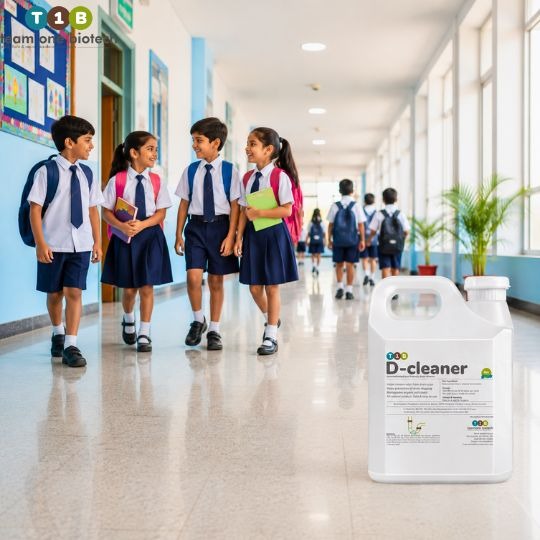
School administrators are, in many ways, the most exposed decision-makers in the institutional cleaning landscape. They answer to parents, to health inspectors, to education boards, and to their own sense of duty toward the children in their care.
The transition to non-toxic floor cleaning for institutions in the school segment is being driven by several converging pressures:
- Parental awareness is rising. Urban Indian parents researching allergen triggers, respiratory conditions, and chemical sensitivity in children are increasingly asking schools direct questions about the cleaning products being used on campus.
- CBSE and state board guidelines are beginning to reflect an emphasis on healthy school environments, pushing procurement committees to re-evaluate legacy chemical cleaning contracts.
- Cost efficiency over a full academic year is increasingly compelling. Bioenzyme cleaners, when properly diluted and deployed in a scheduled application program, deliver a reduction in total cleaning product expenditure in the range of 20% to 40% over conventional chemical regimes, when residue buildup, re-treatment costs, and material surface wear are factored in. (These are general values based on standard testing conditions; actual results may differ across various environments and ETP setups.)
- Monsoon season resilience. Bioenzyme cultures actively outcompete the fungal and bacterial bloom that follows India’s rainy season, making them particularly well-suited to the Indian institutional calendar.
What a Bioenzyme Cleaning Protocol Looks Like in a School Setting
A properly implemented bioremediation solution for schools is not simply a product substitution, it is a program. Team One Biotech’s approach to institutional bioremediation involves:
- Initial surface audit to identify high-load zones: toilet blocks, canteens, gymnasium floors, corridors near entry points
- Customized dilution schedules based on daily footfall, surface type, and water quality
- Staff training modules that ensure correct application, since bioenzyme products require appropriate dwell time to perform enzymatic digestion rather than immediate mopping off
- Periodic microbial monitoring to validate efficacy and adjust concentration levels seasonally
This is a structured, compliance-ready approach, and it is precisely what differentiates a professional bioremediation partner from simply purchasing a “green” product off a shelf.
Beyond Schools: The Institutional Case for Bioenzyme Cleaners
The logic that makes bioenzyme floor cleaners the right choice for schools applies with equal or greater force across other high-stakes institutional environments. Team One Biotech’s bioenzyme solutions are designed for institutional versatility, engineered to perform across the full range of India’s demanding facility management contexts.
Hospitals and Healthcare Facilities
Eco-friendly hospital-grade cleaners represent one of the most technically demanding product categories in the world. Hospitals in India face the dual challenge of maintaining sterile environments while managing the risk of hospital-acquired infections (HAIs), a risk that conventional chemical disinfectants, paradoxically, can exacerbate by contributing to antimicrobial resistance.
Bioenzyme formulations that eliminate organic biofilm in OT corridors, ICU anterooms, and patient wards address the root cause of pathogen persistence rather than creating selection pressure for resistant strains. For hospital procurement officers navigating NABH compliance frameworks, this positions bioenzyme cleaners as both a clinical and regulatory asset.
Malls and High-Footfall Commercial Spaces
Food courts, restrooms, parking levels, and escalator landings in large malls present a specific problem: extreme organic load combined with public accountability. A single food court corridor may receive footfall equivalent to a small town’s daily traffic. The odor control, grease breakdown, and pathogen suppression requirements are severe.
Bioenzyme cleaners address all three simultaneously, digesting the food residue that generates odor, breaking down the fatty deposits that create slip hazards, and reducing microbial colonization in grout and drainage areas. For sustainable facility management in mall environments, this translates directly into reduced complaints, lower maintenance call-out frequency, and a measurably better guest experience.
Corporate Offices and IT Campuses
The case here is quieter but no less compelling. Employee wellness programs, LEED certification aspirations, and ESG reporting requirements are pushing corporate real estate and facilities teams toward procurement decisions that reflect environmental responsibility. Switching to bioenzyme cleaners India suppliers like Team One Biotech is a documented, verifiable step toward green building compliance, and one that comes with a genuine performance benefit, not merely a PR narrative.
The Indian Market Specificity: Why Generic Solutions Fall Short
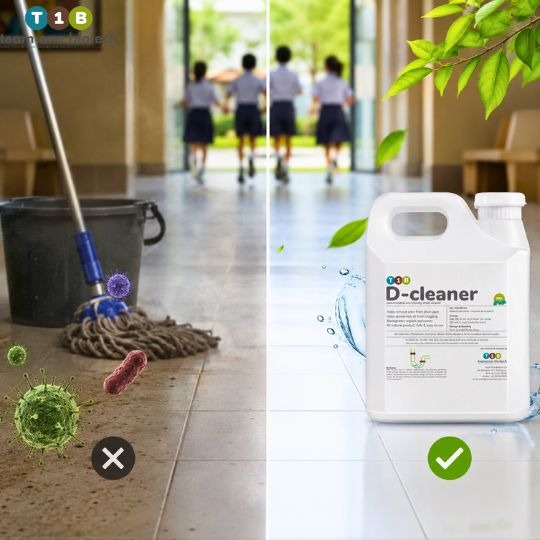
India is not a uniform market, and bioenzyme products designed for European or North American conditions often underperform here for reasons that are entirely predictable: water chemistry, ambient temperature ranges, microbial variety, and application infrastructure all differ substantially.
Team One Biotech’s formulations are developed with Indian conditions as the baseline assumption, not an afterthought. This means:
- Enzyme consortia selected for activity at Indian ambient temperatures (often above 30°C for significant portions of the year)
- Hard water tolerance built into the base formulation, not added as a workaround
- Packaging and dilution ratios designed for the realities of Indian institutional supply chains
- Technical support accessible in local languages, with field personnel who understand the specific challenges of Indian facility management
This is what sustainable facility management looks like when it is built for the market it actually serves.
Making the Decision: What Facility Managers Need to Know
The transition to bioenzyme floor cleaners is not a compromise, it is an upgrade. It delivers better long-term microbial control, eliminates chemical residue risk, reduces total cost of ownership over an annual cleaning cycle, and positions your institution as one that treats the health of its occupants as a non-negotiable priority.
For school administrators, it is the answer to the question every parent is eventually going to ask. For hospital procurement teams, it is a defensible, compliance-supportive choice. For mall and corporate facility managers, it is the intersection of performance and responsibility that modern stakeholders increasingly demand.
If you are responsible for a building where people spend significant portions of their lives, the floor beneath their feet is not a minor procurement decision. It is a health decision.
Take the Next Step with Team One Biotech
Team One Biotech specializes in customized bioremediation solutions for schools, hospitals, corporate campuses, malls, and industrial facilities across India. Whether you are evaluating a full facility transition or seeking a targeted solution for a specific problem zone, drainage odor, high-humidity mold, monsoon-season bacterial load, their team of bioremediation specialists can conduct a comprehensive site audit and design a program built for your specific environment.
Contact Team One Biotech today to schedule your facility bioremediation audit. The children sitting on your floors, the patients walking your corridors, and the employees breathing the air in your spaces deserve a cleaning strategy that is as serious about their health as you are.
Looking to improve your ETP/STP efficiency with the right bioculture?
Talk to our experts at Team One Biotech for customised microbial solutions.
Contact: +91 8855050575
Email: sales@teamonebiotech.com
Visit: www.teamonebiotech.com
Discover More on YouTube – Watch our latest insights & innovations!-
Connect with Us on LinkedIn – Stay updated with expert content & trends!