

Why Soil Biomes are the Secret to Healthy Pond Bottoms
It was 3 AM when Ramesh’s phone rang. The manager’s voice cracked with panic: “Sir, the aerators are running full blast, but the shrimp are surfacing. Something is wrong with the bottom.”
By sunrise, Ramesh stood at the edge of his 2-acre vannamei pond in Nellore, watching 60 days of investment, and hope, die in front of him. The water tested fine. Dissolved oxygen was adequate. But when the harvest crew waded in, they recoiled from the stench. The pond bottom had turned black, releasing hydrogen sulfide gas that suffocated his crop from below.
Ramesh’s tragedy was not caused by bad feed, poor genetics, or even disease in the traditional sense. His enemy was invisible, suffocating, and living in the very foundation of his pond: a degraded, anaerobic soil biome that had transformed from a productive ecosystem into a toxic waste dump.
This is the story playing out across thousands of hectares in Andhra Pradesh, West Bengal, Gujarat, and Tamil Nadu. And it is entirely preventable.
To prevent tragedies like Ramesh’s and master the science of soil management, refer to The Complete Handbook for High-Yield Shrimp and Fish Farming.
Understanding the Pond Bottom: Not Dirt, But a Living Biome
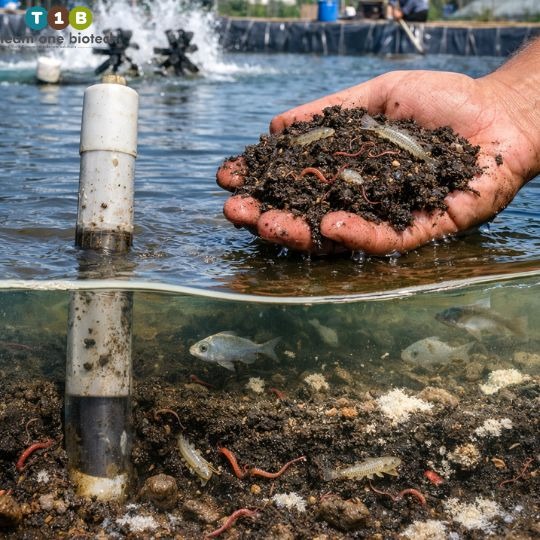
For too long, Indian aquaculture has treated the pond bottom as an inert surface, something to clean between crops but otherwise ignore. This is a catastrophic misunderstanding.
Your pond bottom is a soil biome: a complex, living ecosystem containing billions of microorganisms per gram of sediment. These microbes, bacteria, fungi, protozoa, and archaea, perform critical functions that determine whether your culture thrives or collapses.
The healthy soil biome acts as:
- A biological filter that processes organic waste (uneaten feed, fecal matter, dead plankton)
- A nutrient recycling center that converts ammonia and nitrite into harmless nitrate
- A competitive barrier that prevents pathogenic colonization
- A stabilizer for water quality parameters that would otherwise fluctuate wildly
When this biome degrades, through chemical overuse, organic overloading, or poor management, the pond bottom becomes an anaerobic zone. Beneficial aerobic bacteria die off. Sulfate-reducing bacteria proliferate, generating toxic hydrogen sulfide. Vibrio species, including the deadly strains responsible for white spot syndrome and acute hepatopancreatic necrosis disease, establish dominance in the sediment.
The result? Higher mortality, lower growth rates, increased FCR, and the constant threat of catastrophic crop failure.
The Science Behind the Crisis: What Happens When the Biome Fails
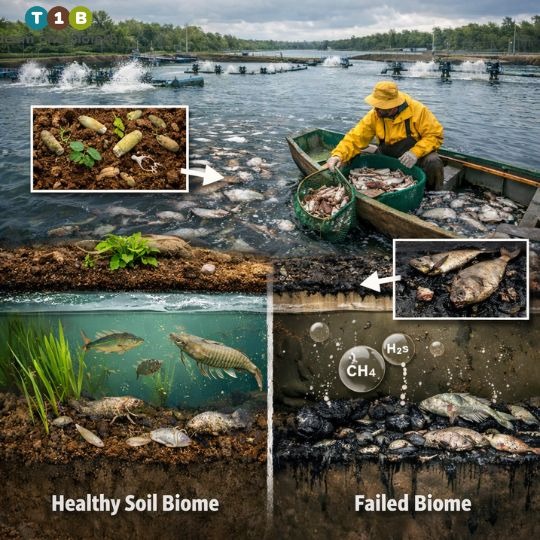
The nitrogen cycle in aquaculture ponds is often discussed in relation to water chemistry, but its foundation lies in the sediment. Here is what occurs in a degraded versus healthy system:
The Degraded Pathway
In ponds with compromised soil biomes, organic matter accumulates faster than it can be decomposed aerobically. As oxygen penetration into sediment decreases, typically beyond 2-3 mm depth, anaerobic bacteria take over.
These organisms perform denitrification and sulfate reduction, producing:
- Hydrogen sulfide (H2S): Toxic to gill tissue, causing stress and mortality even at 0.01 ppm
- Methane: Reduces oxygen availability and indicates severe degradation
- Ammonia flux: Sediment releases stored ammonia back into the water column, creating chronic toxicity
Simultaneously, the sediment becomes a reservoir for pathogens. Research from the Central Institute of Brackishwater Aquaculture has demonstrated that Vibrio concentrations in degraded pond sediments can exceed 10^6 CFU/gram, orders of magnitude higher than in the water column.
The Healthy Pathway
In bioremediated systems with robust soil biomes, aerobic and facultative bacteria maintain dominance. These organisms:
- Rapidly mineralize organic matter into CO2, water, and biomass
- Convert ammonia to nitrite and then nitrate through nitrification
- Produce enzymes (proteases, lipases, amylases) that break down complex organic compounds
- Secrete biosurfactants that prevent pathogen adhesion to sediment particles
- Generate organic acids that chelate heavy metals and reduce their bioavailability
The critical difference is oxygen availability and microbial diversity. Healthy sediments maintain aerobic conditions in the top 5-10 mm, with a diverse microbial community that resists pathogen invasion through competitive exclusion and resource monopolization.
Economic Reality: The Cost of Ignoring Your Soil Biome
For intensive shrimp farmers stocking 60-80 post-larvae per square meter, the economic stakes are brutal. Consider the numbers:
Degraded Pond Bottom Scenario (Common in Year 3+ ponds):
- Survival rate: 45-55%
- Average Body Weight at harvest (90 days): 16-18 grams
- FCR: 1.8-2.2
- Disease outbreaks: 2-3 per crop cycle
- Net profit per hectare: ₹80,000-₹150,000 (if the crop survives)
Bioremediated Soil Biome Scenario:
- Survival rate: 70-80%
- Average Body Weight at harvest (90 days): 22-25 grams
- FCR: 1.3-1.5
- Disease outbreaks: 0-1 per crop cycle
- Net profit per hectare: ₹400,000-₹600,000
The difference is not marginal, it is transformative. A farmer in Purba Medinipur running ten ponds can see profit swings of ₹30-40 lakhs per crop based solely on sediment health.
For Indian Major Carp polyculture systems in states like Odisha and Chhattisgarh, the dynamics are similar. Ponds with healthy soil biomes show 20-30% higher growth rates in Rohu and Catla, reduced incidence of epizootic ulcerative syndrome, and dramatically lower supplemental feeding requirements.
Comparing Pond Bottom Conditions: The Data Speaks
| Parameter | Degraded Pond Bottom | Bioremediated Soil Biome |
| Sediment Oxygen Demand | 2.5-4.0 g O2/m²/day | 0.8-1.5 g O2/m²/day |
| H2S Concentration | 0.05-0.3 ppm | <0.01 ppm (undetectable) |
| Total Vibrio Count | 10^5 – 10^7 CFU/g | 10^2 – 10^4 CFU/g |
| Organic Carbon Content | >8% (excessive) | 3-5% (optimal) |
| Redox Potential | -100 to -250 mV (reducing) | +100 to +250 mV (oxidizing) |
| Beneficial Bacillus spp. | 10^3 CFU/g | 10^6 – 10^8 CFU/g |
| Ammonia Flux from Sediment | 15-40 mg/m²/day | 2-8 mg/m²/day |
The data is unambiguous: sediment condition is not a minor variable but a primary determinant of production success.
Regional Challenges in Indian Aquaculture
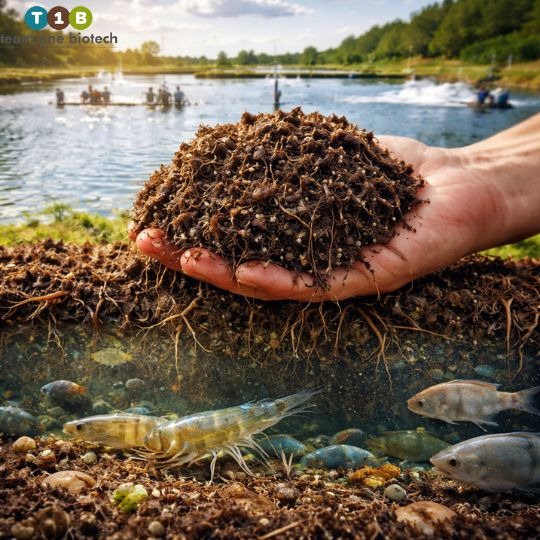
India’s diverse geography creates unique challenges for maintaining healthy pond soil biomes:
Coastal Andhra Pradesh and Tamil Nadu: High stocking densities and year-round culture create rapid organic accumulation. Monsoon flooding introduces terrestrial pathogens and disrupts established microbial communities. Summer temperatures exceeding 35°C accelerate decomposition but also favor pathogenic Vibrio proliferation.
West Bengal and Odisha: Traditional practices combined with intensive shrimp culture create legacy pollution in sediments. Accumulated copper and zinc from decades of algaecide and lime use create toxic zones that suppress beneficial bacteria.
Gujarat and Maharashtra: Highly saline conditions and alkaline soils create unique microbial dynamics. Conventional bioremediation protocols developed for brackish systems often fail without modification for pH 8.5+ environments.
Inland States (Punjab, Haryana, Uttar Pradesh): Freshwater aquaculture faces different challenges, agricultural runoff introducing pesticides and antibiotics that suppress soil biome function, and hard water chemistry that complicates microbial inoculation protocols.
Each region requires localized solutions, but the fundamental principle remains: a diverse, aerobic, competitive soil biome is non-negotiable for sustained high-yield production.
Management Protocols: Building and Maintaining Your Soil Biome
Transitioning from a degraded to a healthy soil biome requires systematic intervention:
1. Pre-Stocking Bioremediation
Before introducing stock, prepare the pond bottom with targeted microbial inoculants. Effective formulations contain:
- Bacillus species (subtilis, licheniformis, megaterium) for organic matter decomposition
- Nitrifying bacteria (Nitrosomonas, Nitrobacter) to establish nitrogen cycling
- Photosynthetic bacteria to process organic acids and hydrogen sulfide
- Enzyme complexes (proteases, cellulases, lipases) to accelerate waste breakdown
Application rates: 2-5 kg/hectare of high-concentration (10^9 CFU/gram) consortia, incorporated into sediment or broadcast with organic carriers.
2. During-Culture Maintenance
Weekly or bi-weekly maintenance dosing prevents degradation:
- Probiotic supplementation through feed or water: 1-2 kg/hectare/week
- Aeration focused on bottom layers during high organic load periods
- Strategic water exchange (10-15% weekly) to remove dissolved metabolites while preserving benthic communities
3. Monitoring and Intervention Triggers
Regular sediment testing provides early warning:
- Redox potential below +50 mV: Increase aeration and bioremediation dosing
- H2S detection: Emergency intervention with oxidizing agents and intensive microbial application
- pH drop in sediment: Indicates acid accumulation from anaerobic metabolism
- Visual assessment: Black coloration, gas bubbles, or foul odor demand immediate action
4. Between-Crop Regeneration
The critical window between crops determines next-cycle success:
- Dry the pond bottom for 10-15 days (when feasible) to oxidize accumulated metabolites
- Till the upper 10-15 cm to incorporate oxygen and break up anaerobic zones
- Apply agricultural lime (200-500 kg/hectare) to neutralize acidity and precipitate heavy metals
- Re-inoculate with beneficial microbes at double the standard rate before refilling
For farmers running continuous culture or back-to-back crops, in-situ bioremediation becomes even more critical since physical intervention is limited.
Species-Specific Considerations
P. Vannamei (Pacific White Shrimp): Extremely sensitive to H2S and ammonia. Require redox potential above +100 mV for optimal growth. Benefit dramatically from probiotic-supplemented feed that colonizes gut and sediment simultaneously.
P. Monodon (Tiger Shrimp): More tolerant of marginal conditions but significantly more valuable. Economic losses from suboptimal soil biomes are proportionally higher. Longer culture periods (120-150 days) mean cumulative organic loading is substantial.
Rohu, Catla, and IMC Polyculture: Bottom-feeding behavior means direct interaction with sediment. Gill damage from H2S exposure is a primary cause of mortality in intensive carp systems. Healthy soil biomes also support natural benthic food organisms that supplement artificial feed.
The Biology-First Revolution: Moving Beyond Chemicals
For decades, Indian aquaculture relied on chemical solutions: antibiotics for disease, algaecides for blooms, lime for pH management, and chlorine for disinfection. These interventions provided temporary relief but progressively destroyed the soil biome, creating dependency cycles.
The biology-first approach represents a paradigm shift: instead of killing everything and hoping the good survives, we deliberately cultivate beneficial organisms that outcompete pathogens and process waste efficiently.
This is not experimental science. Research institutions including CIBA, CIFE, and MPEDA have published extensive validation. Commercial farms implementing comprehensive bioremediation protocols consistently achieve:
- 25-40% reduction in FCR
- 15-30% improvement in survival rates
- 40-60% reduction in antibiotic and chemical usage
- Stable production across consecutive crop cycles without pond abandonment
The technology is proven. The question is implementation.
Your Next Move: The Pre-Season Window Is Closing
If you are reading this in the weeks before your next stocking season, you are at a decision point. You can continue managing symptoms, treating disease outbreaks, adjusting feed rates, running aerators harder, or you can address the root cause.
A healthy soil biome is not built overnight, but transformation begins with the first application. Farmers who start bioremediation protocols now will see measurable improvements within 30-45 days. Those who wait will repeat this season’s struggles, watching competitors achieve yields they thought were impossible.
The choice is clear: Invest in your pond’s foundation, or continue gambling on every crop.
Contact Team One Biotech today for region-specific bioremediation protocols tailored to your water source, stocking density, and target species. The invisible ecosystem below your water’s surface is waiting to work for you, if you give it the tools to thrive.
Your next harvest depends on decisions you make this week. Make them count.
Looking to improve your ETP/STP efficiency with the right bioculture?
Talk to our experts at Team One Biotech for customised microbial solutions.
Contact: +91 8855050575
Email: sales@teamonebiotech.com
Visit: www.teamonebiotech.com
Discover More on YouTube – Watch our latest insights & innovations!-
Connect with Us on LinkedIn – Stay updated with expert content & trends!
