

Solving the ETP Sludge Crisis: 5 Ways to Reduce Sludge Volume and Disposal Costs
Every plant manager who oversees an ETP in India knows the feeling. It usually hits around budget review time, or worse, right before a regulatory inspection. You look at the disposal invoices stacking up, you look at the sludge drying beds that never seem to empty fast enough, and somewhere in the back of your mind a number keeps growing, a number that represents money leaving your plant for no productive reason whatsoever.
Sludge. Not the effluent you treat. Not the water you discharge. The leftover mass that your biological treatment process generates and that nobody, not your operators, not your contractors, not your compliance team, has a clean answer for.
This problem is not unique to any one sector. Textile dyeing units in Surat, API manufacturers in Hyderabad, dairy processors in Punjab, tanneries in Kanpur, the conversation is identical across all of them. Too much sludge, nowhere adequate to send it, and a cost curve that only moves in one direction. CPCB and SPCB inspection cycles are not getting more lenient. Third-party disposal contractors charge more every year and their compliance trail is increasingly under the scanner, which means your liability does not end when the tanker pulls out of your gate.
What compounds this in India specifically is the nature of industrial production itself. Seasonal peaks, inconsistent raw material quality, the monsoon’s effect on influent dilution, your ETP was designed around a baseline that real operations almost never maintain. Tropical temperatures accelerate microbial activity in ways that can swing sludge generation rates dramatically from one month to the next. Your operators are managing a living system under conditions that shift constantly, and the sludge output reflects every one of those shifts. Often, the solution lies in Advanced Bioremediation: Using Microbial Cultures to Solve Complex Industrial Waste as a way to stabilize these biological fluctuations.
The result is a reactive posture that most plants are stuck in: manage the sludge that already exists rather than address why so much is being produced in the first place. More dewatering capacity, more disposal contracts, more compliance paperwork, all of it treating the symptom while the underlying biology keeps generating the problem.
That reactive posture is exactly what needs to change. The five strategies below are not quick fixes. They are a biology-first approach to cutting ETP sludge at the source, and keeping it cut, season after season.
Way 1: Bio-Augmentation , Putting the Right Microorganisms to Work in Your Bioremediation System

Here is something most ETP operators already know intuitively but rarely act on: the microbial population running your aeration tank is probably not well-suited to your effluent.
Naturally seeded microbial communities are generalists. They colonize your system over time, establish a working equilibrium, and do a passable job under average conditions. The operative word is passable. When your influent COD spikes because production shifted to a higher-strength product, or when a batch of toxic intermediates hits your collection sump ahead of the ETP, those generalist populations struggle. They produce excess sludge as a byproduct of incomplete organic degradation, biomass that should have been converted to energy and CO₂ instead ends up in your sludge press.
Using Specialized Microorganisms in Bioremediation to Tackle Toxic Industrial Effluents
To counter this, modern ETP management relies on the strategic deployment of specialized microorganisms selected for high-toxicity resistance. Unlike standard cultures, these “specialist” strains are capable of breaking down recalcitrant molecules like phenols, cyanides, and halogenated hydrocarbons that typically inhibit or kill off standard biomass. By integrating these specialized microbes into your bioremediation strategy, you ensure that even the most toxic industrial effluents are mineralized at the source. This targeted approach prevents the accumulation of hazardous chemical intermediates in the sludge, effectively lowering the toxicity profile of the resultant waste and making disposal significantly safer and more cost-effective.
Bio-augmentation addresses this directly. The principle is straightforward: instead of waiting for nature to seed your system with whatever microorganisms happen to be present, you deliberately introduce specialized, high-density microbial consortia that are matched to your specific effluent matrix. These are not generic culture products. Effective bio-augmentation uses organisms selected or developed for the particular compounds your plant generates, sulfate-reducing bacteria for tannery effluent, nitrifiers and denitrifiers for food processing wastewater, hydrocarbon-degrading strains for petrochemical ETPs.
The impact on sludge volume is direct. When microorganisms in bioremediation are well-matched to the organic compounds they are degrading, more of that organic load gets converted into energy and CO₂ rather than new biomass. Net sludge yield drops, typically by 20–35% compared to a poorly adapted mixed culture running the same load. (Note: These are general estimates and actual performance parameters will vary based on specific ETP design, effluent characteristics, and operating conditions.)
For Indian plants dealing with high seasonal variability, bio-augmentation also functions as an operational buffer. A robust, diverse microbial population recovers faster from shock loads. It bulks less. It bounces back from monsoon-related influent swings without the week-long process instability that typically follows, instability that is itself a significant driver of sludge generation spikes.
The work involved in bio-augmentation goes beyond adding a culture to your aeration tank. Microbial selection, dosing protocols, system monitoring, and periodic re-inoculation all require expertise. Getting the biology right is an investment. But the return, a lower, more stable sludge baseline, compounds over every month of operation.
Way 2: Fine-Tuning Your Aerobic and Anaerobic Processes for Smarter Biological Digestion
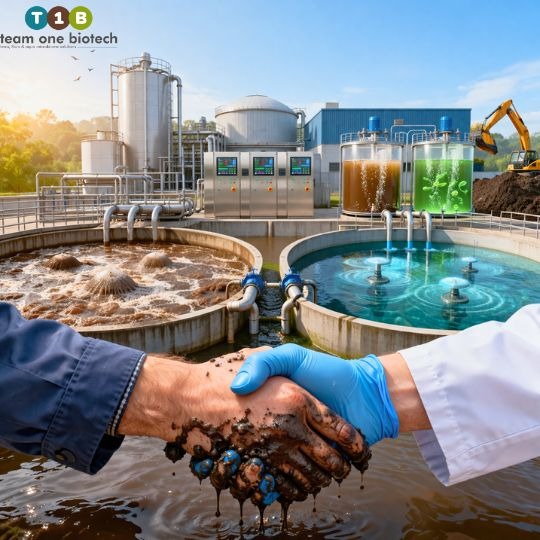
Running your ETP and running it well are two different things. Most plants operate in a fixed configuration that was set during commissioning and adjusted only when something goes wrong. Aeration runs at a fixed rate. The clarifier operates on a fixed cycle. Sludge gets wasted on a schedule that was set years ago and never revisited. The system produces effluent. Sludge accumulates. The cycle repeats.
What is almost never done is genuine process optimization, adjusting operating parameters based on what the biology actually needs at different load conditions. And the gap between a fixed-configuration ETP and an optimized one is where enormous quantities of excess sludge are quietly generated, day after day.
Understanding the difference between aerobic and anaerobic processes is central to this optimization.
The aerobic process is effective but biologically expensive. Aerobic bacteria consume oxygen to break down organic matter, and they produce significant biomass in the process, roughly one gram of sludge for every gram of COD removed under conventional conditions. That ratio is not fixed; it responds to operating parameters. But under standard activated sludge conditions, aerobic treatment is your biggest sludge generator.
The anaerobic process is fundamentally different. Anaerobic bacteria convert organic matter to biogas, primarily methane and CO₂, with dramatically lower biomass production. Anaerobic systems typically produce 80–90% less sludge than aerobic systems treating equivalent organic loads. (Note: These are general estimates and actual performance parameters will vary based on specific ETP design, effluent characteristics, and operating conditions.) For high-strength industrial effluents, distillery spent wash, dairy process water, chemical manufacturing effluent, a properly designed anaerobic pre-treatment stage can remove the bulk of the organic load before the aerobic polishing stage handles the rest. The aerobic system works on a fraction of the original load, generates a fraction of the original sludge, and consumes significantly less aeration energy in the process.
Beyond the aerobic-anaerobic balance, process fine-tuning also means:
- Sludge retention time management: Longer SRTs give microorganisms time to metabolize their own cellular material, a process called endogenous respiration that directly reduces net biomass output.
- Dissolved oxygen control: Maintaining DO in the right range prevents both anaerobic dead zones that cause bulking and over-aeration that wastes energy without improving treatment.
- Load equalization: Smoothing influent peaks through equalization reduces shock loads, one of the primary drivers of excess sludge generation in Indian industrial ETPs where production schedules are rarely uniform.
These are not capital-intensive changes. They are operational disciplines that pay for themselves in reduced sludge volumes across every billing cycle.
Way 3: Mechanical Dewatering Combined With Biological Conditioning
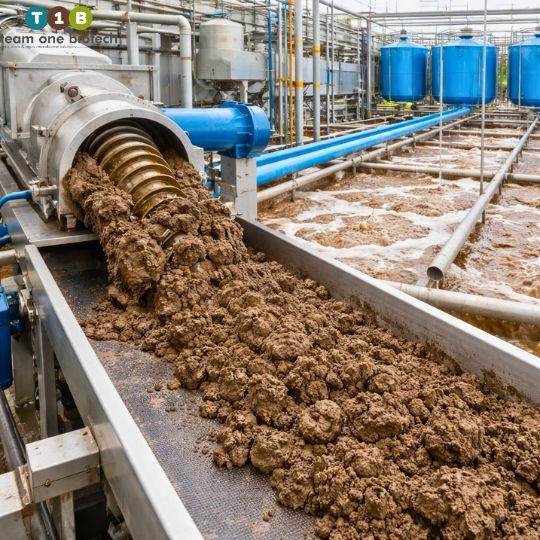
Let us be precise about what mechanical dewatering does and does not do. A belt press, filter press, or centrifuge does not reduce the mass of sludge your ETP generates. It removes water from the sludge that is already there, making it lighter, easier to handle, and cheaper to transport. The organic solids remain.
What determines how well your dewatering equipment performs is not the machine itself, it is the nature of the sludge going into it. And this is where biological conditioning changes everything.
Raw biological sludge dehydrates poorly. The reason is a substance called extracellular polymeric substances, EPS, which is essentially the structural glue holding microbial cells together in the sludge matrix. EPS is highly hydrophilic. It holds water tenaciously, which is why raw biological sludge going into a filter press often produces a cake with only 14–18% dry solids. The rest is water you are paying to transport and dispose of.
Biological conditioning treats this problem at the molecular level. Enzymatic preparations, specific enzyme blends selected for your sludge composition, break down the EPS matrix before dewatering. The sludge structure loosens. Water releases more freely. The same belt press or centrifuge that previously produced a 16% dry solids cake now produces one at 22–28%. (Note: These are general estimates and actual performance parameters will vary based on specific ETP design, effluent characteristics, and operating conditions.)
That improvement has a direct financial translation. Drier sludge is lighter sludge. Fewer disposal trips per tonne of dry solids. Lower transportation costs per cycle. And in many cases, particularly for plants in sectors like textiles or food processing where sludge composition is relatively consistent, improved dry solids content can shift the sludge from landfill disposal to co-processing in cement kilns, where it is used as an alternate fuel. The cost difference between those two disposal routes, calculated over a year of operations, often runs into significant lakhs for mid-to-large plants.
Biological conditioning requires no capital investment in new dewatering infrastructure. Your existing press or centrifuge remains the mechanical workhorse. The biology changes what goes into it, and dramatically improves what comes out.
A note before we continue: if you are spending more on sludge disposal than your operational budget can absorb comfortably, the answer is almost certainly in your process biology, not in more dewatering capacity or more expensive disposal contracts. Team One Biotech works with Indian industrial plants to identify exactly where excess sludge is being generated and what it is costing. Our sludge audits are detailed, specific, and actionable. If that conversation is relevant to where your plant stands right now, reach out to our technical team.
Way 4: Source Reduction and Hydraulic Retention Time Management

The most underrated sludge reduction strategy is also the most logical one: generate less organic load in the first place.
Source reduction is not glamorous. It does not involve advanced biology or specialized equipment. It involves looking honestly at your production process and identifying where organic waste enters your wastewater stream unnecessarily, and then doing something about it. In the Indian industrial context, this typically means three areas of focus.
Stream segregation is frequently overlooked in plants that grew incrementally without a master ETP design. High-strength process effluent, concentrated dye baths, mother liquor, high-COD process condensates, gets mixed with low-strength washdown water or cooling water before reaching the ETP collection sump. The result is a larger volume of moderate-strength effluent that your biological system has to process. Segregating these streams allows high-strength waste to be treated separately and efficiently, while low-strength streams bypass biological treatment entirely or receive minimal treatment. The reduction in total organic load hitting your ETP directly reduces biological sludge generation.
In-process water reuse reduces the total hydraulic volume entering your ETP. Less water means less biomass turnover and proportionally less sludge production. For water-intensive industries, textiles, food processing, paper, even modest reuse ratios can produce meaningful reductions in ETP load.
Process chemical substitution is a longer-term lever but a powerful one. Replacing poorly biodegradable surfactants, dispersants, or process aids with more biodegradable alternatives reduces the fraction of organic material that passes through biological treatment and ends up concentrated in sludge. This is particularly relevant for specialty chemical, pharmaceutical, and textile sector plants.
On the ETP operations side, HRT management deserves specific attention. Hydraulic retention time, how long wastewater spends in each treatment zone, directly affects how completely biological treatment removes organic load. When operators increase flow rates during production peaks to prevent upstream backup, HRT drops precisely when the biology needs more contact time. Organic material that should have been metabolized passes through instead, concentrating in the sludge fraction. Establishing HRT control protocols, supported by a proper equalization basin, keeps contact time consistent across load variations. The impact on sludge volumes, typically a reduction of 15–25% on a sustained operational basis, is one of the highest-return improvements available without any capital spend on new treatment infrastructure.
(Note: These are general estimates and actual performance parameters will vary based on specific ETP design, effluent characteristics, and operating conditions.)
Way 5: Advanced Enzymatic and Biological Treatment to Break Down Refractory Organics

Every industrial ETP has compounds that its biological system cannot fully degrade. In textile plants, it is reactive dyes and their breakdown products. In pharmaceutical manufacturing, it is API intermediates and complex ring structures. In the leather sector, it is chromium complexes and vegetable tanning compounds. In specialty chemical plants, it is any number of synthetic polymers and aromatic compounds.
These are called refractory organics, compounds that resist conventional biological treatment because the microbial populations in a standard activated sludge system simply do not carry the enzymatic machinery to break them down. Instead of being metabolized, they accumulate in the sludge fraction. They increase sludge volume. They elevate the organic and sometimes hazardous content of your final sludge cake. And they complicate disposal, because sludge containing high concentrations of recalcitrant compounds often fails TCLP testing, forcing landfill disposal of material that might otherwise qualify for co-processing or land application.
Advanced enzymatic treatment targets these compounds specifically. Enzymes such as laccases, peroxidases, and hydrolases can depolymerize complex organic structures, breaking apart the molecular architecture of compounds that biological systems cannot attack directly. Once depolymerized, the simpler breakdown products become available for microbial consumption in the subsequent biological treatment stage. The result is a two-stage attack: enzymatic breakdown followed by biological assimilation.
When implemented as part of a comprehensive sludge treatment program, advanced enzymatic treatment delivers several compounding benefits:
- Reduced total sludge mass: More complete degradation of organic compounds means less material accumulating in the sludge fraction.
- Improved sludge biodegradability: Sludge with lower refractory organic content digests more effectively in downstream anaerobic digesters or co-composting systems, turning a disposal liability into a potential resource.
- Improved regulatory classification: Lower TCLP values in the final sludge cake can shift disposal classification from hazardous to non-hazardous, a compliance milestone with direct cost implications that many Indian plants are actively working toward.
- System stability: Better organic removal reduces the accumulation of inhibitory compounds in your biological system, improving overall treatment performance and reducing the frequency of process upsets that generate sludge spikes.
For sectors where refractory organics are a defining characteristic of the effluent, textiles, pharmaceuticals, specialty chemicals, this fifth strategy often delivers the most significant ROI precisely because it addresses both the compliance risk and the disposal cost simultaneously.
The ROI of Bioremediation: What Sludge Reduction Actually Means for Your Bottom Line
Put the five strategies above together and the cumulative impact on sludge generation is substantial. Plants implementing combined bio-augmentation, aerobic and anaerobic process optimization, biological conditioning, source reduction, and advanced enzymatic treatment have achieved total sludge output reductions in the range of 30–50% on a sustained operational basis.
(Note: These are general estimates and actual performance parameters will vary based on specific ETP design, effluent characteristics, and operating conditions.)
For a mid-sized plant generating 500–800 tonnes of wet sludge annually, that reduction translates into measurable, line-item savings across every cost category associated with sludge management:
- Fewer contractor disposal trips per month
- Lower tipping fees per tonne of material disposed
- Reduced dewatering equipment wear and maintenance
- Smaller compliance documentation burden per audit cycle
- In favorable cases, a shift in disposal classification that eliminates hazardous waste handling costs entirely
Beyond the direct financial impact, there is a strategic dimension that plant managers and CXOs increasingly recognize. Regulatory pressure on industrial sludge disposal in India is moving in one direction. CPCB and SPCB are tightening manifesting requirements, scrutinizing disposal contractor compliance trails more carefully, and in some states moving toward stricter limits on landfill-bound industrial waste. The plant that has already reduced its sludge volume by 35–40% enters that regulatory environment from a fundamentally stronger position than one still running a maximum-sludge-generation process.
Sludge reduction through bioremediation is not a cost center. When it is done correctly, it is one of the highest-return environmental investments an Indian industrial plant can make.
Stop Managing Sludge. Start Eliminating It.
Most plants dealing with a sludge problem respond with logistics: more trucks, bigger presses, higher-capacity storage. That approach does not solve the problem. It defers it at increasing cost, quarter after quarter, until the disposal invoices become impossible to ignore and a regulatory notice forces a more fundamental response.
The manufacturers getting ahead of this issue are taking a different approach. They are investing in the biological intelligence of their ETP, the microbial populations, the enzymatic toolkit, the process discipline, that converts organic load into energy and CO₂ rather than tonnes of wet sludge requiring disposal. They are treating their ETP not as a compliance obligation to be managed but as a biological system to be optimized.
Team One Biotech partners with Indian industrial plants across sectors to design and implement bioremediation-based sludge reduction programs built around your specific effluent chemistry, your existing infrastructure, and your compliance obligations. We do not sell generic microbial products or off-the-shelf enzyme packages. We start with a rigorous sludge audit, characterizing your effluent, assessing your biological treatment system, identifying the specific drivers behind your sludge generation, and quantifying what they are costing you. Then we build a program around what your system actually needs.
If sludge disposal costs are a recurring pressure in your operational budget, and for most Indian industrial plants they are, the first step is understanding exactly where that sludge is coming from and why it keeps coming.
Book a Sludge Audit with Team One Biotech. Our technical team will assess your ETP, map your sludge generation profile, and deliver a clear, specific, actionable reduction roadmap. No generic recommendations. No theoretical frameworks. A real plan for your plant, grounded in your actual numbers.
Contact Team One Biotech today and turn your most stubborn operational liability into a problem that stays solved.
Looking to improve your ETP/STP efficiency with the right bioculture?
Talk to our experts at Team One Biotech for customised microbial solutions.
Contact: +91 8855050575
Email: sales@teamonebiotech.com
Visit: www.teamonebiotech.com
Discover More on YouTube – Watch our latest insights & innovations!-
Connect with Us on LinkedIn – Stay updated with expert content & trends!