
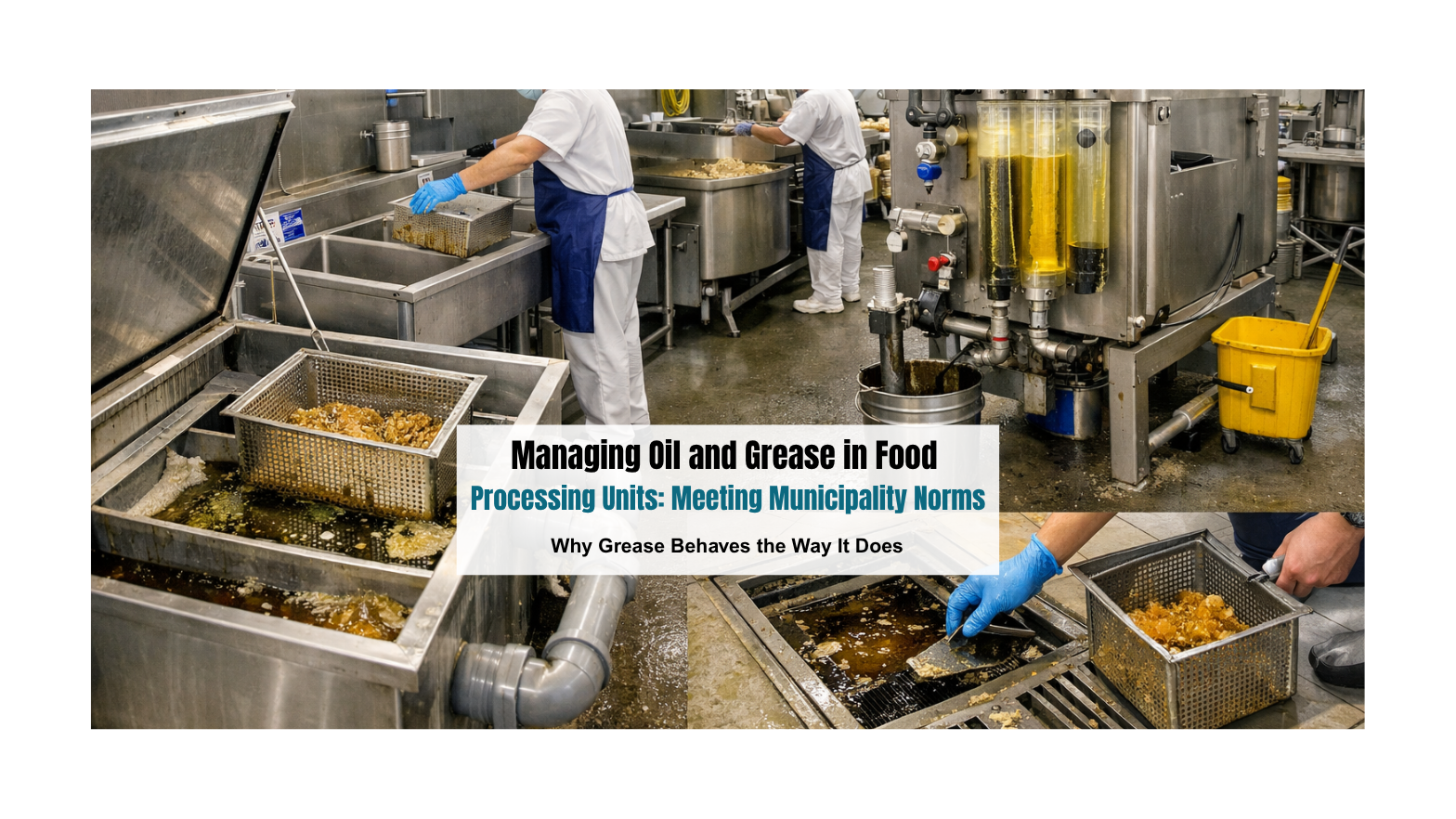
Managing Oil and Grease in Food Processing Units: Meeting Municipality Norms
Ask any hotel operations manager what their worst Saturday night looks like, and somewhere in that story, there is a blocked drain.
It is peak service. The banquet hall is full. The main kitchen is running three stations simultaneously. And then the floor drain near the dishwashing area starts backing up. Slowly at first, just a thin film of greasy water spreading across the tiles. Then faster. Within minutes, the kitchen supervisor is on the phone, the executive chef is furious, and someone is making the call that nobody wants to make: we need to slow down service.
What follows is not just a plumbing emergency. It is a cascade. Guests notice delays. Staff morale takes a hit. If a health department inspector happens to visit the following morning, and in several Indian cities, anonymous complaints do trigger surprise visits, the conversation becomes significantly more expensive than a plumber’s bill.
FOG management, which stands for Fats, Oils, and Grease, is one of those operational responsibilities, often detailed in “ The Ultimate FOG Management & Septic Health Guide for Commercial Facilities “, that sits quietly in the background until it does not. And when it fails, it fails loudly, expensively, and almost always at the worst possible time.
Why Grease Behaves the Way It Does
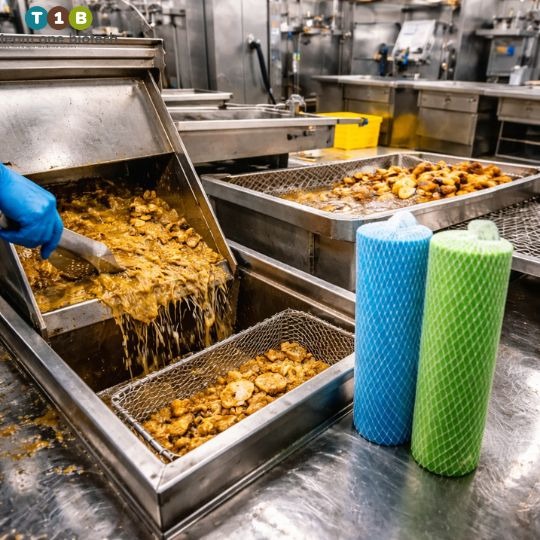
To understand why oil and grease trap maintenance matters so much, it helps to understand what FOG actually does inside a commercial drain system.
When kitchen wastewater is hot, grease moves freely. It looks harmless flowing down a drain. The problem begins about two meters into your pipe network, where the water starts to cool. As temperature drops, FOG transitions from liquid to semi-solid, and it starts sticking to pipe walls. Over time, those thin layers build up into something considerably more stubborn.
Indian kitchens add another variable to this: the cooking itself. Heavy use of ghee, refined oils, coconut oil, and animal fats in Indian cuisine means the FOG load per meal is considerably higher than in, say, a continental kitchen. A hotel running a multicuisine buffet, a south Indian restaurant doing high-volume lunch service, or an industrial canteen preparing meals for a factory shift, each of these operations pushes a significant FOG burden into the drain system every single day.
The consequences compound quickly:
- FOG narrows drain channels gradually, then blocks them suddenly
- Accumulated grease produces hydrogen sulfide gas, responsible for the rotten-egg odor that no amount of air freshener solves
- It creates a warm, nutrient-rich environment where pathogens multiply
- It is the single biggest reason commercial grease traps fill faster than their scheduled maintenance intervals
None of this is dramatic in isolation. Each day’s accumulation is small. But over weeks and months, a drain system that receives no biological intervention will degrade in a way that physical cleaning alone cannot reverse.
The Honest Problem with Traditional Grease Trap Cleaning
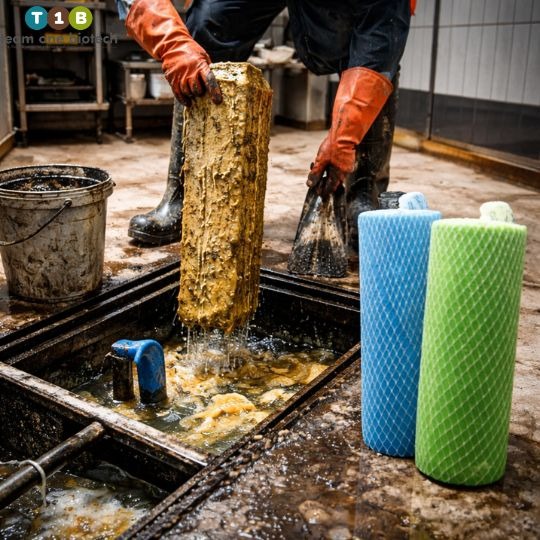
Most facility managers running commercial kitchens already know what a grease trap is. The interceptor unit sits between your kitchen drains and the municipal sewer line, capturing FOG before it enters the public network. It does its job, but only up to a point.
The standard maintenance routine is physical cleaning: a crew arrives with pumps and hoses, removes the accumulated grease, washes down the trap interior, and leaves. This is necessary. But here is what it does not fix.
Physical cleaning removes what has already separated out in the trap. It does not address:
- The grease film coating the interior walls of the trap between cleanings
- The FOG that has already migrated past the trap into downstream pipes
- The biofilm layer building up across your entire drain network
- The fact that accumulation resumes almost immediately after the crew leaves
In a high-volume Indian kitchen, a monthly cleaning cycle is often not enough. Some operations, banquet kitchens, large QSR franchises, hospital cafeterias, generate enough FOG that their grease traps are at capacity well before the next scheduled visit. When that happens, grease bypasses the trap entirely and flows directly into the municipal sewer. That is both a compliance problem and a practical one.
There is also the cost reality. Grease trap cleaning by external vendors is not cheap when you add up service visits, pump-out fees, and the labor cost of the downtime involved. Many operations are spending more on reactive maintenance than they would on a well-designed preventive programme.
What Indian Regulations Actually Require From You
This is the part of the conversation that most facility managers find uncomfortable, not because they do not care about compliance, but because the regulatory framework is genuinely layered and not always easy to navigate.
In India, commercial wastewater discharge is governed at two levels. The Central Pollution Control Board (CPCB) sets the national standards. State Pollution Control Boards (SPCBs) enforce them, and enforcement varies considerably depending on your state, your commercial zone classification, and how actively the local municipal corporation is pursuing the issue.
For food establishments discharging into municipal sewers, the effluent standards cover oil and grease content, BOD levels, pH, and suspended solids. Several large municipal corporations, including those in Delhi, Mumbai, Bengaluru, and Hyderabad, have tightened scrutiny on commercial kitchens specifically, driven by the growing problem of sewer chokes that municipal engineers are linking directly to restaurant grease.
On top of CPCB and SPCB requirements, FSSAI’s licensing framework under Schedule 4 of the Food Safety and Standards (Licensing and Registration of Food Businesses) Regulations, 2011, requires that wastewater management systems be maintained and functional.
In practical terms, compliance means having:
- A correctly sized grease interceptor or oil and grease trap installed and operational
- Documented maintenance records available for inspection at any time
- Effluent quality that meets the applicable CPCB and SPCB discharge limits for oil and grease
- In several states, periodic effluent test reports submitted to the SPCB
What makes this more than just paperwork is the consequence of getting it wrong. A show-cause notice from the PCB does not just result in a fine. It can delay license renewals, disrupt procurement relationships with institutional clients, and in repeated-violation situations, result in closure orders. For a hotel group or a managed kitchen operation, that is a risk worth taking seriously.
The facilities that treat compliance as a business asset, rather than a nuisance, tend to be the ones that never have that conversation with an inspector.
What Bioremediation Does That Cleaning Cannot
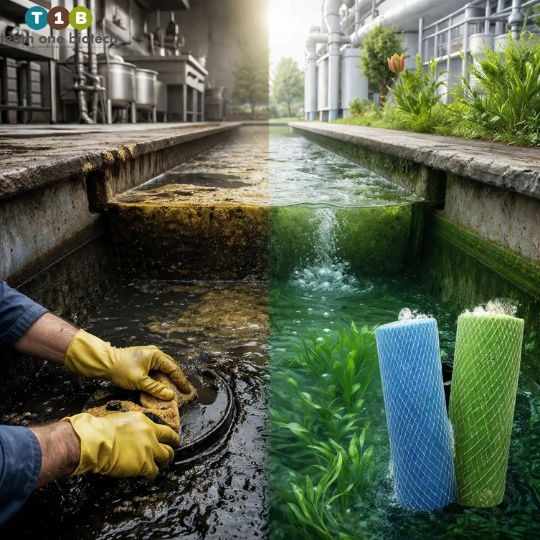
Bioremediation is not a new concept in industrial waste management. What is relatively newer is its application in commercial kitchen and food processing environments in India, where awareness has historically lagged behind the technology.
The principle is straightforward. Certain strains of naturally occurring bacteria produce enzymes called lipases, which break down the molecular structure of fats and oils. When introduced into a grease trap or drain system, these bacteria colonize the surfaces where FOG accumulates and digest it continuously, not just during a scheduled cleaning visit, but around the clock, between visits, through the weekend rush, and through the Monday morning prep session.
Bio-Blocks for Hotels
For busy hotel kitchens where staff turnover is high and operational consistency is key, Bio-Blocks for Hotels offer the ultimate “set and forget” solution. These slow-release bacterial blocks are placed directly inside the grease trap or high-flow drain lines. Unlike liquid treatments that can be washed away during heavy cleaning shifts, the block stays in place, eroding slowly to provide a constant, metered dose of FOG-digesting microbes. This eliminates the need for daily manual dosing by kitchen staff, ensuring the drainage system remains protected even during the most hectic banquet seasons.
Liquid Bacterial Concentrates are dosed periodically into floor drains, sink drains, and grease trap inlets. These are particularly suited to larger kitchen operations with multiple drain points, where a single-location block may not reach every part of the drain network. The liquid format ensures bacterial activity extends through the full length of the drainage system.
Team One Biotech’s product range for FOG management is built around two primary delivery formats:
Dosage and application frequency depend on kitchen volume, FOG load, trap size, ambient temperature, and the specific drain configuration. General treatment ranges run between doses applied every few days to weekly intervals, depending on operational intensity.
These are general values and may vary significantly based on the specific facility design, FOG load, and environmental conditions. A site assessment gives you the precise protocol rather than a generic one.
FOG Challenges and Bioremediation Solutions
| FOG Challenge | Conventional Approach | Bioremediation Solution |
| Grease trap fills rapidly | More frequent pump-outs | Bio-Blocks reduce accumulation rate between cleanings |
| Drain line blockages | High-pressure jetting | Bacterial cultures digest grease on pipe walls continuously |
| Foul odors from drains | Deodorizers and masking agents | Bacteria eliminate odor-causing compounds at the source |
| Non-compliant effluent | Increased cleaning frequency | Sustained FOG reduction brings discharge closer to CPCB norms |
| Septic tank FOG overload | Emergency desludging | Bio-augmentation restores microbial balance and prevents recurrence |
| High maintenance costs | Treated as fixed operating expense | Preventive dosing reduces frequency and cost of mechanical intervention |
What a Well-Managed FOG Programme Actually Looks Like
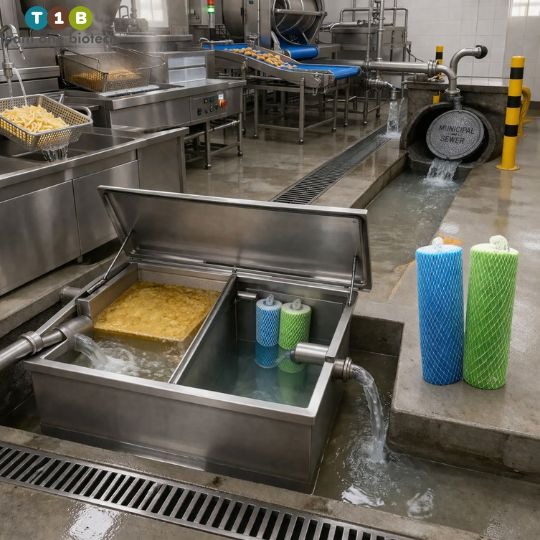
The facilities that get this right are not necessarily spending more. They are spending differently, shifting budget from reactive callouts to preventive dosing, and getting considerably more operational stability in return.
In practice, a well-managed FOG programme for a commercial kitchen combines three things: correctly sized physical infrastructure (grease trap appropriate for your kitchen’s daily output), a scheduled biological dosing routine using bacterial products, and periodic physical cleaning on a cycle that is determined by actual accumulation data rather than a fixed calendar.
For a hotel managing multiple F&B outlets, standardising this protocol across all kitchen units also simplifies audit preparation. Your maintenance logs are consistent. Your effluent quality is predictable. When the PCB inspector visits, you are not scrambling.
For a standalone restaurant or QSR franchise, the benefit is simpler: fewer emergency drain callouts, less odor, and a grease trap that your cleaning crew actually likes working with.
Ready to Stop Reacting and Start Managing?
Every kitchen is different. The right FOG management protocol depends on your kitchen’s size, cooking style, drain configuration, trap capacity, and whether you are on municipal sewer or a septic system.
Team One Biotech works with hotels, restaurant groups, hospital kitchens, food processing facilities, and industrial canteens across India to design site-specific bioremediation programmes. The process starts with a facility audit, a straightforward assessment of your current grease management setup, your drain health, and your compliance position.
If your grease trap is being cleaned more often than it should be, if your drains smell between cleaning visits, or if you are not entirely confident in your current effluent quality, that is worth a conversation.
Get in touch with Team One Biotech for a site audit consultation. The right programme does not just fix the problem, it means the 2 AM call never comes.
Looking to improve your ETP/STP efficiency with the right bioculture?
Talk to our experts at Team One Biotech for customised microbial solutions.
Contact: +91 8855050575
Email: sales@teamonebiotech.com
Visit: www.teamonebiotech.com
Discover More on YouTube – Watch our latest insights & innovations!-
Connect with Us on LinkedIn – Stay updated with expert content & trends!