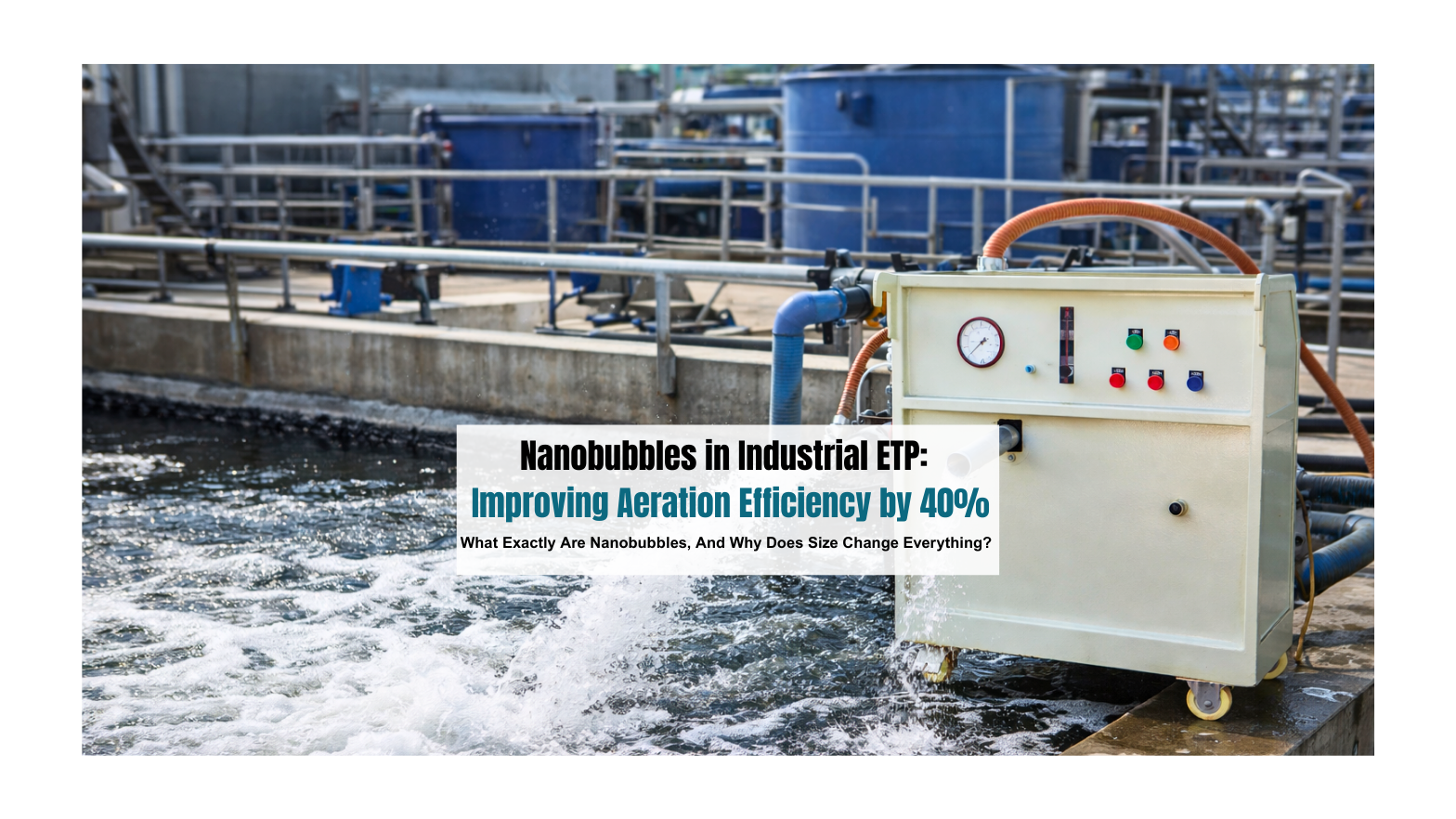
Nanobubbles in Industrial ETP: Improving Aeration Efficiency by 40%
Water is the UAE’s most politically sensitive resource, and for industrial operators, it is rapidly becoming the most financially dangerous one. The Arabian Peninsula sits atop one of the world’s most water-stressed geographies, and industrial effluent treatment has never carried higher stakes, regulatory, reputational, and economic.
Here is the uncomfortable reality: most industrial Effluent Treatment Plants (ETPs) in Dubai and Abu Dhabi are hemorrhaging operational budgets through one largely overlooked system, aeration. Conventional diffused aeration and surface aerators consume anywhere between 50% to 70% of an ETP’s total energy load. In the UAE’s climate, where ambient temperatures routinely exceed 45°C and reduce dissolved oxygen (DO) saturation to critically low levels in biological treatment tanks, that energy expenditure buys far less oxygen transfer than operators assume.
The result? Biological treatment underperforms. BOD and COD readings breach the thresholds set by Dubai Municipality (DM) Circular 17 and Abu Dhabi Sewerage Services Company (ADSSC) Technical Standards. Penalties follow. Reputational damage follows that.
Water Treatment with Nanobubble Generator Technology is the solution every Facility Manager, Sustainability Officer, and plant operator in the Gulf should be looking for; the question is no longer whether their ETP can meet compliance, but whether their aeration strategy is fit for purpose in an environment that actively works against conventional oxygen transfer physics.
What Exactly Are Nanobubbles, And Why Does Size Change Everything?
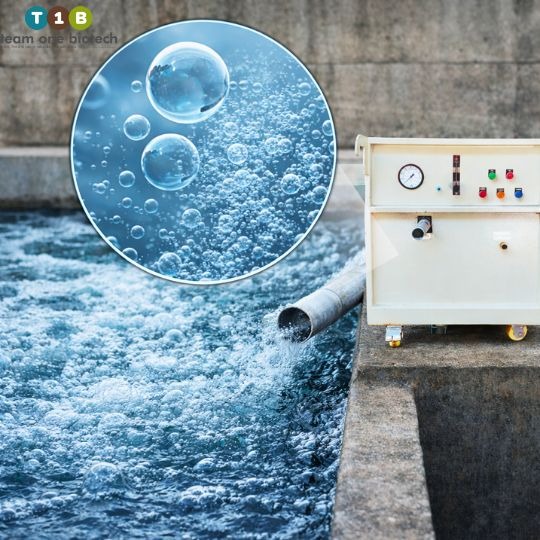
The physics of bubble-based aeration are straightforward: smaller bubbles mean greater surface area for gas-liquid mass transfer. Conventional coarse-bubble aerators produce bubbles in the 2–5 mm range. Fine-bubble diffusers drop that to 1–3 mm. Both represent incremental improvements on the same fundamental limitation, buoyancy causes bubbles to rise and escape the liquid column rapidly, limiting contact time to fractions of a second.
Nanobubbles (NBs) operate in an entirely different regime.
Nanobubbles are defined as gaseous cavities with diameters below 100 nanometers, roughly 2,500 times smaller than a fine bubble. At this scale, three physical phenomena converge to produce treatment outcomes that conventional aeration simply cannot replicate:
1. Near-Neutral Buoyancy and Extended Residence Time
At sub-100 nm diameters, buoyancy forces are negligible relative to the drag forces exerted by the surrounding liquid. Nanobubbles do not rise and escape, they remain suspended in solution for hours, sometimes days. In a biological aeration basin, this translates directly to prolonged oxygen availability for microbial biomass, even in thermally stratified tanks where DO depletion at depth is a persistent UAE-specific challenge.
2. High Internal Pressure and Accelerated Gas Transfer
Governed by the Young-Laplace equation, the internal pressure of a bubble increases inversely with its radius. A nanobubble at 100 nm diameter carries an internal pressure orders of magnitude higher than a 1 mm fine bubble. This elevated pressure gradient drives oxygen molecules across the gas-liquid interface at significantly accelerated rates, the fundamental mechanism behind the 40% improvement in oxygen transfer efficiency documented in industrial deployments of nanobubble generator UAE systems.
3. Electrostatic Surface Charge and Colloidal Stability
Nanobubbles carry a negative surface charge (zeta potential) that provides electrostatic repulsion between bubbles, preventing coalescence and maintaining population density within the liquid phase. This property also enhances interaction with positively charged suspended solids and biological floc, supporting both biological treatment and physical separation processes.
The 40% Advantage: Breaking Down What This Means for Your ETP’s Bottom Line
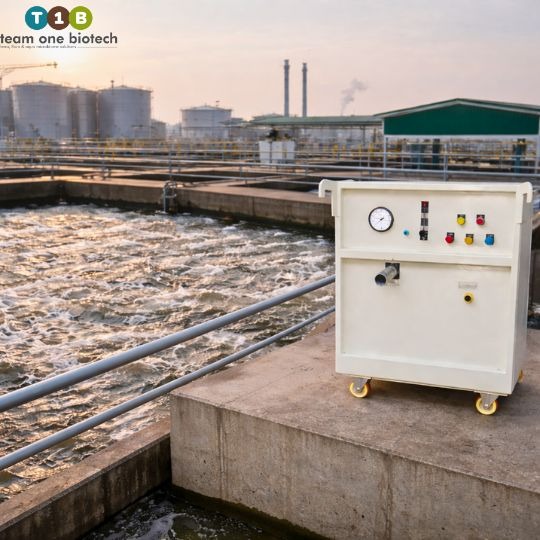
When Team One Biotech (T1B) deploys its Nanobubble Generator UAE systems into an industrial ETP, the 40% efficiency improvement is not a marketing figure, it is a measurable, auditable outcome grounded in Standard Oxygen Transfer Rate (SOTR) and Standard Aeration Efficiency (SAE) testing protocols.
Consider what a 40% reduction in aeration energy demand means in practice for a mid-scale industrial ETP in Dubai’s Jebel Ali Industrial Zone processing 500 m³/day of effluent:
- Baseline aeration energy cost at AED 0.38/kWh: approximately AED 180,000–220,000 annually
- Post-nanobubble deployment energy savings: AED 72,000–88,000 per year, conservatively
- Payback period on capital investment: typically 18–30 months depending on plant configuration
- Reduction in aeration-related CO₂ emissions: directly aligned with UAE Net Zero 2050 decarbonization commitments
Beyond energy, the biological performance gains are equally significant. Elevated and sustained DO levels, maintained at 4–6 mg/L even during peak summer temperatures when conventional systems struggle to hold 2 mg/L, accelerate heterotrophic and nitrifying bacterial activity. In practice, T1B clients document BOD removal efficiencies exceeding 95% in aerobic biological treatment stages, compared to 75–85% with conventional fine-bubble aeration under UAE summer conditions.
This is not marginal optimization. This is the difference between reliable Dubai Municipality Wastewater Compliance and monthly variance reports.
If your ETP has not been benchmarked against nanobubble-enhanced aeration in the last 24 months, you are operating on assumptions that the science has already moved past. Request an efficiency audit from T1B today.
UAE-Specific Challenges That Make Nanobubbles Not Optional, But Necessary
High Salinity Wastewater and Oxygen Transfer Depression
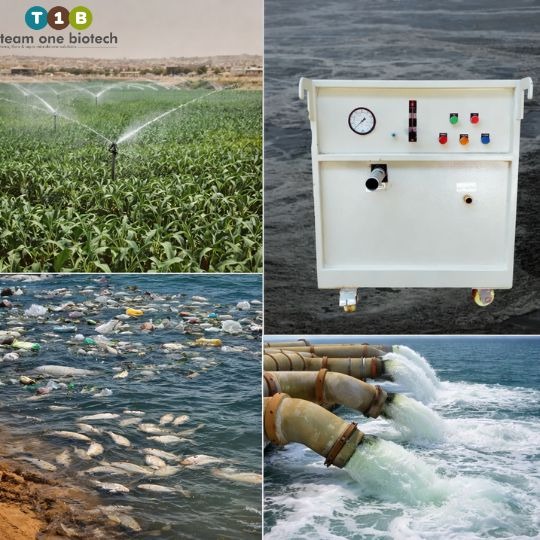
Industrial facilities across Abu Dhabi’s industrial corridors, particularly those involved in produced water handling, brine discharge management, and coastal manufacturing, contend with elevated salinity levels that chemically suppress oxygen transfer coefficients (the alpha and beta factors in aeration design). Saline water holds less dissolved oxygen at saturation, and conventional aeration systems are rarely corrected for this in UAE deployments.
Nanobubble technology exhibits significantly lower sensitivity to salinity-driven oxygen transfer depression due to the pressure-driven transfer mechanism. Where a fine-bubble diffuser may see a 20–30% reduction in effective oxygen transfer in high-TDS produced water streams, T1B’s nanobubble generators maintain transfer rates within 8–12% of freshwater performance benchmarks.
Extreme Temperature and Thermocline Formation
Above 35°C, the oxygen saturation ceiling in water drops precipitously. At 45°C, a realistic surface temperature in an uncovered ETP in July, DO saturation is barely 6.5 mg/L, leaving almost no operational headroom for conventional aerators to maintain the minimum 2 mg/L threshold required by ADSSC Technical Standards for biological treatment performance.
Nanobubble generators integrated with T1B’s bioaugmentation programs (seeding specific microbial consortia adapted to thermophilic UAE conditions) allow biological treatment to remain effective at ambient temperatures where conventional ETPs enter compliance risk.
Sector Deep-Dive: Where Nanobubbles Are Transforming UAE Industry Right Now
Oil and Gas: Produced Water Treatment
Produced water, the largest volume byproduct of hydrocarbon extraction, arrives at treatment facilities loaded with residual hydrocarbons, suspended solids, and often significant hydrogen sulfide. ADNOC onshore facilities and offshore platform operators face escalating scrutiny on produced water discharge quality under UAE environmental frameworks.
T1B’s nanobubble generator UAE systems applied to produced water bioreactors deliver measurable TPH (Total Petroleum Hydrocarbon) degradation improvements by sustaining aerobic conditions in treatment zones that fluctuate violently in organic load. The extended bubble residence time ensures that hydrocarbon-degrading microbial communities are never oxygen-limited during shock loading events, a persistent failure point in conventional produced water ETPs.
Cooling Tower Blowdown: Reducing Chemical Dependence
Industrial cooling towers in Dubai and Abu Dhabi generate blowdown streams that are chemically complex, biologically active, and increasingly regulated under DM Industrial Wastewater Guidelines. Conventional treatment relies heavily on chemical oxidants, which carry their own disposal costs and regulatory footprint.
Nanobubble-enhanced treatment of cooling tower blowdown reduces chemical oxygen demand (COD) through accelerated aerobic biodegradation, and the elevated reactive oxygen species (ROS) generated within collapsing nanobubbles provide a natural biocidal effect that reduces Legionella risk, a growing priority for port authority and hospitality sector facilities in the region.
Aquaculture: Sustainable Water Treatment Meets Food Security
The UAE’s push toward food security under the National Food Security Strategy 2051 has accelerated investment in land-based aquaculture facilities, particularly Recirculating Aquaculture Systems (RAS). Dissolved oxygen management is the single most critical operational parameter in RAS, directly determining fish density, feed conversion ratios, and mortality rates.
T1B’s nanobubble generators installed in RAS oxygenation circuits have demonstrated the ability to maintain DO levels above 8 mg/L in recirculating seawater systems, a benchmark that conventional liquid oxygen injection struggles to achieve economically at scale in the UAE’s climate. The result is higher stocking densities, lower mortality, and a demonstrably more sustainable water treatment footprint.
Meeting Dubai Municipality and ADSSC Standards: T1B as Your Compliance Architecture
Dubai Municipality Circular 17/2016 and ADSSC’s Technical Guidelines on Industrial Effluent set clear discharge quality thresholds: BOD below 20 mg/L, COD below 150 mg/L, TSS below 30 mg/L, and pH within 6–9. For facilities discharging to the sewer network or coastal waters, the compliance burden has never been more rigorously enforced.
T1B’s integrated approach, combining nanobubble generator hardware with precision bioaugmentation using specifically formulated microbial consortia, addresses the root cause of ETP non-compliance: insufficient and inconsistent biological treatment performance. Unlike equipment-only vendors, T1B provides ongoing performance monitoring, microbial health assessments, and process optimization support to ensure that Industrial ETP Efficiency translates into sustained regulatory compliance, not just initial commissioning performance.
Do not wait for a non-compliance notice from Dubai Municipality or ADSSC to initiate your ETP modernization. T1B’s engineering team conducts rapid efficiency audits, contact them before the next inspection cycle.
Aligning with UAE Net Zero 2050: Nanobubbles as a Decarbonization Tool
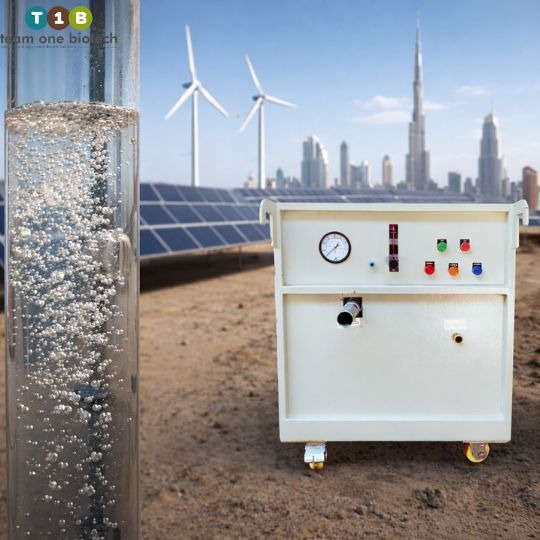
The UAE’s Net Zero 2050 Strategic Initiative places direct responsibility on industrial operators to reduce Scope 1 and Scope 2 emissions across their operations. Aeration systems, given their energy intensity, are a logical and high-impact decarbonization target.
A 40% reduction in aeration energy consumption across an industrial ETP does not merely save money, it generates verifiable, auditable Scope 2 emission reductions that can be reported against corporate sustainability targets. For organizations pursuing LEED certification, ISO 14001 compliance, or ESG reporting obligations, T1B’s nanobubble deployments provide quantifiable environmental performance data that supports these frameworks directly.
Sustainable Water Treatment is no longer a corporate social responsibility aspiration in the UAE, it is a regulatory and commercial imperative.
Global Accessibility: Source T1B Technology Through the Official Alibaba Store
For procurement teams operating across the UAE and internationally, sourcing advanced nanobubble hardware and microbial formulations through verified, auditable supply chains is a non-negotiable requirement.
Team One Biotech operates a fully verified Official Alibaba Store, providing procurement officers, plant engineers, and international facility managers with direct access to T1B’s complete product range, including nanobubble generator units, replacement components, and proprietary microbial bioaugmentation formulations.
The Alibaba platform provides verified supplier credentials, trade assurance protections, and international shipping logistics support, making T1B’s technology accessible whether your ETP is located in Jebel Ali, the Ruwais Industrial Complex, or internationally across Southeast Asia, South Asia, and Africa.
For UAE-based procurement teams with existing DM or ADSSC vendor approval requirements, T1B’s regional engineering team provides full technical documentation, compliance dossiers, and on-site commissioning support in parallel with Alibaba store procurement.
The platform removes every barrier between your facility’s efficiency gap and the technology that closes it. Visit the T1B Official Alibaba Store today, request a product consultation, and let your procurement team begin the process that your engineering team has already identified as necessary.
One Final Thought for Decision-Makers in Dubai and Abu Dhabi
Every month that an industrial ETP in the UAE runs on conventional aeration is a month of energy cost, biological underperformance, and compliance risk that nanobubble technology could have eliminated. The science is settled. The deployments are documented. The regulatory alignment is direct.
The only remaining variable is whether your organization acts before a non-compliance event, an energy audit, or a competitor’s sustainability report forces the conversation.
T1B’s engineering team is available for rapid ETP efficiency assessments. The audit costs nothing. The delay costs more than you may currently be accounting for.
Looking to improve your ETP/STP efficiency with the right bioculture?
Talk to our experts at Team One Biotech for customised microbial solutions.
Contact: +91 8855050575
Email: sales@teamonebiotech.com
Visit: www.teamonebiotech.com
Discover More on YouTube – Watch our latest insights & innovations!-
Connect with Us on LinkedIn – Stay updated with expert content & trends!