
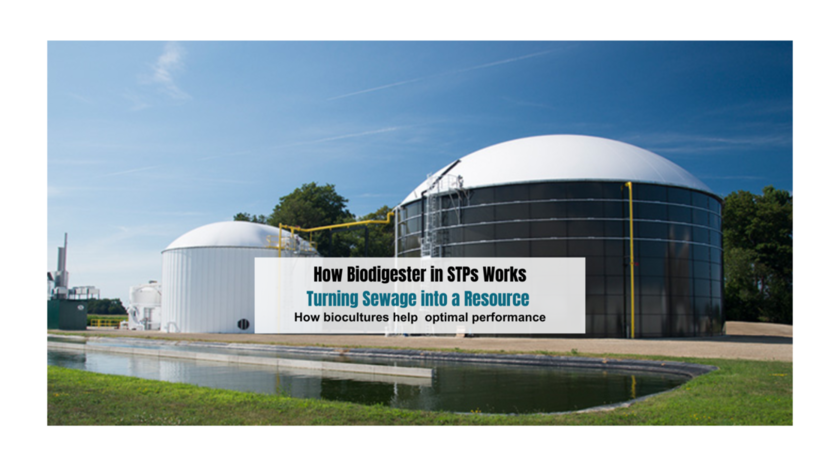
Turning Sewage into a Resource using biocultures (2) (1)
How Biodigester in STPs Works: Turning Sewage into a Resource Using Biocultures
India’s Sewage Challenge

India generates over 72,000 MLD of sewage daily, but less than half is treated effectively. This untreated wastewater flows into rivers like the Yamuna, Ganga, and Mula-Mutha, causing severe health and ecological damage. Despite multiple government initiatives like the Ganga Action Plan and National Mission for Clean Ganga, a significant sewage burden persists.

India is often termed by the world as the Spiritual capital, and people around the world flock to India to seek penance, embrace the tranquillity of nature and follow the path of GOD. But unfortunately, the past few centuries of dark chapters and post-independence blunders have made India and Indians be looked at as unfriendly to cleanliness, and we even prove it sometimes, because the very rivers that we worship and are sacred in our texts are among the most polluted rivers in the world.

By the 1970s and 80s, untreated sewage had become a national crisis. Outbreaks of cholera in Kolkata, jaundice in Surat (1994), and recurring typhoid cases in Delhi highlighted the urgent need for structured sewage management. It was clear that septic tanks and open drains could no longer cope with urban growth.

Why the Government Was Forced to Act

The first large-scale intervention came with the Ganga Action Plan (1986), which introduced Sewage Treatment Plants (STPs) in Kanpur, Varanasi, and other towns along the river. These were followed by the National River Conservation Plan (1995) and later the National Mission for Clean Ganga (2014).

The government realised that simply building drains wasn’t enough. What was needed were systems that could not only treat sewage but also manage solid waste sustainably. This is where biodigesters became a key component of STPs.

City Case Studies

Delhi ( Okhla STP, 1990s): One of the largest STPs in Asia, Okhla adopted biodigesters to process sewage sludge and generate biogas. However, poor maintenance has kept its output below potential, highlighting the gap between design and operation.

Kanpur (Ganga Action Plan, 1986): As one of the first cities to adopt STPs with biodigesters, Kanpur showed early promise.  But decades later, many plants fell into disrepair due to lack of funding and technical oversight, contributing to ongoing Ganga pollution.

Pune (Mula-Mutha River STPs, upgraded in 2018): A positive example, where biodigesters were modernised to produce electricity from biogas, helping reduce operational costs while tackling sewage loads.

Why Many Systems Struggle Today

Despite success stories, 40% of India’s STPs are either non-functional or underperforming (CPCB data). The reasons include:

  1. Poor Maintenance: Microbial cultures die out when not replenished.
  2. Finding Gaps: Municipal budgets often fail to cover operations.
  3. Skill Shortages: A lack of trained operators undermines performance.
  4. Outdated Designs: Many STPs still run on decades-old technology.
Role of Biodigesters in STPs

Biodigesters in Sewage Treatment Plants (STPs) are anaerobic chambers that use microbes to break down sludge. They:

  • Convert organic matter into biogas and nutrient-rich slurry.

  • Enable energy generation from methane.

  • Stabilise sludge and make it safe for reuse.

While cities like Delhi, Kanpur, and Pune have adopted biodigesters, around 40% of India’s STPs underperform due to poor microbial management, outdated designs, and lack of skilled operators.

How Biocultures Improve Biodigester Working

Biodigesters thrive only when the microbial population is balanced and active. Without replenishment, microbial colonies collapse, leading to foul odour, incomplete digestion, and reduced biogas yield.

Here’s how biocultures for STPs can solve these challenges:

  • Enhanced COD/BOD Reduction: Specialised microbial strains accelerate organic load breakdown.

  • Consistent Performance: Prevents biodigester failure during hydraulic shock loads.

  • Sludge Reduction: Biocultures minimise sludge accumulation, reducing disposal costs.

  • Odour & Pathogen Control: Maintains hygienic and sustainable operations.

Team One Biotech’s Expertise

As one of the leading biotech companies in India, Team One Biotech provides customised bioculture formulations to optimise biodigester working in STPs, ETPs, and decentralised sewage systems.

Our solutions include:
  • Anaerobic Biocultures tailored for methane generation.

  • Sludge-reducing microbial consortia to extend biodigester life.

  • Start-up cultures for new STPs or after shock loads.

  • On-site consultation and training for plant operators.

By integrating our biocultures, municipalities and industries can transform underperforming biodigesters into efficient, sustainable, and cost-saving systems.

Conclusion

Biodigesters are the backbone of modern sewage treatment in India, but they need consistent microbial support. Team One Biotech bridges this gap with advanced biocultures for STPs, ensuring reliable biodigester working, reduced sludge, and higher biogas yields.

With the right biotechnological support, India can move towards a circular wastewater economy, cleaner rivers, and healthier cities.

Explore More Solutions by Team One Biotech

Apart from biocultures for wastewater treatment, Team One Biotech also offers innovative and eco-friendly solutions across multiple sectors, including:

– Plant Growth Promoters – microbial formulations for improved agricultural productivity

– Aquaculture Probiotics – supporting fish and shrimp health naturally

– Bio Enzyme Floor Cleaner – eco-safe cleaning for homes and industries

– Multipurpose Cleaner – powerful natural alternative to chemical cleaners

– Septic Tank Cleaning Powder – maintaining septic efficiency and reducing odour

– Probiotic Drain Cleaner – preventing clogs and ensuring hygienic drains

Email: sales@teamonebiotech.com

Visit: www.teamonebiotech.com

Discover More on YouTube – Watch our latest insights & innovations!-

Connect with Us on LinkedIn – Stay updated with expert content & trends!

industrial holidays Anaerobic Wastewater Treatment in Industries
The effect of industrial holidays on ETP health

The ecosystem of industries is complex as well as consistent. However, shutdowns due to festivals, season, operational failure, or force give a halt to the whole system. Although mostly planned, these industrial holidays are intended to give relief, but deep down in the concrete basins of effluent treatment plants brews a storm of crisis, whether it may be in the primary, secondary, or tertiary systems.

Looking for expert solutions to manage ETP shutdown challenges? Contact Us today for tailored advice and services!

And if we focus on the secondary system, the microbial population gets the worst hit. This blog focuses on what happens inside the secondary system during an industrial holidays, its effects, precautions, and prevention.

The living Microbial world of ETP:

The secondary system is like a society where microbial populations i.e, bacteria, fungi, yeast, metazoans etc. thrive on:

Food: Readily biodegradable organic matter.

Shelter: Biofilms, flocs, or suspended habitats.

Environmental Comfort: pH, temperature, DO, and nutrients in a narrow optimal range.

Maintaining microbial diversity and stability is crucial for consistent ETP performance.

Microbial Starvation- A Hidden Shutdown Crisis

A 10-15 day shutdown without influent feed creates what we call a starvation phase in the bioreactor. The period can trigger several microbial stress responses:

Autolysis Begins:
  • Without food, heterotrophic bacteria begin digesting their own cellular reserves.
  • When reserves run out, cell walls rupture, releasing intracellular enzymes and ammonia into the mixed liquor.
Shift in Community Structure:
  • Fast-growing, high-COD degraders die off first.
  • Resilient microbes like filamentous bacteria and nitrifiers may survive longer, but their metabolic activity drops drastically.
Dissolved Oxygen (DO) Becomes Redundant:


  • With no substrate to oxidize, aeration continues but becomes wasteful.
  • High DO levels can paradoxically stress certain facultative anaerobes used to fluctuating oxygen levels.


MLSS/MLVSS Decline:
  • The Mixed Liquor Volatile Suspended Solids (MLVSS)- the biologically active portion of MLSS drops due to decay.
  • Settling characteristics deteriorate, and the SVI (Sludge Volume Index) can spike due to deflocculation.
Recovery is Not Instant – The Myth of “Rest and Run”

When production resumes, many assume the ETP will bounce back like a machine switched on. But biological wastewater treatment systems have no reset button.

Lag Phase in COD Reduction
  • Microbial populations take time to rebuild numbers and enzyme systems.
  • Expect 2-5 days of poor performance and higher COD/BOD in the outlet, especially in systems with no pre-seeding plan.
Sludge Age Misbalance
  • Sludge that has aged during the shutdown may have lost its settling efficiency.
  • Decayed sludge may also release toxins and nutrients, creating internal loading.
Shock Loads on Restart
  • Sudden reintroduction of full-strength effluent can lead to shock loading.
  • This exacerbates foaming, odor, and even system upset.
Preventive Measures

ETP health during shutdowns doesn’t have to be a gamble. Here are proven strategies, drawn from both research and field practices.

1.Feed Synthetic System:
  • Use glucose, molasses, milk whey, or diluted Urea/COD substitutes to mimic organic load at low levels (10-20% of actual COD).
  • Feed once or twice daily to maintain microbial respiration and floc integrity.\
2.Aerate intermittently:
  • Continuous aeration is wasteful. Instead, apply 4-6 hours/day intermittent aeration to maintain DO and prevent anoxic.
3.Monitor pH and ORP
  • During starvation, microbial metabolism can skew pH or ORP. Keep these in range to avoid unfavorable drift.
4.Bioaugmentation on Restart
  • Introduce high-count commercial biocultures tailored to your effluent type. This accelerates recovery.
  • Use starter cultures or preserved sludge from pre-holiday if available.
5.Sludge Management 
  • Remove aged or decaying sludge before shutdown. 
  • During long holidays, periodic recirculation or RAS/WAS adjustments prevent septic conditions.
Maintaining ETP Efficiency During Industrial Holidays with Bioculture Support

When industrial units pause operations during holidays, the ETP treatment process often slows down due to the absence of organic load. Microbes inside the aeration tank gradually lose activity, leading to poor degradation once the plant restarts. That’s where a bioculture for ETP operations becomes critical — it revitalizes the microbial community, improves resilience, and stabilizes performance without costly chemical interventions.

During downtime, parameters like ETP sludge volume, dissolved oxygen, and pH can fluctuate drastically. A pre-dosage of selected microbial strains helps maintain a balanced environment and prevents sludge bulking or odour generation. When operations resume, the system achieves faster recovery and reduced start-up lag.

To ensure long-term system reliability, work with trusted ETP plant manufacturers in India who understand the importance of integrating biological solutions into design. Many modern ETP and STP systems now include dedicated dosing points for microbial formulations and smart monitoring dashboards that track ETP standard parameters such as BOD, COD, TSS, and MLSS.

Whether you operate a textile, chemical, or food processing unit, maintaining your ETP treatment plant during holidays means safeguarding compliance and avoiding post-shutdown surges in effluent load. Explore how Team One Biotech’s Bioculture Solutions ensure consistent ETP water treatment efficiency even under variable operating conditions.

For more insights on biological treatment technologies, check out our detailed blog on What Are Biocultures for Wastewater Treatment — A Complete EHS Guide and a practical case study Bioculture for ETP- How a Textile Unit Stabilized ETP Performance with T1B Aerobio . Both resources complement this article by showing how bioculture for ETP transforms operational challenges into measurable efficiency gains.

Conclusion:

Industrial holidays are an unavoidable part of operations across industries such as textiles, pharmaceuticals, and chemicals and can’t be avoided but the problems related to it in an ETP can surely be avoided by taking the right steps, proper planning, and taking proactive measures.Investing in bioaugmentation, sludge handling, and strategic aeration ensures microbial resilience during shutdowns.

Team One Biotech is one of the leading Biotech Companies in India, providing advanced microbial solutions like bacteria for ETP treatment and bacteria culture for wastewater treatment.
Reach out now to enhance your wastewater treatment efficiency.

Email: sales@teamonebiotech.com

Visit: www.teamonebiotech.com

Discover More on YouTube – Watch our latest insights & innovations!-

Connect with Us on LinkedIn – Stay updated with expert content & trends!

effluent treatment plant
Enhancing effluent treatment efficiency at a Nylon tyre cord company

Industry Overview

A leading manufacturer of Nylon Tyre Cord Fabric (NTCF) and Nylon Filament Yarn (NFY) in India. The manufacturing process generates waste water containing high BOD COD and complex organic pollutants, requiring an advanced effluent treatment system or compliance with environmental norms. 

To learn how our solutions can help optimize wastewater management and ensure regulatory adherence, contact us today.

ETP Overview

 The company operates a 650 KLD effluent treatment plant (ETP) with the following aeration tank capacities:

  • Aeration Tank 1: 450 KL
  • Aeration Tank 2: 800 KL
  • Aeration Tank 3: 400 KL

The wastewater treatment system includes equalization, primary treatment, biological treatment (aeration tanks), secondary clarification, and waste management through sludge treatment.

Challenges Faced by the ETP

  1. Frequent Upsets Due to Multiple Waste Water Streams 

The industry has multiple waste water streams, including:

  • ✅ Process wastewater treatment from Nylon production – Contains high COD, phenols, and recalcitrant organics.
  • Dye and finishing waste water – High in sulfates, surfactants, and residual dyes.
  • Boiler & cooling tower blowdowns – High in TDS and scaling compounds.

These varied streams led to fluctuations in pH, organic load, and microbial inhibition, making biological treatment inconsistent.

  1. Filamentous Bacteria Growth Leading to Bulking & Poor Settling 

The aeration tanks experienced frequent filamentous bacterial overgrowth, leading to:

  • Sludge bulking – Poor settleability in the secondary clarifier.
  • ❌ Reduced oxygen transferFilamentous microbes formed a mat, lowering aeration efficiency.
  • ❌ High MLSS but poor COD removal – Inefficient microbial metabolism caused high effluent COD.
  1. High COD and BOD in Final Discharge
    • COD levels >1200 mg/L after biological treatment (well above discharge limits).
    • BOD levels exceeded 250 mg/L, indicating poor organic degradation.
    • Fluctuations in ammonia and nitrate levels due to microbial stress.

Solution: Implementation of Our Customized Bioculture for Effluent Treatment System

To address these challenges, a customized culture solution was implemented in three stages:

  1. Bioaugmentation with Specialized Microbial Strains We introduced a high-performance microbial culture consortia designed to degrade recalcitrant organics and control filamentous growth.
Pollutant / Issue Targeted Bioculture Strains Mode of Action
High COD from dyes & finishing Pseudomonas putida, Bacillus subtilis Produces oxidative enzymes to break down complex organics.
Phenolic compounds & nylon by-products Acinetobacter sp., Comamonas testosteroni Uses phenol hydroxylase to degrade toxic aromatics.
Surfactants & residual oil Sphingomonas sp., Rhodococcus sp. Breaks down surfactants & hydrocarbons.
Filamentous bacterial overgrowth Bacillus licheniformis, Nitrosomonas sp. Competes with filamentous microbes & improves sludge settling.
Ammonia & nitrate fluctuations Nitrobacter sp., Paracoccus denitrificans Enhances nitrification & denitrification for ammonia removal.

Dosage Strategy:

  • First 10 days: Shock dosing of bioculture for STP wastewater treatment (10 ppm/day) to quickly establish microbial dominance.
  • Post-10 days: Maintenance dosing (2–3 ppm/day) for stable microbial activity.
  1. Process Optimization in Aeration Tanks
    • Dissolved Oxygen (DO) Optimization: Increased DO from 1.5 mg/L to 2.5 mg/L by fine-tuning aeration rates.
    • MLSS & SRT Adjustments: Maintained MLSS at 3500–4000 mg/L for optimum microbial growth.
    • Sludge Recycle Ratio: Adjusted to 60% return rate to prevent sludge bulking.
  1. Enhanced Settling & Clarifier Performance
    • The addition of floc-forming microbes (Bacillus sp.) improved sludge compactness, reducing SV30 from 200 ml/L to 80 ml/L.
    • Sludge volume index (SVI) improved from >250 mL/g to <120 mL/g, indicating better sludge settleability.

Results Achieved

Parameter Before Treatment After Bioculture Implementation Reduction %
COD in Effluent 1200 mg/L 180 mg/L 85%
BOD in Effluent 250 mg/L 35 mg/L 86%
Phenol Concentration 45 mg/L 5 mg/L 88%
Filamentous Bacteria Issue Frequent sludge bulking Fully controlled
Dissolved Oxygen (DO) 1.5 mg/L 2.5 mg/L
Sludge Settling (SVI) >250 mL/g <120 mL/g 52% Improvement

Key Benefits for the Industry 

Consistent Compliance with Environmental Norms

  • Effluent quality now meets CPCB discharge limits (COD < 250 mg/L, BOD < 30 mg/L).

Reduced Operating Costs

  • Lower aeration energy costs due to improved oxygen transfer efficiency.
  • Reduced chemical usage (e.g., less need for coagulants & antifoam).

Stable ETP Operation with No More Upsets

  • Bioculture created a robust microbial ecosystem that handled stream variations effectively.

Improved Sludge Management

  • Better settling resulted in less sludge disposal & reduced maintenance costs.

Conclusion 

The implementation of our customized bioculture solution successfully transformed the effluent treatment system at Century Enka Ltd., Bharuch. By addressing COD BOD problems, filamentous bacterial issues, and inefficient aeration, the plant achieved stable treatment performance, reduced operational costs, and regulatory compliance

Are you looking for expert solutions in effluent treatment and sustainable wastewater management?

Contact us to know more about how our customized bioculture solutions can help!

Email: sales@teamonebiotech.com

Visit: www.teamonebiotech.com

Discover More on YouTube – Watch our latest insights & innovations!-

Connect with Us on LinkedIn – Stay updated with expert content & trends!

Scan the code