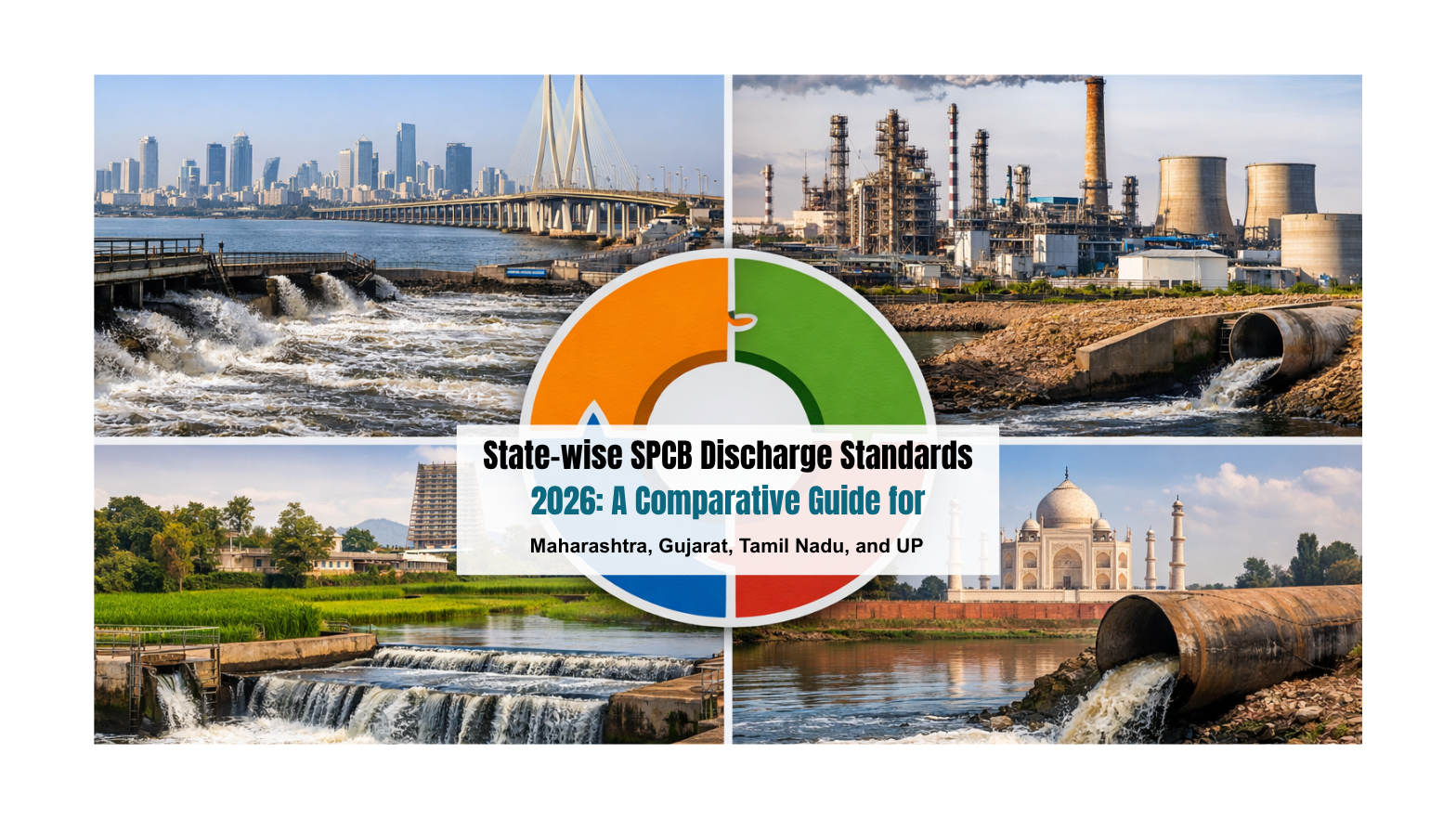
State-wise SPCB Discharge Standards 2026: A Comparative Guide for Maharashtra, Gujarat, Tamil Nadu, and UP
It is a Tuesday morning. Your plant is running at 80% capacity. Then the gate security calls, SPCB officers are at the entrance for an unannounced inspection. Your ETP operator is on leave. The online monitoring display is throwing an amber flag on COD. And somewhere in a drawer, your Consent to Operate is six weeks past its renewal date.
This is not a hypothetical. Across Maharashtra’s MIDC corridors, Gujarat’s chemical clusters, Tamil Nadu’s textile belts, and Uttar Pradesh’s Ganga-basin units, this scenario plays out dozens of times every month. The “Show Cause” notice that follows is not just a fine, it is a production shutdown, a reputational hit, and in serious cases, a criminal liability under the Water (Prevention and Control of Pollution) Act, 1974.
What has changed in 2026 is the margin for error. The CPCB has accelerated the rollout of OCEMS, Online Continuous Effluent Monitoring Systems, which means that the old buffer of “we’ll fix it before the quarterly sample” no longer exists. Real-time data is being transmitted directly to the state board’s servers. Non-compliance is no longer discovered after the fact. It is flagged live.
The environmental audit culture has also matured. States like Maharashtra and Gujarat now cross-reference OCEMS data with energy consumption logs, water purchase records, and production reports. If your effluent generation doesn’t correlate with your declared production volumes, you will be called to explain the gap. Compliance in 2026 is a 24×7 operational commitment, not a once-a-quarter exercise.
Decoding the SPCB vs. CPCB Hierarchy
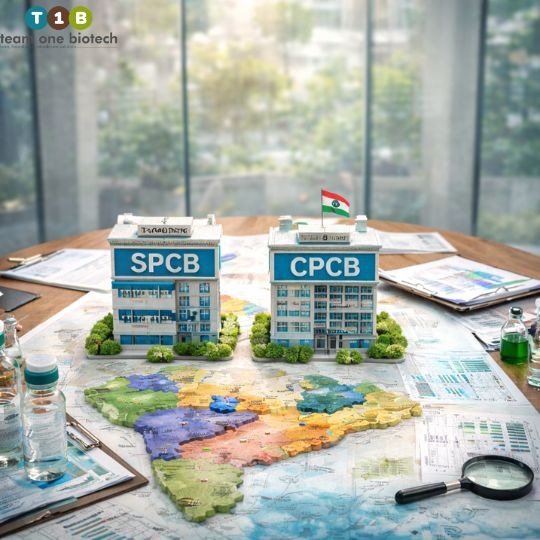
A common and expensive misconception among factory owners, especially those expanding from one state to another, is that the CPCB General Standards are the only standards they need to meet. They are not.
The CPCB sets the national minimum floor. State Pollution Control Boards operate independently under the Water Act framework and are legally empowered to impose standards that are far more stringent. And they do.
Maharashtra’s MPCB, for instance, enforces much tighter norms in MIDC notified areas and in regions classified as “water-stressed” under the state’s water budgeting framework. GPCB, operating in a state that hosts one of the densest concentrations of chemical and pharmaceutical units in Asia, has evolved some of the most granular discharge classifications in the country. TNPCB was one of the first boards to mandate Zero Liquid Discharge for specific textile sub-sectors, a position it has held and strengthened over successive years. UPPCB, reshaped significantly by the Namami Gange programme, operates with exceptional vigilance on any unit whose drainage basin connects, even indirectly, to the Ganga river system.
What this means practically: your Consent to Establish and Consent to Operate are site-specific legal documents. The limits written into your CTO override the general schedule. A unit in Vapi is not governed by the same numbers as a unit in Coimbatore, even if both are classified under the same industry category.
This is why a one-size-fits-all compliance strategy fails. State-level expertise is not optional, it is foundational.
The Four-State Comparison: SPCB Discharge Standards at a Glance

The following section provides general indicative ranges to help ETP operators and factory owners understand where the compliance bar is set across four key industrial states. These ranges cover discharge to inland surface water, public sewers, and land for irrigation.
Note: These are general ranges for baseline understanding. Exact discharge limits are site-specific and are explicitly mentioned in your SPCB Consent to Operate (CTO) based on your industry category and discharge point.
Maharashtra, MPCB Standards
Maharashtra is home to some of India’s most industrial districts, Pune, Nashik, Aurangabad, Nagpur, and the Mumbai-Thane-Raigad corridor. The density of Red Category industries here means MPCB operates with a higher baseline of scrutiny.
General indicative ranges for inland surface water discharge:
- pH: approximately 6.5 to 8.5
- BOD: typically in the range of 20–35 mg/L for most industrial categories
- COD: generally expected to fall between 200–280 mg/L, though many MIDC-specific CTOs push this lower
- TSS: usually within 80–120 mg/L
- Oil and Grease: typically between 8–12 mg/L
A defining feature of MPCB’s 2026 posture is the active push toward Zero Liquid Discharge in water-scarce talukas, particularly across Marathwada and parts of Vidarbha. Units in these regions with freshwater intake above a notified threshold are being progressively moved to ZLD mandates. This is not a future possibility; MPCB has issued specific directives to MIDC estates identifying which units are expected to achieve ZLD compliance within a defined timeline.
Note: These are general ranges for baseline understanding. Exact discharge limits are site-specific and are explicitly mentioned in your SPCB Consent to Operate (CTO) based on your industry category and discharge point.
Gujarat, GPCB Standards
Gujarat presents a unique compliance environment because of the sheer sectoral diversity, chemicals, dyes and intermediates, pharmaceuticals, ceramics, textiles, and food processing often operate within a few kilometres of each other. The GPCB has responded by creating highly granular discharge classifications, and the state’s network of Common Effluent Treatment Plants (CETPs) in clusters like Ankleshwar, Vapi, and Vatva carries regulatory weight that factory owners cannot ignore.
General indicative ranges for inland surface water discharge:
- pH: approximately 6.0 to 9.0
- BOD: typically in the 25–40 mg/L range, though pharmaceutical and dye units face tighter sub-limits
- COD: often in the 225–300 mg/L range at the industry level, with CETP inlet standards applying separately
- TSS: generally in the 90–130 mg/L range
- Oil and Grease: usually between 8–15 mg/L
For units connected to CETPs, the compliance obligation is dual: you must meet the CETP inlet standards AND ensure your internal pre-treatment ETP is functional. GPCB audits have increasingly cited units where the CETP was absorbing non-compliant effluent, and the industrial unit, not just the CETP operator, was penalised.
Note: These are general ranges for baseline understanding. Exact discharge limits are site-specific and are explicitly mentioned in your SPCB Consent to Operate (CTO) based on your industry category and discharge point.
Tamil Nadu, TNPCB Standards
Tamil Nadu has historically been a policy leader on effluent management, particularly in the textile sector. The state was among the first in India to mandate Zero Liquid Discharge for dyeing and bleaching units, a move that reshaped how plant owners in Tiruppur, Erode, and Karur approach water management.
General indicative ranges for inland surface water discharge:
- pH: approximately 6.5 to 9.0
- BOD: typically between 20–30 mg/L for most manufacturing categories
- COD: generally in the 200–260 mg/L range
- TSS: usually 80–110 mg/L
- Oil and Grease: typically 8–12 mg/L
- Colour: TNPCB specifically tracks colour units (Hazen) in textile effluent; limits are sector-specific
The fecal coliform standard is also more actively enforced in Tamil Nadu, particularly for food processing and slaughterhouse discharges. Units that focus only on BOD and COD and overlook microbiological parameters are frequently caught out during inspections.
Note: These are general ranges for baseline understanding. Exact discharge limits are site-specific and are explicitly mentioned in your SPCB Consent to Operate (CTO) based on your industry category and discharge point.
Uttar Pradesh, UPPCB Standards (Namami Gange Impact)
No state-level compliance conversation in India carries more political and regulatory weight right now than UP’s, particularly for units operating in the Ganga basin. The Namami Gange programme has transformed UPPCB from a board with a historically mixed enforcement reputation into one of the most active in recent years, with the National Green Tribunal providing consistent judicial backing.
General indicative ranges for inland surface water discharge in Ganga-basin districts:
- pH: approximately 6.5 to 8.5
- BOD: often in the 15–25 mg/L range for Ganga-tributary discharge points, notably tighter than the national floor
- COD: generally 175–240 mg/L, with significant variation by industry type
- TSS: typically 80–100 mg/L
- Oil and Grease: usually 8–10 mg/L
- Ammoniacal Nitrogen and Phosphate: actively monitored at Ganga discharge points, often carrying specific numerical limits in CTOs
Sugar mills, distilleries, tanneries, and paper mills in UP districts like Kanpur, Unnao, Muzaffarnagar, and Saharanpur operate under the highest level of scrutiny. NGT has imposed closure orders on units in this corridor multiple times in recent years. The message from regulators is clear: Ganga basin compliance is non-negotiable.
Note: These are general ranges for baseline understanding. Exact discharge limits are site-specific and are explicitly mentioned in your SPCB Consent to Operate (CTO) based on your industry category and discharge point.
Bioremediation, The Compliance Tool Your ETP Is Probably Missing

Most ETP systems were designed for a specific load, a specific input quality, and a relatively stable production schedule. The reality of 2026 operations is none of these things. Production runs change weekly. Raw material quality fluctuates. A new product line introduces a compound your bioculture has never seen. The result is a “shock load”, a spike in BOD, COD, or TSS that pushes your effluent quality outside the CTO range at exactly the moment you cannot afford it.
Traditional chemical treatment has a ceiling. You can dose more coagulant or flocculant, but beyond a point, you are adding cost without adding performance. And for parameters like BOD and residual COD, where biological activity is the primary degradation mechanism, chemical dosing offers no meaningful advantage.
This is where bio-augmentation delivers disproportionate value. By introducing specifically selected microbial consortia into your ETP, whether in the aeration tank, the anaerobic stage, or the sludge return, you enhance the biological treatment capacity without expanding infrastructure. The microbes work on organic load continuously, handling fluctuations that would otherwise breach your discharge standard.
Team One Biotech’s bioremediation solutions are formulated for Indian industrial conditions, monsoon temperature swings, variable TDS inputs, and the high-strength effluent profiles typical of food processing, dairy, textile, and pharmaceutical operations. COD reduction of 30–55% has been observed across client ETPs in documented cases (results vary based on influent quality and system design). More critically, bio-augmentation helps maintain consistent effluent quality, not just peak performance, which is what OCEMS-era compliance actually demands.
Common Compliance Pitfalls for RWAs and Factory Owners

The RWA/Housing Society Blind Spot
Resident Welfare Associations managing apartment complexes with on-site Sewage Treatment Plants are increasingly receiving notices from state boards, a development many RWA committees find shocking. The misconception is that STPs are simpler and lower-risk than industrial ETPs. They are not, legally.
Key parameters that RWA STPs frequently fail on:
- Fecal Coliform: Often entirely overlooked in daily operations. TNPCB and MPCB have both issued penalty orders to housing societies for fecal coliform levels far in excess of the permissible range for discharge to surface drains.
- BOD after tertiary treatment: Many older STPs installed between 2005 and 2015 are not achieving the BOD range required for 2026 reuse or discharge norms.
- Sludge disposal records: SPCB inspectors routinely ask for a log of sludge removal and disposal. Few RWAs maintain this adequately.
Factory Owners, The Documentation Gap
Technical compliance and documentation compliance are two different things. A factory can be achieving perfectly acceptable effluent quality and still receive a notice because:
- Flow meters are uncalibrated or non-functional
- Lab records are not maintained in the SPCB-prescribed format
- The CTO has lapsed and renewal is pending
- OCEMS data shows gaps in transmission, which inspectors treat as evidence of possible tampering
Actionable Checklist for ETP Operators
Daily monitoring and operations:
- Record inlet and outlet pH, BOD, COD, TSS, and flow rate every operational day
- Check aeration equipment, dissolved oxygen in the aeration tank should remain within the range prescribed for your biological treatment stage
- Verify nutrient dosing (nitrogen, phosphorus) is calibrated to the organic load, under-dosing starves your bioculture; over-dosing creates its own compliance risks
- Inspect sludge return rates and thickener performance; excess sludge buildup in the aeration tank suppresses treatment efficiency
Preparing for an SPCB inspection:
- Ensure your CTO is current and physically available at the plant, inspectors will ask for the original
- Maintain at least 12 months of lab analysis records in a bound register, not just digital files
- Keep OCEMS calibration certificates accessible and up to date
- Brief your operator on the inspection protocol, who speaks to the inspector, where records are kept, and what not to guess at
- Walk your effluent flow path before any scheduled event and correct visible issues, overflowing clarifiers, uncovered sludge beds, and broken baffles are photographed first
Compliance Is Operational Stability, Not Just Avoiding Fines
If your ETP is consistently struggling to hit the BOD and COD ranges specified in your Maharashtra, Gujarat, Tamil Nadu, or UP SPCB Consent to Operate, the answer is rarely “dose more chemicals.” It is almost always a process gap, in biological activity, in load management, or in operational consistency.
Team One Biotech’s environmental consultants work with ETP operators across Red, Orange, and Green Category industries to diagnose exactly where the treatment process is losing ground. Whether the issue is shock loads crashing your bioculture, sludge bulking in the secondary clarifier, or a COD plateau that chemical treatment cannot break through, a targeted bio-augmentation programme addresses root causes, not symptoms.
Compliance isn’t a checkbox. It is what keeps your plant running, your CTO renewable, and your name off the NGT defaulter list. If your ETP is under pressure, let our bio-experts audit your process today and build a treatment protocol calibrated to your specific SPCB discharge standard.
To schedule a process audit or speak with a bioremediation specialist, contact Team One Biotech through the website consultation form.
Looking to improve your ETP/STP efficiency with the right bioculture?
Talk to our experts at Team One Biotech for customised microbial solutions.
Contact: +91 8855050575
Email: sales@teamonebiotech.com
Visit: www.teamonebiotech.com
Discover More on YouTube – Watch our latest insights & innovations!-
Connect with Us on LinkedIn – Stay updated with expert content & trends!