
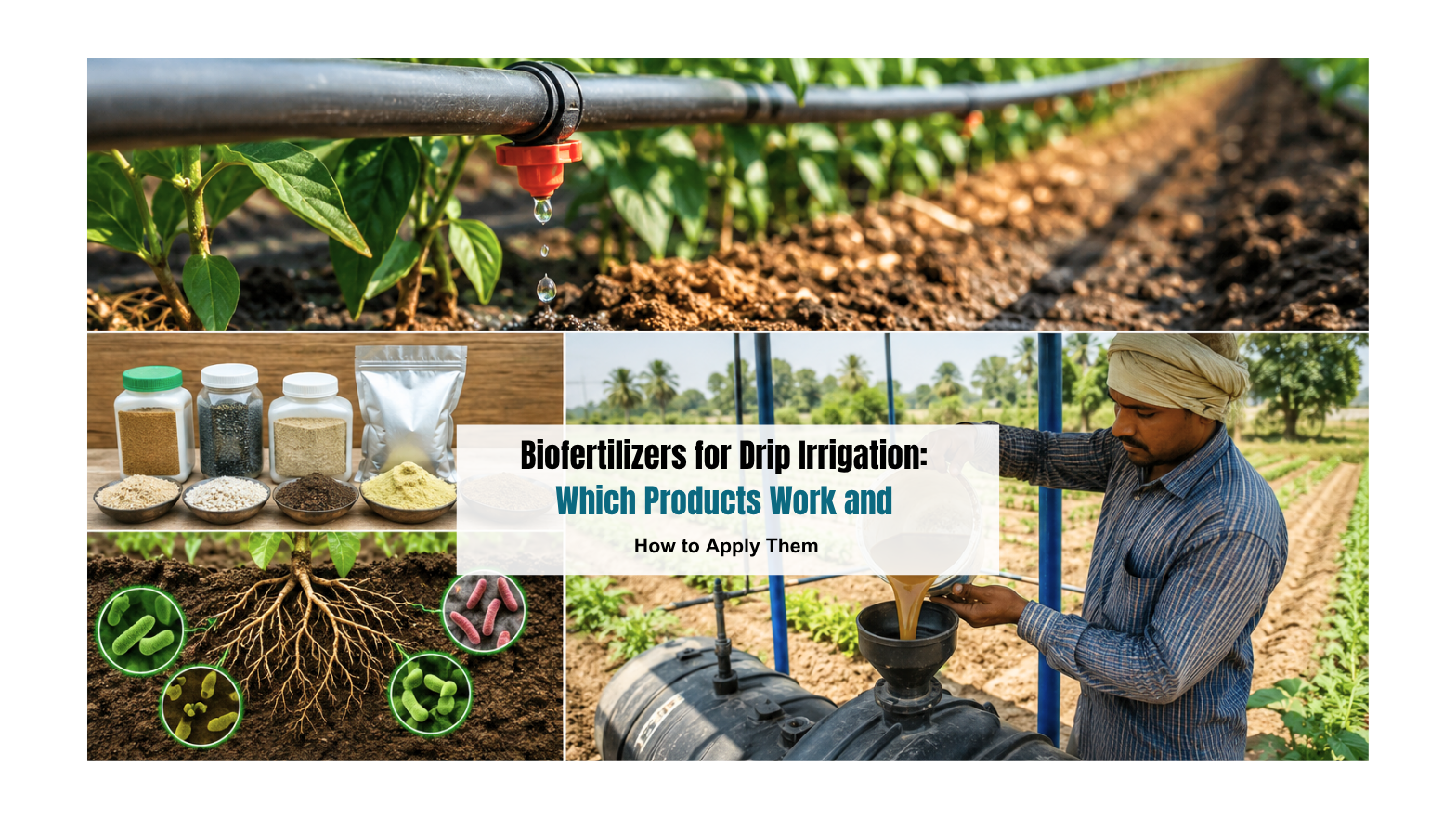
Biofertilizers for Drip Irrigation: Which Products Work and How to Apply Them
A farmer in Maharashtra spends two seasons saving up to install a drip irrigation system. The brochures promised water savings, better nutrient delivery, and higher yields. He does everything right, lays the lines, calibrates the emitters, sets the timer. Then, on the advice of an input dealer, he starts pushing a popular biofertilizer through the system. Within three weeks, his emitters begin to clog. The pressure drops. One section of his crop starts wilting. He calls the dealer, who tells him to flush the lines. He does. It helps a little, but the damage to his soil biology, and his confidence, is already done.
This is not a rare story. It plays out across drip-irrigated farms in India every season, and it happens because there is a significant gap between what gets marketed as a biological product for agriculture and what actually performs inside a pressurized drip system.
The shift toward biological products for agriculture in India is real and accelerating. Farmers are increasingly looking at organic fertilizer for drip irrigation India-wide as a way to cut input costs, improve soil health, and meet the demands of buyers who want produce grown with fewer chemicals. And in theory, drip irrigation and biofertilizers are a perfect match, you get precise delivery right into the root zone, minimal wastage, and consistent dosing. In practice, most farmers discover the hard way that not every biofertilizer belongs in a drip line.
At Team One Biotech, we work with farmers who have made this mistake, and we have helped them fix it. This article will tell you exactly which liquid biofertilizers for drip irrigation are compatible with fertigation systems, how to apply them step by step, and what to watch for at every stage of the process.
Why Drip Systems Demand a Different Kind of Biofertilizer
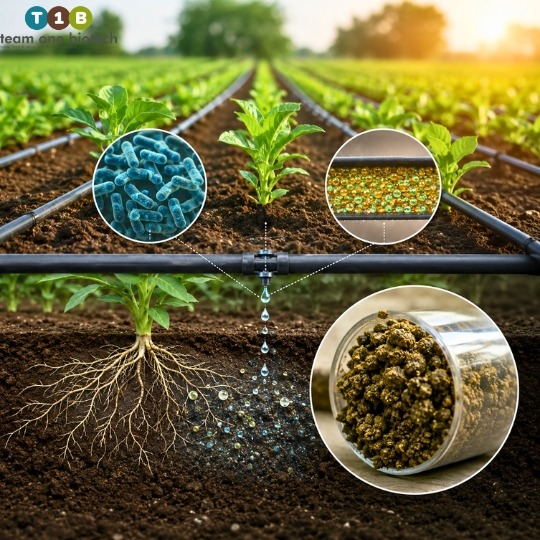
Drip irrigation is a precision technology. Water, and whatever travels with it, moves through narrow tubing, passes through filters, and exits through emitters with orifices sometimes as small as 0.5 to 1.2 millimetres. The entire system depends on unobstructed flow. Any material that clogs, precipitates, or settles inside those lines creates problems that can cascade quickly across an entire field.
This is where conventional bio inputs fall short. A granular biofertilizer designed for broadcasting into soil has no place in a drip line. Even some powder-carrier liquid biofertilizers, the kind with visible particulate matter, can gradually coat the inside of emitters and reduce flow over time. The damage is often invisible until it is too late.
So what separates a drip-compatible liquid biofertilizer for drip irrigation from one that will cause you problems?
What makes a biofertilizer drip-compatible:
- Fully soluble in water, no grit, sediment, or undissolved carriers that can settle inside tubing
- Fine particle size, microbial suspensions must be fine enough to pass through mesh filters without being trapped
- Stable pH range, the product must remain stable within the typical pH range of your irrigation water, usually 6.0 to 7.5
- No reaction with common fertilizers, if you are running a mixed fertigation programme, the biofertilizer must not precipitate when it contacts other dissolved nutrients
- Designed for fertigation, this must be stated or demonstrated by the manufacturer, not assumed
The distinction between a drip fertilizer designed for fertigation and a general-purpose biofertilizer is not marketing language. It is an engineering reality. Most farmers go wrong precisely at this point, they select a product based on its microbial content or its price, without asking whether its physical formulation is compatible with their system.
Compatibility parameters vary by system design, emitter type, and water quality. Always conduct a jar compatibility test before full-scale application.
Biofertilizer Products That Actually Work in Drip Systems
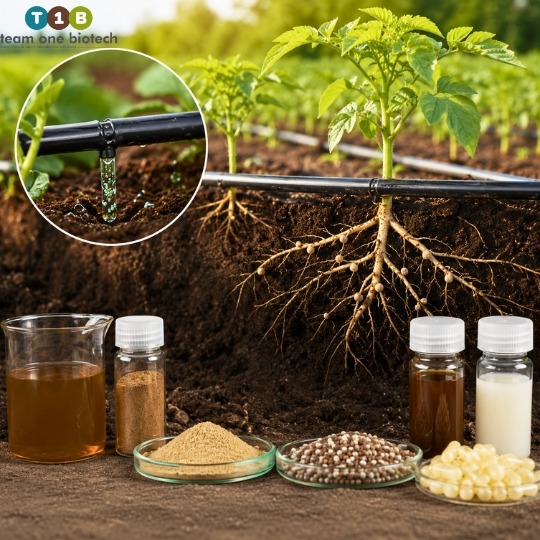
Nitrogen-Fixing Liquid Biofertilizers
Nitrogen-fixing biofertilizers based on Rhizobium and Azospirillum are among the most widely used biological products in Indian agriculture, and for good reason. Rhizobium strains form symbiotic associations with legume root systems, converting atmospheric nitrogen into plant-available ammoniacal nitrogen. Azospirillum, a free-living nitrogen fixer, colonises the root zone of cereals, grasses, and vegetables, supplying nitrogen while also producing growth hormones that enhance root development.
When these organisms are formulated as liquid biofertilizers, suspended in a water-based carrier free of particulate matter, they move cleanly through drip lines and deliver their microbial payload precisely into the wet root zone created by your emitters. This is the advantage of drip fertigation: the microbes land exactly where the feeder roots are active.
For legume crops like groundnut, soybean, and chickpea, Rhizobium-based liquid biofertilizers are best applied as a pre-sowing root drench or as a post-transplant drip dose in the first two weeks after establishment. For cereals and vegetables, Azospirillum applications are most effective during the active vegetative phase when root biomass is expanding rapidly.
Team One Biotech manufactures FCO-compliant liquid nitrogen-fixing biofertilizers specifically formulated for fertigation use. Always verify that the product you select carries an FCO registration, this is your primary assurance of quality, viable microbial counts, and formulation standards.
Phosphate-Solubilizing Bacteria (PSB) for Drip Application
Phosphorus is one of the most critical yet frustrating nutrients in irrigated agriculture. Soils across much of India, particularly those with high calcium or iron content, lock up applied phosphorus quickly, making it unavailable to plant roots even when it is present in significant quantities. This problem is often worse in drip-irrigated fields, where phosphorus tends to concentrate in a narrow band around the emitter zone and can form insoluble complexes with soil minerals.
Phosphate-solubilizing bacteria, particularly strains of Bacillus megaterium and Pseudomonas fluorescens, release organic acids that break these insoluble phosphate complexes apart, converting locked phosphorus into the soluble form that plant roots can absorb. Applied through a drip fertilizer programme, PSB liquid formulations work directly in the root zone band where this conversion matters most.
Drip application of PSB also allows for targeted delivery during the stages when phosphorus demand is highest, early root establishment, flowering, and fruit set. A well-timed PSB drip dose during these windows can meaningfully reduce the need for additional soluble phosphate applications.
Application rate ranges for PSB liquid biofertilizers vary based on soil phosphorus levels, crop type, water pH, and system design. The figures provided by any manufacturer are general indicative ranges. Actual dosage must be determined in consultation with a qualified agronomist based on your specific conditions.
Biostimulants for Drip Systems, Seaweed Extracts, Humic Acids, and Microbial Consortia
Biostimulants represent one of the fastest-growing categories in modern crop nutrition, and there is considerable confusion in the market about what they are and how they differ from biofertilizers. The distinction matters practically, not just academically.
Biofertilizers contain live microorganisms, bacteria or fungi, that perform a specific nutrient function: fixing nitrogen, solubilizing phosphorus, or mobilizing potassium and zinc. Biostimulants, by contrast, do not supply nutrients directly. They work by enhancing the plant’s own physiological processes, improving root architecture, increasing stress tolerance to heat and water deficit, and optimising the uptake of nutrients that are already present in the soil or applied through fertigation. Seaweed extracts, humic and fulvic acids, amino acid hydrolysates, and complex microbial consortia all fall under this category.
For greenhouse managers and commercial horticulture operators running sophisticated drip systems, biostimulants for drip systems have become a standard tool rather than an optional extra. A well-formulated humic acid product applied through drip irrigation can improve soil aggregate structure in the root zone over time, enhancing water retention and reducing the compaction that occurs around high-frequency drip emitter points. Seaweed-based biostimulants applied during transplant shock, drought stress, or post-hail events have been shown to accelerate recovery and maintain yield potential.
The critical point with biostimulants for drip systems is that most fully liquid, chelated formulations are inherently drip-friendly, they are designed to be dissolved and applied through irrigation systems. However, the market also carries poorly formulated or unregistered products that use fillers and carriers not suited for pressurised systems. Team One Biotech manufactures microbial consortia products designed specifically for compatible use in fertigation programmes, with formulations tested for solubility and emitter safety.
If you are considering biostimulant products from any manufacturer, verify that they are registered and have been tested for drip system compatibility. Unverified or unregistered products carry both compliance risk and the practical risk of system damage.
Looking for FCO-registered liquid biofertilizers for your drip system? Contact Team One Biotech to discuss your crop and system requirements.
How to Apply Biofertilizers Through Drip Irrigation, Step by Step
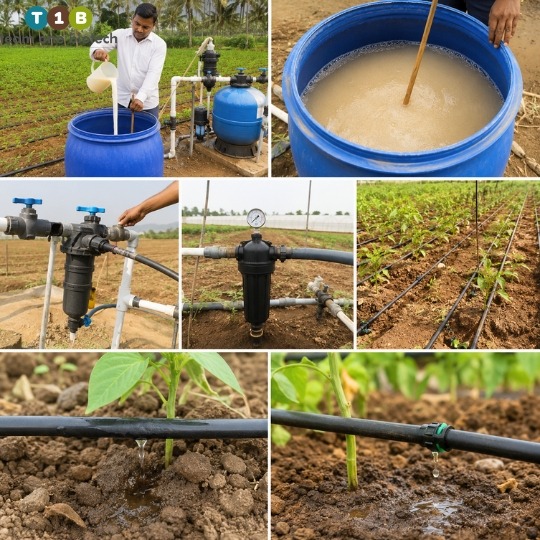
This section is where theory becomes practice. Whether you are an irrigation technician, a farm manager, or a farmer running your own system, these steps apply every time you introduce a biofertilizer or biostimulant into a drip line.
Step 1: Pre-Application Compatibility Check
Before you introduce any new biofertilizer into your system, conduct a jar test. Take a clean glass jar, fill it with your irrigation water at the concentration and pH you typically run, and add the biofertilizer at the intended application rate. Stir it and let it stand for 30 minutes. If you see precipitation, clumping, colour change, or visible settling, the product is not suitable for your water without further adjustment, or at all. Do not skip this step.
Step 2: Filter Check and Cleaning
Clean all mesh filters in your system before any bio input application. Particles from previous fertigation cycles or organic matter in your water source can combine with the incoming biofertilizer and accelerate clogging. The mesh size appropriate for your system depends on your emitter specifications, consult your system manufacturer for the correct mesh rating for your setup.
Step 3: Pre-Application System Flush
Run clean water through all drip lines for at least 10 to 15 minutes before introducing any biofertilizer. This clears residual salts, fertilizer precipitates, or organic matter from previous irrigation cycles that could react with the microbial product.
Step 4: Injection Method Selection
There are two primary methods for injecting liquid biofertilizers into a drip system: venturi injectors and dosing pumps. For liquid biofertilizers, a dosing pump is generally preferred because it delivers a consistent, controllable dose without creating the turbulence that a venturi injector can generate. Turbulence can damage microbial cells, reducing the effective CFU count that reaches your root zone. If a venturi injector is your only available option, ensure the product is formulated for that method of delivery.
Step 5: Timing of Application
Apply biofertilizers during early morning irrigation cycles when soil temperature is lower and microbial viability is better preserved. Avoid applying during peak afternoon heat, particularly in summer months, when high soil and water temperatures reduce the survival rate of introduced microorganisms. Also avoid application when your irrigation water is running at unusually high EC levels, as high salinity can inhibit microbial activity.
Step 6: Post-Application Flush
After the biofertilizer dose has been fully injected and delivered through the lines, flush the system with clean water for a minimum of 10 to 15 minutes. This step is non-negotiable. It clears any residual microbial suspension from the interior of tubing and emitters, preventing biofilm buildup that can narrow emitter orifices over repeated applications.
Step 7: Rotation Between Applications
Do not apply the same biofertilizer product in every irrigation cycle. Rotating between different microbial strains, nitrogen fixers one cycle, PSB the next, a microbial consortia after that, supports soil biome drip application diversity rather than creating an imbalance where one organism dominates at the expense of others. Diversity in soil microbiology is a marker of long-term soil health.
The steps outlined here are general guidelines. Specific rates, timings, and injection volumes must be calibrated to your crop, soil type, and system specifications. Always seek guidance from a qualified agronomist or your product manufacturer before finalising your programme.
Staying FCO-Compliant: What Indian Farmers Must Know
The Fertilizer Control Order governs the manufacture, sale, and use of biofertilizers across India. For commercial farmers and agri-operators, FCO compliance is not a bureaucratic detail, it is your assurance that the product you are applying contains what the label claims, at the microbial counts that actually make a difference.
When purchasing any drip fertilizer or bio input, here is what to verify on the product label:
- FCO registration number, this must be present. If it is not, walk away.
- CFU count range, this tells you the concentration of viable microorganisms. Lower counts can mean reduced efficacy. Note that CFU specifications are general reference values and vary by product and manufacturer, what matters is that the count meets FCO minimum standards.
- Carrier medium, liquid carrier should be specified; avoid products with ambiguous or unspecified carrier descriptions
- Shelf life and storage conditions, live microbial products have a genuine shelf life; check the manufacture date and do not use expired stock
- Manufacturer contact details, a legitimate FCO-registered manufacturer will provide traceable contact information
Using unregistered bio inputs carries regulatory risk if you are supplying produce to processors, exporters, or retail chains with traceability requirements. It also carries the practical risk of applying a product that contains far fewer viable organisms than claimed, or one that has been formulated with carriers unsuitable for your drip system.
From an environmental standpoint, drip-applied bio inputs must be managed responsibly. Excessive application or use of incompatible products can contribute to localised nutrient imbalance or, in poorly drained fields, seepage that affects groundwater quality. Choose products, dosages, and frequencies that a qualified agronomist has reviewed for your specific site.
All bioremediation and biofertilizer products developed by Team One Biotech are built in alignment with FCO standards and environmental safety norms.
Do not risk your crop cycle or your compliance record with unverified products. Partner with a manufacturer who builds to FCO standards from day one. Get in touch with Team One Biotech today.
Common Mistakes Farmers Make, and How to Avoid Them
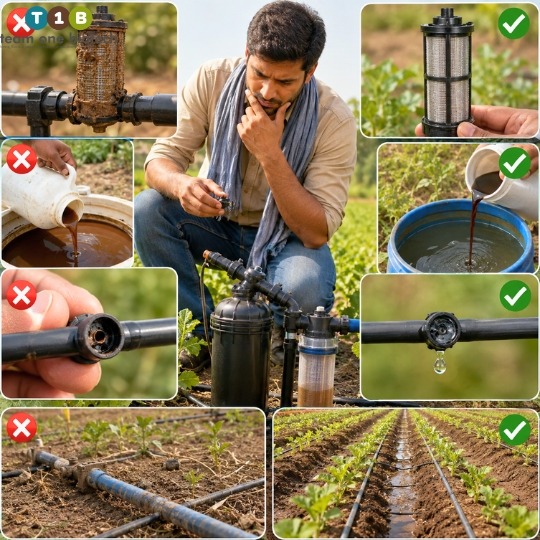
- Mixing biofertilizers directly with chemical fertilizers in the tank without first conducting a compatibility test, this frequently results in pH shifts that kill the microorganisms before they ever reach the root zone
- Using powder-form biofertilizers in drip systems, powder carriers are not designed for pressurised delivery and will clog filters and emitters over time
- Applying during peak heat hours, high temperatures reduce microbial viability in both the tank and the soil, wasting product and reducing results
- Skipping the pre- and post-application flush, residue accumulates with each application cycle and eventually restricts flow in emitters
- Purchasing non-FCO-registered products to reduce cost, this is a false economy; unregistered products have no quality guarantee, and a single clogged drip system can cost more to repair than a season’s worth of quality product
- Applying the same microbial strain in every cycle, this undermines the soil biome diversity that makes biofertilizer programmes effective over the long term
Frequently Asked Questions
Can I mix liquid biofertilizer with chemical fertilizer in the same drip tank?
Generally not recommended without prior compatibility testing. Many chemical fertilizers alter the pH or electrical conductivity of the solution in ways that reduce microbial viability significantly. Where possible, apply biofertilizers in a separate irrigation cycle from your main chemical fertigation dose.
How often should I apply biofertilizers through my drip system?
Frequency depends on your crop type, growth stage, and baseline soil health. General practice ranges from once every two to three weeks to monthly applications during active growth phases. This is crop- and system-specific, consult an agronomist for your conditions rather than applying a generic schedule.
Will biofertilizers clog my drip emitters?
A correctly formulated liquid biofertilizer designed for fertigation use should not clog emitters when applied with proper pre- and post-flush protocols. The risk rises sharply with powder formulations, poorly solubilized carriers, and when the flush steps are skipped.
Are biostimulants the same as biofertilizers?
No. Biofertilizers carry live microorganisms that fix nutrients or release locked minerals. Biostimulants enhance the plant’s own physiological processes, root growth, stress response, nutrient uptake efficiency, but do not supply nutrients directly. Both can be applied through drip systems provided the formulations are appropriate for fertigation.
Is organic fertilizer for drip irrigation different from liquid biofertilizer?
Yes, and the difference matters practically. Organic fertilizers supply nutrient-rich organic matter but often contain particulates, undigested plant material, or suspended solids that are unsuitable for pressurised drip lines. Liquid biofertilizers carry live microbial cultures in a fully soluble medium purpose-built for fertigation delivery.
The Soil You Feed Today Determines the Yields You Earn Tomorrow
Return for a moment to that farmer in Maharashtra. His investment in a drip system was sound. His instinct to combine it with biological products for agriculture was right. What failed him was the absence of product-specific knowledge, and a supply chain that did not distinguish between a biofertilizer designed for broadcasting and one engineered for fertigation.
You do not have to make that mistake.
The path forward is straightforward: choose fully soluble, FCO-compliant liquid biofertilizers proven for drip system use, follow the application protocols without shortcuts, protect your emitters with pre- and post-flush discipline, and rotate your microbial strains to support genuine soil biome drip application diversity over time.
The shift toward biological products for agriculture in India is not a passing trend. It reflects where soil science, regulatory direction, and market demand are all converging. Farmers who build their soil biology now, who invest in organic fertilizer for drip irrigation India strategies that are compatible with their systems and compliant with FCO standards, will be positioned ahead of the curve as that shift accelerates.
Team One Biotech is built to support this transition. Our products are developed for field conditions, not laboratory ideals. They are formulated for real drip systems, real water quality variations, and real compliance requirements. Our technical team works with farmers, irrigation engineers, and agri-operators to select the right product, design the right application programme, and avoid the mistakes that cost seasons.
Ready to integrate biofertilizers into your drip irrigation system the right way? Team One Biotech’s technical team is available to guide your product selection, application planning, and compliance review. Reach out to us, your soil biology cannot wait.
Looking to improve your ETP/STP efficiency with the right bioculture?
Talk to our experts at Team One Biotech for customised microbial solutions.
Contact: +91 8855050575
Email: sales@teamonebiotech.com
Visit: www.teamonebiotech.com
Discover More on YouTube – Watch our latest insights & innovations!-
Connect with Us on LinkedIn – Stay updated with expert content & trends!